Painting and applying decals
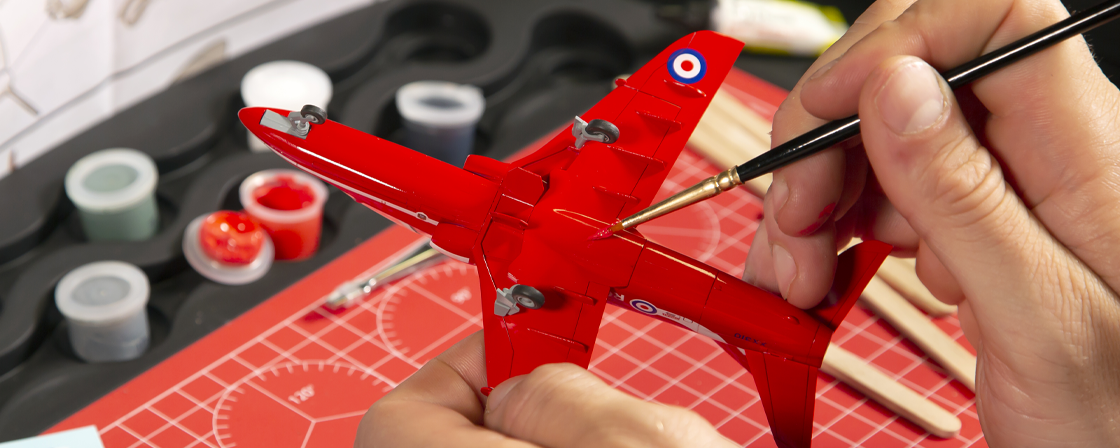
Welcome to Airfix’s official model aircraft painting and decal application guide, designed to help you complete your first build with the confidence of an old master. Staring down the barrel of your first paint job can be intimidating — where on Earth do you even begin? Never fear, we’re here to lead you through the setup, build, and paint job!
Preparing your painting area
Arguably the simplest, yet one of the most important steps first — prepare your workbench. Don’t worry too much about having a professional setup right off the bat, any hard, stable surface will do. Your workbench can be anything from a desk to a dining table, — you only need to make sure that it’s sturdy and a place no one will mind if you spill some glue or paint.
Onto the tools. We recommend a comfortable chair and some stellar lighting. You need to be comfortable and able to see everything you’re doing clearly. This is especially important when it comes to painting the finer details. We also suggest a good supply of paper towels to keep ready for spills and removing any excess paint from your brush.
After that, assemble your self-cutting mat (the best in the business in terms of mats), glue, paints, brushes, a hobby knife, and nippers (a clipping tool designed to remove any extra plastic).
Assembling your model aircraft
Many of our model planes come with a little assembly required (all part of the fun), so we’ve included a few useful tips and tricks here to get you ready for painting in no time at all.
You will need your trusty nippers to clip the aircraft pieces out of the sprue and then cut away any excess plastic still stuck on your model using a hobby knife. Your hobby knife should look like a little scalpel and to avoid re-enacting a particularly gory scene from Grey’s Anatomy or Casualty, make sure that you’re only ever cutting down on the mat. Fingers and various other limbs inside the aircraft at all times please, ladies and gentlemen.
Once you have done this, grab the plastic glue and attach the pieces to each other so that you’re ultimately left with a complete model plane ready to be primed for painting.
Priming your aircraft
The final bit before we move onto the painting itself, is the priming of your aircraft. Priming is an essential step because it makes it much easier to apply multiple layers of paint. Think of priming as creating a canvas on your model. It also helps give a more even finish on your model aircraft.
If you’re not sure where to purchase a reliable can or pot of primer, the Humbrol website has primer in bucketloads. Whether you’re a spray-can whiz or a dedicated brush user, Humbrol has it all. Just make sure that you’re picking the right primer for your project! Also, if you’re priming with a spray can, don’t forget to do this in a well-ventilated area to avoid inhaling the fumes.
Start Painting
Finally, we’re going to give you some top tips for actually painting your model planes. The trick to creating a truly breath-taking paint job is to know which brush works best for each aspect. The different sizes are an important distinction — the larger brushes are ideal for covering bigger surface areas, whilst smaller brushes are perfect for the dizzying detail you need to make your model come alive. A great tip to keep in mind is the dry brush technique. You apply paint to a brush and then wipe as much of the paint off on a paper towel as possible. Then you sweep the brush over certain parts of your model (raised bolts on a wing for example) and this gives a quick and easy, but effective highlight.
When it comes to the actual painting, many modellers have found it best to start by colour blocking and then adding your detailing last. It’s good to start with thin layers of paint as it is far easier to build it up later than it is to try to cover the model with one thick layer. Thin layers help the drying process and ensure that your coats will dry smooth and even.
In terms of colours, we have found great success in colour blocking with all your dark colours first and then layering the lighter ones on top. This will provide a lovely dimension to your models and ensure that your chosen colours really pop. A beloved technique of many modellers is edge highlighting, where you go in with lighter colours and brush them along the edges of certain points on your figure (where the sun might hit an aircraft for example). This is a great way of breathing life into your models.
Applying decals
For the modelling novice, a decal is a decorative sticker designed to enhance the look of your model aircraft or add a bit of historical detailing that might verge on the impossible to do with just a brush. The decals come on a sheet of cardboard which means you’ll need your trusty hobby knife to free them from their paper prison.
Once your decal is separated from the sheet, you place it in some warm water (almost like those temporary tattoos you used to get as a child). We recommend warm water as opposed to cold to help the decal slide off the cardboard without any issues.
A tip that we have picked up over the years is to dab a little of the water onto the area of the model where your decal is going to go. This ensures that you can continue to adjust it once you have applied it to the aircraft in case it didn’t lie as smoothly as you would have liked, or if the positioning was slightly off.
To apply the decal, grab your brush and use it to pick the decal up from the cardboard and manoeuvre it carefully onto your plane. A gentle hand is necessary when positioning the decal with your brush and smoothing out any air bubbles as you don’t want it to tear.
If water isn’t cutting it and you’re after something a little more permanent, we also sell adhesives made specifically to secure your decals!
And there you have it folks! If you’ve made it this far through the article, that means you have successfully painted and decorated your first model plane! Congrats!