A02110 Hawker Tempest Mk.V Post War
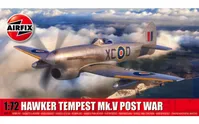
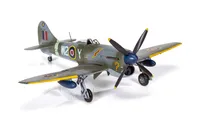
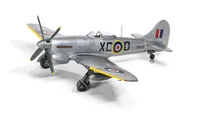
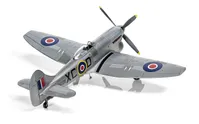
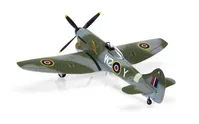
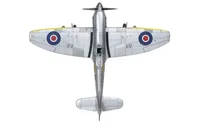
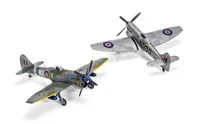
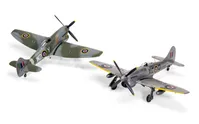
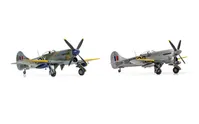



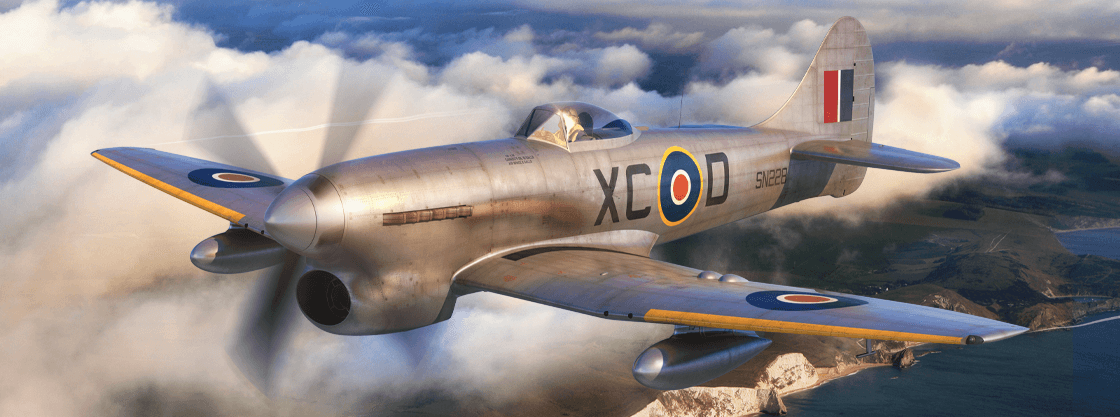
Hawker Tempest Mk.V Post War
Featuring a newly designed laminar flow wing and a much thinner compared to its predecessor, this plane had its first flight on 2nd September 1942. With its lighter frame and powered by a massive 24-cylinder Napier sabre engine, this fighter aircraft performance was spectacular.
Product Info
This remarkable 1:72 scale model of the Hawker Tempest Mk.V Post War is a tribute to one of the most outstanding piston-engined fighters ever created. Comprising 72 pieces, this kit offers a detailed and immersive building experience. It embodies the pinnacle of World War II fighter design, allowing you to recreate Sydney Camm's vision of a 'Super Hurricane' - an aircraft known for its remarkable speed, formidable firepower, and outstanding performance at lower and medium altitudes.
Key Features
- 1:72 scale model with a wingspan of 174mm
- 72-piece kit suitable for builders aged 8 and up
- Skill level 2 - ideal for advancing modellers
- Offers a choice of two genuine post-war paint schemes
- Detailed plastic construction capturing the Tempest's unique laminar flow wing
- Accurately replicates the powerful silhouette of this iconic RAF fighter
History
Regarded as one of the premier aircraft of the Second World War, the Hawker Tempest V's design lineage can be traced back to the Hurricane fighters that played a crucial role in the Battle of Britain. It stands as the pinnacle of piston-engined fighter design. When Sydney Camm aimed to develop a 'Super Hurricane' successor, the Tempest V emerged as the result. The initial replacement for the Hurricane was the Typhoon, which combined the era's most potent piston engine with a compact, robust, and heavily armed airframe. Though intended as an interceptor, the Typhoon's thick wing hindered its high-altitude capabilities, but it thrived as a ground attack aircraft during the Normandy invasion. Recognising the Typhoon's potential but need for enhancement, Hawker embarked on a new fighter project initially named Typhoon Mark II, later renamed Tempest as its maiden flight approached. Despite being large for a single-engine fighter, the Tempest boasted a lightweight airframe powered by the formidable 24-cylinder Napier Sabre engine, delivering exceptional performance. First taking to the skies on 2 September 1942, the Tempest featured a newly designed laminar flow wing, thinner and shaped for speed with a straighter leading edge and an elliptical trailing edge, distinguishing it from the Typhoon's wing. Other differences included an extended nose and a larger tail with a prominent dorsal fillet on the vertical stabiliser. The prototype achieved a top speed of 477 mph in level flight, impressing both the design team and the Air Ministry. Entering RAF service in early 1944, Tempests were initially deployed in ground attack roles before D-Day but could transition to air combat during missions. With a greater range than the Typhoon, Tempests could remain in combat zones longer, strike deeper into occupied Europe, or await Luftwaffe fighters. As the fastest Allied fighter at low and medium altitudes, Tempest squadrons were retained for home defence after D-Day to counter the V-1 'Doodlebug' flying bombs. The Tempest excelled at intercepting V-1s using its speed, firepower, and pilot skill. Squadron Leader Joseph Berry achieved 61 V-1 kills. After the V-1 threat diminished, Tempest squadrons launched aggressive missions into occupied Europe, capitalising on their speed, range, and firepower. The Tempest proved to be one of the most capable fighters globally and was reportedly the Allied aircraft most feared by Messerschmitt Me262 jet pilots, especially during vulnerable takeoff and landing phases. The Hawker Tempest V was a swift, heavily armed fighter with performance surpassing any Luftwaffe piston-engined fighter, except the Me262 at full speed. Although introduced late in WWII, the Tempest V remains one of the most effective piston-engined fighters and fulfilled Sydney Camm’s vision of the 'Super Hurricane.'
BAE SYSTEMS is a registered trade mark of BAE Systems plc.
What's Inside
Schemes
Recommended For You


Tech Specs
- Item Length - Without Packaging (cm)
- 14.3
- Item Width - Without Packaging (cm)
- 17.4
- How many pieces will be found in the box opened by the customer?
- 72
- Item Scale
- 1:72 Scale
- License line
- BAE SYSTEMS is a registered trade mark of BAE Systems plc.
- Contents (what's in the box) sets
- Plastic model kit, instruction sheet, paint layout sheet and decals.
- Finish
- Plastic
- Number of Scheme options
- 2
- Skill Level
- 2
- Flying Hours
- 1
- Wingspan (mm)
- 174
WARNING. Not suitable for children under 36 months. It contains small parts which can present a choking hazard. Please retain these details and the address for future reference. CAUTION Please remove all packaging before giving the toy to a child.