
Welcome to this latest edition of Aerodrome and our regular look at the fascinating world of aeroplanes and the historic aviation scene around the UK.
The joint Lincolnshire Lancaster Association and Battle of Britain Memorial Flight Members Day event, which is held at RAF Coningsby at the back end of the UK Airshow season each year, is a celebration of some of the best loved historic aircraft in the world today, and is an opportunity to give our thanks to the men and women who operate and care for these classics. An informal and thoroughly enjoyable event arranged for those people who support one or both of these impressive organisations, Members Day offers an opportunity to get up close to these historic aeroplanes, and weather and serviceability permitting, will usually include a short flying demonstration, if not a full display.
At this year’s show, although we didn’t know it at the time, one UK aviation classic was announcing its much anticipated return to the UK Airshow circuit (although she was only on static display on the day), whilst another more contemporary aircraft was making one of her final display appearances (even though we didn’t realise that at the time). In this latest edition of Airfix and Corgi Aerodrome, we report from a sunny RAF Coningsby on what proved to be another successful Members Day event, but with our focus of attention being on these two rather special aviation heavyweights, in a case of what proved to be one display aircraft in, and another one out.
Although the past couple of months have been dominated by poor weather, we’ll be trying our best to convince you that the sun does sometimes shine in Britain, and it won’t be too long before we’re photographing aeroplanes in blues skies once again (fingers crossed).
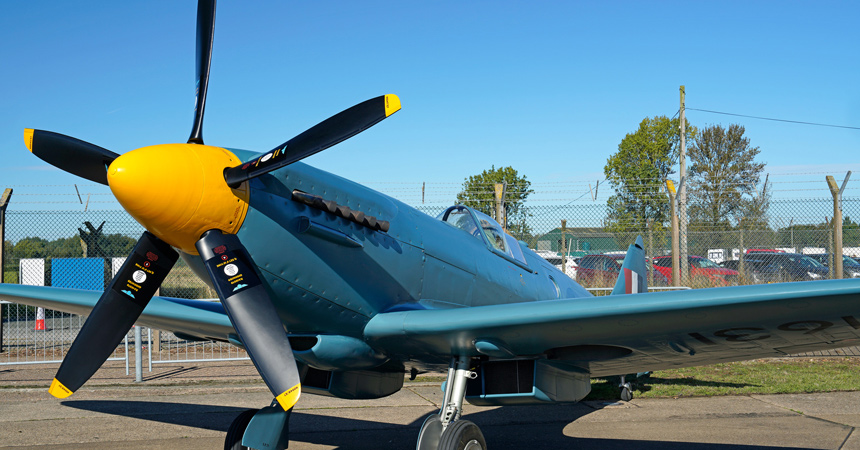
Looking resplendent in the Coningsby sunshine, Supermarine Spitfire PR Mk.XIX PM631 was looking resplendent at the latest LLA and BBMF Members Day event in September.
As the LLA and BBMF Members faithful headed to Coningsby in order to attend their latest gathering event, little did we know that we would be seeing two aircraft at opposite ends of their display careers during what would prove to be a thoroughly enjoyable event. We all knew that most of the current BBMF fleet would be available for viewing on the day, and if we’re being honest with ourselves, how most in attendance would probably be there as passionate devotees of the aviation phenomenon we all know as Avro Lancaster PA474, this year’s show turned out to be more significant than most.
We can’t begin this review without mentioning the fact that 2024 had been a particularly challenging one for everyone connected to the BBMF, following the tragic loss of Sqn Ldr Mark Long last May. Mark was a hugely popular figure around the Flight and always had time to speak to enthusiasts whenever he was taking part in any display event. Although most of us would not count ourselves fortunate enough to be close to Mark, we probably saw him so many times at various events that we felt as if we did know him, even just by virtue of the smile he always had on his face and the fact that everyone around him clearly thought the world of him.
The weeks and months which followed Mark’s loss must have been really distressing for members of the Flight, and even as they were returning to something like their normal display service, they weren’t prepared to do so without making their own personal tribute to their friend and colleague. Although Mark flew many of the aircraft in BBMF inventory, he probably spent most time at the controls of Supermarine Spitfire Mk XVI TE311, and to commemorate that association and the enduring affection in which Sqn Ldr Mark Long is held, they altered the starboard side of the aircraft’s squadron code.
The BBMF made this fitting tribute to their much-loved friend and colleague, Sqn Ldr Mark Long.
With the famous RAF roundel on the starboard side of the Spitfire serving as an O, the coding now read LONG, with the aircraft also carrying Mark’s name and Squadron Leader’s pennant on the same side, under the windscreen. The aircraft was positioned amongst the static aircraft display on Members Day, side on, with the new port side artwork displayed for us all to see and admire. Although sad to see, it did make for a fitting tribute by the Battle of Britain Memorial Flight for one of their own, a man whose loss will be felt by a great many people.
Another of the BBMF single engined aircraft many people at this year’s show probably wouldn’t have been expecting to see was Supermarine Spitfire PR Mk.XIX PM631, one of two mighty Rolls Royce Griffon powered late mark Spitfires currently on strength with the flight. This aircraft last flew in 2021 and since then, had been undergoing an extensive major maintenance programme, as the Flight continues to tend to her every need, ensuring she will be able to represent the Flight and this most distinctive variant of Spitfire for many years to come.
As one of the most important fighting aeroplanes in the history of warfare and one which saw service throughout the entire Second World War, it will come as no surprise to learn that the Supermarine Spitfire preformed a variety of roles during the war, including that of high speed, high altitude photo reconnaissance aircraft. As the RAF's premier fighter of the day, a small number of modified Spitfires were used early in the war, to perform specialist photo reconnaissance duties, with individual aircraft modified to carry cameras in something of a hand-built, bespoke manner.
Prior to the use of Spitfires, larger aircraft had been carrying out reconnaissance missions from the very first days of the Second World War, however, it quickly became apparent that the two most important factors in establishing an effective photo reconnaissance service were speed and altitude, along with specialist training and the RAF simply didn't have aircraft capable of consistently carrying out such missions at that time. To make matters worse, the Germans knew exactly what these aircraft were attempting to do, and they were determined to prevent them from returning home with their valuable photographic records.
An unarmed warrior, the return of this magnificent aircraft pays tribute to the vital contribution made by photo-reconnaissance pilots during the Second World War.
Initially, two standard Spitfire Mk.I fighters were modified for photo reconnaissance duties and whilst these were certainly an operational improvement over the Blenheims and Lysanders which usually performed such missions, the RAF still had much work to do if their photo reconnaissance Spitfires were to prove successful in this highly specialised role.
Work continued in something of a bespoke manner until the introduction of more powerful variants of the Spitfire transformed the art of aerial reconnaissance, allowing missions to be flown higher, faster and over longer distances than ever before. Now, all the lessons learned over previous months could be brought to bear in perfecting this service and even though PR Spitfires would operate wherever British forces were deployed and their services were in great demand, it's always surprising to discover that relatively few aircraft were produced specifically in this configuration.
The pinnacle of Spitfire photo reconnaissance capability arrived with the introduction of the Rolls Royce Griffon powered variants of the aircraft, an aircraft which made full use of the now exceptional infrastructure behind the gathering, examining and dissemination of photographic intelligence in Britain. Handling of the new aircraft was generally excellent and they were real 'speedbirds', something their pilots relied upon, as they were flying unarmed missions deep into enemy occupied territory.
Flying at altitudes of around 40,000 ft, PR.XIX Spitfires were impervious to ground defences and interception by most piston engined Luftwaffe fighters. Indeed, even the much feared Messerschmitt Me 262 would have difficulty bringing down a Spitfire PR.XIX, even if one could be spared from anti-bomber duties. If a Spitfire was being stalked, the tactic used by most pilots was to enter a shallow dive, gradually building up more speed as they gently descended earthwards. A pilot also had the option of increasing altitude still further and whilst there were reports of Spitfires flying above 40,000 ft, this was actually an exercise fraught with danger.
Capable of maintaining a steady 370mph even at extreme altitude, these aircraft also carried the highest internal fuel load of any PR Spitfires, all attributes which made these the most effective clandestine, information gathering variants of this famous aircraft. Clearly, when operating at these altitudes, the aircraft were usually only deployed on days when the weather was fine, as cloud cover and stormy conditions would preclude the taking of photographs.
Built for speed, these snooping Spitfires were almost 100 mph faster than the first Spitfires to enter Royal Air Force service.
If cloud cover was obscuring any target, PR pilots had the discretion of descending to a lower altitude in order to secure the imagery they needed, however, this significantly increased the risk or interception, or sustaining damage inflicted by enemy flak batteries. Photo reconnaissance Spitfires would regularly be sent to provide raid effectiveness imagery following a bombing mission, arriving over the target area only minutes after the last bomb had been dropped, with their pictures determining it the bombers would have to return again in the days which followed.
Operating with the specialist Photo Reconnaissance units at RAF Benson, the RAF's Spitfire PR.XIX aircraft worked tirelessly in the months leading up to the D-Day landings, providing detailed imagery of enemy defences and supply depots across the intended invasion area. Careful not to alert the Germans to the most likely location of the long anticipated invasion, these missions were flown along a vast stretch of coastline, from Bordeaux in the south west, to the Low Countries in the north, a crucial aspect of these pre-invasion preparations.
Spitfire PM631 was built by Vickers Armstrong at Reading in late 1945, part of an order for 600 reconnaissance configured Spitfires for the Royal Air Force. Delivered to No.6 MU at Brize Norton in November the same year, her early service life appears to be the subject of some conjecture, however, it is thought that in addition to being passed around several sites across the country, she may have also spent time with an advanced flying school.
After a 4 year absence from the UK Airshow circuit, enthusiasts will be looking forward to seeing this yellow nosed beauty displaying once again.
In July 1951, she was allocated to the Meteorological Research Flight, a civilian operation run by Short Bros & Harland, which was also referred to as THUM – the Temperature and Humidity Flight. Although formed at RAF Hooton Park near Liverpool, it would soon move to a more permanent home at nearby RAF Woodvale, with the Spitfire PR XIX being seen as the ideal aircraft for this specialist work. This was due their excellent range, climb performance, pressurised cockpit and impressively stable handling characteristics once at operating altitude. Over 2,000 of these Meteorological Spitfire flights would be made during the Woodvale THUM years.
The role previously performed by Woodvale’s Spitfires was taken over by de Havilland Mosquitos in the summer of 1957, with the three remaining Spitfire PR XIX aircraft subsequently departing for RAF Biggin Hill, intended to form the nucleus of the RAF’s new Historic Aircraft Flight, a unit which would eventually become the Battle of Britain Memorial Flight which is so cherished today.
Spitfire PR XIX PM631 was one of those aircraft and is therefore significant as the oldest serving aircraft in the BBMF, one of its founding airframes. Between 1959 and 1965, she was actually the only Spitfire operated by the Flight, so as you can see, she really is quite the aviation celebrity. Set to continue her proud BBMF legacy during this coming Airshow season, it will be a real treat to see this magnificent aircraft thrilling Airshow audiences once again after her 4 year absence, a stunning example of these high-flying unarmed reconnaissance variant Spitfires.
Has a Eurofighter Typhoon ever looked as good as Moggy?
Over the past few years, those members fortunate enough to secure a ticket for this limited attendance event have been treated to a display by that year’s RAF Typhoon Display Team pilot and his dynamic mount, the Eurofighter Typhoon FGR4. For this latest event, we were fortunate enough to be allocated that season’s actual display jet, an aircraft which benefitted from the application of a striking special scheme, one intended to commemorate the 80th Anniversary of D-Day, and she was a real beauty.
As the aircraft type charged with protecting UK airspace from unauthorised incursion, the interceptor fighters which have performed this role over the years have always become firm favourites with enthusiasts and the general public alike, arguably becoming the most widely recognised aircraft types of their era. Currently performing this vital role in home skies, the Eurofighter Typhoon FGR4 is an incredibly capable aircraft born of an international design collaboration which aimed to produce an agile air defence fighter (European Combat Fighter Project) for service with several European air forces. Such a collaboration held the prospect of keeping costs to more manageable levels for those involved, as they were being shared across the partner nations, although each would ultimately have their own requirements, something which would put a strain on both costs and working relationships.
At the time this new aircraft entered the development phase, Britain’s sovereign airspace was being policed by such aircraft as the McDonnell Douglas F-4 Phantom and BAe/Panavia Tornado F.3, the air defence variant of the RAF’s highly capable Tornado strike jet and whilst both were classic aircraft in their own right, neither could really be described as being agile performers. With the US Air Force able to boast such manoeuvrable aircraft as the General Dynamics F-16 Falcon and world leading McDonnell Douglas F-15 Eagle, the new Eurofighter consortium was looking to develop their own agile fighter, one which was much better suited to the modern and constantly changing air combat arena.
The multinational consortium was made up of the aviation industries of Britain, Germany, Italy and Spain and as the project progressed, it was clear that the new Eurofighter was going to be an extremely advanced aeroplane. Designed to be aerodynamically unstable at all speeds, the aircraft was controlled by a powerful suite of computers, which combined to endow the fighter with exceptional agility.
Making extensive use of composite materials, the aircraft was to be powered by a pair of Eurojet EJ200 engines which propelled the fighter to a maximum speed of Mach 2.35 (currently limited in RAF service) and the ability to supercruise without the use of afterburner. These engines were just as advanced as the aircraft itself and were designed in 15 fully interchangeable modules, with everything monitored in real-time to ensure the early indication of any potential problems with the unit. This was all designed to keep the aircraft serviceable and ready for action.
Moggy’s unique scheme took inspiration from an RAF Hawker Typhoon serving around the time of D-Day, in order to mark last year’s 80th Anniversary commemorations.
Equipped with an impressive array of targeting and defensive technologies, the Typhoon can also carry a seemingly endless selection of ever more capable weapons, as it has developed from its original air superiority fighter designation, into an exceptional multi-role platform, one which is truly at the forefront of military aviation technology. Now at the midpoint of its service life, the Typhoon is expected to remain in service until 2040 and beyond.
The Typhoon era began in earnest on 27th March 1994, when the first prototype aircraft made its maiden flight from the EADS facility at Manching in Bavaria, to be followed six days later by the first flight of Britain’s first development Typhoon (ZH588) from the Bae facility at Warton in Lancashire. The name ‘Typhoon’ was officially adopted for the new fighter in September 1998, the same year that the first production contracts were signed, committing nations to purchasing an aircraft they had already been working on for five years at that point.
The first operational RAF Typhoon Squadron was No.3 Squadron, which was established at Coningsby on 31st March 2006 and by the summer of 2007, the unit were sharing national QRA (Quick Reaction Alert) responsibilities with the RAF’s existing Tornado F.3 force, initially on a rolling month on - month off basis, but working up to taking this important duty over entirely.
The only thing that remained now was to introduce the Typhoon to the British public and allow this exciting new aircraft to take its place on the UK Airshow circuit as a regular display performer. Although the Typhoon had displayed at the huge RIAT show in 2004, this was a restricted performance from a development aircraft which only served to whet the appetite for what we could expect to see the aircraft doing in years to come. For a sizeable 50,000 crowd, that event proved to be the 2005 Cosford Airshow, an event which boasted a typically impressive line-up of historic and serving RAF aircraft, but for the first time, also a Eurofighter Typhoon, but still a development aircraft based at Warton on that occasion.
Over the course of the next few dynamic minutes, this early Typhoon T.1 pre-production aircraft proceeded to do things that an 11-ton aeroplane really shouldn’t be able to do, cartwheeling across the sky at the whim of its pilot, keeping his display routine within the confines of a relatively small imaginary box above the airfield. With the display pilot making full use of the aircraft’s ultra-responsive afterburners, the dark skies only served to add to their impact, as they flicked on and off like a pair of extremely high-powered torches.
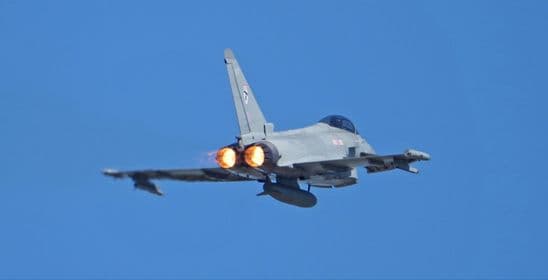
Such a dynamic performer, the RAF Typhoon Display aircraft is always a highlight act on any display programme in which she is included.
Ending the display with a spirited high-speed pass, followed by a pull up into the angry skies above, the Typhoon had introduced itself to an Airshow audience and what a performance it was. The age of the Typhoon had arrived, and this was now the aircraft everyone now wanted to see – we simply couldn’t get enough of it.
Now twenty years on, the Typhoon is a mature combat aircraft, arguably one of the most capable aircraft in world service today, and one which is now in service with the air forces of nine different nations, with just under 700 aircraft ordered to date. Still the consummate Airshow performer, thousands of Airshowgoers will be looking forward to seeing this year’s Typhoon Display Team putting this exciting performer through its paces and with it, inspiring the next generation of future Royal Air Force recruits.
As one of the World’s most capable multi-role combat aircraft, the Eurofighter Typhoon FGR4 is not only the pride of the Royal Air Force, but also happens to be the consummate Airshow performer and as such, continues to serve as an effective recruitment tool for the Force. Each year’s Typhoon display aircraft is destined to become one of the most popular aircraft in the country and a much sought after highlight on any Airshow display programme, and over the years, the aircraft have actually taken on their own widely acknowledged individual personas.
Referred to in such endearing terms as GINA, the RAF Centenary Display jet and Blackjack, RAF Display Typhoons are loved by enthusiasts and those people who enjoy attending Airshows during the summer months, and without doubt, become the highest profile individual aircraft in current Royal Air Force service. The RAF Typhoon Display also makes a celebrity of its pilot for the duration of their tenure, in addition to inspiring thousands of youngsters to consider a career in the RAF.
With the recent tradition of the RAF presenting their display jet in special markings, the weeks and months leading up to the start of the UK Airshow season tend to be rather exciting for enthusiasts, who are glued to developments at RAF Coningsby and on the RAF Typhoon Display Team’s social media feeds. For the 2024 season, we were sorry to lose our beloved Blackjack, but gained ‘Moggy’ in return, Eurofighter Typhoon ZJ913 which was presented in a stunning special scheme to mark last year’s 80th Anniversary of D-Day commemorations.
Creating its own rainbow, is there anything that the RAF’s display Typhoon can’t do!
Display salute – how we love a Typhoon display.
The aircraft wore a scheme which drew its inspiration from a Hawker Typhoon fighter bomber from the Second World War, a No.257 (Burma) Squadron aircraft which was flown by Squadron Leader Denzil Jenkins in support of the D-Day landings during the summer of 1944. Throughout last year’s Airshow season, and at commemorative events in both the UK and France, and also undertaking a successful Canadian tour, the aircraft, which its support team and enthusiasts alike referred to as ‘Moggy’, ably displayed the legendary agility of the Eurofighter Typhoon and highlighted the professionalism of the modern Royal Air Force in some style. Just like her immediate predecessors, she became the star of the Airshow scene, and attracted a huge army of admirers in the process.
For her Members Day performance last September, RAF Typhoon Display Team pilot Flt Lt David ‘Turbo’ Turnbull really did seem to be enjoying himself, performing at his home airfield and in an aircraft which had become such a star attraction during the summer months. Pushing his aircraft to perform to its maximum, and under clear blue Lincolnshire skies, the display was simply breathtaking and even though we were really there to pay homage to British aircraft of a more classic nature, this modern contemporary really did steal the show.
Moggy served up such a display treat that we were all left in no doubt as to why we’re such fans of the RAF Typhoon Display Team these days, however, as we all grabbed our pictures of this beautiful aircraft and saluted pilot ‘Turbo’ for his impressive performance, little did we know that for many of us, this would be the last time we would be seeing this attractive Typhoon in the air.
Late last year, news started to circulate confirming that Moggy’s tenue as the RAF Display Typhoon would be a short one, and she would be relinquishing that role before the years was out. Thankfully, she wasn’t destined to follow her predecessor into the Reduce to Produce program, but would instead be heading to RAF Lossiemouth to perform a new role as a Ground Training Aircraft, a training aide for the next generation of Royal Air Force engineers and technicians.
Although we didn’t know it at the time, we had just seen one of the last public display performances by Moggy, who has now taken up a very different role at RAF Lossiemouth.
Although sad to be losing such a great looking aeroplane, Moggy has certainly left her mark. In addition to this, her good looks must have helped convince so many people that an RAF Typhoon just looks so much better in historic camouflage than it does in boring old Barley Grey.
To revisit the title of this section once more, could we just take this opportunity to say, ‘Thanks Moggy, it was definitely a blast!’ The question now is, should we start to get excited about what the RAF intend to do with their Display Typhoon in this Battle of Britain anniversary year?
That’s it for another edition of Aerodrome, however, we’ll be back again in four weeks’ time with more news and pictures from the fascinating world of aviation. Thank you for your continued support and as always, if you would like to comment on anything blog related or suggest a subject you would like to see covered in a future edition of Aerodrome, please do drop us a line at aerodrome@airfix.com, where we would be delighted to hear from you.
Should you wish to continue the aviation discussions between editions, you will always find something of interest over on the Airfix Aerodrome Forum and if social media is more your thing, please use the respective official social media icon links at the foot of the main Airfix and Corgi website homepages to access our official sites.
The next edition of Aerodrome is scheduled to be published on Friday 28th February, when we will be bringing you more news from the fascinating world of aviation.
I hope to see you all back here then.
Michael