
Welcome to this latest edition of Aerodrome and our regular look at the fascinating world of aeroplanes and the historic aviation scene around the UK.
We have something just that little bit different for you in this latest edition of Aerodrome, as we bring you details of a recent pre-Airshow season visit made to a fabulous little museum situated on the site of the former Bottisham Airfield, one made to check in on their Magnificent Mustang after a period of maintenance and renovation. An airfield which was home to British, US and Belgian airmen during wartime and immediate post war years, this volunteer run museum is dedicated to the preservation of the airfield’s history, particularly the men and women who served there during its time of operation.
This blog post will be reporting on this latest visit, as well as one made last year, and will include a selection of pictures taken on both occasions, but with particular emphasis being placed on their most impressive Mustang, and aircraft which was previously on display in the American Air Museum at the nearby IWM Duxford. We will also be looking at some of the famous wartime pilots who flew from this airfield, in addition to trying our best to encourage as many people as possible to come and experience this fantastic place for themselves.
The former USAAF Station 374 and their rather famous yellow nosed P-51D Mustang are in the crosshairs of this latest edition of the Airfix and Corgi Aerodrome blog.
Bottisham’s magnificent Mustang pictured during my first visit to this excellent museum last summer.
Speaking from my own personal experience, I don’t think I will be the only person reading this latest edition of Aerodrome who always found History to be the most engaging subject during my school years, and how a love of history went on to play a significant, and incredibly enjoyable role in my life. That being the case, the old saying that we ignore history at our peril has always had powerful resonance with me, and I suspect millions of other people who share a similar fascination with the past.
Some of the happiest times I have ever spent have been learning about the lives of our forebears, and walking in their footsteps at historic sites up and down the country, fortunate to be enjoying the endeavours of people who share a similar passion for history and are determined to preserve it.
As an aviation enthusiast, sometimes an abandoned former airfield can be just as interesting and usually far more evocative than an active station, and visiting a location were we’re treading the same ground as the personalities that inspired us in our youth, can be incredibly emotive for us. As my daughter currently lives in Cambridge, I’ve been fortunate enough to branch out from my usual haunt of the Imperial War Museum airfield at Duxford, to discover something of an aviation heritage trail in the county, and have loved every minute of it. From a sobering and thought-provoking visit to the beautifully maintained American Cemetery and Memorial at Madingley, to enjoying a refreshing pint in the historic Eagle pub in Cambridge centre, Cambridgeshire is an aviation enthusiasts dream, and a discovery of fascinating locations that just keeps on giving.
Over the past year or so, I’ve visited a fantastic little museum on the outskirts of Cambridge on a couple of occasions. I was aware that there was a wartime airfield at Bottisham from my interest in military aviation, but news of an exhibit development carried in the enthusiast press some years ago, and seeing a signpost for the airfield when staying locally with the Airfix team when we were working a Duxford Airshow, placed a visit high on my priority list. On a recent visit to see my daughter, and whilst taking a slight detour from visiting the gardens at nearby Anglesey Abbey, I finally managed to break my Bottisham Airfield duck, and enjoyed the experience so much that I had to make this second visit on the first day it opened for business this 2026 season.
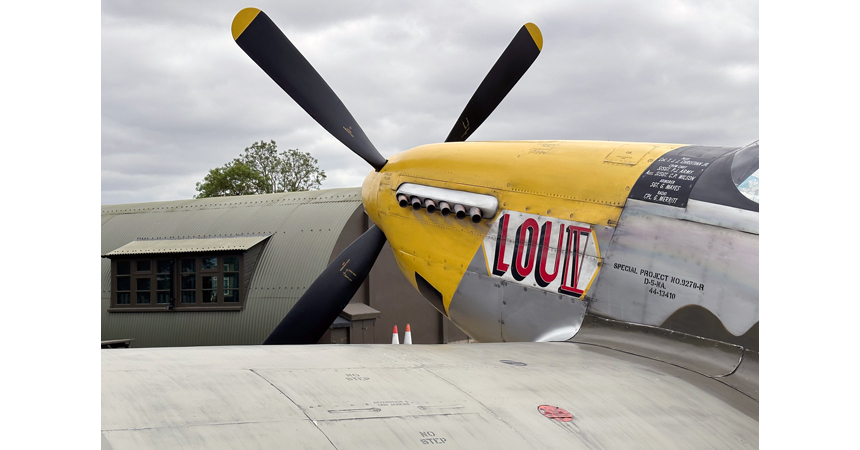
This famous aircraft sported a different nose art name on either side of its yellow nose.
The airfield at Bottisham was established in 1940 as a satellite field for RAF Waterbeach, and consisted of a grass runway and initially at least, relatively basic airfield amenities. The site was used as a relief landing ground for the Tiger Moths of the Cambridge based No.22 Elementary Flying Training School, but all the time in the shadow of RAF Duxford, which was just 14 miles away.
For a two-year period from the beginning of July 1941, the airfield went on to be occupied by a succession of Royal Air Force Army Co-operation units, including Nos. 241, 652, 168, 654, 2 and 4 Squadrons. This would see aircraft such as Lysanders, P-40 Tomahawks, Tiger Moths, Austers and Allison-engined Mustang Mk.Is all using the airfield, which was now taking on a much more active role. In October 1941, Bottisham’s grass runways were reinforced with Army Track surfaces, however, this didn’t stand up to the rigors of increased flying activities and were subsequently replaced with steel mesh Summerfeld Track the following summer.
Unquestionably, the most interesting period in Bottisham Airfield’s history started in the summer of 1943, when the Air Ministry Works Directorate began work on enlarging and improving buildings and facilities at Bottisham, in preparation for the arrival of new overseas residents. They were expecting the 361st Fighter Group of the United States Eighth Air Force, which was made up of the 374th, 375th and 376th Fighter Squadrons, and would also see the arrival of seven additional support units.
Having arrived in the UK after travelling aboard the HMS Queen Elizabeth, the Group, which was commanded by L/Col. Thomas J.J. Christian, Jr., became established in December 1943, the last 8th Air Force fighter group to be equipped with the mighty Republic P-47 Thunderbolt. They would be tasked with providing fighter escort for the 8th Air Force’s daylight bombing offensive, in addition to hunting the Luftwaffe and engaging in ground attack and missions. On 3rd January 1944, RAF Bottisham was officially handed over to the Americans, and the base was renamed Army Air Force Station F-374.
On the 21st January, the Group flew its first combat mission over Europe, increased flying activity which soon resulted in further improvements to airfield facilities - Pierced Steel Planking (PSP) was fitted on a widened runway, to allow formation take-offs in the heavy Thunderbolt to take place.
Such a beautiful looking aircraft, these yellow nosed Mustangs must have looked magnificent taking off from this Cambridgeshire airfield.
During the first four months of 1944, the 361st Fighter Group gave a good account of themselves in combat with the Luftwaffe, despite the limited range of the Republic P-47 Thunderbolt, however, in May that same year, they would convert to a thoroughbred fighting aeroplane, the long-range North American P-51 Mustang.
The Group’s combat achievement continued throughout the summer, but not without suffering losses to their own number, including one of the squadron commanders and the Group CO, who were both killed in action over France. In September, L/Col. Joseph J. Kruzel took command of the Group and the 376th Sqn would take a particularly heavy toll of enemy aircraft on the 27th. Nevertheless, by the end of the month, the Group had moved down to Little Walden in Essex, and Bottisham fell silent. In total, the 361st had flown 214 missions and claimed 148 enemy aircraft destroyed in the air, with a further 86 destroyed on the ground. Tragically, they would lose 39 pilots in doing so.
The sound of aero engines would not be heard regularly at Bottisham again until June 1945, when it was once again assigned duty as a relief landing ground, this time for the RAF (Belgian) Initial Training School which was based at nearby RAF Snailwell. By October, Bottisham had become a full satellite of Snailwell, and the following month, saw the activities of the Belgian Training Unit split equally between the two stations. Their time training in Cambridgeshire must have been successful, because by March 1946, the Belgians had departed to begin operations in their home nation, but not before leaving an important mark on this part of Cambridgeshire.
The airfield finally closed on 1st May 1946 and was eventually sold off for agricultural use by October 1958.
The last picture of Bottisham’s Mustang taken during my visit last year, when the aircraft was still on display outdoors.
When travelling along either the A1303 or Wilbraham Road in rural Cambridgeshire, unless you had prior knowledge, you would have absolutely no idea that you were driving past one of the busiest former USAAF fighter stations from the latter stages of the Second World War, or indeed that there was a P-51D Mustang actually within spitting distance. Thankfully, there are a group of people who are dedicated to ensuring that this location remains on the aviation map of the UK and that the active years of this airfield’s operations remain documented and preserved.
According to the Bottisham Airfield Museum website, the museum was opened in 2009 to commemorate the sometimes forgotten role of the airfield at Bottisham in World War Two. It is the only UK museum dedicated to the Royal Air Force, United States 8th Army Air Force and Belgian Air Forces. We are now operating out of the last remaining airfield buildings to exist within the airfield’s original perimeter.
A Nissen Hut was erected in the original location of one that was there in 2016, and the restoration of the original buildings was completed in 2020.
The museum is now fully functioning with modern facilities, which include a coffee shop and well stocked museum shop.
Some of the fascinating exhibits on display at this magnificent museum.
Looking resplendent after receiving some closed season TLC, Bottisham’s beautiful Mustang is currently displayed under cover.
The museum’s mission statement is as follows - To collect, restore, conserve and display items relevant to the history of Bottisham Airfield, including material relating to the Home Front in the local communities and local personalities. To promote and encourage interest in the Museum, especially among the local communities, young and old, and in relation to items or memorabilia that individuals might wish to donate to the Museum.
To educate visitors to the Museum regarding the role of the airfield, the units that served there and the role the village played in the war effort.
Having now visited the museum twice within the space of twelve months, I can say with some confidence that they appear to be succeeding in all their aims, and if you want to visit a museum where the volunteers possess boundless enthusiasm, and are only too happy to inform and entertain when requested, then you need a visit to Bottisham.
With so many interesting displays and artifacts to discover, it might seem a little trite to suggest that the volunteers are actually one of the main attractions, but they really are. When making your visit, please do take the time to speak with as many of the volunteers as possible, because they all have interesting stories to tell, and will help to build a much more complete picture of Bottisham and the air operations which took place there.
You might also find that the person you are talking with actually owns the exhibits you’re admiring, and has loaned them to the museum to allow as many people as possible to enjoy them. Usually taking years to collect, and probably at great expense, many of these exhibits have interesting stories to tell and when receiving those stories, who better to have it delivered by than the person who is the most knowledgeable about them.
One of the original USAAF drop tanks on display at the Bottisham Airfield Museum
This historic picture shows fighter gathered at Bottisham for the Group Commander’s Conference at the end of August 1944.
The Museum buildings are crammed full of exhibits and artefacts intended to provide a sense of what it might have been like in wartime Britain, and in particular, how this quiet corner of Cambridgeshire became ‘All American’ to the sound of Pratt & Whitney and Packard Merlin engines. With hundreds of rare and unusual exhibits, those with an interest in wartime aviation will be fascinated to see the impressive collection of USAAF related artefacts, such as a Mustang canopy frame which still has the red paint of the 375th Fighter Squadron on it, or an original 75 gallon aluminium external drop tank which was purchased from a local farmer off ebay.
The walls or the buildings are similarly adorned with memorabilia, including one fascinating picture taken at Bottisham in August 1944, when the airfield was the venue for a Fighter Group Commander’s Conference. The line up includes Mustangs, Thunderbolts and P-38 Lightnings displaying some of the iconic group markings of the various fighter groups at that time, but what makes it all the more interesting, is that the picture also includes an arrow which shows the building where you are currently standing admiring the picture! For me, this has to be one of the most memorable exhibits.
The picture described previously might be good, but the real star of the Bottisham show is the P-51D Mustang they proudly have on display, one which was previously out on the field, but is now under the protection of a fabric hangar, having just benefitted from a period of maintenance and renovation. She’s our next review port of call.
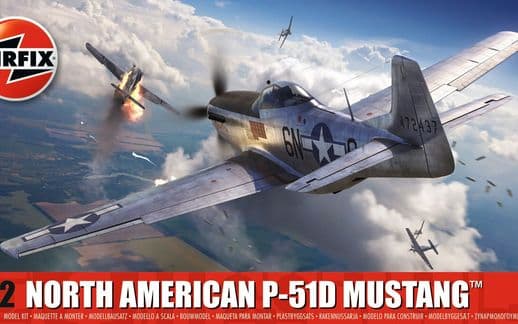
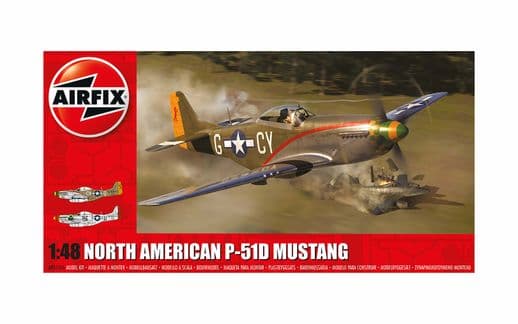
This famous Mustang as replicated in Airfix box artwork.
Aviation enthusiasts will no doubt remember seeing articles relating to this exhibit during the summer of 2022, as this former Duxford resident was unveiled wearing her smart new Bottisham linked scheme at her new museum home. The aircraft is actually an impressive fibreglass replica of a P-51D Mustang, which previously hung from the roof of the American Air Museum at Duxford wearing the distinctive black and white chequerboard markings of the 78th Fighter Group.
The Mustang was secured from Duxford and on its arrival at the Bottisham Museum, had plenty of time and attention lavished upon it, as its new owners had ambitious plans for her. Destined to be the centrepiece of their impressive museum, the Mustang had work done on its undercarriage and canopy, and was finished in the authentic scheme of the 361st Fighter Group’s Commander at Bottisham, Col Jack Christian. In fact, the replica looks so accurate, that you really can imagine this beautiful fighter blasting off from the museum for a fighter sweep over northern France.
North American P51D-5-NA Mustang 44-13410/E2-C ‘Lou IV’, flown by Colonel Thomas Jonathan Jackson Christian Jr., 375th Fighter Squadron, 361st Fighter Group, 8th Air Force, USAAF, Air Force Station F-374 (RAF Bottisham), Cambridgeshire, England, July 1944.
By the time Thomas Jonathan Jackson Christian Jr. arrived in Europe, he was already one of the most experienced combat pilots in the USAAF and an accomplished leader of men. The great grandson of famous Confederate Civil War general ‘Stonewall Jackson’, Christian graduated from the West Point military academy and initially embarked on a career in the US Army Field Artillery, only to have a change of mind soon afterwards, applying to train as a pilot with the Army Air Corps.
A natural pilot possessing exceptional flying skill, on gaining his wings Christian was posted to the basic flying school facility at Randolph Field in Texas, but his desire to fly operationally would see him transferring to a bomber group, where he would fly the Dougals B-18 and Boeing B-17 bombers from bases in the Philippines. Continuing to cram his logbook with an impressive list of aircraft types flown and hours in the air, Thomas Christian was later reassigned to a fighter unit, where he would spend time ferrying Curtiss P-40 fighters in the Australasian region. He was actually shot down flying one such mission, and was officially posted as MIA, presumed lost, but thankfully managed to survive the incident, living in the jungle helped by local people and eventually returning to his home station.
After spending time flying the Bell P-400 Airacobra from Guadalcanal, Christian returned to the US, where he would marry his sweetheart and take command of the newly formed 361st Fighter Group in Richmond, Virginia – nicknamed the ‘Yellow Jackets’, pilots of the 361st were trained to fly the mighty Republic P-47 Thunderbolt, one of the heaviest and most powerful fighters of the Second World War, and a real brute of an aeroplane.
In November 1943, the 361st FG were posted to Britain and set sail aboard the liner Queen Mary, arriving in Scotland on 29th of the month, and immediately travelling onwards to their new home base at Bottisham in Cambridgeshire. Their new Thunderbolts were waiting for them when they got there, and following a period of training and familiarisation, the unit took their mighty fighters into combat against the Luftwaffe.
The unit converted from Thunderbolts to Mustangs in May 1944 and would be heavily involved in actions supporting the D-Day landings and subsequent liberation of Europe.
One of the most famous wartime air to air pictures ever taken – Bottisham Four take a bow.
In the skies above Bottisham airfield on the 26th July 1944, four Mustang fighters of the 375th Fighter Squadron/ 361st Fighter Group formed up on the starboard side of Boeing B-17 Flying Fortress ‘Bomber Dear’ camera ship to allow USAAF combat cameraman Ben Ross to take a series of air to air colour images, pictures which would go on to become some of the most widely published aircraft images of the war and synonymous with USAAF operations during WWII. The images feature four yellow nosed Mustang fighters from the American base at Bottisham in Cambridgeshire, and would go on to be widely referred to as the ‘Bottisham Four’.
Each of the Mustangs were fitted with long range fuel tanks, giving the appearance that they were about to embark on their latest bomber escort mission over Europe. The aircraft which took part were also examples of several different variants of the Mustang, with one razorback P-51B, two early P-51D fighters without the dorsal fin fillet extension fitted, and one complete with the tail fillet modification addition. The lead aircraft, 44-13410/E2-C ‘Lou IV’ was the personal mount of Group Commander Col. Thomas JJ Christian Jr., a highly decorated aviator and American hero His Mustang is considered to be one of the most famous and widely published Mustangs of the Second World War.
Although this is a fibreglass replica aircraft, it’s a fine tribute to the aircraft flown by Bottisham’s Commanding Officer Col. Thomas JJ Christian Jr.
Christian’s Mustang was named ‘LOU IV’ after his daughter Lou Ellen, who had been born back home in Dallas in January 1944. This name was carried on the port side of the forward fuselage, with the starboard side displaying the name ATHELENE, which is thought to have been the name of either the wife or girlfriend of the aircraft’s crew chief, S/Sgt. D Jameson’s. This Mustang is particularly interesting for a number of reasons, not least of which is the fact that it features the much more prominent full yellow nose of the 361st Fighter Group, markings which would be applied to the rest of the group’s Mustangs during August 1944. ‘LOU IV/ATHELENE’ also has its top D-Day identification markings overpainted using a lighter shade of olive drab on both the wings and horizontal stabilisers, making this an extremely noteworthy and attractive aircraft indeed.
Highlighting the many dangers facing those engaged in air combat operations during the Second World War, none of the aircraft which took part in this famous photoshoot would survive the war, with three of them actually being destroyed within 7 weeks of the famous ‘Bottisham Four’ pictures being taken, claiming the lives of two of the pilots.
Col Thomas JJ Christian Jr. would lose his life whilst flying his famous Mustang ‘LOU IV’ on 12th August 1944, on a mission to support a large 8th Air Force raid against targets in northern and central France. He was last seen leading a bombing attack against the railway marshalling yards at Boisleux au Mont, just south of Arras, with some eyewitness reports claiming a yellow nosed Mustang lost a wing and crashed whilst making its attack run.
Although Christian wasn’t credited with any aerial victories, he was an exceptional leader with more than 70 combat missions over Europe to his name and had been the recipient of several decorations for valour and devotion to duty. His Mustang ‘Lou IV’ did have two Luftwaffe fighter claims to its name, but these were whilst the aircraft was being flown by other pilots.
Tragically losing his life at the age of 28, Col Jack Christian Jr. never got to see the daughter after whom his Mustang was named.
Run entirely by a passionate and committed team of volunteers, the Bottisham Airfield Museum is dedicated to the preservation of the rich heritage at this airfield site, and specifically, to the memory of the brave airmen who flew, fought and died whilst based there. It also honours the local men and women who helped support the war effort during those dark days, from the people who helped support airfield operations, to members of the local home guard, each one of them having a story to tell.
The well stocked gift shop has this excellent model of Ben Drew’s Mustang ‘Detroit Miss’ on display, another of the ‘Bottisham Four’ pilots.
With something interesting for everyone young and old, your visit might also coincide with another event at the site, such as a classic car show, or a bird of prey day, but what you’re always assured of is a warm welcome and an interesting day out. And of course, there’s that beautiful Mustang of theirs, which really is a stunner.
Currently under cover, it remains to be seen if LOU IV/ATHELENE will be allowed out onto the field again this year, a poignant reminder of the contribution Bottisham pilots made during the latter stages of the Second World War.
If you fancy embarking on your own Cambridgeshire aviation heritage trail, make sure you place the Bottisham Airfield Museum at the top of your list, because you’ll be in for a bit of a treat.
I’m afraid that’s all we have for you this time around, however, we’ll be back again in four weeks’ time with more news, updates and pictures from the fascinating world of aviation. Thank you for your continued support and as always, if you would like to comment on anything blog related or suggest a subject you would like to see covered in a future edition of Aerodrome, please do drop us a line at aerodrome@airfix.com, where we would be delighted to hear from you.
Should you wish to continue the aviation discussions between editions, you will always find something of interest over on the Airfix Aerodrome Forum and if social media is more your thing, please use the respective official social media icon links at the bottom of the main Airfix and Corgi website homepages to access our official sites.
The next edition of Aerodrome is scheduled to be published on Friday 15th May, and we look forward to sharing more aviation inspired content with you then.
I hope to see you all back here in four weeks.
Michael