
Welcome to this latest edition of Aerodrome and our regular look at the fascinating world of aeroplanes and the historic aviation scene around the UK.
As we continue our current winter journey around interesting aviation related sites and events here in the UK, we head north to the Yorkshire Air Museum for this latest review, a location I have visited many times over the years, but unusually, not for quite some time now. For that reason, I was keen to address this situation, so actually visited the museum twice in the space of a few days last November, firstly to attend the museum’s first model show event, then during the following week to photograph the external exhibits in better winter light.
In addition to catching up with some famous YAM residents in this latest edition of Aerodrome, we will also be reporting on a significant recent aviation arrival at the museum, one which holds the prospect of being a major attraction in these parts, once her army of enthusiast helpers have completed their re-assembly work. We will also be featuring one of the museum’s most impressive exhibits, a futuristic looking former French Air Force tactical nuclear bomber which looks like it could have been designed by Gerry Anderson.
We’re heading to one of Yorkshire’s premier visitor attractions in this latest edition of Aerodrome, one which can boast a unique collection of preserved historic aircraft on display.
One of the star attractions at the Yorkshire Air Museum is their magnificent Handley Page Halifax, one of only three in the world and the only one in Europe displayed as a fully restored aircraft.
Aircraft enthusiasts here in the UK really do have to think themselves extremely fortunate with the sheer number of aviation related venues they have to visit. Most of these only came into being due to the hard work and steadfast determination of small groups of incredibly dedicated people, people who wanted to preserve the heritage of their communities, or the wartime contribution made by people stationed in their area. The Yorkshire Air Museum at Elvington, just seven miles from York city centre, is one such venue, a museum built on the site of a former RAF bomber station, and one which now serves to commemorate both this airfield and the aviation heritage of Yorkshire.
The history of this museum site is very much linked to the Second World War, and was originally constructed as an airfield with a grass runway, serving as the satellite station for nearby RAF Pocklington, however, the airfield underwent re-construction just a couple of years later, with the laying of three hard runways and the promise of a much more active future.
The first aircraft residents at the station were the Armstrong Whitworth Whitley bombers of No.77 Squadron, however, they soon traded these ageing bombers for the much more capable four engined Handley Page Halifax, aircraft which operated in some numbers from Elvington, and an aircraft type which still has strong connections with this airfield – we’ll have more on that a little later.
No.77 Squadron would move to nearby RAF Full Sutton in 1944, leaving Elvington to welcome thousands of French personnel and two French Halifax squadrons in the weeks just prior to D-Day, with No.346 ‘Guyenne’ and No.347 ‘Tunisie’ arriving in Yorkshire to support Allied air operations into Europe. This is another proud association still commemorated at the Yorkshire Air Museum, a fascinating story which is told extremely well by the various exhibits they have on site.
These squadrons left in October 1945, as they flew their Halifax bombers back to France, as part of the post war French Air Force, however, those who were stationed at Elvington never forgot the time they spent in Yorkshire, and many of their relatives still make the pilgrimage to the Yorkshire Air Museum to retrace the steps of their wartime relatives.
During the early 1950s, RAF Elvington was made available to the Strategic Air Command of the US Air Force, which resulted in a huge expansion of airfield facilities and infrastructure. Destined to be operating some of the heaviest aircraft in service, the runways were lengthened and strengthened, as were all the supporting taxiways and hard standing areas. Ultimately, Elvington never became operational in the role, but as the Americans left in 1958, they left behind one of the longest runways in Britain.
Moving on to the 1960s, Elvington’s facilities were used by Blackburn Aircraft to test their Buccaneer jet, and many Yorkshire based squadrons would use the airfield’s massive runway to perform touch and go landings, and as an emergency relief landing ground, but by March 1992, the airfield was officially closed.
Elvington’s Halifax commemorates the strong ties between this former RAF bomber station and the French Air Force, by displaying the aircraft in French markings on its starboard side.
Prior to that official closure, a group of local people gained authority to restore the old control tower on the site, as it was falling into disrepair and they wanted to preserve the airfield’s heritage. In addition to this, they turned their hand to preserving many of the other original buildings on the airfield, and clearing vast areas of the site which had become overgrown and unsightly. This proved to be the impetus for the current museum and in June 1985, the Yorkshire Air Museum and Allied Air Forces Memorial were born, and started to take delivery of its first exhibits soon after.
Since then, the museum has gone from strength to strength, and those visiting this impressive former RAF airfield site today owe a debt of gratitude to those visionaries who rolled their sleeves up in the early 1980s.
For a great many people, the main reason they visit the Yorkshire Air Museum is to see the unique and impressive Halifax bomber they have on display, one of only three complete examples left in the world and the only restored, free standing example in Europe. This aircraft is actually a composite restoration using parts from several different Halifax airframes, and other Handley Page aircraft types, but she looks like a Halifax, is preserved on a former Halifax bomber station and is truly magnificent.
She was restored over a period of around ten years and has been finished in the livery of a famous Halifax centurion, one which is simply known by its nose artwork name, ‘Friday the 13th’, not an aircraft for the superstitious.
During the early months of the RAF bomber offensive against Germany in WWII, the men of Bomber Command suffered heavy losses at the hands of Luftwaffe air and ground defences, with many aircraft and crews failing to make it back to their home bases. Flying the Handley Page Halifax bomber, RAF No.158 Squadron based at Lissett airfield in East Yorkshire, didn’t escape those punishing losses, with the high number of replacement crews arriving at the station highlighting that tragic story of heroic loss.
Highlighting the many dangers facing operational bomber crews, the squadron had lost a succession of aircraft carrying the fuselage identification letter ‘F for Freddie’ over several months of operations, a situation which was beginning to affect the morale of crews across the station. In fact, no fewer than seven different aircraft wearing the letter ‘F’ had been lost during this period, something which actually resulted in some superstitious crews flatly refusing to fly any Halifax wearing the F code, despite the disciplinary actions they would face.
As the latest ‘F for Freddie’ replacement Halifax arrived at RAF Lissett (serial number LV907), many of the crews stationed on the base were determined to avoid the aircraft like the plague.
This magnificent aircraft as seen on my latest visit to the Yorkshire Air Museum.
The actual ‘Friday the 13th’ Halifax nose artwork is currently on display at the RAF Museum Midlands, otherwise known as RAF Cosford.
Despite the growing superstition surrounding Lissett based ‘F for Freddie’ Halifax aircraft, LV907 seemed as if it was determined to change this situation right from its first operational mission, maybe even turning superstition on its head. On the night of 30th March 1944, LV907 was due to fly a mission with the rest of No.158 Squadron against targets around the German city of Nuremberg, but initially, didn't have a crew assigned to fly it. Pilot Joe Hitchman was on a rest day that particular day, but as this was to be a maximum effort raid, had been called back to base to take part in the night’s actions.
Unfortunately for him, his usual aircraft ‘G for George’ had been assigned to his Squadron Leader for the sortie, which meant he would have to fly the recently delivered LV907 ‘F for Freddie’ and with a new scratch crew to boot. As mission preparations go, things could hardly have been worse for him?
As the new crew of Halifax LV907 raced down the runway at RAF Lissett bound for Nuremberg, they would have been working almost by instinct to ensure that everything aboard the aircraft was operating as it should. If they did find a moment to think about the coming few hours, the fate befalling several previous ‘F for Freddie’ marked aircraft in the squadron must have crossed their minds, but there wasn’t much they could do about that now.
The Nuremberg raid of 30th/31st March 1944 would prove to be particularly costly one for Bomber Command. Crews had been told to expect significant cloud cover for the duration of the raid, something which would help protect the bombers from Luftwaffe nightfighter attacks whilst over Europe. Unfortunately, what they actually encountered was a cloudless night sky, with a brilliant full moon illuminating their position.
Ordinarily, conditions such as these would result in raid cancellation due to the additional dangers it placed crews in, but on this occasion, the 'Met men' just got it terribly wrong, and crews had to deal with the situation as they found it. As this mighty force totalling some 795 RAF bombers crossed the coast of Belgium, the expected cloud cover was nowhere to be seen and illuminated by the light of the full moon, they knew the Luftwaffe's nightfighters would be waiting to greet them. As far as the German nightfighter pilots were concerned, this was perfect hunting weather for them, and they would have plenty of targets to fill their gunsights.
Ultimately, the raid would be a disaster for Bomber Command, with no fewer than 95 aircraft failing to return to their home bases overnight, a figure which was almost a 12% loss rate, one of the highest attrition rates of the entire war. Tragically, when considering that each of these aircraft typically had a crew of seven men, the magnitude of this disaster is difficult to comprehend. How on earth could the brave men of Bomber Command recover from such a devastating loss?
‘Friday the 13th’ at Elvington, during one of her rare excursions out from the safety oof her hangar.
It was under such devastating circumstances, that the Halifax which inherited No.158 Squadron's unlucky aircraft tag, LV907 ‘F for Freddie’, brought its crew home from the carnage of the moonlit Nuremberg raid safely, and from that mission forward, went on to create one of the most interesting RAF bomber stories of the entire war. As pilot Joe Hitchman checked in for mission de-brief following his arrival back at Lissett, he was informed of the terrible news that his usual aircraft ‘G for George’, which had been flown by his Squadron Leader that night, was one of the missing aircraft, presumed lost.
This is where the story of Halifax LV907 really begins and how it would become one of the most famous examples of its type to see Bomber Command service in WWII. Following the Nuremberg raid, the aircraft sat in a revetment at RAF Lissett, waiting to be allocated to a new crew. Perhaps understandably, the unfortunate loss of several previous ‘F for Freddie’ Halifax bombers at the station left those of a superstitious disposition keen to avoid her. That being said, everyone knew she had to be flown on operations and that one, or several crews would have to fly her. She would subsequently be allocated to Pilot Officer Cliff Smith and his crew, and being a no nonsense sort of fellow, he instinctively knew what he had to do.
He decided that this bomber needed a new name and some nose artwork, something he intended to be a direct challenge the unwanted reputation 'F for Freddie' coded Halifaxes at Lisset had inherited, an attempt to change the fortunes of this aircraft and importantly, its new crew. In a development which must have caused quite some consternation amongst personnel on base, not to mention his own crew, he decided to christen the bomber 'Friday the 13th'. In addition to this, he had artwork depicting the Grim Reaper and a lucky horseshoe painted the 'unlucky' way round on the front fuselage of this bomber, in a direct challenge to the superstitions everyone associated with his aircraft.
He must have been of the opinion that if he was going to be taking on luck itself, he might as well cover all the superstitious bases! Interestingly, one final artwork addition proved to be a superstitious step too far ... quite literally. He had the representation of a ladder painted on the aircraft, just above the crew access door, to symbolise that the crew would be walking under a ladder each and every time they entered the aircraft. This was just too much for base commanders to stomach, who ordered the immediate removal of the painted ladder – perhaps this was just as well!
As far as aircraft exhibits go, this one is worth travelling many miles to see.
Despite staring luck and superstition squarely in the face, Halifax LV907 ‘Friday the 13th’ would go on to become known as one of the luckiest aircraft in Bomber Command. For the remaining months of the air war, ‘Friday the 13th’ would be flown by many different crews on bombing missions deep into enemy territory, and despite the horrendous perils they faced on each and every sortie, she always brought her crews home safely. Fascinatingly, the aircraft nobody initially wanted to fly went on to complete an impressive 128 missions during the final months of conflict, a record unmatched by any other Halifax during WWII.
Following the end of hostilities, the general public became aware of the story of this now famous bomber, and she would become something of an aviation celebrity. Taking her place as an imposing centrepiece for victory celebrations, Halifax LV907 ‘Friday the 13th’ was placed on public display outside the bombed out Lewis’ department store in Oxford Street, London, allowing tens of thousands of people to see and touch her, paying their own respects to this incredible machine and the brave crews who flew her during the war.
Unfortunately, this time in the national limelight proved to be relatively short-lived and the bomber was soon taken back to Yorkshire and unceremoniously scrapped. Like so many RAF Halifax bombers before her, ‘Friday the 13th’ was taken to the Handley Page operated York Aircraft Repair Depot and simply broken up for scrap. A sad end for an aircraft which served so faithfully during the latter stages of WWII.
Thankfully, her iconic fuselage artwork was saved, and it can currently be seen on display in the Bomber Command exhibition hall at the RAF Museum Midlands (Cosford). A visit to the Yorkshire Air Museum allows us all to marvel at this representation of that famous Halifax centurion, the only place in Europe where you can see a Halifax bomber standing imperiously on its own undercarriage.
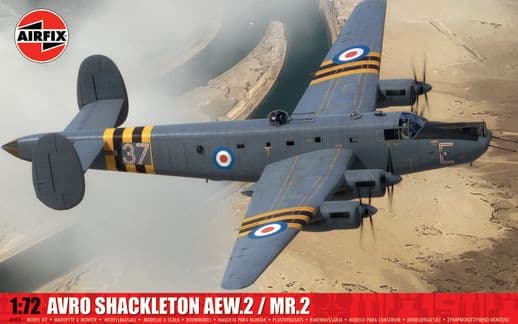
Avro Shackleton MR.2 WR963 has been a Yorkshire resident for around twelve months now. She can look forward to a much brighter future, once her volunteer force get to work on her.
One of the main reasons for my latest visit to the Yorkshire Air Museum was to secure my first pictures of Avro Shackleton MR2 WR963 at her new home, having relocated from Coventry Airport around a year ago. Now safely residing at Elvington, this aircraft was previously maintained in spectacular running order, with her engine run events always attracting healthy numbers of enthusiasts to witness the spectacle. Currently in a semi-assembled state, it’s hoped that the aircraft will continue to receive ongoing care and attention at her new home, with Yorkshire ultimately destined to reverberate to the sound of her active Rolls Royce Griffon engines.
Tracing its aviation legacy back to the famous Lancaster bomber of WWII, the Avro Shackleton was an extremely capable long range maritime patrol aircraft, which also served in the roles of Airborne Early Warning, anti-submarine detection/attack and Air Sea Rescue. Powered by four Rolls Royce Griffon engines, the Shackleton also employed contra-rotating propellers, in an effort to maximise the power output from her engines - the incredible noise generated by this engine/propeller combination earned the aircraft its iconic nickname, ‘The Growler’.
Shackleton MR2 WR963 made her first flight from the Avro airfield at Woodford in March 1954 and would go on to have an impressive 37 year service during her time with the Royal Air Force. During her service as an airborne early warning AEW.2 aircraft with No.8 Squadron at RAF Lossiemouth, WR963 was given the name ‘Ermintrude’ after the Magic Roundabout children’s TV character. Twelve Shackleton airframes were converted to AEW Mk.2 variant configuration and operated in the colours of RAF No.8 Squadron, originally at RAF Kinloss in early 1972, but quickly moving to nearby Lossiemouth following the completion of runway strengthening works.
The winter conditions certainly didn’t help to diminish the size of the task facing the Shackleton team, but they remain unbelievably positive about the prospects of their beloved aircraft firing up all four of her Griffon engines once again.
One particularly endearing feature of Britain’s AEW.2 Shackleton fleet was the fact that each of the twelve aircraft inherited the name of a characters from one of two children’s TV programmes of the period, either from ‘The Magic Roundabout’, or ‘The Herbs’. The aircraft would also feature artwork depicting their respective character, usually applied under the cockpit on the port-side fuselage. Originally envisaged as a stop-gap detection arrangement, these twelve Shackletons would go on to provide Britain with almost 19 years of effective airborne early warning cover, with the final Shackletons only retiring in the summer of 1991.
As the RAF finally retired their remaining Shackletons, two aircraft, WR963 and WL790, were secured at auction by a private buyer and delivered to their new home at Coventry Airport. The intention back then was to return at least one of them back to airworthy condition and onto the UK Airshow circuit, however, as we all now know, that didn’t happen for a multitude of perfectly understandable reasons.
Thankfully for Shackleton WR963, she could rely on the efforts of a loyal band of supporters who were dedicated to her wellbeing, and for many years, maintained her in good condition and in engine running order. They would even hold regular events where the Shackleton’s four Griffon engines roared into life, and if it was an evening event, the exhaust flames made it look like some sort of fire breathing dragon.
With WR963 now safely at the Yorkshire Air Museum, it’s to be hoped that 2026 proves to be a big year for the Shackleton and will hopefully see her back in one piece. Once they’re in a position to re-start their engine run events, this will be yet another significant aviation reason to put Elvington on your visit schedule for the year.
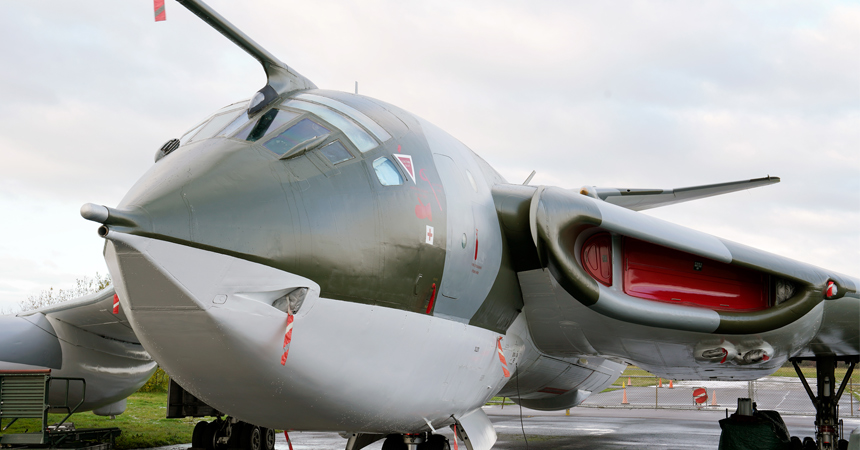
Lusty Lindy’s iconic Gulf War scheme has recently been replaced with these handsome camouflage markings, once she hasn’t worn for over 40 years.
The other famous Handley Page aviation resident at the Yorkshire Air Museum is their magnificent Victor K.2 XL231, and whilst you never need an excuse to go and admire her for a few hours, a recent change of appearance has made this a must for any self-respecting aircraft enthusiast. After wearing her iconic Gulf War ‘Lusty Lindy’ livery since arriving at Elvington back in November 1993, she has been returned to an RAF camouflage scheme for the first time in around 40 years, and she looks fantastic.
Handley Page Victor B.2 XL231 was built at the company’s Radlett factory in 1961, making her maiden flight on 28th December of the same year. After successfully negotiating her test programme, she was delivered to the famous ‘Wittering Wing’ as the first B.2 Victor to be taken on strength by the newly re-formed RAF No.139 Squadron, wearing the all-white anti-flash scheme which would become synonymous with the nuclear capable Victors of the V-Bomber force. She would later shed this iconic scheme for one featuring upper surface camouflage, as the effectiveness of Soviet surface to air Missiles dictated that V-Bomber operations had to move from high speed, high altitude missions, to low level nuclear penetrations.
Once Britain’s nuclear deterrent capability had been passed to the submarines of the Royal Navy, the RAF’s Victor squadrons were disbanded, with some aircraft earmarked for conversion to the airborne tanker role. Victor XL231 was selected as the K.2 tanker development aircraft and was to become the prototype Victor K.2 variant, although in actual fact, she was initially only partly converted to K.2 configuration for trials work – she only received the full conversion upgrade later in the program.
Victor XL231 looking resplendent in her new markings
Undergoing Conversion at the former Avro factory at Woodford in Cheshire, XL231 still exhibits fascinating details from this period in her history, most noticeably on two panelled over sections at the rear of her fuselage. These were used to cover the area where cameras had been positioned to record the in-flight refuelling process during the development of these aircraft. When a suitable Victor K.2 was available to take her place, XL231 could receive the full K.2 upgrade, permanently changing her operational role, whilst at the same time effectively returning her to a zero rated fatigue life aircraft. This also marked her as the first Victor to be upgraded to K.2 tanker standard, but the last one to enter RAF service.
Continuing to be a rather important aircraft, XL231 did not see direct service with the rest of the Victor tanker force during the Falklands War, but would work tirelessly to ensure that other aircraft could do so. Not knowing how long, or how successful the South Atlantic campaign would be, the MOD had an immediate need to equip both the Nimrod and Hercules with an in-flight refuelling capability, thus increasing their operational effectiveness and allowing them to cover much greater distances. Victor XL231 served as the development aircraft for these trials, further marking her as a tanker of distinction. She did later make the long trip to RAF Ascension Island, supporting a flight of nine Harrier GR.3s on a direct route from the UK.
It can often be four seasons in one day when you pay a visit to the Yorkshire Air Museum.
Now upgraded to full K.2 tanker standard, XL231 would go on to play a significant role in ‘Operation Granby’, the Gulf War of 1990, where she would fly 16 tanking sorties in support of coalition air operations. The mission markings on her nose actually show 18 fuel pump mission markings, two of which are in red, however, those final two missions were flown after the ceasefire had been agreed. Despite this, there was still a very real possibility that factions of the Iraqi military may choose to ignore the ceasefire, and target the aircraft, those final two missions were effectively still flown under combat conditions.
Standing testament to the effectiveness of RAF tanking operations during the Gulf War, RAF No.55 Squadron were required to mount 299 sorties during their deployment and all 299 were carried out – an enviable serviceability record indeed. It was also during the Gulf War that this aircraft received her iconic nose artwork and a name by which she would be referred to until this day. Named after the wife of the crew-chief during the aircraft’s Gulf deployment, XL231 will probably forever to be referred to as ‘Lusty Lindy’, even though she has just been repainted in a very different scheme.
Over the years, this aircraft has been lovingly cared for by Andre Tempest and his talented team, maintaining the aircraft in engine running configuration, and always being the star attraction at the museum’s regular ‘Thunder Days’.
She currently looks very different from the appearance visitors have become used to seeing her in over the past 32 years, and once you get over the shock, she really does look magnificent. I can’t wait to go back and see her when the weather improves and even the sun comes out to admire this famous aeroplane in her new plumage.
If you want to get up close and personal with a Mirage IVA nuclear bomber here in the UK, all roads lead to the Yorkshire Air Museum.
Although the Yorkshire Air Museum can boast several large and impressive exhibits amongst their collection, if you find yourself looking for an aircraft that’s just that little bit different, one that looks more like a rocket than an aeroplane, then they definitely have the aircraft for you. If British people revere the Avro Vulcans and Handley Page Victors which served as nuclear deterrents during the Cold War years, the French are similarly attached to the Mirage IV, a mighty strategic nuclear bomber they describe as ‘the most beautiful aircraft ever built’.
Making this exhibit all the more significant, the Yorkshire Air Museum is the only location in Britain where you can see an example of this spectacular looking aircraft, one which looks like it could have been designed by Gerry Anderson, and featured on an episode of Fireball XL5. It really is a spectacular looking aircraft.
Produced in response to a French desire to maintain its own nuclear deterrent force, the Mirage IV was essentially an upscaled Mirage III fighter, and even though this fighter was itself a sleek and attractive aircraft, designers of the Mirage IV took aircraft aesthetics to another level altogether. Entering French Air Force service in the early 1960s, 62 of these incredible aircraft would eventually see service, with 18 later upgraded to deliver ramjet powered cruise missiles.
Ultimately though, even for an aircraft as exciting and visually appealing as this, time and advancing technology always march on and by the mid 1990s, the Mirage IV was withdrawn from service, replaced by the smaller, but extremely capable Mirage 2000N.
Such an imposing looking aircraft, the Mirage IV has to be considered one of the highlight attractions at this former Bomber Command station.
So how did a museum in North Yorkshire end up with this magnificent example of Cold War French air power? Well, that stems back to the thousands of French service personnel who were stationed at RAF Elvington during the Second World War, and the two squadrons who flew Halifax bomber missions from there, No.346 ‘Guyenne’ and No.347 ‘Tunisie’. ‘Guyenne’ was one nine squadrons to operate this mighty jet, and when the Citée des Sciences Museum in Paris were looking to move their Mirage IV off display in an exhibit shake up, a former French Air Force officer who just also happened to be a member of the Yorkshire Air Museum, suggested Yorkshire as a potential destination for her.
After around nine years of high level negotiations, Dassault Mirage IVA 45/BR embarked on the road journey from Paris to York, surely one of the most unusual transport loads to make such a journey. Arriving at Elvington in March 2017, she was unveiled as a museum exhibit at the Yorkshire Air Museum on Allied Air Forces Memorial Day the following September, a stunning achievement for the museum team and a further illustration of the close ties between the former RAF Elvington and the French nation.
This is a really big aeroplane, and no matter which angle to view her from, she looks fast. As the only example of this impressive aircraft on display in Britain, she is just one of many reasons to add a visit to the Yorkshire Air Museum to your itinerary this year, and you certainly won’t be disappointed.
Cold War nuclear deterrent, French Air Force style!
Since my previous visit, there appear to have been quite a lot of changes made by the current management team, all of which greatly enhance the visit experience. A new entrance building is extremely impressive, particularly as it also serves as a souvenir shop, packed full of YAM branded merchandise, models, gifts and collectables. The entrance ticket itself entitles the bearer to return to the museum free of charge within the next twelve months, a really fantastic benefit and one which sees many people coming back several times each year – this is such a great idea and is deserving of our support.
General museum facilities are excellent, and the friendly staff are only too happy to spend time answering any questions you might have, or guide you to a nice lunch in the atmospheric NAAFI. In fact, there’s a really nice feeling about this place and it has to be said that a visit to the Yorkshire Air Museum is much more than just a Halifax bomber pilgrimage these days.
With more things to see than any review article could ever hope to cover, why not add a visit to the museum in your events calendar for 2026, and enjoy a little Yorkshire aviation heritage.
Please enjoy this final selection of Yorkshire Air Museum images taken during my recent visits.
Handley Page Victor B.2 XL231 in reflective mood.
Replica Hurricane Mk.IIc nightfighter greets visitors on first entering the Yorkshire Air Museum site.
An example of the Mirage IV’s baby brother is also on display at Elvington.
Big Boy’s corner!
Fairey Gannet AEW3 all wrapped up for winter.
British jet royalty, in the shape of this English Electric Lightning F.6.
Blackburn used to use the runway at Elvington to test their prototype Buccaneer aircraft.
I’m afraid that’s all we have for you in this latest edition of Aerodrome, however, we’ll be back again in four weeks’ time with more news, updates and pictures from the fascinating world of aviation. Thank you for your continued support and as always, if you would like to comment on anything blog related or suggest a subject you would like to see covered in a future edition of Aerodrome, please do drop us a line at aerodrome@airfix.com, where we would be delighted to hear from you.
Should you wish to continue the aviation discussions between editions, you will always find something of interest over on the Airfix Aerodrome Forum and if social media is more your thing, please use the respective official social media icon links at the bottom of the main Airfix and Corgi website homepages to access our official sites.
The next edition of Aerodrome is scheduled to be published on Friday 20th March, and we look forward to sharing more aviation inspired content with you then.
I hope to see you all back here in four weeks.
Michael