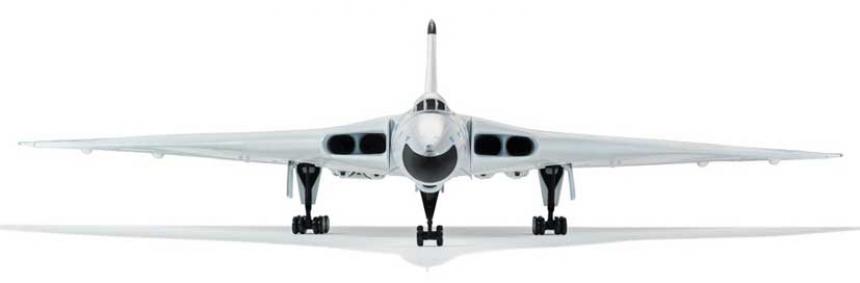
Although the 2015 airshow season should have been all about commemorating the 75th anniversary of the Battle of Britain, one of the most distinctive aircraft ever produced by the British aviation industry has inadvertently become something of a major distraction. The upsetting, if not totally unexpected confirmation that the current display season would be the last opportunity for enthusiasts to see Avro Vulcan B.2 XH558 in the air, has seen huge crowds flocking to any event boasting the appearance of the Mighty Delta. Desperate to have one final chance to see this much loved aeroplane perform its unique display, one of Britain’s most famous bombers is proving to be just as popular as the Spitfires and Hurricanes of the Battle of Britain. I have a personal affinity with the flight operations of XH558 and will include this in a future edition of Aerodrome, but for this current feature we are going to leave sentiment aside and look at the more sinister attributes of this iconic aircraft.
I count myself extremely fortunate to have been born and raised in the North West of England, which has such a rich heritage in both industrial prowess and aviation development and production. As a young man, our local newspapers would often include features detailing the work carried out at the aviation factories at Chadderton and Woodford. These interesting articles would often be illustrated with enigmatic images of Lancaster and Vulcan production lines at the Chadderton factory. They would also show Lancaster fuselages being transported by road from Chadderton, for final assembly and flight-testing at the Woodford site. The annual Airshow at Woodford would always allow the aviation enthusiast to see Nimrods, Vulcans and any number of other aircraft currently in RAF service and importantly for the young spotter, was easily available by bus. Unfortunately, all these delights are now long in the past and the current status of these facilities are a pale shadow of their former aviation glories – our local aviation history has virtually disappeared, which many find extremely distressing. The only positive development on the horizon is the establishment of the Avro Heritage Centre, on the site of the former Avro Woodford airfield, which is soon to open to the public and will preserve the rich aviation heritage the North West of England has. I hope to be paying a visit to this exciting new facility later in the year and will certainly report back to Aerodrome readers when I do.
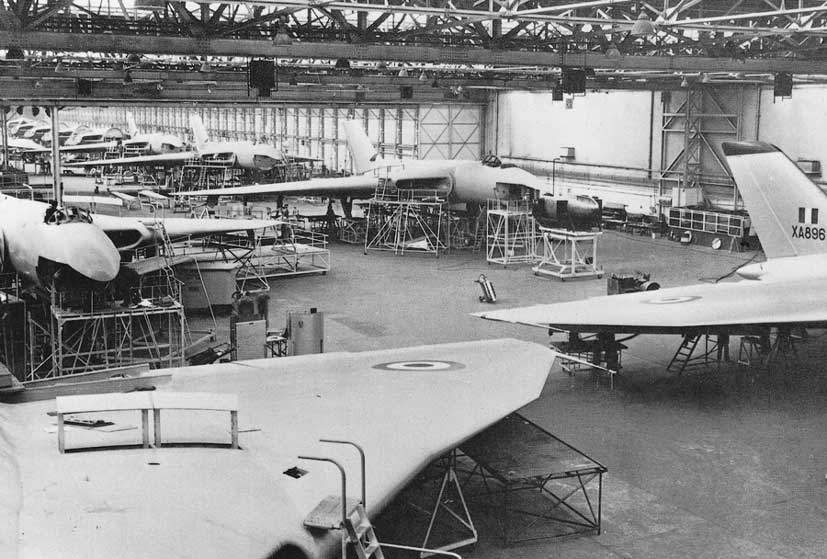 Vulcan assembly lines at the Avro Chadderton factory
When looking at the handsome delta profile of the Vulcan bomber, it is difficult to appreciate that work on development plans for this magnificent aircraft actually began in 1947, just a few short years after the Lancaster was arguably the most effective four-engined bomber the world had ever seen. At their Chadderton facility, the A.V Roe design team began work on this significant project, in response to Ministry of Defence requirement B35/46. This called for an aircraft that possessed an operating range in excess of 3,350 nautical miles, at a speed of 500 knots and with an operating ceiling of 50,000 feet. Significantly, the aircraft was also required to carry a ‘special’ payload of 10,000 imperial pounds in weight, which was clearly a reference to a nuclear device. The new aircraft was intended to be a significant deterrent in preventing possible attack by any potential aggressor nation.
The design requirements said much about the military thinking of the day and how volatile the years following the end of the Second World War were proving to be. High altitude operation was required to keep the new aircraft out of range of surface-to-air missile defences, making it difficult to locate on radar and too high to be intercepted by current enemy fighter aircraft. The range requirement was clearly pointing to the belief that any potential future military threat would be coming from the Soviet Union and from a weapons delivery perspective, the nuclear age dictated that bombing strategies would never be the same again.
In order to satisfy these design requirements, the Avro team were exploring the possibility of adopting rather revolutionary technology in their new aircraft design, which began to take the form of a large delta configuration. Although this radically different thinking would present the team with some significant challenges throughout the development and testing process, they were certain that the benefits offered by a delta airframe would far outweigh these difficulties – they were quite literally breaking new ground with this work.
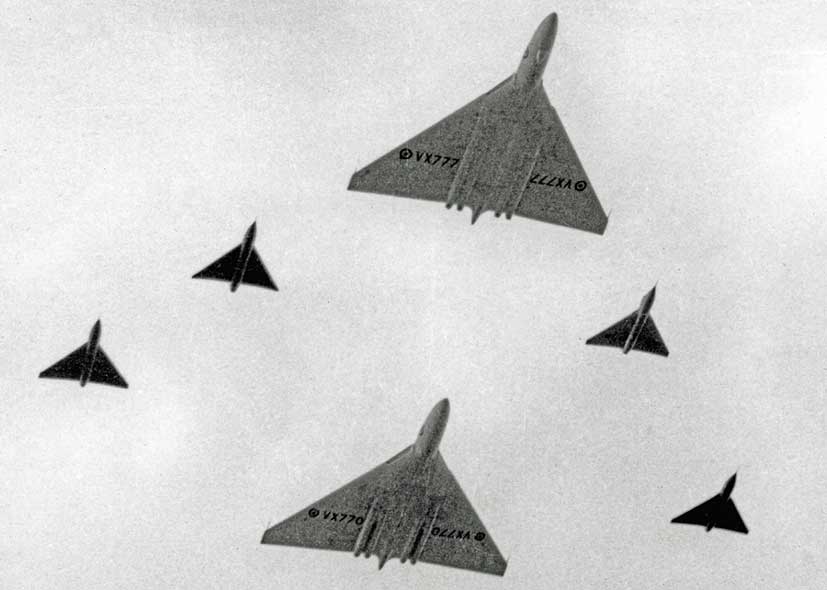
Avro produced the largest delta aircraft in the world
We will look more closely at the design and development of the Avro Vulcan in a future Aerodrome, but for this edition we will jump straight to the last week of August 1952 – on this day, the huge doors of the construction hangar at Woodford were pushed open to reveal something of a breath taking sight. In what must have surely been an extremely proud moment for the Woodford staff, Avro Vulcan prototype VX770 was wheeled out onto the hard standing, resplendent in its white ‘Anti-Flash’ paint finish and wearing RAF insignia.
The next few days saw a series of extensive systems testing and runway taxiing trials, in preparation for the all important first flight. At this stage, the aircraft had not been given an official name and was simply referred to as ‘698’, but it was about to make its mark on the history of British aviation. On Saturday 30th August 1952, which turned out to be a beautiful late summers day, Avro officials and a number of Woodford employees assembled for the historic first flight of the new Avro bomber prototype. The flight would be commanded by the highly experienced Avro test pilot Roland ‘Roly’ Falk, who had spent the last few years evaluating every aspect of delta flight in support of this project. Falk was previously the chief test pilot at the Royal Aircraft Establishment, and in this position was able to fly and evaluate many of the captured German aircraft from WWII, including the Me 262 jet and Me 163 rocket fighters. He was also famous for conducting his Avro test flights wearing a pinstriped suit and tie – how reassuringly British.
After a couple of fast taxi runs and a short delay to clear a flock of seagulls from the field, the beautiful new aircraft blasted down the Woodford runway and into the clear blue Cheshire sky. This was a worrying time for Falk and the Avro designers, as much of the technology used on 698 was totally new and until the aircraft returned to Woodford safely, there were a great many suits biting nails and wringing their hands. The aircraft was taken to 10,000ft, before completing a series of prescribed manoeuvres and repositioning for landing back at Woodford. Drama ensued following deployment of the main undercarriage, as something was seen to fall from the aircraft – Falk was informed and told to hold in a wide circuit of the airfield. A de Havilland Vampire and Avro 707 research aircraft were sent to assess the situation and discovered that the fairing panels behind the undercarriage had become detached. As all three of the undercarriage legs had locked down and the aircraft was handling normally, Falk was cleared to land back at Woodford, which he duly did, using the drogue parachute to reduce the landing distance to a minimum. At this point, the gathered onlookers burst into a spontaneous round of applause, as the Avro team had achieved a significant aviation milestone and the project could now progress to the next stage. One of the gathered onlookers commented that as Britain was still subject to food rationing, the celebrations centred around a nice hot cup of tea and some biscuits.
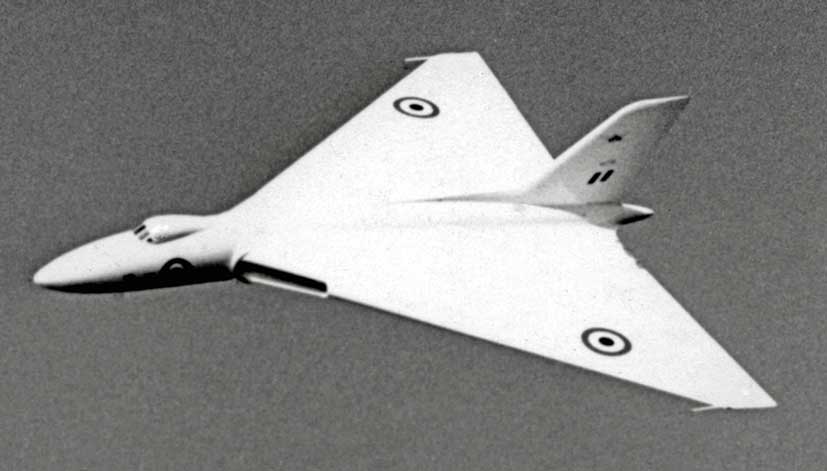
Avro Vulcan prototype VX770 displaying at the Farnborough Airshow
The Avro delta bomber programme was full of interesting facts and figures and the choice of a suitable name was no exception. Avro themselves preferred the name Ottawa, in recognition of the close connection they had with Avro Canada, whilst influential aviation magazine Flight had suggested Albion, after previously rejecting Avenger, Apollo and Assegai. Thankfully, the Chief of the Air Staff intervened and requested that the aircraft name should form part of a V-class of bomber aircraft and soon after, it was announced that the Avro bomber would be called Vulcan, after the Roman god of fire and destruction.
Tragically, the Avro Vulcan prototype VX770 was destroyed, following a horrendous flying accident whilst performing at the 1958 RAF Syerston Battle of Britain Airshow. Following the completion of a high speed pass, the aircraft attempted a rolling climb, when the starboard wing appeared to disintegrate – at such a low level, there was no time for the crew to escape and all four sadly perished, along with a further three people on the ground, who were manning the flight control caravan. From available film evidence, eyewitness accounts and examination of the wreckage, it was concluded that the accident was caused by the catastrophic structural failure of the main spar.
It seems strange to describe a high performance nuclear capable bomber aircraft, which possessed the ability to inflict untold devastation at the press of a button as a peace keeping asset, but that is exactly what the Vulcan was. At a time when the world was fully aware of the destructive power of nuclear technology, Europe had descended into a period of dangerous international mistrust and former allies began to flex their muscles. Military planners thought only way to preserve an uneasy peace was to let your potential adversary know that if they dared to launch an attack against you, the consequences of a retaliatory strike would be catastrophic. The more capable and ultimately devastating your strike capability, the more frightening it was to your enemy, therefore serving as an essential deterrent to conflict. Britain’s V-bomber force was simply an aviation show of strength, but this would only have the desired effect if the technology actually worked.
From the outset, the Avro Vulcan was designed with a nuclear payload in mind and the specification of these early weapons would significantly influence how the aircraft would need to be configured. The bomb bay of the aircraft would have to be large enough to accommodate a ‘Blue Danube’ atomic gravity bomb, which was Britain’s first independent nuclear weapon. Weighing in at a significant 10,000Ib, this was a large bomb and said much about the strategic military thinking of the day – this was to be the primary armament of the V-bomber force, with British military planners intending to fight and win a war with free-fall nuclear weapons, similar in size to the one used at Hiroshima. For ease of installation, a ‘Blue Danube’ bomb was fitted with four flip out fins, which would deploy and stabilise the bomb once it had been released from the Vulcan – when folded, they made loading the weapon in the aircrafts bomb bay more manageable. ‘Blue Danube’ was designed to be released from a height of 50,000 ft. over its intended target, which when combined with the physical weight of the weapon, dictated that the Vulcan would have to be a very large and very powerful aircraft.
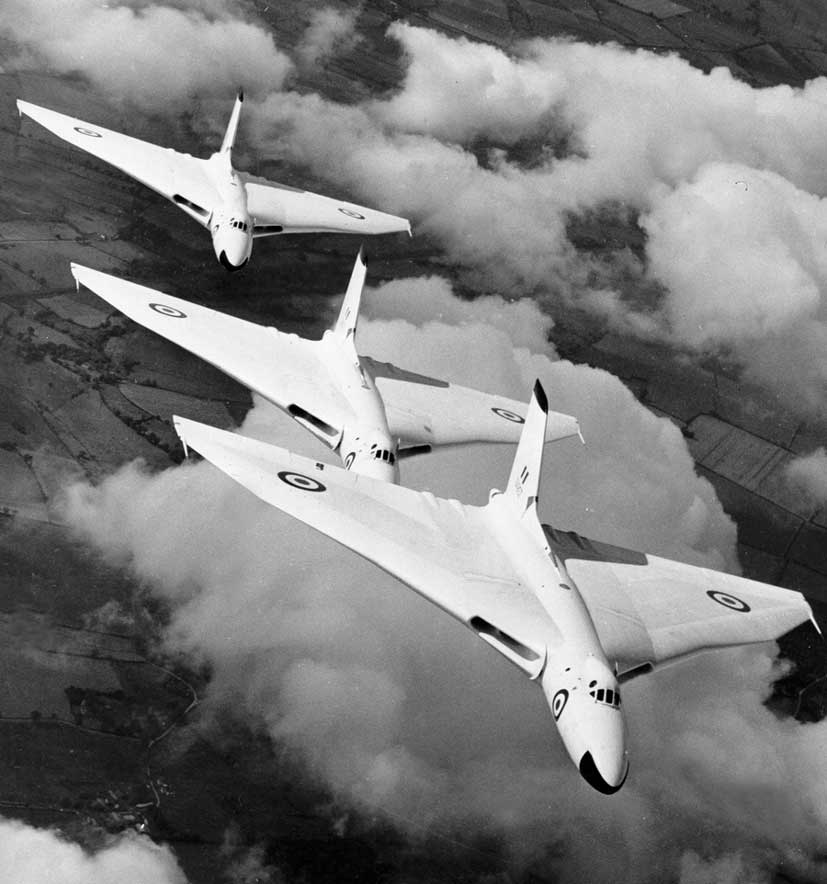
Iconic official MOD picture of the Vulcan nuclear bomber force
It is important to remember that in the 1950s, Britain’s nuclear technology was in its infancy and almost as soon as a weapon was introduced, a more suitable alternative was nearing completion. A ‘Blue Danube’ bomb was so large, because it was a very early attempt to provide Britain with an independent nuclear capability and designers were worried about its stability in operational situations and specifically the nightmare of possible predetonation. As scientists gained more knowledge of nuclear technology, smaller more suitable weapons were developed for Britain’s V-bomber force. The cavernous bomb bay of the Vulcan dictated that it was capable of being adapted to carry a number of munitions options.
When you consider the total devastation that a nuclear engagement would result in, it is astonishing to realise how practically Western military planners looked at the prospect of prevailing in such a scenario. As the Cold War descended and the Warsaw Pact began their military sabre rattling, Europe and the US drew up a plan for a decisive nuclear one-two knock out punch, should the deterrent threat fail to work. This would see the British V-bomber force launch devastating initial strikes against air bases, command and control centres, troop staging areas and tank concentrations, immediately reducing the possibility of a Warsaw Pact ground offensive in Europe. It would also allow valuable time for US and NATO follow up strikes to be mounted, which would totally eradicate any remaining threats. On paper, this all sounds quite plausible, but in reality, things may have been very different. One thing is absolutely certain, many, if not all of the V-bomber crews sent on this doomsday mission would not be returning to their home bases.
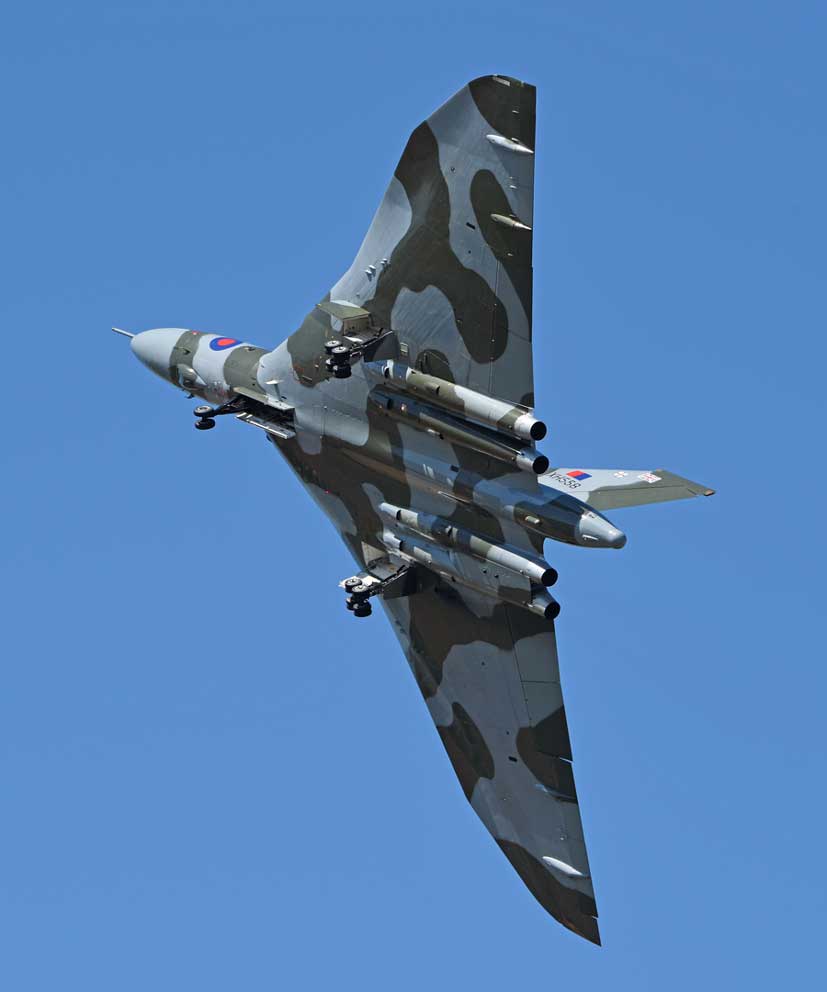 The Vulcan was an agile performer for such a large aircraft
Absolutely central to the success of this first strike plan would be the speed at which Britain could mount their attack and the Vulcan was ideally suited to this task. This massive aircraft possessed almost fighter-like performance and crews were specifically trained in rapid reaction operations. A tactical scramble of multiple Vulcans was a sight to behold and would have been a spectacle that British military planners would have hoped seemed equally impressive in the Kremlin. A Vulcan could start all four engines simultaneously, with little ground support required and could be airborne in less than 5,000 feet of runway. Once in the air, a fully loaded Vulcan did not require aerial refuelling and would head straight for its assigned target. In this rapid reaction role, Vulcans could be dispersed at airfields all over the UK and Europe and had a launch reaction time only restricted by the readiness state of the crew – typically, a Vulcan could be in the air and heading for Russia in just over two minutes. It was generally accepted that Britain’s early warning system would allow Vulcan crews fifteen minutes notice of an impending Soviet strike, by which time as many Vulcans as were serviceable would need to be in the air and launching their retaliatory attack.
Impressive as these statistics are, the threat of nuclear confrontation in those days was very real and as an impressionable young man fascinated by aviation, I remember being absolutely petrified at the prospect. Reading about the horrors of the Hiroshima attack and watching the public information films, which offered guidance in the event of a nuclear strike, I remember lying through many a sleepless night, worrying about the safety of my loved ones and wondering if I would ever see another birthday. This really was a frightening time to be growing up. Thankfully, good sense prevailed and the deterrent aspect of these devastating weapons managed to keep an uneasy peace.
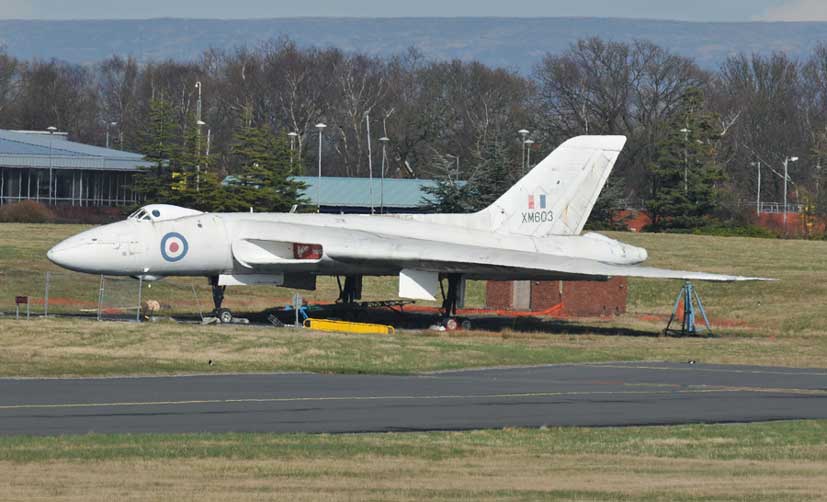
Avro Vulcan B.2 XM603 at the Woodford site in 2011
As the first Vulcans entered Royal Air Force service, they also became the first delta-winged bombers in the world. These extremely large triangular aeroplanes would have seemed absolutely spectacular to an aviation public used to seeing Lancasters, Lincolns and Washingtons – it also has to be remembered that delta technology was still relatively new and as the first aircraft entered service, unforeseen deficiencies began to surface. Arguably the most problematic of these occurred when the more powerful Rolls Royce Olympus engines were installed in the aircraft. At higher speeds, the massive wing of the Vulcan was reported to suffer buffeting when performing manoeuvres and designers were so concerned that modification of the entire wing shape was initiated. Indeed, of the many upgrades and improvements to the Vulcan in RAF service, the most noticeable was the change in wing size and shape. By the time the definitive Vulcan B.2 had entered service, the wing area had increased significantly and although still classed as a delta, so had the shape. To cope with the increased power availability from subsequent engine upgrades and to cure the stability issues of the original wing design, the B.2 wing had two defined kinks in its leading edge, well forward of the profile of the original. Rather than detract from the aesthetic appearance of the early Vulcan delta, the B.2 actually enhanced the profile of the aircraft, even though the changes were obviously made purely for reasons of operational effectiveness.
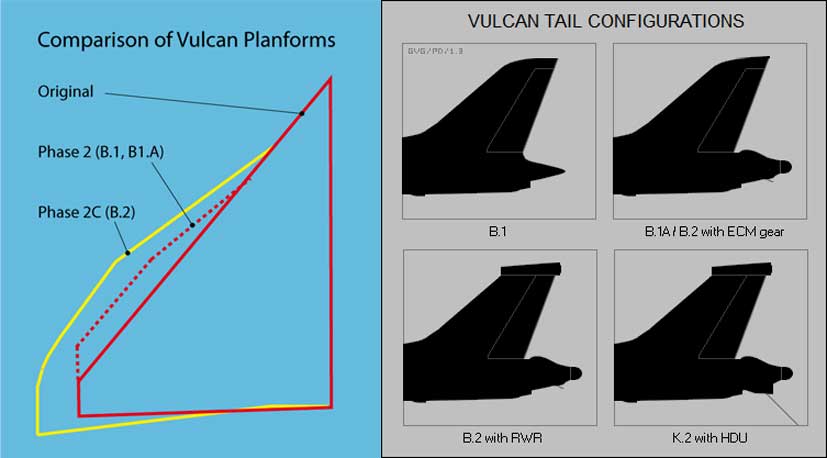
Vulcan wing area comparison illustration by Andy Leitch
The service introduction of the Vulcan B.2 would coincide with Britain’s nuclear industry maturing somewhat. This would see the number of weapons available to the V-bomber force increase both in number and in potential destructive potential. It would also bring about a change in thinking regarding the delivery of these weapons, as significant advances in Soviet anti-aircraft technology could affect the successful dropping of a free-fall gravity munition. A new weapon would be needed to maintain the deterrent threat of the Vulcan and its V-bomber partners.
In order to maintain the validity of Britain’s nuclear deterrent threat, the designers at Avro developed an air-launched, nuclear stand off missile, which would allow V-bomber crews to launch their attack out of the range of Soviet surface-to-air missile batteries. Given the name ‘Blue Steel’, this new weapon would have significantly enhanced the capability of the V-force and cause much consternation within the Warsaw Pact. Potentially, this was a devastating new development and although full details of its performance would have been highly classified at the time, it would have raised the nuclear stakes in Britain’s favour.
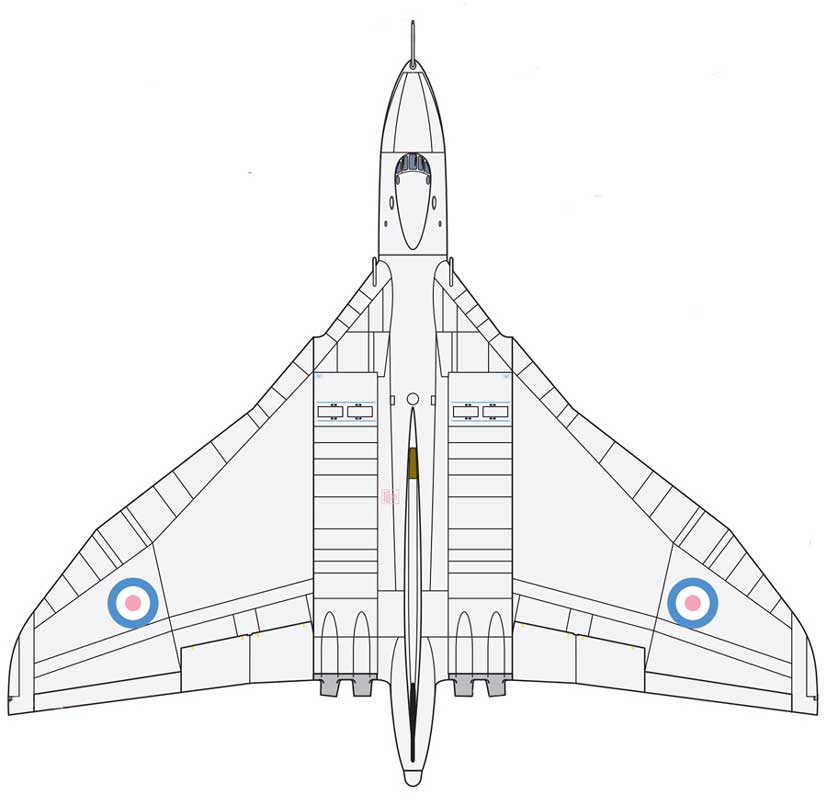
The classic lines of the Avro Vulcan B.2 bomber
Had a Vulcan been required to launch a Blue Steel strike, it would have approached the pre-determined target at an altitude of approximately 50,000ft. When the aircraft was around 100 miles from the target, the missile would have been released and the Vulcan would immediately turn back on itself and fly at high speed away from the detonation. Four seconds after release, the missile would ignite its main rocket motor and begin a climb to 70,000ft, travelling at a speed approaching Mach 2. Once close to the target, a second motor would fire, accelerating the missile to Mach 3, before cutting out, allowing the missile to free-fall to its target. The missile would detonate its warhead as an air burst delivery, with untold devastation resulting below. Once released from the delivery aircraft, the missile was autonomous and therefore could not be jammed, or diverted by enemy countermeasures. The speed at which it travelled and the trajectory prior to impact meant that it would be impossible for the target nation to intercept the weapon once released, which allowed Blue Steel to possess the ultimate deterrent potential Britain desperately needed.
Had this horrendous scenario been realised, the fate of the Vulcan and its crew would have been questionable at best. Nuclear deterrent Vulcan bombers were finished in an all-over anti-flash white paint finish, which was designed to have a dual benefit. As operations of this nature would have been flown at altitudes greater than 40,000 feet, the white scheme made the aircraft extremely difficult to see from the ground and thus afforded it some much needed protection from possible SAM attack. Secondly, in the event of a nuclear delivery, the white scheme was thought to offer some reflective properties, which would help to deflect any thermal energy hitting the aircraft, following detonation, and thus protecting the Vulcan and her crew. Thankfully, this theory was never put to the test, indeed despite all of this potential destructive power, no British bomber ever flew with a live nuclear weapon on board – a true testament to the deterrent threat offered by the Vulcans of the nuclear V-force.
Unfortunately for Britain and her NATO allies, they did not have the monopoly on technological development and Soviet advances in surface-to-air missile technology was to bring about a total rethink of nuclear strategies. With the destruction of an American U2 spy plane, flying at an altitude of 60,000ft, it was clear that height alone would no longer protect the nuclear Vulcans and whilst they still retained their nuclear capability, they would be required to fly at much lower altitudes, carrying smaller, tactical weapons. The iconic white anti-flash scheme would be replaced with a much darker disruptive camouflage, but the change to these lower altitude operations would suit the highly manoeuvrable Avro Vulcan, which continued to serve the RAF with distinction until March 1984.
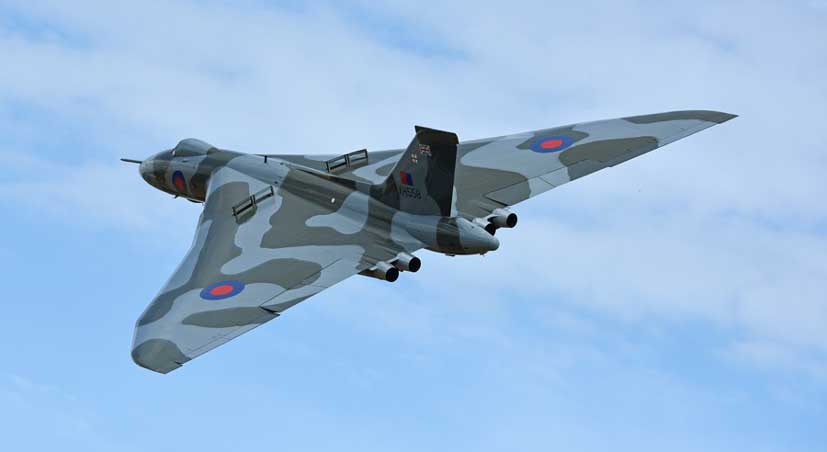
Vulcan XH558 has preserved the legacy of Britain’s V-bomber force
In 1969, the Royal Air Force handed its strategic nuclear deterrent responsibilities to the Royal Navy and their ‘Polaris’ missile equipped submarine fleet. The Navy maintain Britain’s deterrent threat to this day.
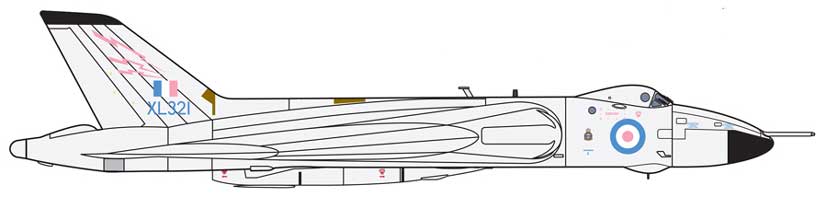
Profile artwork featuring a ‘Blue Steel’ armed Avro Vulcan B.2
Many aviation enthusiasts would argue that the most iconic image of the mighty Avro Vulcan in its nuclear deterrent role is whilst it served with the famous No.617 ‘Dambusters’ Squadron, based at RAF Scampton, in Lincolnshire. 617 Squadron enjoyed a 23 year association with the mighty Avro Vulcan, which seems rather fitting, considering their previous association with an earlier Avro bomber type. ‘Blue Steel’ equipped Vulcans arrived at Scampton in 1962 and immediately began working up to operational status – images of ‘Blue Steel’ equipped Vulcans on the Scampton runway would become some of the most enduring reminders of Britain’s V-bomber force and how their deterrent threat kept us safe, throughout the volatile days of the Cold War.
As the latest edition of Aerodrome goes live, I have the pleasure in announcing that the second model from the spectacular new 1/72nd scale Avro Vulcan B.2 tooling has arrived and is to be released early next week. This much requested model is sure to delight many Aviation Archive collectors, as it presents the Vulcan in one of its most iconic schemes and comes complete with a magnetically attached, but fully detachable ‘Blue Steel’ nuclear missile.
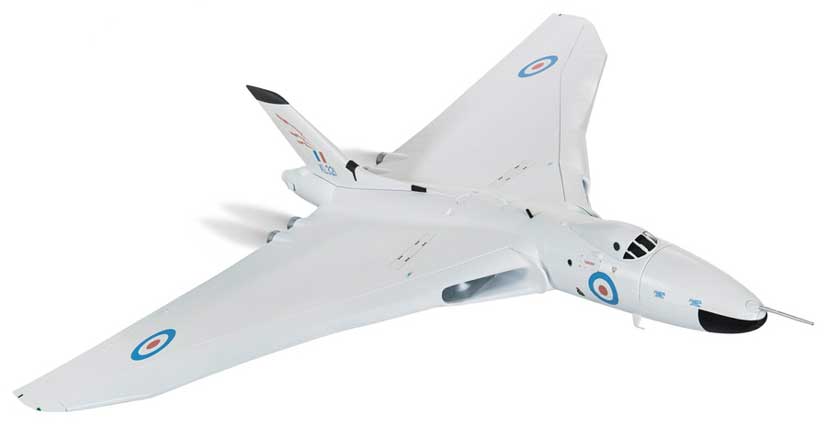
Corgi catalogue image featuring the new ‘Blue Steel’ Vulcan release
AA27202 will complement the already released Vulcan XH558 ‘Return to Flight’ release, which has now sold out and is becoming increasingly difficult to find – with all the publicity regarding the final display season of XH558, it is hardly surprising that these beautiful models are causing quite a stir. The only question collectors will have to ask themselves now is, should we display our ‘Dambusters’ Vulcan next to Vulcan XH558, or next to a 1/72nd scale ‘Dambusters’ Lancaster? I think that I have decided which way to go, but I will leave you to ponder that one until next weekend’s edition of Aerodrome.
Collectors who have ordered the latest Blue Steel Vulcan can look forward to receiving their model in the next few days, but if you would like to take a closer look at AA27202, you can see it here.
May I take this opportunity to thank you very much for taking the time to read the twentieth edition of our aviation blog and I hope to see you back here next Friday for more aviation indulgence.
You can discuss this week's blog on the Airfix Aerodrome Forum or Corgi Aerodrome Forum, and if you have any comments, questions or suggestions for future editions, please feel free to let us know on Airfix Facebook or Corgi Facebook, or on Airfix Twitter or Corgi Twitter using #aerodrome.
Michael
© Hornby Hobbies Ltd. All rights reserved.