
Welcome to this latest edition of Aerodrome and our regular look at the fascinating world of aeroplanes and the historic aviation scene around the UK.
Although the current UK Airshow season is now well underway, and the huge Royal International Air Tattoo is now less than 29 days away and counting (at the time of writing), things never seem to be getting serious for aviation enthusiasts until we’ve enjoyed our latest instalment of a show which holds particular significance within Britain’s Airshow scene. The RAF Cosford Airshow is now the only remaining Royal Air Force arranged Airshow, and is a fascinating step back into Airshow nostalgia, when RAF airfields all over the country threw open their doors, and invited the public in to come and experience all the activities that take place there on a daily basis. They would also arrange for lots of aeroplanes to be there, both in the air and on the ground.
In this latest edition of Aerodrome, we will be paying our customary annual visit to the Cosford Airshow to review both their static and flying displays, and also to explain why this show continues to be one of the best attended events of its kind in the UK. We will also see that despite a year of planning and the best efforts of a committed group of show organisers, a flexible and adaptable approach to this work is needed at all times, even when display aircraft are already in the sky.
As usual, we have international acts, Airshow favourites and an impressive selection of contemporary RAF heavy metal, as we review the 2025 Cosford Airshow.
You lookin’ at me? You definitely wouldn’t want to get on the wrong side of a British Army Apache.
Aerodrome readers of some years standing will no doubt share similar memories of attending Airshow events in the 1980s when it actually seemed as if it just wasn’t possible to shoehorn any more cars or people onto the airfield we were on, and how the variety of aircraft types assembled for our entertainment was simply bewildering. Could it be that we were guilty of taking those days for granted back then, anyway, I digress. We’re not even taking about the huge events at places such as RAF Mildenhall and Greenham Common, we’re talking the large number of RAF station ‘At Home Day’ events, where local communities were invited on base to allow the RAF to entertain them for the day – these really were great shows.
Although things have changed dramatically over the years, with neither the variety of RAF organised events, nor the variety of aircraft types surviving those changes, there is one annual Airshow which still continues to fly the flag for the Royal Air Force, and for one day in June every year, it’s standing room only on this famous RAF Airfield. Come rain or shine, in good times and in bad, the organisers of the RAF Cosford Airshow know that they enjoy the support of huge numbers of people across the Midlands area and further afield, and that if they put on the show, their people will come, and they’ll come in some numbers.
As is the case with most Airshows these days, particularly the larger shows that can boast military content, they tend to target three distinct visitor group types – enthusiasts, members of the local population and families/those looking for an enjoyable day out. If we’re being honest with ourselves, the most important people needed to make any Airshow event a success is probably the last group, despite what hardened enthusiasts might think, which is probably why shows tend to arrange their showground attractions in a particular manner ,and not be completely aviation centric. How many times have you been at an Airshow and seen an absolute exodus of people and cars following the final manoeuvre of the latest Red Arrow’s display, even though the aircraft you personally came to see has yet to perform?
RAF training aircraft through the ages, classics each and every one.
Having said that, for any show to be considered a success, all three groups will need to be catered for, with the cadet force drafted in for the day, volunteers and hired staff all playing their part in ensuring the public have an enjoyable day and more importantly, will be looking forward to coming back again next year. Thankfully, our friends at Cosford know they can always rely on strong support from local communities, and for as far back as I can remember, Cosford Airshow has always been a sell-out occasion, which it was again this year.
In fact, in the old days, prior to the need for advanced ticketing, the ability to pay on the day meant that this airfield was positively bursting at the seams, as the constant stream of traffic coming in was only replaced by the first cars going home in the late afternoon.
As for Airshow heritage, Cosford has long been regarded by the county of Shropshire and the wider Midlands region as ‘their Airshow’, and come rain, sleet or shine, the people turn up in their tens of thousands each and every year, determined to show their support for a show they continue to hold dear. They’re probably also trying their level best to give organisers as few excuses as possible when it comes to them even considering the future of the show. For them, that’s simply not an option, they love their Airshow, and their links to the Royal Air Force – you’re not taking this anywhere.
Although this famous airfield site is now an important training and engineering facility for trades within the wider Royal Air Force, Cosford is steeped in RAF history, and is a fascinating place to visit for those with even a passing interest in the subject of aviation. Helping to maintain the future development of the Force, flying training operations still take place here under the control of No.6 Flying Training School, whilst the various disciplines of the Defence College of Technical Training help prepare engineers and technicians for a future career in one of Britain’s armed services.
Big Cat sanctuary Cosford.
Without doubt though, Cosford’s real jewel in the crown is the magnificent aircraft collection of the Royal Air Force Museum Midlands, a collection which occupies three massive hangars across this historic site, in addition to the cavernous display space within the impressive National Cold War Exhibition building. Over recent years, Cosford’s collection of exhibits has been greatly enhanced by the addition of several truly historic aircraft which have re-located from the RAF Museum’s Hendon site, a development which has made an annual pilgrimage to Cosford essential for thousands of people living far and wide.
On Airshow day itself, one of the unique aviation benefits of being amongst the crowds at Cosford is the possibility of seeing one or two of the collections incredibly rare aircraft being temporarily displayed in the open air, often for one day. For true aviation fans, a spectacle such as this has to be seen in person, and documented for posterity.
As for the show itself, Cosford’s organising team strive all year long in their efforts to create a varied and interesting display programme for the crowds to enjoy, that is of course if they can tear themselves away from the many attractions and displays which make up the wide and varied showground. Always boasting solid participation from the current Royal Air Force Display Teams, organisers have also become extremely proficient at securing ‘special’ acts for show day, often participants from overseas who in many cases, will be making their only UK Airshow appearance at the Cosford show.
As you can see, for one glorious day each June, all roads most definitely lead to Cosford.
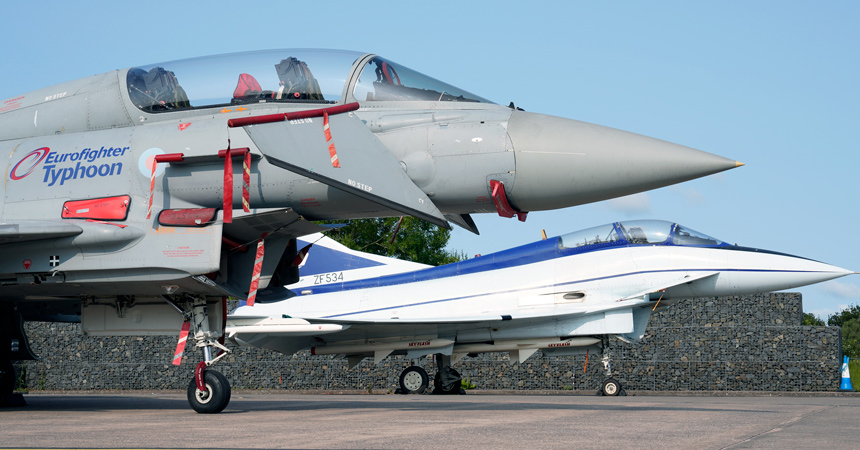
EAP ZF534 and DA4 ZH590 getting acquainted in the deployed operations training area at Cosford.
As the last remaining RAF organised Airshow, those in attendance know that the display program will include strong participation from the year’s official Royal Air Force display teams, and when it comes to thrilling high-octane jet action, that means the RAF Typhoon Display Team. With the display pilot for the year enjoying celebrity status for the duration of the Airshow season, the Typhoon is a highlight act on any display program in which it appears, particularly as this aircraft is the one which performs the same role as the famous Spitfire, in securing our nation’s skies.
This current display season happens to be a significant one for the Typhoon Display Team, as they are commemorating their 20th display season, something which is definitely worth celebrating. An aircraft which can always be relied upon to ‘bring the noise’, some of the Typhoons which have represented the team over that time have to be regarded as some of the most distinctive to have ever seen RAF service, indeed many people are a little disappointed that we only had one year with Moggy, particularly as we’re currently in a significant Battle of Britain anniversary year, and we don’t have a specially presented jet.
At this year’s show, in addition to the joys of experiencing what was only the second full RAF Typhoon display of the season, one which began with an unusual from behind the crowd display arrival, enthusiasts had the opportunity to view something rather special in the deployed operations training area section of the airfield, something which was Typhoon related. Charting the early development on this incredible aircraft, organisers had arranged for their long time resident Experimental Aircraft Programme (EAP) aircraft ZF534 to be positioned next to the relatively recently arrived Typhoon DA4 ZH590 in a revetment, two aircraft which were vital in developing the Typhoon into the aircraft we know today.
Now a rather historic airframe in the annals of the modern British aviation industry, the British Aerospace Experimental Aircraft Programme airframe ZF534 was a one-off research aircraft produced to test pioneering manufacturing techniques and aviation technologies which could be used in the production of a future advanced fighter aircraft for the RAF and other European partner nations. An unstable aircraft from design outset, this was an extremely agile aeroplane and would include a host of technologies which at the time, were all new, but are now commonplace in aircraft production.
EAP made its triumphant first flight from the British Aerospace factory airfield at Warton on 8th August 1986, and just three weeks later, it was thrilling the public at that year’s Farnborough Airshow. Although EAP incorporated technology which was considered ‘cutting edge’ at that time, it was still something of a test hybrid aircraft, using existing Panavia Tornado engines, in addition to being required to carry the significant additional weight of test and evaluation equipment. This extra weight would certainly have an impact on the aircraft’s performance, but as this was still pretty spectacular, it held great promise for the aircraft which would result from all this flight test work.
The driving force behind the entire EAP test programme was to ensure everything was completed as safely as possible, however, once the aircraft was in the air, the team were determined to push the boundaries of known aviation science. Following its triumphant first appearance at Farnborough, ZF534 embarked on an active and ambitious test flight programme, and in no time had attained speeds in excess of Mach 2.0, in addition to being flown at slow speed angles of attack greater than 35 degrees, all in fully controlled flight. This was particularly impressive, as this was an aircraft which was inherently unstable.
The aircraft clocked up its impressive 100th test flight of a busy 10 month period at the 1987 Paris Air Show, before continuing on with its active testing programme, where an additional 159 flights would be undertaken. The aircraft’s final test flight took place from Warton in May 1991, by which time ZF534 had provided much invaluable flight data which was later incorporated into the design of the Eurofighter Typhoon.
Following the end of its extensive flight test service life, EAP ZF534 was used as an impressive design appreciation exhibit to inspire students at Loughborough University, who will surely have marvelled at the sight of this futuristic looking aircraft. She would arrive at the RAF Museum’s Cosford site for public display in 2012, and two years later was officially donated to the museum by BAE Systems. Displayed next to the equally impressive BAC TSR.2, this test and evaluation pairing represent the very best of the post war British aviation industry, with both also possessing strong connections to the British Aerospace (BAE Systems) airfield at Warton in Lancashire.
A shot that most enthusiasts attempted to get at this year’s Cosford Airshow.
Even though EAP did provide much design and construction data in support of the later Eurofighter Typhoon project, close inspection of the aircraft does reveal some clear differences between the design of the two aircraft. To the naked eye, Typhoon appears to be the much sleeker, more refined aeroplane, whereas EAP appears a little squashed by comparison. Obviously using different engines, EAP also had two large airbrakes which could be extended on both sides of the rear fuselage during landing, however both aircraft possessed the ability to deploy a braking parachute, should that be required.
There were major differences in weapons, sensors and electronics, but externally, EAP also had a different fin profile, different canard placement and was equipped with a main undercarriage with a much narrower in track than the later Typhoon. Other than that, you can certainly see the linage shared by the two aircraft, which made it all the more special to see it out next to the DA4, out of the shadows and into the Typhoon limelight.
Positioned next to EAP at this year’s show and making for an extremely photogenic Typhoon development display pairing, ZH590 DA4 is very much more Typhoon like in appearance and represents a later stage in the gestation of the Eurofighter as we now know it. The fourth of seven development machines, ZH590 was a two-seat avionics development aircraft which operated out of the British Aerospace airfield at Warton, working hard in its role to help this exciting new aircraft enter squadron service and beyond.
Making its first flight on 14th March 1997, this hard working aircraft would spend the next nine years engaged in an intensive series of test flights, evaluating all manner of equipment destined for use in the Typhoon programme in situations which replicated operational conditions as closely as possible. Making her final flight on 13th December 2006, she was later transported by road to RAF Coningsby to serve as a ground instructional airframe, well known to those working on her, but relatively anonymous to those outside the RAF.
All that changed in 2009 when the aircraft left Coningsby for an altogether more visible assignment, when she became part of the impressive IWM aircraft collection at their Duxford site, where she would remain for almost the next ten years. In November 2019, it was announced that the IWM intended to dispose of the aircraft, and invited interested parties to make their interest in acquiring the aircraft known, a process which eventually saw the Newark Air Museum being selected as the new destination for this attractive aircraft.
In an unexpected development, ZH590 didn’t end up travelling to Newark on leaving Duxford, but instead headed for RAF Cosford, and a new career as a ground training aid, a relatively modern airframe to allow students from the School of Technical Training to hone their skills prior to embarking on their careers as specialist engineers and technicians. Clearly, the aircraft’s service days weren’t quite over yet, and the MoD think she still has an important role to play.
Typhoon ZH590 test aircraft took a detour and headed for Cosford when leaving her ten year home at Duxford.
Thankfully, enthusiasts will still be able to see this famous aircraft, even if only on Airshow day, however, this imaginative ground display was certainly an appealing and extremely photogenic way in which to commemorate her arrival.
Other excellent ground displays arranged for our viewing pleasure at this year’s show was a selection of Cosford’s usual Cold War jets, along with an impressive lineup of RAF training aircraft spanning the period from a DHC Chipmunk to BAe Hawk T.1a, but by far the most sinister display in the ground display was provided by an Army Air Corps Apache attack helicopter. These awesomely powerful helicopters look dangerous at the best of times, but with a display of its weaponry laid out in front of it, and the ability to get closer that you would usually have the opportunity to do, I’ll swear it was trying to goad me to make eye contact with it. If I had and that main gun would have twitched even slightly, I’d have been off like a shot!
Unfortunately for us, whilst many in the crowd would have been looking forward to seeing the Apache preforming in the flying programme, with its spectacular wall of fire finale scheduled to be a fitting end to the show, and overnight issue identified with all these helicopters confined the aircraft to just being another spectator, if one toting lots of guns and missiles.
North American L-17B Navion
Anyone who regularly attends Airshows will probably share the opinion that it can be quite a stressful pastime, particularly when it comes to getting in and out of the event. Early mornings and long distance travelling only adds to the stress levels, but once you’re in and enjoying the action, everything settles down, and you can enjoy being there. This year, against my better judgement, I allowed myself to be directed to an area of the site I didn’t want to be in, and when I had finally managed to extricate myself from the situation, I was running behind by just short of an hour.
After trying to make up for lost time, and taking pictures whilst talking to people at the same time, I was fortunate enough to make the acquaintance of Simon Tilling, who rather effectively managed to bring some calm back to proceedings. When I spoke to Simon first, he was polishing a pristine North American NA-145 Navion in such a loving manner that I just had to say something. He noticed my Airfix t-shirt and we started a conversation which encompassed our shared love of modelling, and the gleaming state of his magnificent aircraft, one which he had flown up to Cosford to bring a little culture to the static aircraft display.
Such a beautiful aeroplane, the Navion was the first aircraft North American Aviation produced following the end of the Second World War.
Simon invited me up to look in the cockpit of his aircraft, which is a four seat liaison and VIP transport/sports touring aircraft, and as you might well imagine, it looked just as good on the inside. With the generous use of leather fittings and the iconic North American Aviation logo on each of the flight yokes, this looked more like a high-end Cadillac interior, than an aircraft built for the US Air Force. Apparently, this was the first aircraft North American designed and built after the end of the Second World War, as they attempted to make their first move into the potentially lucrative general aviation market.
Despite showing great promise, competitor manufacturers had already gained a strong foothold in this sector, resulting in North American heading back to military contracts and their iconic F-86 Sabre, but not before they left the world with their delightful little Navion. Simon kindly allowed us the opportunity to visit him and produce a feature on the Navion and other aircraft in his collection, and we very much look forward to bringing you that in the very near future, but be warned, you might just fall in love with a certain little four seater from North American.
Not a full display this year, but any Airshow appearance from an F-35 Lightning II is one to be savoured.
As most Aerodrome readers are more than proficient when it comes to identifying aircraft in reviews, we’ve decided to do something a little different with this latest effort, and include pictures of the display items in chronological order, with little in the way of text distraction, in an attempt to give you a flavour of this year’s show. This year’s event did suffer at the hands of the weather, with several acts having to cancel and others forced to drop out for technical reasons, however, the show we saw was excellent, and where there should have been gaps, organisers arranged for slightly longer displays, a refresh of the display order, or asked some of their friends and acquaintances to make additional display slot appearances.
The show was excellent, and even though the skies were a bit grey and made conditions less than idea for photography, we actually avoided the worst of the showers lurking around the area, so we have to be grateful for that. As can often be the case, the sun put in an appearance right at the end of the show, by which time it didn’t really matter, because we’d all been thoroughly entertained for hours. My first look at the Red Arrows, the BBMF and the display Typhoon for the year, with plenty more action to keep the camera shutter clicking – you’ve got to love a Cosford show.
Same place and time next year everyone?
Right on cue, as soon at the RAF Falcons started thinking about jumping from their support aircraft, the clouds rolled in, and the drizzle started. Thankfully, this team are made of the right stuff!
Always a show highlight, taking good pictures of the BBMF at an Airshow can be challenging, particularly when the weather conditions are not playing ball.
The mighty P-47D Thunderbolt brought some heavy US WWII interest to the proceedings.
A surprisingly spritely performer, the Cessna L-19E Bird Dog marked targets and spotted for ground strikes and rescue missions during the Vietnam War.
More iconic WWII aviation action in the shape of this beautifully presented P-51D Mustang, even though this example was actually constructed in Australia.
Time to bring the noise! The RAF Typhoon Display Team are celebrating their 20th display season throughout 2025.
One of the undoubted highlights of this year’s show was the rare appearance of this beautiful Spitfire Mk.IX resplendent in its Royal Dutch Air Force markings.
The Spitfire’s support aircraft , this was the first time this Beech D18S was making an appearance in the UK for the first time since 1988.
No UK Airshow is ever complete without an appearance from the magnificent Red Arrows.
More heavy metal action now, in the shape of another international contribution to this year’s show, in the shape of this Polish Air Force F-16 Viper sporting conformal tanks.
Always a crowd favourite, the Fairey Swordfish arrived over the showground in formation with the Royal Navy’s Black Cats.
Guaranteed to see everyone running towards the crowd line, the F-35B is still the new aviation kid on the block when it comes to Airshow appearances.
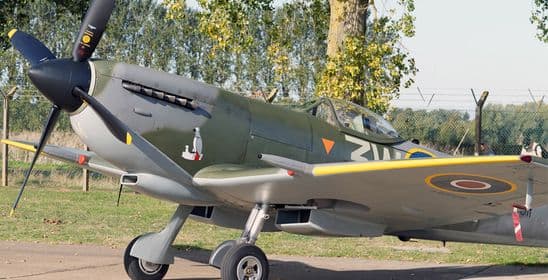
The fighters of the BBMF were drafted in to fill a gap in the display programme at Cosford this year, sending Spitfires from the opposite ends of its development.
It was left to this pair of Strikemaster jets to deal with the pyrotechnics not used by either the Great Warbirds Display Team, and the AAC Apache.
The final international contribution came in the form of the precision aerobatics of the Swiss PC-7 Display Team.
A fitting finale act to bring any Airshow to a close, the mighty Boeing Chinook is a real beast of an aeroplane, especially when flown in a role demo sequence.
We’re afraid that’s it for another edition of Aerodrome, however, we’ll be back again in four weeks’ time with more news and pictures from the fascinating world of aviation. Thank you for your continued support and as always, if you would like to comment on anything blog related or suggest a subject you would like to see covered in a future edition of Aerodrome, please do drop us a line at aerodrome@airfix.com, where we would be delighted to hear from you.
Should you wish to continue the aviation discussions between editions, you will always find something of interest over on the Airfix Aerodrome Forum and if social media is more your thing, please use the respective official social media icon links at the foot of the main Airfix and Corgi website homepages to access our official sites.
The next edition of Aerodrome is scheduled to be published on Friday 18th July, although it’s likely we may have to defer this edition due to our attendance at RIAT – we’ll keep you posted on that.
I hope to see you all back here then.
Michael