If you were brave enough to delve into the dangerous territory of asking any group of aviation enthusiasts to name their favourite aircraft, you will probably receive a long and exhaustive list of different aircraft types. Each respondent will likely offer you a current favourite aircraft (from a constantly changing list of favourites), or give you an era of aviation which particularly fascinates them. Others will have a personal affinity with a specific type of aircraft, but what will become almost universally apparent is that the resultant list will have a distinct lack of training aircraft on it, which does seem rather strange. By their nature, training aircraft allow many more people to experience flight than other aviation types and even allow non-fliers to experience the thrill of flight. Despite this, they are simply not viewed with the same enthusiasm as fighter, bomber, or even civilian aircraft. In this edition of Aerodrome, we'll be taking a closer look at a classic British jet trainer, which was instrumental in allowing thousands of pilots to earn their wings during its RAF service career of over thirty years.
For aviation enthusiasts of a certain vintage, the Hunting Percival (BAC) Jet Provost will be extremely familiar to them, as the RAF’s primary jet training aircraft between the late 1950s and early 1990s. Today's announcement of a new 1/72nd scale Airfix model kit version of the aircraft is a good excuse to take a closer look at this important British aircraft that certainly deserves much more respect than it gets.
The training of new military pilots for any air force has to be one of the most crucial tasks they undertake and the establishment of an effective flight training programme was always of vital importance. Following the end of the Second World War, the RAF replaced their ageing Tiger Moth trainers with the rather unusual Percival Prentice basic trainer, which was a three seat aircraft, allowing a second student to sit behind the pilot and instructor, to gain flight experience. The Prentice was the first all-metal aircraft to be produced by the Percival Aircraft Company, but due to the specific demands of military pilot training, it was to see only a short service life.
 The Percival Provost T.1 was an effective pilot training aircraft
By the early 1950s, the RAF were already looking to replace the venerable Percival Prentice with a more suitable basic training aircraft. Building on their experience with the Prentice, Percival developed a new aircraft which they felt could fill Air Ministry specification T.16/48 for a single engine basic trainer. The P.56 Provost was an all metal monoplane aircraft with a fixed conventional landing gear and fully castoring tail wheel, powered by a 550 hp Alvis Leonides 25 radial engine, which gave the aircraft double the power of the earlier Prentice. The aircraft retained the side-by-side cockpit arrangement for pilot and student (but dispensed with the third observers seat), which was seen as being much more effective in a training environment as it allowed for closer observation and more effective demonstration of flight procedures. This layout was thought to actually speed up the effectiveness of the pilot training programme. The Piston Provost T.1 possessed excellent performance and flight handling characteristics – importantly, it was also designed to be extremely rugged and easy to maintain. At this time, it was seen as an ideal basic training aircraft and entered RAF service as the Provost T.1 with the Central Flying School at RAF South Cerney in 1953. Proving to be a resounding success, the Provost intentionally incorporated a complicated cockpit layout, which allowed the student pilot to become accustomed flying the more complex aircraft they would go on to fly once qualified. This actually proved so effective that the Provost allowed newly qualified student pilots to pass straight on to the advanced de Havilland Vampire fighter aircraft. The Percival Provost had the distinction of being the last piston engined basic training aircraft to be operated by the Royal Air Force.
Despite the effectiveness of the Percival Provost T.1 design, the aviation world was now very much in the jet age - this was placing increasing demands on the pilot training programme and the RAF required a dedicated jet training aircraft. The basic Provost design was so effective for pilot training that the Percival company (becoming Hunting Percival Aircraft from 1954) were determined to develop a suitable aircraft. In essence, they took the Provost T.1 airframe and installed a jet engine! This is rather a simplistic description of the new aircraft's development, but essentially that is what the Hunting Percival design team did. Retaining the successful side-by-side cockpit arrangement of the piston-powered Provost, the rather modest diameter of the Armstrong Siddeley Viper 101 turbojet engine required some significant design modifications. The engine was mounted on a secondary structure of steel tubes within the fuselage, but this allowed the external appearance of the new jet to closely resemble that of its piston powered predecessor.
 The unusual long undercarriage arrangement of the Hunting Percival Jet Provost T.1
In June 1954, the prototype Jet Provost XD674 made its maiden flight from the Hunting Percival factory at Luton Airport, in the hands of chief test pilot Dick Wheldon. The aircraft really did resemble the Piston Provost T.1 in many ways, but with the piston engine replaced by a sleek rounded nose and the fixed undercarriage changed for a rather elongated tricycle arrangement (which was fully retractable). This unusually long undercarriage arrangement gave the Jet Provost T.1 a rather elegant appearance and with its smart all silver paint finish, it really was an attractive looking aeroplane.
Following the successful completion of extensive flight trials, the RAF were keen to assess whether the Jet Provost would be the answer to their jet trainer requirement. An order for ten Jet Provost T.1 trainers was placed and in August 1955, No.2 Flying Training School at Hullavington became the first RAF Training School to receive the Jet Provost. They received three aircraft to begin phase ‘A’ of RAF suitability trials, where the aircraft was evaluated as a potential training jet and an effective flight training programme developed. Importantly, the aircraft were also used to train the first batch of RAF flight instructors for the proposed future jet powered training programme.
 The Jet Provost T.1 would prove to be an extremely successful jet training aircraft
Eighteen student pilots were immediately selected to undertake training exclusively on the Jet Provost and from the outset, the aircraft proved to be a resounding success, with the only operating gripe being the noise from the Viper jet engine. Before the end of 1955, the original three Jet Provost T.1 aircraft had been joined at RAF Hullavington by a further six machines and it is interesting to note that these new jet trainers were operated alongside the earlier Piston Provosts. I am sure that the students selected to fly the Piston version of the Provost would have looked on enviously at their colleagues flying the new jet trainers!
The RAF’s new jet trainer enters service
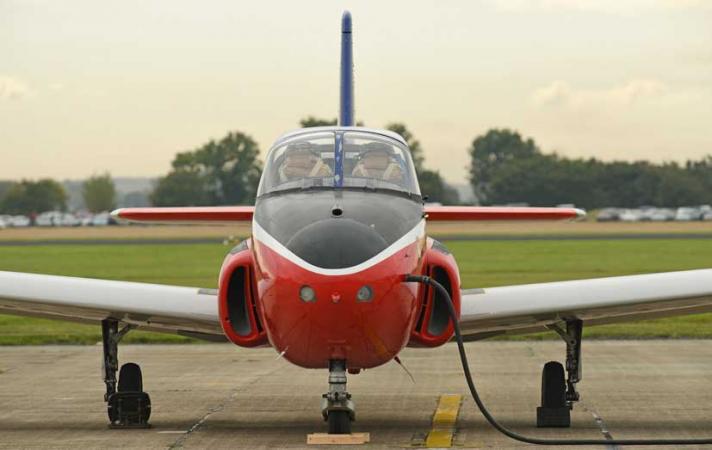
Following the successful completion of the Jet Provosts acceptance trials, the RAF formally accepted the type in 1957 and a large production order followed. Hunting Percival took the existing Jet Provost T.1 design and incorporated a number of improvements, as a result of feedback received from the extensive RAF acceptance trials. The original Armstrong-Siddeley Viper 101 engine was replaced with the more powerful Viper 8, which gave the aircraft a much needed thrust boost. The cockpit canopy was re-designed to afford the instructor and student pilot a much better field of view and the aircraft was now fitted with a pair of Martin-Baker ejection seats. The wings were also strengthened, which allowed for the addition of wing-tip mounted fuel tanks, increasing flight durations and significantly changing the profile of the Jet Provost. Perhaps the most significant visual alteration affected the undercarriage legs – the long ‘stilt-like’ undercarriage legs of the T.1 were replaced with much smaller units, which saw the aircraft sit much lower to the ground.
 A Jet Provost T.3 is readied for its latest sortie
The first Jet Provost T.3 aircraft (XM346) made its maiden flight on 22nd June 1958 and heralded the beginning of a long association between Britain’s first jet trainer and the Royal Air Force. As is the case with most new aircraft types, the first Jet Provost T.3s were sent directly to the Aircraft Armament and Experimental Establishment (AA&EE) at Boscome Down, so that the resident test pilot school could assess the effectiveness of the aircraft before it could be released for widespread RAF service. Production of the new trainer continued apace and in June 1959, the first Jet Provost T.3 trainers arrived at No.2 Flying Training School – the same unit that had received the original T.1 jets. Now stationed at RAF Syerston No.2 FTS now offered its students an all jet training programme, which was the first such course in the world. The summer of 1960 saw the completion of the worlds first ‘all jet’ flight training course, which was a major development in the history of the RAF and a proud achievement for British aviation.
As more Jet Provost T.3 aircraft became available, the retirement of the earlier Piston Provost T.1 began in earnest. The first two units to trade their Piston Provosts for the new jet trainer were the Central Flying School at RAF Little Rissington and the Royal Air Force College at Cranwell. They also went on to equip 1 FTS at Linton-on-Ouse, 6 FTS at Acklington (later based at Finningley), 7FTS at Church Fenton and 3 FTS at Leeming. Of the 201 Jet Provost T.3 aircraft ordered by the Royal Air Force, each and every one was delivered between 1958 and 1962.
Training Times – The Jet Provost and the RAF student pilot
As I know from personal experience, attempting to become an RAF pilot in any era will always be a difficult goal to achieve. If a prospective recruit managed to successfully navigate the notoriously difficult and highly competitive aircrew selection procedure, they would then be thrust into one of the most intensive training programmes in the world. During the 1960s and the widespread introduction of the new Hunting Percival (BAC after 1960) Jet Provost, training as an RAF student pilot must have been one of the most thrilling and exhilarating occupations in the world. Flying one of the world’s first jet training aircraft in arguably the most progressive air force in the world must have made them feel just a little special.
 Up where it belongs. The clean lines of the Jet Provost
The course itself would consist of weeks of rather laborious ground school study, followed by more specific familiarisation work on the Jet Provost itself. You would be required to know your way around the cockpit, starting and emergency procedures and any number of specific handling parameters, before you were allowed to sit at the controls of an active aircraft. Then came the momentous occasion of your first flight – it is difficult to imagine how fantastic and petrifying this day must have been. Not only would you have to put all the ground school study into practice, but you would also have to impress your instructor, who would be like your teacher, mother and father for the duration of your course. Typically, the student would keep the same instructor for the entire course, which meant that they would be spending lots of time with them, both in the air and on the ground. If you got a friendly instructor, you could consider yourself extremely fortunate, but whoever you got, you had better be looking to impress them with your flying abilities.
The close side-by-side arrangement of the Jet Provost cockpit could surely be a blessing or a curse for the student pilot, but would certainly have highlighted any mistakes. For the capable, instinctive student, it would have allowed them to closely observe the skills of his flying instructor and emulate these in developing his own flying style. For the less confident, or struggling student, the cockpit of his aircraft must have been an intimidating environment.
Despite the high-pressure nature of the military flight training programme, it was actually designed to help each and every student to successfully pass the course and triumphantly graduate in front of an extremely proud family. Amongst the flight instructors, there was something of a mantra, which stated ‘There are no bad students, only bad instructors’, although I am sure that they would be able to offer their own take on this statement!
No sooner had the trepidation and excitement of your first flight in the Jet Provost taken place, the student pilot could find himself sitting alone in the cockpit, ready to fly his first solo sortie. Holding at the end of the runway, cleared for take-off and with your instructor proudly looking on, it is difficult to imagine just how magnificent this moment must have been. I am sure that in most cases, the moment would have been even more special once the aircraft had landed back at the airfield, following the successful completion of your first solo flight! It would have been congratulations all round in the officers mess, phone calls to loved ones and probably a beer or two in the evening.
Jet Provost memories – I am sure we all have one!
As the successful Jet Provost trainer went on to see over thirty years of RAF service, I am sure that many Aerodrome readers will have their own personal recollections of seeing these classic British jet trainers being operated – some may even be able to boast flying in a Jet Provost. My own recollections are as an enthusiast and photographer, spending many a happy hour watching the Jet Provosts at Linton-on-Ouse, usually from the small car park at the end of the 04 runway. No matter which day I decided to go, there always seemed to be something going on at Linton and you were usually assured of seeing plenty of aircraft movements, specifically from the home based Provost T.3s, or various front line aircraft who used the airfield for an over flight. The distinctive red and white Provosts of RAF Training Command were certainly some of the most visible and accessible RAF aircraft in the country and they always made for an attractive photograph. The only drawback was the sound of the rather noisy Viper engine, which would still be ringing in your ears throughout the drive home!
 A sight that is reminiscent of RAF training bases all over the UK, during the time of the Jet Provost
I also remember travelling down a particular stretch of the A1 motorway, where you were afforded a really good view of the airfield at Dishforth. The runway ran parallel and quite close to the motorway and if you were lucky, you might see Jet Provosts from RAF Leeming practicing touch and go manoeuvres on the runway – this was a fantastic sight. Unfortunately, I was never able to obtain a photograph of this, but it certainly stopped me nodding off on the journey and usually resulted in yet another trip to see the Provosts at Linton-on-Ouse.
If you do have any Jet Provost stories to share, please get in touch with us and post your recollections on either the Corgi or Airfix Forum, or Corgi or Airfix Facebook pages – you never know, you could be the star of a future edition of Aerodrome!
30 years of training service
The Hunting Percival/BAC Jet Provost went on to provide over thirty years of faithful service to Royal Air Force training units and over 500 aircraft were eventually constructed for the RAF alone. It is highly likely that almost every RAF pilot to serve between 1960 and 1988 would have time in his log book on the JP and in many cases, would have received his basic training on the aircraft. When you consider these facts, it is clear that the Jet Provost deserves to be remembered as one of the most significant jet aircraft to ever serve in the Royal Air Force and was a resounding success for the British aviation industry.
 The final version of RAF Jet Provost was the T.5 series
Upgraded throughout its service career, the last RAF version of the Provost was the T.5 series, which saw the aircraft equipped with a high visibility ‘blown’ one piece canopy, pressurised cockpit, more powerful engine and upgraded avionics package. It also received some significant export orders, particularly in T.5 form, which was developed in to a low cost, low maintenance ground attack jet, known as the ‘Strikemaster’. Allowing air forces to operate the aircraft as an advanced trainer, weapons trainer, or counter-insurgency strike-attack jet, the Strikemaster was a popular choice for a number of the world’s smaller air forces, including Saudi Arabia, Oman, Ecuador and New Zealand. The RAF did not use the Strikemaster, as they already had dedicated aircraft for this role.
In the early 1990s, and following over thirty years of sterling training service for the Royal Air Force, the Jet Provost began to be withdrawn from training establishments all over the country. The last units to relinquish their Provost T.3A jets were No.1 FTS at RAF Linton-on-Ouse and No.3 FTS at RAF College Cranwell. Strangely, the first jet training aircraft in Royal Air Force service was replaced by a turboprop aircraft, which featured tandem seating arrangement for student and instructor – the Short Tucano.
The Jet Provost lives on
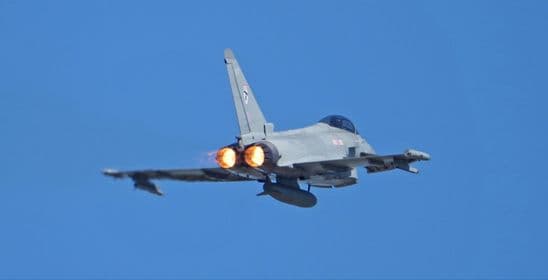
As the RAF relinquished their Jet Provost trainers a company called Global Aviation, who were based at the former RAF base at Binbrook, purchased a large number of airframes. They eventually managed to acquire sixty-five former RAF Jet Provosts, intending to service the aircraft and offer them for sale, both in the UK and abroad. The Jet Provost was such an easy aircraft to maintain and operate, that these ex military jets were of great interest to wealthy individuals and civilian consortiums all over the world and many of the aircraft quickly found new homes. Thankfully, quite a number of these buyers were in the UK and this classic British jet trainer is still a regular performer at Airshow events all round the country. Although it is definitely no match for a Eurofighter Typhoon display, the graceful Jet Provost is a welcome addition to any flying display programme and its historical importance as the first RAF jet trainer and sheer number of pilots it was responsible for training dictate that it should be viewed with real respect and affection. Hopefully we will see many more JPs booked for the 2016 Airshow season, which will be sixty years since the original Hunting Percival Jet Provost T.1 was evaluated by the RAF.
 Jet Provost T.3 XN637 is a fine example of this famous RAF jet trainer
If you do have any pilot training, or Jet Provost stories to share with our readers, please do get in touch with us using the channels below. We'd also love to see any Jet Provost pictures you might have! You can discuss this week's blog on the Airfix Aerodrome Forum or Corgi Aerodrome Forum, and if you have any comments, questions or suggestions for future editions, please feel free to let us know on Airfix Facebook or Corgi Facebook, or on Airfix Twitter or Corgi Twitter using #aerodrome.
That’s it for another week, but I look forward to posting another edition of Aerodrome again next week. Thank you for reading our latest edition, which I hope you enjoyed and perhaps brought back happy memories for some.
Until next week
Michael
© Hornby Hobbies Ltd. All rights reserved.