Welcome to this latest edition of Aerodrome and our regular look at the fascinating world of aeroplanes and the historic aviation scene around the UK.
Having spent many previous editions of Aerodrome reporting on events which had taken place within a few weeks of each blogs respective publication date, we’ve decided to take a different path this time around by looking back at an event which took place in early 2011. Our destination is going to be RAF Cottesmore in Rutland, where an enthusiast group were afforded the opportunity to pay their final photographic respects to an aircraft that meant so much to the British people, with the BAe Harrier having already been taken out of service.
Although we will be heading back more than fifteen years in digital photography technology terms, and how we were forced to deal with typically inclement British weather during our visit, we can promise you an exclusive selection of Harrier related imagery which will more than likely remind us all what we’ve been missing since losing the Harrier. It will also reaffirm just why we loved this aircraft so much and how it would surely have been the ideal aviation platform to respond to international events over the past 15 years, had it still been in service.
We will be diverting thrust to ride on a column of hot air in this latest edition of Airfix and CORGI Aerodrome.
Harrier GR9A ZG506 was painted in a gloss camouflage scheme to mark 41 years of RAF Harrier service.
One of the huge benefits of being a member of a dynamic and forward thinking aviation club or society is that if you have a decent visits officer, he or she will always be putting the group forward for visit opportunities other enthusiasts can only dream of. That certainly proved to be the case when the group I was a member of at the time were offered the chance to spend some time at RAF Cottesmore, home of Joint Force Harrier, or to be completely accurate, the former home of Joint Force Harrier.
Only weeks earlier, I had joined hundreds of fellow enthusiasts in lining the boundary fences at Cottesmore on a freezing December day with camera in hand, hoping to document the final operational flights of Harriers in British service. Despite being on the run up to Christmas, news that this would potentially be the last time we would see British operated Harriers in British skies meant that any enthusiast worth their salt had to drop everything to make sure they could be there – this was going to be a unique, if rather sad moment in British aviation history.
As anyone with even the slightest interest in aviation will be able to tell you, the Harrier was something of an aviation phenomenon, a strike aircraft with STOL capabilities and even the ability to take off and land vertically should that be required. The envy of the aviation world, the Harrier was a huge source of national pride for the British people, as it was unmatched by any other nation and even had the Americans salivating. It would go on to post an impressive 41 year service record, but when the end came, it would be swift and brutal.
With the changing face of the political landscape in Europe and around the world during the 1990s, the traditionally perceived military threats facing Britain were considered to have altered significantly. The close air support capability and ability to operate from aircraft carriers anywhere around the world, arguably made the British Aerospace Harrier one of the most useful asset available to military planners and it would be deployed successfully on numerous occasions in the years that followed the Falklands conflict.
ZG477 resplendent with her RAF No.1 Squadron 41 years commemorative tail.
It was with this knowledge that the UK Government published their Strategic Defence and Security Review in October 2010, which amongst the many cost saving measures it encompassed, also included the unexpected announced early retirement of Britains highly capable, highly flexible Harrier force. Surely this was a mistake and lobbying by military officials would see a reversal long before the announced date of retirement.
At the time, the Harrier was an extremely capable aeroplane, one which was bristling with modern technology and the ability to carry some of the latest weaponry available, so concerns about this decision were immediately raised by serving aircrew and Joint Force Harrier commanders alike. Despite highlighting the fact that this decision would effectively leave Britain without a naval surface strike capability for many years to come, their objections were ignored and incredibly, the Harrier’s proposed withdrawal date was actually moved forward.
In a move which still causes shock and disappointment across the aviation world, less than two months after the Strategic Defence and Security Review was delivered to Parliament, Britain’s much loved Harrier had been unceremoniously wrenched from service.
Harrier requiem. Things would never be the same at RAF Cottesmore again.
As I made my way down to Cottesmore on the morning of 15th December 2010 in the pitch dark and with snowflakes falling, I remember everything feeling all rather surreal. As the rest of the population were making the final touches to their Christmas plans, I and a few hundred fellow enthusiasts were preparing to be in attendance at one of the saddest occasions in the history of British aviation, self-inflicted damage brought about by the people who had the ultimate responsibility for defending the nation.
Having only ever spotted at Cottesmore on one previous occasion, I made for the same spot as last time, only that first time it was during a sunny summers morning, and this was the dead of night – everything looked so different and very confusing. Thankfully, a fellow enthusiast was much better informed than I was regarding the location, so I followed him to an area already full of cars on nearby farmland, just a short walk from the northeastern end of the main runway.
Official RAF information communicated over the previous few days had encouraged our attendance with their plan to launch at least sixteen Harriers in what was scheduled to be the final operational flight of Joint Force Harriers, before these aircraft were left to await their fate, possibly moving overseas as spares aircraft. Once airborne, the aircraft were scheduled to form into a diamond formation, before overflying locations across the country which had links to Harrier operations over the years, a fitting way to mark the retirement of this magnificent aircraft.
Obviously, as far as the people gathered at RAF Cottesmore were concerned, we were hoping that on their return, the Harriers would remain in formation for a series of passes over their home airfield, before breaking off into smaller sections prior to landing. We were also hoping that the recently painted retro scheme Harrier would take its place in the formation, along with the several other aircraft which were sporting anniversary tail artwork, so this sad occasion could be marked in style.
A cold way to spend the week before Christmas looking for Harriers.
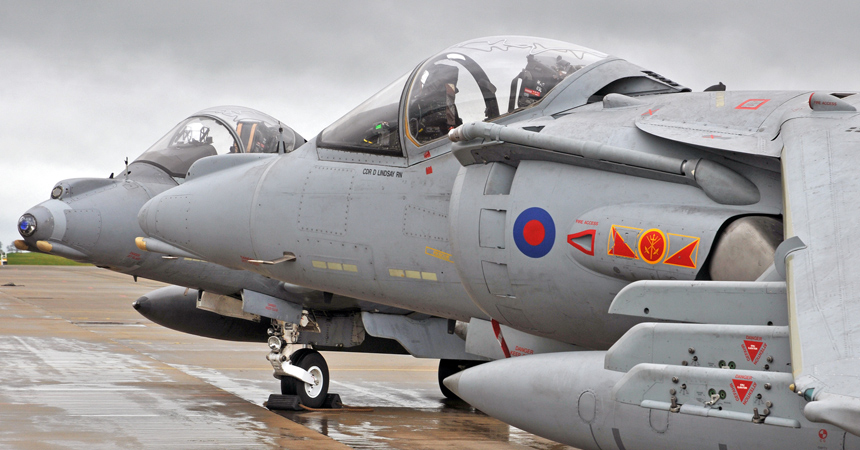
One of three Harrier T.12 aircraft taking part in the final operational flight of the aircraft in British service.
Unfortunately for us and the Harriers, the day didn’t exactly go as everyone had been hoping. In addition to being bitterly cold, a thick, low cloud base meant that we could hardly see anything on the airfield, let alone hope to see any Harriers in the sky. There was no movement in the morning and as we headed towards 2pm, we did hear the sound of a Pegasus engine, but this was just a single aircraft heading out to perform a weather check – we heard it, but we certainly didn’t see it.
Just as everyone had started to give up hope, the telltale sound of multiple engine startups drifted across the still misty airfield, and it seemed as if the flypast was going to go ahead after all. As we continued to freeze, the aircraft all took to the air one after the other, although it has to be said that the majority of them were well into the grey mirk before they reached our position at the end of the runway. Now all we had to do was wait for their return, and try to avoid freezing to death.
Disappointingly, the weather conditions across the rest of the country were no better than those shrouding the airfield at RAF Cottesmore, and news started to circulate that the formation element of the flight had been cancelled and the aircraft were making their way back to base – would conditions improve enough to allow the formation to overfly their home base, or were we just kidding ourselves?
Of course we were. With the base being filled with families and invited dignitaries, insult added to injury and most of the returning Harriers landed short and didn’t even come down to our end of the airfield. One or two considerate pilots did bring their aircraft down to acknowledge the freezing crowd at the end of the runway and were roundly cheered for doing so, but that was it, the Harrier had gone and we hadn’t even had the opportunity to bid it an appropriate goodbye.
Thankfully, a few of the Harrier pilots elected to bring their aircraft down to the end of the runway so the enthusiasts gathered there could show their appreciation.
With even the weather gods conspiring against the Harrier, once the last Pegasus engine fell silent, I and a great many other gathered enthusiasts trudged back to our cars in sombre silence, each one of us alone with our thoughts, still trying to come to terms with the enormity of the events we had just witnessed. The Harrier had gone, and the haste with which it had all happened made it seem as if sinister forces were at play. Surely this was going to leave Britain in a weaker position than before, even if they were going to save a few quid.
To add insult to injury, if this sad story couldn’t get any more bemusing, it was just about to. The national press soon carried a story confirming that all the remaining fleet of British Harriers (thought to have been 74 airframes), plus all spares stocks were to be sold to the US military as a single lot the following year. They intended to use them to keep their own fleet of US Marine Corps Harriers flying for many years to come, and as many of the British aircraft had only recently benefited from an upgrade and re-fit program at significant expense to the treasury, this was tantamount to daylight robbery!
One commentator at the time described how the US were the beneficiaries of an incredibly generous deal - ‘It’s like they’re buying a car with only 15,000 miles on the clock and at a knockdown price'. At least somebody still loved the Harrier.
Harrier ZG858 was sporting this stylish commemorative RAF No.4 Squadron tail, and didn’t she look great.
Although more than three months had passed since that freezing day in December, the weather conditions at Cottesmore on the day of our arranged visit had hardly improved. That same dark, low cloud was still hanging around the airfield and there was rain in the air – well, at least it wasn’t snowing. Ground handling teams had arranged several Harriers out on the dispersal area, including ZG506 ‘Ninja 1’ in her smart retro camouflage retirement scheme, even though the weather was doing its best to take the gloss off its stunning good looks.
Harrier GR9A ZG506 had been painted in a gloss camouflage scheme similar to the one applied to some of the very first Harriers in RAF service, in commemoration of 41 years of RAF Harrier service. The aircraft was the mount of Joint Force Harrier Commander and RAF Cottesmore Station Commander Group Captain Gary Waterfall OBE, and on 15th December 2010, he and his aircraft led the intended formation flight on the final day of British Harrier operations.
Using the callsign ‘Ninja 1’, this aircraft would also be the final Harrier to land back at RAF Cottesmore, but not before pilot and his aircraft had made one final trademark Harrier bow of acknowledgement towards the dignitaries and family members gathered at Cottesmore. Such a beautiful aeroplane, it was such a shame that more people didn’t get the opportunity to admire this uniquely presented aircraft before the Harrier was withdrawn from service. Like most of the other airframes at Cottesmore, ZG506 would end up at Davis-Monthan Air Force Base in Arizona.
RAF Cottesmore Station Commander Group Captain Gary Waterfall OBE’s beautiful Harrier.
We were also given the opportunity to enter one of the hangars which were full of Harriers, however, photography was forbidden in there, presumably because all the aircraft were being prepared for shipment to their new owners. I also remember it being quite a rushed affair on the day and how once the formalities had been negotiated, how it only seemed like half an hour before we were being invited to make our way back to our cars.
Location wise, we were basically in the same position that had been occupied by all the families and invited guests on that final day of flight operations back in December the previous year, and even though the weather was still foul, it was clear that they would have had a much better view of the day’s drama than we had out on the edge of the airfield.
Thanks to the media team at Cottesmore, we did have our own opportunity to see the Harriers at their home base one final time, which is something we will always be grateful for, although it would have been nice if they could have fixed the weather for us as well.
Other aircraft we were able to see during our visit were Harrier GR3 gate guardian XW917, Hawker Hunter F6A XE606 in RAF No.4 Squadron colours and a pair of Sea Harriers (ZH800 and ZH801), with their numbers chosen to commemorate the fact that Nos 800 and 801 Naval Air Squadrons both reformed at Cottesmore to fly the Harrier GR.7/9.
Although far from the best images in my aviation collection, this opportunity to visit RAF Cottesmore so close to the Harriers being sent onward to their new owners was a real treat for us, and brought my own Harrier withdrawal story to a fitting close. Even though a few months had passed since the withdrawal announcement had been made, that time had certainly not diminished the disbelief this development had been widely greeted with. On the day, every one of the aircraft on display looked as if they were ready to fire up and come to the aid of the nation at a moment’s notice – could this really still be happening?
With about a similar amount of undue haste with which these magnificent aircraft had been withdrawn from service, our group was invited to make their way off the airfield, leaving the ground trades to prepare their aircraft for a new posting across the Atlantic Ocean. Our loss would be America’s gain, but they could never take our memories of our time spent with the Harrier, or how this British aircraft found its way into US service.
BAe Harrier, you are still very much missed.
Please enjoy this final selection of images which were all taken during my base visit to RAF Cottesmore in March 2011.
RAF Cottesmore gate guardian Harrier GR3 XW917.
No 800 NAS Sea Harrier FA2 keeping guard during photoshoot proceedings.
Marking an earlier Harrier retirement, this No 801 NAS Sea Harrier was also on display during this poignant visit.
Hawker Hunter XE606 was also resplendent in RAF No.4 Squadron markings.
Joint Force Harrier would see aircraft deploying on naval vessels as and when required.
A final look at ‘Ninja 1’ and her stunning commemorative scheme to mark 41 years of Harrier service.
That’s all we have for you this time around, however, we’ll be back again in four weeks’ time with more news, updates and pictures from the fascinating world of aviation. Thank you for your continued support and as always, if you would like to comment on anything blog related or suggest a subject you would like to see covered in a future edition of Aerodrome, please do drop us a line at aerodrome@airfix.com, where we would be delighted to hear from you.
Should you wish to continue the aviation discussions between editions, you will always find something of interest over on the Airfix Aerodrome Forum and if social media is more your thing, please use the respective official social media icon links at the bottom of the main Airfix and Corgi website homepages to access our official sites.
The next edition of Aerodrome is scheduled to be published on Friday 27th November, and we look forward to sharing more aviation inspired content with you then.
I hope to see you all back here in four weeks.
Michael