
Welcome to this latest edition of Aerodrome and our regular look at the fascinating world of aeroplanes and the historic aviation scene around the UK.
As far as the UK Airshow scene is concerned, it seems as if 2026 has been a significant year for the Shuttleworth Collection and their latest feature packed Airshow event schedule at the delightful Old Warden airfield. With their world renowned collection of home based aircraft being joined by some of the most exciting aviation visitors from across Europe, this year has certainly been a memorable one for Shuttleworth fans, and we all have the full photographic hard drive back-ups as a consequence.
Despite our Aerodrome blog having only reported from Old Warden the previous time we posted, a recent development at the airfield was requiring of a further update this time around, and whilst we will be including some rather upsetting news regarding one of the jewels in the crown of our nation’s rich aviation heritage, everything does have an air of positivity and excitement about it, which surely has to be a good thing.
As the title suggests, we spent some time inspecting the Old Warden hangars at last weekend’s Military Airshow whilst trying to avoid the many showers on the day, and discovered interesting updates regarding two of the Collection’s aircraft to bring you, one about to be spending plenty of time in the workshops, whilst the other is just about to return to the skies. As you would expect, we have a selection of supporting imagery to illustrate the update, some taken on the day, whilst others were taken on previous visits – all will soon become apparent.
We will be immersing ourselves in the world of classic 1930s British aircraft types in this latest edition of Aerodrome.
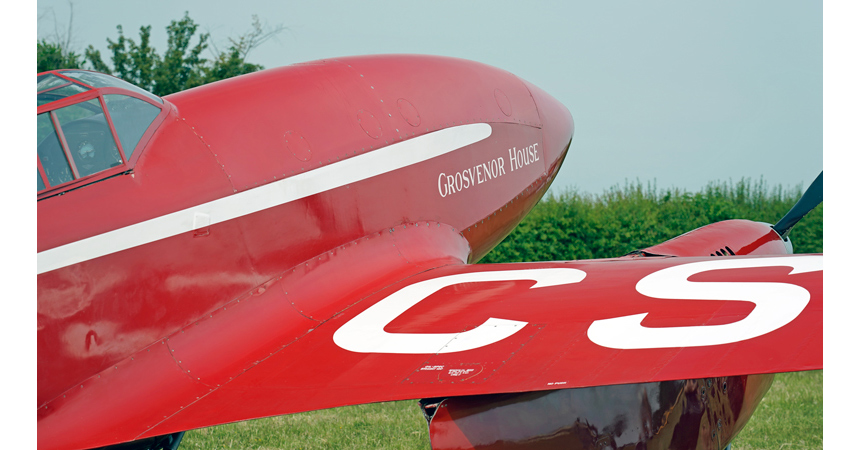
Such a beautiful sight, the de Havilland DH.88 Comet racer is without doubt one of the jewels in the crown of Britain’s historic aviation scene.
For the many thousands of people who attend the various events arranged by the Shuttleworth Collection each year, one of the undoubted highlights of any flying display involves the beautiful sight of de Havilland DH.88 Comet racer ‘Grosvenor House’ slipping through Bedfordshire skies as one of the most historic airworthy aircraft to be seen anywhere in the world. Unfortunately, despite the aircraft having an exceptionally successful year of display flying under her belt to this point in 2026, Shuttleworth’s recent Flying Proms display saw the aircraft involved in an unfortunate landing accident, and whilst the pilot managed to escape from the incident without suffering serious injury, the aircraft itself was badly damaged.
Videos posted of the incident appeared to show the lack of rainfall and long periods of high temperatures resulting in the grass runway at Old Warden becoming unusually hard, and with the Comet always looking like being something of a handful for pilots to handle on landing, these circumstances appear to have created the conditions for trouble. The most important thing is that everyone escaped the incident without injury, and we have extremely positive news regarding the aircraft to bring you a little later.
Of the many rare and historic aircraft currently under the specialist care of the Shuttleworth Collection, there’s one which is as striking as it is scarce, a racing aeroplane of real 1930s pedigree which still cuts a dashing silhouette in the skies above Old Warden to this day and one which has to be described as a particularly spirited performer, their beautiful de Havilland DH.88 Comet. The Collection’s distinctive de Havilland DH.88 Comet racer is a truly stunning aeroplane and one which has to be considered the Collection’s ‘Jewel in the crown’, actual British aviation royalty, yet an aircraft which is still regularly flown to the delight of the Old Warden masses.
Designed and produced specifically to take part in the 1934 London to Melbourne MacRobertson Trophy Air Race, the new aircraft proved so impressive that three orders were received whilst the design was still on the drawing board – one from Jim Mollison, to be flown by him and his wife (Amy Johnson), one from A.O. Edwards, managing director of London’s Grosvenor House Hotel and the third from motor racing enthusiast Bernard Rubin. Incredibly, this sleek, twin engined aircraft only made its first flight eleven days before the start of the race itself, but was about to embark on one of the most challenging feats of aviation endurance the world had ever seen to that point, one which had captured the imagination of a watching world.
An impressive 63 aircraft were initially registered to take part in the race, however, only twenty aircraft from seven different nations would actually gather on the starting line on race day itself. The race began from Mildenhall airfield in Suffolk at dawn on 20th October 1934, with the competing aircraft all hoping to navigate the flight to Australia’s Flemington Racecourse in the fastest time possible. In front of a sizeable crowd approaching some 60,000 people, de Havilland DH.88 Comet ‘Black Magic’ G-ACSP crewed by Mollison and Amy Johnson took off first, with the rival ‘Grosvenor House’ taking to the air fourth.
Can you believe that this is the actual aircraft that took part in and won the 1934 MacRobertson Air Race from London to Melbourne!
Wearing a smart scarlet red and white colour scheme and proudly carrying the name ‘Grosvenor House’ (promoting the aircraft owner’s London hotel) on both sides of its forward fuselage, this aircraft was actually one of the three DH.88 Comets which took part in the race, with two eventually managing to cross the finish line in Australia. Comet G-ACSS ‘Grosvenor House’, flown by Charles Scott and Tom Campbell Black crossed the winning line first, posting an official time of 70 hours 54 minutes and 18 seconds for the flight.
Victory secured the aircraft’s owner a handsome prize of £10,000, but of much greater significance, earned the aircraft and its crew a place in aviation history. For the design engineers at the de Havilland Aircraft Company, their technical prowess was now the talk of the aviation world, and they must have been delighted with their high-profile achievement.
Incredibly, although often taken for granted by the crowds attending Old Warden Airshow events, the beautiful red aircraft which performs at many of their events is the actual historic aeroplane that emerged victorious in the MacRobertson Trophy air race back in 1934, and really does have to be considered one of the most significant historic aircraft in Britain today.
After its stunning race victory, this incredibly fast aeroplane was passed over to the Royal Air Force for evaluation, during which time it suffered a number of unfortunate mishaps, and was subsequently let go for scrap. Thankfully, the aircraft was later rescued and restored to airworthy condition, where it would go on to set more aviation records, before being left abandoned on the edge of an airfield, unwanted, falling into steady disrepair, and left to an uncertain fate.
De Havilland DH.88 Comet G-ACSS finally came into the care of the Shuttleworth Collection during 1965, where she embarked on a program of long-term restoration and renovation to flying condition, the culmination of which saw her triumphantly taking to the air once more in 1987.
We won’t be dwelling on this next series of images, but are posting them as a record of the planned restoration program. The first two pictures were taken on the Friday prior to the recent Military Airshow, and are being shown with the kind permission of Aerodrome reader John Bagot.
Unfortunately, the aircraft suffered an undercarriage collapse when landing back at Old Warden following an Airshow appearance back in 2002, with the resulting damage requiring another extended period of renovation in their workshops. Whilst these works were underway, the Shuttleworth engineering team worked hard to obtain CAA clearance to incorporate several significant modifications to the original de Havilland undercarriage design, all with the intention of making the units much more functional for contemporary use.
After many years of painstaking work, de Havilland DH.88 Comet G-ACSS ‘Grosvenor House’ made her most recent post restoration flight on 1st August 2014, gracing Bedfordshire skies with her iconic shape and stunning good looks for the first time in twelve years, but more importantly, marking another significant aviation achievement for the world famous Shuttleworth Collection.
An extremely photogenic aeroplane, the Comet has gone on to become one of the real stars of the UK Airshow circuit and although she is always most comfortable when displaying to a home crowd at Old Warden airfield, she’s not averse to venturing a little further afield when a display organiser is looking to add a little historic aviation culture to their Airshow event. One of the most significant British aircraft still in existence, the de Havilland Comet is a real crowd pleaser, and whenever she is listed as being part of a display programme, will always have an army of excited enthusiasts gratefully filling their senses with the sight and sounds of this magnificent historic aeroplane.
The Comet will be back
For vast numbers of aviation enthusiasts the world over, not to mention the good people at the Shuttleworth Collection themselves, news of the recent accident which befell the DH.88 Comet will have been greeted with some dismay, as this rare and historic aircraft may well be a stalwart of the current Airshow scene, but is very much an example of 1930s technology. Requiring an understanding of aviation manufacturing techniques which are now the realm of a small number of highly skilled specialist engineers and technicians, the immediate fear was that this beautiful aeroplane may be lost forever and if it were to be restored, it might only be to static display standard.
Thankfully, it didn’t take the Shuttleworth Collection long to calm such fears, releasing an official statement in the week leading up to their latest Airshow announcing their intention to return G-ACSS back to airworthy condition and significantly, to take steps to ensure that this work would be dedicated to preserving the long term operability of the aircraft.
With 2034 marking the centenary of the MacRobertson Trophy Air Race, let’s hope that we see ‘Grosvenor House’ back in the air in time for those centenary celebrations.
In support of this, they have launched a dedicated project page on their website, where those interested can check on the current status of the project, and at the same time, established a fund raising campaign to allow us all to contribute towards this sizeable undertaking – we can all know play our own small part in securing aviation history in Bedfordshire.
There’s no doubting that this painstaking project will be a long and expensive one, so the Comet team are going to need all the help and support they can get. I’m sure you will all allow me to send them our very best wishes on your behalf, at the same time as allowing me to include a link to the de Havilland DH.88 Comet project page, in the hope that their fund raising appeal achieves its aim in short order.
I’m sure we will all be watching progress on this rebuild program with great interest over the coming months, and can’t wait for the day when Comet ‘G-ACSS ‘Grosvenor House’ returns to Old Warden skies once more.
Hopefully, we can look forward to this being before the centenary commemorations of the MacRobertson Air Race in 2034.
Good luck to all involved.
One in and one out. Hawker Hind G-AENP is about to emerge from the Shuttleworth workshops at the end of an eleven year restoration program.
Although we were forced to report on the unfortunate accident suffered by the Collection’s Comet earlier in this update, we do have much better news relating to their much-loved Hawker biplane bomber which also heralds from the 1930s, an aircraft which has resided in the workshops at Old Warden for over a decade now. Hawker Hind G-AENP is an example of one of a series of highly successful inter-war biplanes designed and produced by Hawker Aircraft Limited, at a time when this company was arguably one of the most influential aircraft manufacturers in the world.
Before the aviation world finally turned its back on biplane aircraft and accepted the fact that a new breed of monoplanes would be taking aviation technology forward towards world war, the 1930’s witnessed the introduction of a series of aircraft which were all vying for the title of the ‘ultimate biplane type’, several of which have long been regarded as some of the most attractive aeroplanes to ever take to the skies. These beautiful aircraft came to represent the glamour and excitement of aviation, captivating the general population in their millions and still proving to be an enduring source of fascination almost a century later. With highly polished metal panels and brightly coloured flamboyant liveries, is it any wonder how Britain’s inter-war aircraft continue to fascinate aviation enthusiasts to this day, even though few of these aircraft types remain in flying condition.
A man who was responsible for designing some of the most important and indeed attractive aircraft of the inter war period, Sidney Camm was the chief designer of the Hawker Aircraft Company and during the time he was employed by the company, was involved in the design of an incredible 52 different aircraft types. Ultimately, this involvement would result in the production of over 26,000 aircraft and at one point during the 1930s, Sidney Camm designed aircraft accounted for no fewer than 84 percent of the aircraft in service with the Royal Air Force.
In fact, during that period, an incredible 7 out of ever 8 new aircraft delivered for RAF service were Hawker produced machines.
Looking magnificent in her new RAF No.605 Squadron colours, and complete with bombs and bomb racks.
During the golden era of the biplane, Camm earned a reputation for designing some of the world’s most capable fighting aeroplanes, with a string of aircraft all being developed from the Hawker Hart, such as the Audax, Demon and Hind all proving to be some of the most effective aircraft available to any air force at that time. With bombers which were faster than the leading front-line fighter aircraft of the day, and adopting the latest construction techniques which allowed these aircraft to harness the full power of the V12 Rolls Royce Kestrel engine, it could be argued that the RAF was a Hawker equipped service at that time.
The Hawker Hind was an improved derivative of the successful Hawker Hart bomber, and one ultimately intended to replace it. Introduced during the mid 1930s, the Hind was adopted into RAF service as something of a stopgap aircraft, a tried and tested variant of an ultra-successful series of aircraft, but one required to hold the line until a new breed of modern monoplane bombers could be introduced, such as the Fairey Battle. Despite this, the Hind would go on to equip 20 RAF bomber squadrons, and with 528 aircraft produced, would also see extensive service with several overseas air forces.
The aircraft owned by the Shuttleworth Collection was one of a batch of 20 aircraft delivered to the air force of Afghanistan during 1938, and was made up of eight newly constructed aircraft, and twelve former RAF machines. It’s thought that the aircraft were in service well into the mid 1950s, by which time they were considered surplus to requirements. In 1969, this aircraft was offered to the Collection with one caveat – they had to go and collect it. This significant undertaking involved a road trip covering over 7000 miles, one which saw the aircraft arriving back at Old Warden in 1971.
When she takes to the air again, Shuttleworth’s Hind will be an extremely rare example of one of Hawker’s classic inter-war biplanes which formed the backbone of the Royal Air Force during that period.
The aircraft immediately embarked on an intensive restoration program which would take a decade to complete, but saw the aircraft taking to Bedfordshire skies for the first time in August 1981, at that time wearing Afghan Air Force colours. Later repainted in the colours of an RAF No.15 Squadron Hind, the aircraft (G-AENP) is currently coming to the end of a further lengthy period of restoration, and is about to take her place amongst the Collection’s airworthy fleet once again, after some 11 years in the workshops.
Spotted looking resplendent in Shuttleworth’s workshops at the recent Military Airshow, the Hind has been undergoing engine tests of late, and looks stunning in her new RAF No.605 Squadron colours – she’s even sporting two bombs under each wing, with the quality of this workmanship suggesting that they may even be considering flying the aircraft with the bombs in place. This might be a bit of wishful thinking, but it hopefully won’t be too long now before we get to see this beautiful aircraft displaying at an Old Warden event once again, an incredibly rare example of Hawker’s design prowess during the inter-war years.
The Shuttleworth team love nothing more than getting a rare aeroplane back where it belongs, up in the skies above their world famous airfield.
This final image has been included to prove that the rain did stop for a while during the recent Shuttleworth Military Airshow.
I’m afraid that’s all we have for you this time around, however, we’ll be back again in four weeks’ time with more news, updates and pictures from the fascinating world of aviation. Thank you for your continued support and as always, if you would like to comment on anything blog related or suggest a subject you would like to see covered in a future edition of Aerodrome, please do drop us a line at aerodrome@airfix.com, where we would be delighted to hear from you.
Should you wish to continue the aviation discussions between editions, you will always find something of interest over on the Airfix Aerodrome Forum and if social media is more your thing, please use the respective official social media icon links at the bottom of the main Airfix and Corgi website homepages to access our official sites.
The next edition of Aerodrome is scheduled to be published on Friday 2nd October, and we look forward to sharing more aviation inspired content with you then.
I hope to see you all back here in four weeks.
Michael