
Welcome to this latest edition of Aerodrome and our regular look at the fascinating world of aeroplanes and the historic aviation scene around the UK.
As this coming Monday will see the nation commemorating Battle of Britain Day once more, many of us will no doubt reflect on what our nation was facing 85 years ago, some of the darkest days Britain had experienced in its recent history. For weeks, the Luftwaffe had been launching devastating raids against targets right across southern England, in an attempt to destroy Fighter Command, and in advance of either attempting an amphibious invasion of Britain, or offering peace terms to a nation on its knees.
Thankfully, the hero pilots of Fighter Command prevailed, inflicting such grievous losses on the Luftwaffe that invasion plans were postponed indefinitely, but whilst the Supermarine Spitfire is usually lauded as the saviour of Britain, it’s important to acknowledge that it did have an able hangar-mate in securing this unlikely victory, an aircraft which despite its performance during the Battle of Britain, often goes unheralded.
In this latest edition of Aerodrome, we will be doing our level best to pay tribute to the Hawker Hurricane, an aircraft which was much more than just a Spitfire support act, and one which occupies a particularly significant position in the history of British aviation. We will be using last weekend’s Duxford Battle of Britain Airshow as the base for our review, as this magnificent event proved to be historic in its own right in terms of Hurricane participation, as it included the sight of eight Hurricane flying in formation on Saturday, something which is thought to have been the first time such a spectacle had been seen in British skies since the 1950s.
We mark the Battle of Britain contribution of the Hawker Hurricane in the latest edition of Airfix and Corgi Aerodrome.
All the images used to illustrate this article (bar one) were taken at last weekend’s Duxford Battle of Britain Airshow. Hawker Hurricane Mk.I P2902.
In the previous edition of Aerodrome, we looked at the heritage and early development of the Supermarine Spitfire, an aircraft which has to be considered one of the most significant in the history of aviation, marking the 90th anniversary of construction getting underway on the prototype aircraft K5054. In this latest edition, we could hardly have chosen a more suitable follow up subject, as we feature the famous fighter aircraft which preceded the Spitfire in Royal Air Force service by eight months, but would join it in fighting for the survival of Britain during the summer of 1940, the Hawker Hurricane.
Whilst the Spitfire is arguably even more familiar to millions of people across the world today than it was back during the dark days of the Second World War, the Hurricane has never faired quite so well when it comes to public recognition, and could almost be described as an aviation unsung hero in that regard, despite occupying a significant position in British aviation history, and accounting for 60% of Luftwaffe aircraft destroyed during the pivotal Battle of Britain.
Much more than just an aviation support act for the iconic Spitfire which always appeared to hold the limelight, the Hurricane is deserving of far more recognition than it has historically received and in this 85th Anniversary year of the Battle of Britain, we thought it was about time we attempted to do something about that.
The 1930’s were considered something of a golden era for Britain’s aviation industry, which in many ways at that time, was the envy of the world. With a number of aviation records being set by both British aviators and British aviation companies, it seemed as if they were pushing the very boundaries of flight on an a monthly, if not weekly basis. The British public were totally captivated by these intrepid aviators and their glamorous machines, and any opportunity they had to see aeroplanes being displayed would draw huge crowds to those venues. At the forefront of this aviation infatuation were the annual RAF Pageants held at Hendon aerodrome, where the latest aircraft types and aerobatic displays thrilled an enthralled public.
Those displays were a clever and cost effective way for the Royal Air Force to gain favour with the British public, as the force was often subjected to government cost cutting, and they needed to be seen as an essential and technologically advanced force in the eyes of the public. The Hendon displays would include combat demonstrations and thrilling aerobatic routines, but perhaps the most popular sections with the public were the record breaking and new aircraft display areas, where they could view the future of the Royal Air Force.
Wartime veteran Hurricane Mk.I R4118 is now in the care of the aircraft restoration company. Interestingly, there is a Hawker Nimrod biplane in the background, one of the Hurricane’s successful predecessors.
The Hendon Pageants ended in 1937, as the changing economic climate and gathering clouds of war dictated that the RAF had more pressing priorities, however, that final show was perhaps the most spectacular of them all, with over 200,000 spectators descending on the airfield. Significantly, the new aircraft park that year included both a Hawker Hurricane and a Spitfire for the duration of the show!
Throughout those inter-war years, Sydney Camm and his Hawker design team had gained an enviable reputation for the production of advanced biplane combat aircraft, many of which would go on to see service with the Royal Air Force. Even though his thoroughbred Hawker Fury biplane fighter was the most capable aircraft of its type in world service at that time, and was the pride of the RAF, Camm knew that the days of the biplane were numbered. For fighter development to advance further, new thinking and new technology would be required, and that being the case, he set about working on a new breed of fighter aircraft.
Building on the experience and technological advances incorporated in their magnificent Fury I biplane fighter, the Hawker team designed a radical new fighter, one which was initially referred to as their ‘Fury Monoplane’, an aircraft which was a clever combination of existing manufacturing techniques and ground-breaking new technologies. At the time this aircraft was taking shape, Britain’s Fighting Area/Fighter Command was equipped with just thirteen squadrons of Hawker Fury, Hawker Demon, or Bristol Bulldog biplanes, all of which had similar design characteristics, such as fixed pitch wooden propellers, fixed undercarriage and in truth, limited future development potential. The new Hawker monoplane fighter addressed all of those limitations, introducing some highly advanced design features which would all to become commonplace on the design of future fighting aeroplanes.
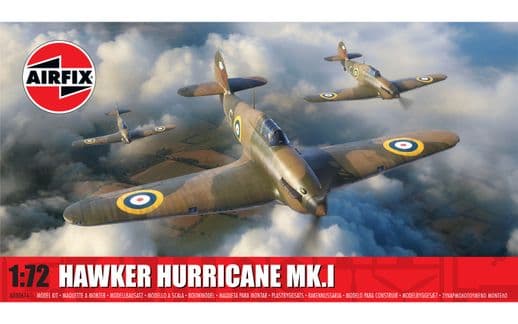
The only non-Duxford image, this is new Airfix box artwork produced in support of the latest early Mk.I Hurricane kit release.
Despite the fact that the Hawker Hurricane would enter service eight months before the Spitfire, and introduced so much new technology to the Royal Air Force, the aircraft never managed to capture the imagination of the public in the same way the Spitfire would go on to do, which always seemed a little unfair. The Hurricane not only represented a technological breakthrough for a modernising Royal Air Force, but it was also the most numerous fighter type in service when Britain needed it most. Fighting in France and alongside the Spitfire during the Battle of Britain, it would take a heavy toll of Luftwaffe aircraft, not just bombers as history would have us believe, but also a great many enemy fighters too.
On 6th November 1935, the Hawker Monoplane prototype (K5083) took to the air from the Hawker factory airfield at Brooklands, in the hands of company Chief Test Pilot George Bulman and into the annals of British aviation history. Although the new aircraft was very different in profile to any other British fighter design that had gone before it, it’s actual handling characteristics were familiar to Bulman. The design of the new fighter could be described as an impressive exercise in aviation evolution, as opposed to revolution, as it adopted the best manufacturing practices of the day, but also introducing some exciting new technologies. That being the case, it must have felt reassuringly Hawker to test pilot Bulman.
The new aircraft was essentially a larger, upgraded variant of the Hawker Fury, with the top wing removed, retractable undercarriage and a host of other improvements – oh, and it was fast! Back then, this was still quite radical design thinking, as the general opinion of the day was that nothing could compete with the exceptional manoeuvrability of the biplane in a combat situation, and how the country with the most effective bomber force would probably emerge victorious in any future conflict.
The Hawker monoplane proved to be fast, manoeuvrable and relatively easy to fly, and other than the usual little niggles associated with the first flight of any new aircraft type, was already showing great promise. From the outset, Sydney Camm wanted to design an aeroplane which was pilot friendly, with several design innovations incorporated specifically to support this.
The aircraft’s modern, fully enclosed enclosed cockpit was given an elevated position on the aircraft’s fuselage, which presented the pilot with an excellent field of view, whilst also giving the fighter a rather deep fuselage. He also incorporated a retractable undercarriage to greatly reduced drag and increase performance of the fighter, but unlike the later Spitfire, the Hurricane’s undercarriage legs were much wider apart, making the ground handling of the Hurricane far superior. Utilising the thickest part of the fighter’s wing structure, this wide track undercarriage opened outwards, making the fighter much easier to operate during take-off and landing, whilst also aiding general ground handling.
For new pilots converting to the Hurricane, the wide undercarriage would become one of the most appreciated features of the new fighter, as they already had enough to worry about, without having to battle with an aircraft that fought them whilst it was still on the ground. The Hurricane’s relatively thick wing also allowed it to be equipped with a pair of machine guns in each wing, complete with large capacity ammunition boxes, but with space enough to accommodate double that armament if required. A subsequent specification requirement would ultimately require the fitting of eight guns, but the Hurricane was able to manage this with ease. All eight guns were concentrated in banks of four in each wing, meaning that the fighter could bring extremely heavy firepower to bear in a combat situation.
Finally, the use of the latest Rolls Royce V-12 27 Litre piston engine powered the fighter to speeds in excess of 300mph, a mark which represented a significant speed increase for an RAF fighter. In many respects, the RAF’s exciting new monoplane fighter exceeded all expectations.
A line-up of airworthy Hurricanes at Last weekend’s Duxford Battle of Britain show.
After a period where a great many alterations and improvements were made to the prototype aircraft, which then went on to be evaluated by the Aircraft & Armament Experimental Establishment at Martlesham Heath, the name ‘Hurricane’ was officially approved for the new Hawker monoplane interceptor. This was quickly followed by a sizeable Air Ministry order for 600 aircraft, something which was unprecedented for a peacetime aircraft order at that time.
The race was now on to get these new fighters into squadron service, however, despite experiencing issues with the delivery of new engines from Rolls Royce, and some re-design work requirements to allow latest incarnation of this powerplant to be mated to the airframe, the traditional manufacturing techniques the Hurricane utilised dictated that the new fighter was able to enter Royal Air Force service in December 1937, with No.III Squadron at Northolt taking the honour of being the first Hawker Hurricane unit.
Those first service aircraft were very similar to the prototype Hurricane in appearance and still retained the twin bladed ‘Watts’ wooden propeller, however, this unit was quickly found to be unsuitable for operational service, as it was found to place undue stresses on the aircraft’s Merlin engine. It also affected the take-off performance of the aircraft, resulting in these early Hurricanes requiring an extremely long take off run for them to get into the air.
Whilst these issues were being addressed, the task of converting fighter pilots to the new fighter was also in full swing. Even though many of the pilots were used to flying much slower biplane fighters of simpler design, but were extremely manoeuvrable, conversion to the monoplane Hurricane turned out to be much less problematic than many pilots had feared. As much of the technology used on the Hurricane was similar to the aircraft they were used to flying, and because many of the technological improvements on the Hurricane were incorporated with the squadron pilot in mind, they found the new aircraft to be extremely forgiving and reassuringly stable. Indeed, many pilots described their early experiences with the Hurricane as being like flying a much faster version of the Hawker Hart biplane.
Improvements to those first Hurricanes came thick and fast, something which highlighted the flexibility of the aircraft’s basic design. The troublesome twin bladed propeller was quickly replaced with more modern units, first with a de Havilland variable pitch unit, and then with a hydraulically operated constant-speed Rotol propeller, both of which significantly improved the performance of the aircraft.
The original wings of the Hurricane were actually covered with doped lined fabric, something which highlighted the evolutionary development of the fighter. These would subsequently be exchanged for metal covered wings, as these allowed the aircraft to cope with much greater stress loadings and further increase the performance of the fighter. The flexibility of the basic Hurricane design meant that the new metal wings which were obviously fitted as standard to newly manufactured aircraft, could also be replaced on existing fighters during servicing or repair, taking an experienced team of fitters only three hours or so to complete.
Interestingly, although most aircraft had been upgraded to metal covered wings by the time of the Battle of Britain, a small number of Hurricanes still operated with fabric wings during the battle, with some even flying with one fabric and one metal wing!
Airshow stalwart Hurricane Mk.XII G-HURI is currently presented in markings to commemorate the Battle of Britain service of two Polish pilots who served with the Royal Air Force.
With the start of the Second World War, a mutual protection agreement between Britain and France saw a sizeable force of men, equipment and aircraft heading to France in an attempt to deter any further German military aggression, and in particular, prevent an attack against France itself. As part of the air component of this force, four squadrons of RAF Hurricane fighters were sent to France which, along with the French Dowoitine D.520, were the most capable fighter aircraft available to the Allies in France at that time.
The ‘Phoney War’ period of late 1939 and early 1940 saw an uneasy period of probing and posturing by the opposing sides, as Germany, who were clearly preparing for a significant attack, began to send reconnaissance flights ever deeper into French territory. Not wanting to provoke a military response, Allied forces would rise to challenge these incursions as a show of strength and their combat readiness, but not fire on the intruders.
Tensions raised significantly on 30th October 1939, when a Dornier Do17P on strength with 2(F)/123 was sent to gather reconnaissance photographs of Allied airfields close to the border. The German aircraft was intercepted by Hurricane Mk.I L1842, from RAF No.1 Squadron flown by Pilot Officer Peter ‘Boy’ Mould, who dispatched Dornier the bomber, sending it crashing down to earth at Meurthe et Moselle, just south of Toul. This was the first RAF fighter victory over a Luftwaffe aircraft in the Second World War and signified the beginning of a challenging period for France, Britain and the Royal Air Force.
Actual aerial combat between the Allied air forces and Luftwaffe units during the Phoney War were quite rare occurrences, and RAF pilots would only claim four aerial victories during this period. One of those victories occurred on 8th November, when Flying Officer E.J ‘Cobber’ Kain brought down another Dornier Do17, gaining both his own first aerial victory, and that of his parent RAF No.73 Squadron. Kain would go on and become the RAF’s first ace pilot and the leading RAF fighter pilot of the Battle of France, with 17 victories to his name, in addition to a further three unconfirmed enemy claims. Like so many fighter pilots during this frenetic period, Kain was to lose his life before the year was out.
Hurricane Mk.I R4118 again, this time looking as if she has just returned from her latest combat sortie.
During the spring of 1940, the Battle of France began in earnest, as the full horror of Blitzkrieg was unleashed against Allied forces on the continent. When sent to face the Luftwaffe, the RAF’s Hurricanes acquitted themselves extremely well, posting excellent combat success ratios, even against the much vaunted Messerschmitt Bf 109E. They did have some problems when facing the more experienced Bf 109 pilots, but the Hurricane was capable of holding its own in a combat situation. Crucially though, the overwhelming tactical superiority of the Luftwaffe, coupled with the speed of the German attack meant that Hurricane operations were constantly under pressure, and having to move base regularly.
Had the Allied response been better coordinated, with more RAF fighters as their disposal, the German advance may have been slowed significantly, but as history recorded, ‘Blitzkrieg’ simply could not be stopped by the forces sent to oppose it.
At this pivotal period, every RAF fighter sent to support operations in France was depleting defensive forces back in Britain, and there came a point when this simply did not make any sense. In a decision which must have been particularly painful for ministers going back on their agreement with their French allies, all remaining Hurricane fighters in France were ordered back to Britain, in the certain knowledge that they would be needed much closer to home in the months to come.
The Battle of France was costly for both Allied and German forces, but the combat experiences gained by Hurricane pilots would better prepare them for a further onslaught to come.
As German forces massed on the northern coast of France, the Royal Air Force was assessing the heavy losses suffered over the previous few months. Weakened by the losses in France, they were determined to maximise the effectiveness of their available forces and to utilise the combat experiences of Hurricane pilots who had fought in France. They needed time to make good their losses and to bring as many new pilots to front-line units as possible, so the longer Germany delayed, the better.
The RAF arranged for aircraft still equipped with the original twin bladed Watts propeller to be replaced with more effective units, a move which greatly improved the performance of those aircraft. Due to combat experiences gained in France, many pilots changed the way that they intended to attack enemy aircraft, by altering the harmonisation of their fighter’s guns. Rather than firing their guns at the previously prescribed 600 yards, the guns were concentrated for an attack at just 200 yards, where a well-placed burst from all eight guns would have a more devastating impact on the enemy aircraft being attacked.
Pilots knew they would have a much better chance of bringing down an enemy aircraft by attacking in this manner, even though this decision would also make the attacking fighter much more susceptible to defensive fire from enemy aircraft, and would surely have required a great deal of courage to press home effectively. Thankfully, the pilots of Fighter Command were not lacking in moral fibre.
As Fighter Command prepared to face the might of the Luftwaffe, the Hurricane unquestionably formed the backbone of Britain’s defence. There is some conjecture regarding the actual squadron strength of aircraft available to Fighter Command at this time, but it is generally accepted that there were 35 squadrons equipped with Hurricanes, 19 Spitfire squadrons, 9 squadrons of Blenheims, 2 of Defiants and one each of Gloster Gladiators and Sea Gladiators.
Facing them was the most feared air force the world had ever known, which could boast battle hardened pilots and massive numbers of available aircraft, estimated at being more than 3,000 in number. At the beginning of the battle, aircraft numbers available to the Luftwaffe outnumbered their adversaries by almost 4:1 and on paper, the outcome of this mighty aerial clash was painfully inevitable. Thankfully for Britain, battles are never fought on paper.
A trio of Hurricanes taking to the air at the recent Duxford Battle of Britain Airshow.
If the Luftwaffe were confident about the coming battle, so the pilots of Fighter Command were confident they would give a good account of themselves.
As the most numerous fighter available to the RAF, the Hurricane would play a leading role in the struggles to come and prove to be one half of an incredibly effective fighting double-act – in fact, it would turn out to be more than one half.
As we currently find ourselves in the 78th Anniversary of the Battle of Britain, this fascinating subject has been receiving plenty of media attention over the past few months, and many people will have a robust knowledge of the details behind this pivotal battle. As the RAF’s main defensive fighters, both the Hurricane and the Spitfire continue to be two of the most recognisable British aircraft in the history of aviation, even though there is no disputing how many still regard the Spitfire as the saviour of Britain.
Although the Spitfire was certainly a vital and high-profile component of Britain’s defensive network during the summer of 1940 and would go on to become arguably the most important British aircraft of WWII, it’s interesting to note that it actually played second fiddle to the Hurricane during the battle itself. Obviously, there is a bigger story behind a claim such as this, but the Hurricane accounted for more enemy aircraft destroyed during the Battle of Britain than all of Britain’s other defences combined, including the Spitfire.
Indeed, as more and more Luftwaffe aircraft failed to return from operations over England, German pilots would always attribute their loss to the Spitfire, despite the fact that it was more likely that a Hurricane pilot claimed the victory. For every two enemy aircraft shot down by Spitfires, Fighter Command’s Hurricane squadrons would account for three, but rather that claim one as better than the other, it would be more accurate to describe how the two aircraft worked effectively in tandem, sharing the victories and ultimately the glory.
The only two-seat Hurricane in the world, BE505 is presented as a ground attack Hurribomber and looks very different to any other airworthy example of the aircraft.
That’s why it can seem a little unfair how history and public affections tend to overlook the contribution of the Hurricane during the Battle of Britain, even though its record stands proudly for itself.
The Hawker Hurricane proved to be an exceptional fighting aeroplane, one which embraced the tried and trusted manufacturing techniques of the day, whilst at the same time incorporating cutting edge innovation into its design. During the Battle of Britain, the fact that the Hurricane was a less complex design than the Spitfire meant that many more were in service by the time the first Luftwaffe aircraft began operations over southern England.
With many fighters sustaining combat damage during the summer of 1940, due to its traditional construction, it was usually much easier for ground trades to repair a Hurricane, usually doing so at its home airfield, and often having it available for operations the following morning. By comparison, anything but superficial damage would usually see a Spitfire having to be sent to a repair facility, but at the very least, spending more time in the hangar under repair.
It was also claimed that the Hurricane was a more pilot conversion friendly aircraft, one which could be flown well by the average pilot, whereas the Spitfire required the attentions of a more accomplished airman. This is very much open to debate, and should really be left to those who flew both aircraft in combat situations, so perhaps we should leave the subject for now.
Hurricane Mk.I P3717 destroyed a Messerschmitt Bf 110 during the Battle of Britain, and would later go on to serve with the Soviet Air Force.
We’re in much safer territory when describing the Hurricane as possessing superb fighting qualities, with its relatively thick wing and closely grouped gun placement making it an extremely stable gun platform. In most combat situations, the Hurricane was more that capable of holding its own, able to out-turn a Messerschmitt Bf 109, and able to unleash devastating attacks against larger Luftwaffe aircraft. Its more traditional design also allowed the Hurricane to absorb significant amounts of combat damage, something which many pilots were grateful for, as their damaged kite managed to get them home safely, or take them out of the combat zone so they could bail out. This would allow them to quickly return to combat, something Luftwaffe pilots did not have the luxury of.
Unfortunately for the Hurricane, it didn’t take long for the nation to start overlooking its historic significance and the important role it played during the Battle of Britain. In September 1945, a flypast over central London took place to commemorate the 5th anniversary of the Battle of Britain, and the brave airmen who took part in it. Despite featuring aircraft old and new, not a single Hurricane was included in this formation, something which seems to be more than just a clerical oversight.
Thankfully, there are enough people these days who are fully aware of the historic position the Hurricane holds in British aviation, and there’s nothing like an anniversary commemoration to spread that message far and wide.
The Hurricane would go on to have a long and successful service career, with aircraft sent to operate right across the globe during the Second World War – they were even catapulted off modified merchant ships in the middle of the Atlantic, so robust was its construction. Just under 14,500 of these magnificent aircraft were built, with the final machine rolling off the production line in July 1944.
Unfortunately, we have to accept that fact that the Hurricane has always been in the shadow of the Spitfire, and will probably continue to be so, but not this weekend and not in this edition of Aerodrome.
Stars of the show – this formation of eight Hurricanes is thought to have been the most seen in British skies since the 1950s.
As one of the most popular weekends in the annual UK Airshow calendar, Duxford’s Battle of Britain Airshow can always be relied upon to attract healthy attendance figures across both days of the show, and could easily be described as their can’t miss event for thousands of people from all over the country. The show can always be relied upon to include large numbers of Spitfires and Hurricanes on the display programme, and as this year’s event would be marking the 85th Anniversary of the Battle of Britain, those with tickets in hand were hoping to see something pretty special, and they were not to be disappointed.
With ever increasing numbers of airworthy Spitfires and Hurricanes joining display circuits across Europe, this fabulously historic venue always manages to attract the most appealing display acts, and in this Battle of Britain anniversary year, we were all hoping that the show finale Duxford Big Wing Formation would include an impressive collection of aircraft, formation sequences which Duxford always do so well.
In the days leading up to the show, news started to circulate that organisers were hoping for something very special indeed, the largest number of airworthy Hawker Hurricanes over the same airfield at the same event for many a year. Those plans had to be tempered slightly as the Battle of Britain Memorial Flight’s two Hurricanes were forced to cancel their attendance in advance, but that still left eight airworthy Hurricanes on the flightline at Duxford, and if they managed to get all these in the air at the same time, that would indeed be a sight to behold.
Despite the fact that the event had to endure a strong, gusting on-crowd wind for the entire weekend, organisers and pilots alike did their level best to serve up a feast of aviation entertainment, with all but the most fragile of aircraft managed to brave the conditions. We will be bringing readers a full show review later in the year, but this update is all about the Hurricane, and we don’t want to get sidetracked.
As the highlight of the show for many, the Hurricane scramble and formation flypast was scheduled to be one of the opening acts, and as the allotted hour approached, the crowd-line began to swell in anticipation. The sound of multiple Merlin engines starting only heightened the excitement levels and when eight Hurricanes took off towards us, some in close order (obviously appearing much closer than they actually were when looking through a lens), we knew we’d just experienced something very special.
Another pass from this historic formation of Hawker Hurricanes.
Although we can all be guilty of taking our historic aviation good fortune for granted from time to time, where else can you see eight airworthy Hawker Hurricanes taking off in the space of a couple of minutes, in scenes which are the closest we will ever get to experiencing what it must have been like to have been on a wartime airfield? I can honestly say that this was worth the ticket price alone.
We proceeded to be treated to several formation passes, before the aircraft took up station behind one another for a tail chase display, as the show commentator announced that this was the first time that eight Hurricanes in formation had been seen in British skies since the 1950s – what a treat.
Seven of the Hurricanes would also take their place in the Duxford Big Wing Formation at the end of the show, but we wouldn’t be getting a repeat of the eight Hurricane Balbo the following day, as an adverse weather forecast saw Czech based Hurricane Mk.IIa P3351 making an early dash for home.
Although outnumbered by Spitfires in the main formation, it was the Hurricanes many in the crowd had come to see, and to witness a little piece if aviation history being made at this famous old former Battle of Britain airfield. Despite the challenging conditions, this will be an event which will live long in the memories of those fortunate enough to have been in attendance.
As already mentioned, we will be posting our full show review in a forthcoming edition of Aerodrome, so please keep an eye out for that.
It’s a Hurricane scramble! Hurricane Mk.IIB BE505 and Mk.X P2921 reach for the sky at Duxford.
I’m afraid that’s all we have for you in this latest edition of Aerodrome, however, we’ll be back again in four weeks’ time with more news and pictures from the fascinating world of aviation. Thank you for your continued support and as always, if you would like to comment on anything blog related or suggest a subject you would like to see covered in a future edition of Aerodrome, please do drop us a line at aerodrome@airfix.com, where we would be delighted to hear from you.
Should you wish to continue the aviation discussions between editions, you will always find something of interest over on the Airfix Aerodrome Forum and if social media is more your thing, please use the respective official social media icon links at the foot of the main Airfix and Corgi website homepages to access our official sites.
The next edition of Aerodrome is scheduled to be published on Friday 10th October, and we look forward to sharing more aviation inspired content with you then.
I hope to see you all back here in four weeks.
Michael