As many of us begin to look forward to spending time with our families over the Christmas holidays, it can lead people with an interest in military subjects to think about the fighting men and women who were forced to spend Christmas in combat situations. As we celebrate peace and goodwill to all men, it almost seems abhorrent that people continued to fight and die at this time of year, as the horrors of war do not honour religious, or general public holidays.
This will be the final edition of Aerodrome before the Christmas holiday and I really could not bring myself to feature anything that did not have a slightly more optimistic message of hope and humanity - finding such a story with an aviation link would be a challenge. Thankfully, a famous incident that took place in the skies above Germany seventy-two years ago this weekend will fit the bill nicely, where an amazing act of humanity took place during the ferocious air battles between the US Eighth Air Force and the Luftwaffe. For a number of reasons, the incident had to remain secret during the war, but led to a lasting peacetime friendship and one of the most enduring stories of the Second World War. Aerodrome 33 will be devoted to this incredible wartime meeting and how a handful of airmen shared a moment of humanity in the most challenging of situations.
With the industrial might of America now committed to the Second World War, huge numbers of US airmen were training for combat in every theatre of operation. Back in the US, 21 year old Charles ‘Charlie’ Brown and his co-pilot ‘Pinky’ Luke were flying their Boeing B-17F Flying Fortress down to Texas, where they would pick up the eight airmen who would complete their flight crew of ten. Flying this graceful bomber over the serene landscape of the US, Brown found the experience thoroughly enjoyable, although you would not think so by looking at his face. A quiet and considered man, who was very much at home with this own thoughts, Brown had a tendency to look worried in almost any situation. He referred to his B-17 as his ‘Queen of the Skies’, but when they arrived in Texas, they picked up more than her remaining crew members – confirming the exact nature of the aircrafts intended use, they also picked up eleven .50 inch M2 Browning machine guns!
Once the ten-man crew of the Flying Fortress had come together, there followed weeks of intense flight training, where they would learn both to fly and fight in their Flying Fortress and to trust each other. When the crew would be sent into combat, they would have to know that everyone was doing their respective job and the aircraft was operating as effectively as it possibly could – their lives may well depend on this. With the entire crew training together before they entered a combat situation, they began to work like a well-oiled machine, with each member of the crew relying on the performance of the others and close bonds being formed as a result. They were brothers in arms, who were going to war in one of the most capable bombers the world had ever seen.

Cutaway drawing showing the gun positions on a Boeing B-17G
As US bomber units were already involved in combat against Axis forces, Brown and his crew were expecting to receive an overseas posting at any moment. While they waited, news began to reach US training Squadrons of the savage fighting taking place in the skies above occupied Europe and the heavy losses they were taking. Brown preferred a posting to Europe, as flying in the Pacific meant flying over huge expanses of ocean – other crew members preferred the Mediterranean, as they had heard about the dismal weather in England. The Med definitely became the favoured option for all crews once news of the disastrous Schweinfurt raid of 14th October 1943 began to leak out. Of the 291 US bombers sent to attack the ball bearing factories around Schweinfurt, 60 had been shot down and large numbers had returned to their bases after suffering severe damage. Tragically, around 650 US airmen were lost, which represented 22% of the attacking force – just a few days after this raid, Charlie Brown and his crew were posted to England.
As he lay in his bed in the early hours of 20th December 1943 at RAF Kimbolton in Cambridgeshire, 2nd Lt. Charlie Brown was finding it difficult to sleep. The corrugated metal hut was extremely cold in the depths of an English winter and the oil-fired heater in the corner of the room had long since burnt out. On the airfield, the sounds of working engineers and engines running up had been going on all night, as ground crews frantically worked to ensure as many aircraft as possible would be available for the days operation. Today was going to be a big day in the life of Brown – today, he would lead his crew on a bombing mission over Germany for the first time and there was a lot to think about. Only one week earlier, he had flown his introductory mission as the co-pilot of another B-17 crew, at the side of a veteran pilot and although this will have been a valuable experience for him, he would be in the left hand seat for todays mission. Before he had the chance to grab anything approaching a decent sleep, it was time to get up and grab some breakfast.

The crew of Boeing B-17F 42-24577 ‘Hell’s Angels’
Bomber crews on operations against German targets could be in the air for many hours and although they would clearly have trepidations about the coming mission, it was important that they took food and drink before take off. Because they would be flying at high altitude, breakfast was designed specifically to avoid serving foods with a high fibre content, as this may produce body gas, which could in turn afflict an airman with debilitating stomach cramps at altitude. Over breakfast, that evenings station Christmas dance would have been a welcome distraction from the day’s operation, with a chance to escape from the war for just a few precious hours, but before too long, they were summoned to the briefing room.
The men of the USAAF 379th Bomb Group were fully aware of the perils they faced in bombing targets in Germany and occupied Europe. They were all aiming to complete their 25 mission tour and earn a trip back home for some well earned rest and recuperation, but of the original 36 crews to arrive in England, not one had managed to reach this mission mark with all ten crew members unharmed. Brown and his crew were about to embark on their first mission together and they were keen to find out where their target would be. As the base Commander invited his men to sit down, the chart was unveiled and the target revealed – The Focke Wulf aircraft factory, on the outskirts of Bremen. By now, the B-17 crews at Kimbolton were used to attacking targets around Bremen, as they had been sent there three times over the past eight days. For todays mission, almost all of the Eighth Air Force bomb groups would be committed, with some 475 B-17 and B-24 bombers taking part. The crews had been promised friendly fighter protection on both the outward and homeward legs, with the usual P-47 Thunderbolts and P-38 Lightnings being joined by the new P-51B Mustang – gunners were light-heartedly told not to shoot down the new fighter, even if they did look like Messerschmitts!

Boeing B-17F 42-30043 ‘RUTHLESS’ over England
The Intelligence Officer informed the men that they could expect something of a hot reception from the Luftwaffe, with possibly 500 bandits rising to challenge the bombers. Interestingly, these enemy fighters were usually referred to as bandits by anyone who had faced them in combat, out of a strange, possibly superstitious respect for the enemy – hardly anybody called them Jerries, or Krauts! To add to their problems, the target area was ringed with deadly flak guns, which were manned by some of the most capable crews in the Wehrmacht, who were well versed in preparing a murderous flak barrage. Take off time would be 7.30am and the unit would be given the honour of leading the entire Eighth Air Force.
As a novice crew, Brown and his aircraft would be flying ‘Purple Heart Corner’, which was situated on the lower outside edge of a 21 aircraft formation – a spot where Luftwaffe fighter pilots preferred to attack. Flying towards the main body of a bomber formation would result in a hail of defensive fire coming your way, which could bring death, or destruction in an instant – attacking the outside bombers allowed Luftwaffe fighters to adopt a much more advantageous position, with a higher possibility of a victory. Brown would have to earn a safer position in the formation by having a number of missions under his belt.

The Corgi 1/72nd scale B-17F ‘Ye Olde Pub’ from set AA39915
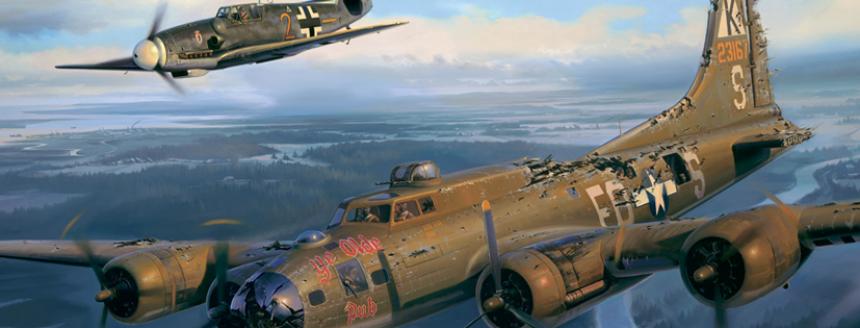
As a novice crew Brown and his men did not have a regular bomber of their own and as they trundled across the perimeter track in a small truck, they wondered which machine they would get. Passing bomber after bomber, the truck came to a halt in front of a Flying Fortress FO-S, which carried the nose artwork ‘Ye Olde Pub’, which had been applied by the aircraft’s previous crew. As the rest of his men climbed aboard the bomber, Brown was walked around The Pub by the crew chief, who took great delight in drawing his attention to the patched up battle damage on the fuselage. Rather than worrying Brown, he saw this as something of a badge of honour, feeling that this was a veteran bomber, which was surely going to bring him and his crew home.
The sun finally began to rise on this English winter morning and Kimbolton airfield began to spring into life. The first bombers began to start their engines, which was the sign for others to follow suit – the still morning became a cacophony of noise as numerous Wright Cyclone engines coughed and spluttered into life. Because of their position in the formation, Brown manoeuvred his aircraft to the last but one position on the taxiway – time for final pre-take off checks. Two green flares fired from the control tower was the signal for the bombers to take off, which they did one after the other, with around thirty seconds separation. As Brown and his co-pilot pushed the throttles forward, the heavy bomber began to trundle down the runway, but even as the speed increased, the weight of the aircraft seemed to be keeping it firmly on the ground and vibrating vigorously. With one final pull on the flight control column, the mighty bomber reluctantly climbed into the air, leaving the heavy vibration behind and replacing it with the steady humming of the engines.
It is difficult to comprehend the dangers that these brave airmen faced every time they took to the air. Brown’s B-17 was full of fuel, ammunition and bombs, but it was just one aircraft in a large formation of aircraft, which were all in the same airspace trying to form up in all weather conditions. On the morning of 20th December 1943, the low cloud was making things even more difficult and as the bombers corkscrewed up through it, they were looking for the tail gunner of the bomber in front, desperate to avoid the disaster of a mid-air collision. There were hundreds of aircraft in the air at the same time, all trying to end up in the same piece of sky at the same time – there was always the chance that returning RAF bombers could be heading in the opposite direction. The logistics behind this aerial ballet are mind blowing and it really is difficult to understand how more collisions did not occur, causing missions to actually be cancelled. As the bombers finally rose above the clouds, the size of the formation began to become apparent to everyone involved – as far as the eye could see, bombers began to take their stations and as different units moved into position, they fired flares to highlight their arrival in the formation – it must have been a magnificent sight!

A dramatic image showing a formation of Boeing B-17 bombers
As the formation passed over the coast of East Anglia, Brown instructed his gunners to test their weapons and the bombs were armed. Constantly checking their position in this highly organised formation, the B-17 was now 27,000 ft. above the freezing North Sea and the crew were now using oxygen and had plugged in their heated flight suits. The thin aluminium fuselage skin of the aircraft could only be touched through thick gloves, as bare flesh would immediately stick to the freezing metal at these altitudes, but as the formation passed over the German coastline, this was the least of their worries. Every member of the crew searched the sky for any signs of enemy aircraft, as they could attack at any point from here – before long they were sighted…Bandits! Before the Luftwaffe could press home their attacks with any conviction, they were chased away by the protecting USAAF P-47 Thunderbolts – unfortunately, the bomber crews knew they would be back.
The time was now 11.32am and the formation was just 30 miles from the target and committed to its bomb run. The flak bursts were now becoming much more concentrated and extremely accurate, with each battery putting up a straddle of four shells to cause maximum damage to the formation. Suddenly, the bright red flash of a shell burst illuminated the nose of Browns bomber, which lurched upwards, before settling back down again. They had been hit and the bomber had sustained significant damage. There was a large piece of the nose Plexiglas missing and the freezing air was ripping down the length of the fuselage interior. To add to this, the inner port engine had been peppered with shrapnel and was losing power – it had to be closed down and the prop feathered to minimise drag. Another flak bust – shrapnel was puncturing the aluminium skin of the aircraft, sounding like hailstones on a tin roof. A shell passed through the starboard wing without bursting, but leaving a gaping hole that may have punctured one of the fuel tanks. Another flak burst caused the starboard outer engine to surge wildly, as if the throttle cable had been severed – with the aircraft being violently buffeted, Charlie Brown ordered his co-pilot to shut down the engine, without fully feathering it – one minute to the target and the bomb doors were opened. The engine was re-started and it seemed to be responding. With flak bursting all around, the bombs were released – twelve 500lb bombs whistling towards the Focke Wulf factory, thousands of feet below. The bomber lurched upwards after shedding its heavy load and Brown wrestled to bring the bomber back under control, before banking away from the target to the left and setting a course for home, with the rest of the formation.
Thankfully, the flak bursts finally abated, but the gunners had lived up to their impressive reputation. With numerous shrapnel holes in the aircraft, one engine stopped and two others were now damaged, ‘Ye Olde Pub’ was losing speed and began to drop out of the formation. As the main bomber formation passed above them, they must have looked on the damaged bomber with pity, knowing that they could do nothing for them and the Luftwaffe would surely find them, like sharks around a sick whale. Brown and his crew sighted another damaged bomber in the distance, which was under attack from a large number of German fighters – the bomber dived for the protection of cloud cover, but as it entered the cloud, a bright flash was seen and something terrible had clearly happened.
As Brown struggled to keep the bomber in the air, his gunners reported multiple bandits about to attack. Five Bf 109s were holding at 6 o’ clock low, with a further eight Focke Wulf FW 190s at 12 o’ clock high – thirteen of the Luftwaffe’s best fighters were circling around a single, badly damaged Flying Fortress. The next few minutes were going to be horrendous.
The first two Focke Wulf fighters dived in to attack, seemingly aiming to strike the cockpit and taking out the pilot. Making a split second decision, Brown pulled the nose of the bomber skyward to face the attack, leaving the enemy with as little a profile to aim for. The 190 began to fire and scored hits on the bomber, but at the same time, the top turret of the B-17 opened up with its twin guns, pouring bullets into the radial engine of the fighter. It began to smoke and fell away, out of control. Immediately, a second fighter attacked in exactly the same manner, with exactly the same outcome – it scored hits on the bomber, but was hit by its defensive fire. The other fighters held their position – what were they waiting for?

‘Ye Olde Pub’ had sustained significant damage
From the tail gunner’s position came the frantic announcement – ‘Bandits attacking now!’ As five Messerschmitts screamed in one after the other, the B-17s gunners prepared to fire everything they had, but when the tail and ball turret gunners pressed their triggers, nothing happened – the guns had seized in the freezing temperatures. Surprized at the lack of return fire from their prey, the Messerschmitts raked the bomber with machine gun and cannon shells, shredding the tail and rudder control surfaces, as well as scoring hits on the wings and fuselage. The attack was almost frenzied, as each fighter seemed determined to claim the bomber for himself, but the more frantic the attacks, the more violent the defensive manoeuvres the bomber was taking. The attacks had devastated the fuselage of the B-17 and the defenceless tail gunner, Sergeant Hugh Eckenrode, had been killed on the first attack. A 20mm cannon shell had also hit the waist gunner’s position, ripping the guns from their mountings and mortally injuring gunner Sergeant Alex Yelesanko. The bomber only had three of its eleven guns in working order and was totally defenceless to anything other than a frontal attack.

A late war Messerschmitt Bf 109G of JG27
For ten minutes, Brown and Luke violently manoeuvred the stricken bomber to avoid each new fighter attack, with the bomber enduring a pummelling at the hands of the Luftwaffe. With each new attack, the bomber was taking a merciless pounding of cannon and machine gun strikes, with the engines struggling to produce sufficient power and damage to the control surfaces making the aircraft increasingly difficult to fly. In a steep, spiralling dive and with the oxygen system damaged, the B-17 entered an inverted flat spin – surely this was the end. Charlie Brown was struggling to control his aircraft and was slipping in and out of consciousness – ‘Ye Olde Pub’ was hurtling towards the ground.
Brown’s B-17 had been falling for nearly four miles, when it voluntarily exited from its spin and entered a steep dive. At 10,000 ft. oxygen began to fill the cockpit and the pilot regained consciousness and immediately wrestled with the aircraft to try and pull out of the dive. Miraculously, the bomber was still responding to Brown’s control inputs and slowly began to level out – importantly, the pursuing fighters had gone, surely believing that the bomber was falling to its certain destruction. At almost tree top height over Northern Germany, Brown requested a damage report and asked his navigator to set a course for home.
By the time the Second World War had started, Franz Stigler was already an accomplished flight instructor with Lufthansa, the world’s largest airline in the late 1930’s. Flying was his life and he excelled at passing on his skill and passion to the students under his charge. His younger brother August, had joined the Luftwaffe and was posted to a Ju88 bomber unit, flying night operations in the last weeks of the Battle of Britain – flying was in their blood. In October 1940, August Stigler had been killed in a freak accident, whilst taking off for a night bombing raid against London – the fully laden bomber was completely destroyed, with the loss of all four crew. The death of his brother had a profound effect on Franz Stigler, who immediately resigned from his post and applied to join the Luftwaffe as a fighter pilot.
Stigler was to see his first combat in the clear blue skies and blazing temperatures of the North African desert, as the Luftwaffe were employed in providing cover for the Afrika Korps and Rommel’s battles against the British. He would come under the command of II./JG27’s celebrated fighter ace Gustav Roedel, who was not only an accomplished airman, but a man of principle. He would tell his pilots that when they were in combat, they score victories and not kills – you are shooting at a machine, not a man. He was reportedly to have addressed his pilots saying, “You are fighter pilots first, last and always. If I ever hear that any of you shooting at a man in a parachute, I will shoot you myself!”

Ground crew painting the nose of a JG27 Messerschmitt
As a novice fighter pilot in North Africa, Stigler had the opportunity to meet some of the most famous fighter pilots the world had yet seen, including the most gifted of all, Hans Joachim Marseille. The Star of Afrika was a naturally gifted pilot, but something of an enigma, who enjoyed something of a superstar status amongst the German people. When Stigler first met Marseille, he was nervous and a little overawed. Marseille asked him if he had managed to score a victory yet and rather embarrassed, Stigler told him that he was sorry, but he hadn’t. The unit usually tried to make sure that new pilots had secured their first victory within their first ten missions, but Stigler had already passed this mark, without success – this was the cause of his embarrassment. Marseille told his colleague not to apologise for never having killed a man. He said, “As soldiers, we must kill, or be killed, but once a man enjoys killing, he is lost.”

Profile artwork of Marseille’s famous ‘Yellow 14’ Messerschmitt
Over the next few weeks, Stigler would enjoy the company of Marseille and the other ace pilots of JG27, who were only too glad to share their knowledge and advice on aerial combat with their new friend. He was told to shoot from as close as possible to ensure a victory – 75 yards or less. Drink lots of milk, as this is good for the eyes. Stare at the sun for a few minutes each day, as this will build up your tolerance and give you an advantage in the air. Strengthen your legs and abdominal muscles, as this will help you to withstand higher G forces and avoid blacking out. All this advice was gratefully received, but when Stigler’s first victory came, he felt no elation, he simply felt hollow.
By the time the Messerschmitts of JG27 were flying against USAAF bombers in defence of the Reich, Franz Stigler had been credited with 28 confirmed victories and a large number of probables. The savage fighting of 20th December 1943 had seen Stigler and his fellow pilots trying to fend off a heavy raid of USAAF Bombers, sent to attack the Focke Wulf aircraft factory at Bremen and during the melee, he had become separated from the rest of his unit. His Bf 109G-6 ‘Yellow 2’ was running low on fuel and ammunition and he headed for the nearby airfield at Jever for supplies. As he taxied in to the dispersal area, the ground crews knew that this was not one of their own aircraft, but were expecting a few visitors, following the days heavy fighting. Stigler instructed the crew chief to refuel and rearm his fighter as quickly as possible – with damaged American bombers in the vicinity, he was keen to get back into the air. Stigler already had 28 victories and with the scoring system allowing two victories for every ‘four motor’ (how the Luftwaffe pilots referred to the Allied heavy bombers), he only needed one more bomber victory to be awarded the coveted Knights Cross. This was not for any other reason than to make his family proud and to show the people of Germany that he had done his duty.

Stigler’s Messerschmitt Bf 109G-6 as part of the AA39915 Corgi set
Whilst Stigler took a few moments to relax, the crew chief came running up to him and informed him that a bullet had lodged itself in the radiator of his machine and he could have it repaired for him. This really should have seen Stigler retiring from the days fighting, as the bullet could cause his engine to overheat at any moment, but he told the crew chief to get his aircraft ready, as he was going back up. Not long after his fighter was fuelled and armed the airfield at Jever stopped to look towards the direction of a low rumbling sound heading towards the airfield – they could hardly believe their eyes. A lone B-17 Flying Fortress was flying at tree top height across the airfield boundary, towards the coast. Stigler jumped into the cockpit of his fighter and started the engine – as the Flying Fortress disappeared behind the trees, Franz Stigler blasted into the air in his fully armed Bf 109 fighter.
On board ‘Ye Olde Pub’, things were looking desperate. The bomber was shot to pieces, with gaping holes in the wings and fuselage and hydraulic fluid bleeding from the wings. In order to get home, the aircraft would have to fly over the murderous flak batteries of the Atlantic Wall and fly for two hours over the freezing North Sea – surely they would not make it. To make matters worse, a navigational error had brought the bomber right over the Luftwaffe airfield at Jever, who would surely alert the coastal defences of its approach. Pilot Charlie Brown announced to his crew that he was going to try and nurse the crippled bomber home, but if anyone wanted to take to their parachutes, he would climb to a higher altitude to give them a better chance – with badly wounded men on board, the crew decided that sticking with their skipper was the better option.
Stigler’s Bf 109 had no trouble in catching the damaged B-17 and he quickly closed in to take his attack position. Looking for the flash of the tail gunner’s bullets, he was surprized that they didn’t come – something was unusual. He drew closer to the bomber and saw that the tail guns were hanging limp, with the gunner himself lying lifeless, draped over the breeches – his station had been shattered by cannon shells and he was in no position to return fire. Stigler was now flying in formation with the bomber and he could not believe what he was seeing – it had been devastated by multiple cannon strikes and he had no idea how it was still flying. Through the gaping holes in the side of its fuselage, he could see the injured crew huddled together, trying to help each other and he decided that he could not shoot this aircraft down, but he had a split second to decide what to do. They were only minutes away from the coastal flak batteries that would certainly destroy the American bomber – his Messerschmitt took up station on the starboard side of the B-17, knowing that the flak units should not fire on a friendly aircraft.

‘A Higher Call’ Painting by John D. Shaw. Image use courtesy of Valor Studios
Back on the B-17, the ball turret gunner had charted the progress of the Messerschmitt and followed him, pointing his frozen guns at him all the time, hoping to drive him away. The intercom system had stopped working long ago and he had no way of alerting the rest of the crew. In the cockpit, Brown and Luke were trying to keep the bomber in the air and make sure they were on the right course for England. Out of the corner of his eye, he saw something out of the cockpit window that made his heart sink – the sinister shape of a Messerschmitt fighter. He rubbed his eyes, not wanting to allow himself to believe what he was seeing, but it was still there. He tapped Luke on the shoulder and pointed at the 109. For a few seconds, the two men stared at the enemy fighter that was flying so close, they could clearly see the pilot, when they noticed that he was gesticulating at them – what was he trying to say? He appeared to be telling them to land and pointing in an easterly direction. Confused and a little frightened, Brown continued to hold his course, not realising that they had passed over the coastal flak batteries, without a shot being fired – they were over the sea. Looking back at the Messerschmitt, the pilot was still pointing and waving at them, mouthing some sort of instructions. The Messerschmitt flew over the bomber and took up station on the port side, looking straight into pilot Charlie Brown’s eyes, but continuing with his gesticulating. “What the hell does this guy want?” shouted Brown, before instructing his dorsal turret gunner to aim his guns at the fighter, but hold his fire. With this, the German pilot saluted Brown and peeled away, heading back towards Germany. The crippled B-17 was alone above the North Sea, but losing altitude with every mile.
The plight of the American bomber crew had shocked Stigler and he could not bring himself to claim an easy victory - more than this, he wanted to give them the best chance of surviving the incident. The most immediate problem was to get them past the coastal flak defences and at great personal risk, he manoeuvred his machine as close to the B-17 as he could, making it appear as if he was escorting a captured aircraft on a clandestine mission. He could not be sure that he would not be blasted out of the sky by friendly units, or indeed that the B-17 would not take the opportunity to dispatch their hated enemy. Once over the sea, he was sure that the bomber was so badly damaged that it had no chance of making it back to England, so he was trying to direct the crew towards neutral Sweden, which was only half an hours flight time away. The crew would be interned for the duration of the war, but they would receive immediate medical treatment and would be alive – if they had to ditch in the sea, the chances were that they would all perish. As his final attempt to direct the bomber towards Sweden appeared to have failed, with the dorsal turret guns being aimed in his direction, he saluted his fellow airmen and made for home.

The magnificent painting ‘The Guardian’ by Nicolas Trudgian, courtesy of Valor Studios
As he flew over the German coast, he was hoping that ground units had not reported the incident to their superiors and an investigation launched, because if he was discovered as letting the bomber go, he would be court marshalled and executed. His story would be that he brought the bomber down in the North Sea, which would be difficult for anyone to disprove, but in any case, he was certain that he had done the right thing. The sight of those injured men aboard that crippled bomber would stay with him for the rest of his life.
As pilot Charlie Brown struggled to keep his badly damaged B-17 in the air, it was becoming clear that they would not be in a position to make it back to their home station at Kimbolton. With one engine knocked out and two others damaged and producing less power by the minute, they would be lucky to make it back to dry land – he ordered all able crew to throw everything they could out of the waist gun windows, in an attempt to reduce weight and take some of the strain of the aircraft. Many items were thrown into the ocean – machine guns, oxygen bottles and ammunition tracks. The only thing that they did not remove was the guns from the tail gunner’s position, as the scene of devastation back there was too distressing to deal with.
Somewhere over the North Sea, Charlie Brown noticed a shadow appearing on his starboard wing – what now, had the German returned to finish them off? A second aircraft appeared on the other side of his aircraft and he got a better look. Little Friends, P-47 Thunderbolt ‘Razorbacks’ – they had a friendly escort. Just as Stigler had seen over Germany, the American fighter pilots must have looked at the B-17 and wondered how it was still in the air. It would certainly have been the most damaged flying aircraft they would have ever seen. One of the P-47 pilots waved at Brown and motioned with this oxygen mask, to ask if his radio was working – a shake of the head confirmed the situation. Seconds later, the Thunderbolts sped away, leaving ‘Ye Olde Pub’ and her crew alone once more – still losing height and streaming hydraulic fluid, co-pilot Spencer Luke noticed something on the horizon … it was England!

A Duxford based P-47 Thunderbolt ‘Razorback’
As soon as the bomber crossed the coastline, Brown began to look for somewhere to land his damaged bomber, but was distracted by two shimmering specks in the distance. It was the two P-47 Thunderbolts performing aerobatics, in an attempt to grab the pilots attention – they were guiding him to the nearest airfield, RAF Seething, which was home to the USAAF 448th Bomb Group. Charlie Brown headed for the airfield and selected gear down for landing – nothing. The hydraulic fluid had drained from the system, but realizing what had happened, one of the other crew members was already on his way to the bomb bay, where he would manually hand crank the undercarriage to its lowered position. As the bomber came in to land, they fired red flares, to indicate to the airfield emergency services that they had wounded men on board, to ensure that they could get immediate medical assistance, one the aircraft came to a halt. At 3.30pm, the B-17 landed at Seething airfield, following a harrowing eight-hour ordeal – the crew of ‘Ye Olde Pub’ had just completed their first combat mission.
On the ground, the support crews at Seething could hardly believe the sight before them. How on earth had this bomber managed to make it home? Tragically, the crew of the battered B-17 did not all survive the mission to tell their story – tail gunner Sergeant Hugh ‘Ecky’ Eckenrode had been killed during the first attack of the Bf 109s over Germany and waist gunner Sergeant Alex ‘Russian’ Yelesanko suffered the amputation of his shrapnel damaged leg.
The fact that these men had managed to nurse their severely damaged bomber back home, was nothing short of miraculous. Reports describe ‘Ye Olde Pub’ as being the most severely damaged bomber to ever make it home from a mission and anyone who saw what was left of it would certainly agree. The station commander at Seething told Brown that he would be up for a medal, but all Brown was worried about was the condition of his crew and recognition of their heroic efforts.
During the mission debrief, Charlie Brown described everything that had just happened, including the strange incident with the Messerschmitt pilot and how he had not shot them down. Brown was still trying to come to terms with the situation himself, but when he looked at the Station Commander, he knew that he was not alone – he was staring back at him in total disbelief.
The following day, Brown was approached by the Station Commander, who told him that he had some bad news. After relaying the details of the Messerschmitt incident to USAAF authorities, he was told that they must instruct the crew of ‘Ye Olde Pub’ to never repeat the incident to anyone – they must completely forget about it. Furthermore, there would be no medals for the crew, as they did not want to draw any attention to them and the possible exposure of the 109 incident. The Air Force top brass were trying to manage the crippling losses that the Luftwaffe were inflicting on the USAAF bomber formations over Germany and they did not want any stories circulating that might show the enemy in a humane light – they needed their crews to hate the enemy and want to inflict maximum devastation on them. Indeed, all pictures taken of the damaged bomber at Seething were ordered to be destroyed and anyone who spoke to the crew were warned of the severe consequences of passing on any story they may have heard. The heroics of this bomber crew and their remarkable encounter with a German fighter ace over the North Sea coast were simply to remain in the memories of the men who took part in it.
In 1986, a retired Colonel Charles Brown was asked to speak at a reunion event for combat pilots called ‘A Gathering of Eagles’. Not usually one for such events, Brown agreed and during his session, a member of the audience asked him if he had any particularly memorable missions that he cared to share. After thinking for a moment, he detailed the events of 20th December 1943 and the strange encounter with the saluting Messerschmitt pilot. As you can imagine, the room was totally captivated by the story and the interest it drew made Brown think about trying to identify the German pilot and if he was still alive, ask him why he did what he did. For the next four years, he searched official records and wrote articles in numerous publications, hoping that someone would come forward with information, but to no avail. In 1989, he tried one last time and wrote an article for a German fighter pilot’s association newsletter.
In Canada, former Luftwaffe fighter ace Franz Stigler read the article about the saluting German and the badly damaged Flying Fortress and decided to write to the author. In the letter, he simply gave his contact details and said, “I was the one!”
Fearing the discovery of his actions and certain death in the final days of the Third Reich, Stigler had been unable to ask any questions about the bomber he had escorted over the German coast, but he had always hoped that the crew had made it home safely. He was involved in the bringing down of another B-17 on 20th December 1943 and on landing back at his base, he took a Fieseler Storch observation aircraft and landed in the same field as the crashed American bomber – he wanted to be sure that the crew were safe and had been well treated by their German captors.
Following the amazing receipt of Franz Stigler’s letter, Charlie Brown contacted him and the two men discussed the incident of 1943. As the man on the other end of the telephone described every detail of their previous meeting, Brown was certain that this was the Luftwaffe pilot that had saluted him all those years ago – only he could have known these facts. Incredibly, after forty-seven years, these two former enemies, who shared a brief moment of humanity and chivalry over war torn Europe had found each other again.

WWII pilots Charles Brown and Franz Stigler
In the summer of 1990, Franz Stigler and Charlie Brown met in the lobby of a Seattle hotel – it was an emotional occasion and they had a lot to talk about. The two men became firm friends and Brown would describe Stigler as his older brother. Their incredible story would captivate audiences at veterans reunions throughout the US and inspire a number of paintings and numerous magazine and newspaper articles. The magnificent book ‘A Higher Call’, by Adam Makos gives a superb account of this incredible story and is an enthralling and emotional read. The two men stayed friends for the rest of their lives and died within months of each other in 2008. They were extraordinary human beings.
I am sure that many Aerodrome readers will already be aware of the amazing story of Charlie Brown, Franz Stigler and ‘Ye Olde Pub’, but I hope that you enjoyed revisiting the story one more time. If you are reading about it for the first time, then I am sure you will agree that it is a very special story and one which is very much worth sharing. It took place 72 years ago this coming Sunday.
I am greatly indebted to a number of people for their kind assistance in the production of this article. Firstly, I would like to sincerely thank Bryan Makos of Valor Studios in the US. Bryan kindly allowed me to use the images from the paintings they have commissioned, which have magnificently illustrated this story. Their superb website at http://www.valorstudios.com contains further details on the book ‘A Higher Call’ and information on the beautiful commemorative prints they have available, including ‘The Guardian’ by Nicolas Trudgian and ‘A Higher Call’ by John D. Shaw.
Secondly, I would like to thank British artist Nicolas Trudgian, for allowing us to use his magnificent painting ‘The Guardian’. I have had the pleasure of knowing Nic for a number of years and he has kindly helped me on numerous occasions during this time. I have a number of his stunning prints in my collection, which seems to grow larger each time I visit his website at https://www.nicolastrudgian.com Thanks for your help again Nic and keep checking out those Hornby trains!
Finally, as this will be the last edition of Aerodrome before the Christmas holiday, may I take this opportunity to wish all our readers a very Happy Christmas. May I also extend a sincere thank you for all the support that you have given Aerodrome during 2015 and for all the kind and supportive comments you have sent us. We will be posting a 2015 review edition, including a little aviation related competition, on New Years Eve and we have some big plans for 2016. Until then, thank you for reading and I hope you have an enjoyable holiday.
As usual, for anyone wishing to discuss our latest blog, you can head for either the Airfix Aerodrome Forum or our Corgi Aerodrome Forum. If you have any specific comments, questions or suggestions for future editions of Aerodrome, please feel free to let us know by using either the Airfix Facebook or Corgi Facebook pages, or at Airfix Twitter or Corgi Twitter using #aerodrome.
Thanks again
Michael
© Hornby Hobbies Ltd. All rights reserved