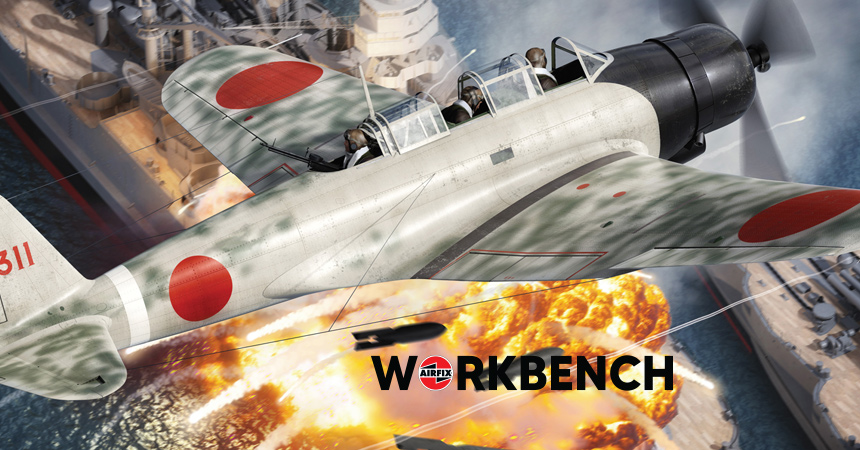
We’re pleased to be bringing you this latest edition of our regular Workbench blog, and all the news, updates, and modelling exclusives from the fascinating world of Airfix.
Since the first aircraft model was released in Airfix kit form back in 1955, aviation subjects have always been an incredibly popular component of any model range we introduce, and even from those early days, would form the bulk of kits on offer. With the majority of the world’s most significant aircraft having been modelled over the seven decades which followed, it will come as no surprise to learn that aircraft which took part in the two world wars have always appealed most to modellers, with our geographical location dictating which subjects proved to be the most popular. For us here in the UK, any aircraft which operated from, or over these shores is fair game for the modelling community, however, models of aircraft which were engaged in combat in Pacific skies have still been popular, but usually less so overall.
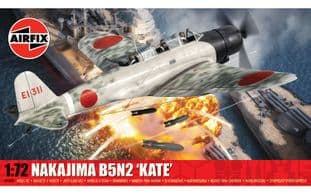
In this latest edition of Workbench, we will be using the re-introduction of our 1:72nd scale Nakajima B5N2 Kate kit to look at a pair of aviation subjects that were engaged in the savage struggle for aerial supremacy over the vast expanses of the Pacific Ocean, aircraft which should be considered significant in their own right and are therefore very much deserving of modeller attention. With extensive use of classic Airfix box artwork and full details behind all the scheme options on offer with each kit featured, we’re looking towards Far Eastern skies in this week’s edition.
The early variant of the Nakajima B5N Kate was unquestionably one of the world’s most advanced naval attack aircraft, a contemporary of Britain’s Fairey Swordfish.
When Japanese military planners were looking to introduce a modern naval attack aircraft during the early 1930s, they were doing so at a time when all similar aircraft in service around the world were fabric covered biplane designs, but as they had aspirations to spread their influence across the Pacific region, they were looking at an aircraft with the potential to be a world leading design. Just one component in a massive military expansion program, the new aircraft would be needed as part of an effective mobile strike force, if their ambitious expansionist plans were to be realised.
The Japanese Empire had made no secret of its desire to increase its influence into East Asia and the greater Pacific region, providing security for its population and securing the raw materials required for its continued industrial expansion. Many in Japan felt that the only way to protect the nation was to expand away from the home islands and to protect Japanese interests by force, claiming territory as their own and occupying many other regions. This expansion would also provide a welcome boost to food availability and raw materials for this rapidly developing nation.
Central to the success of such a policy would be a strong naval force and included the need to develop air power capable of striking with deadly force over great distances, with the ability to operate effectively from the Japanese Navy’s rather modest force of aircraft carriers. The naval aircraft developed during this period were some of the most advanced in the world and would go on to allow Japanese military planners to secure vast areas of Pacific territory, whilst at the same time showing Allied navies the latest aviation technologies they would be coming up against in future combat.
One of the highly capable aircraft in service with the Imperial Japanese Navy at that time, the Nakajima B5N ‘Kate’ was a sleek and rather elegant looking carrier capable torpedo attack bomber, one which incorporated many highly advanced design features which set this apart from most of its contemporaries. Making its first flight in January 1937, the Type 97 Carrier Attack Bomber had a crew of three and was a relatively large aircraft to be powered by the single 800hp Hikari 3, 9 cylinder radial engine, something which would result in a major upgrade programme in the months prior to the Pearl Harbor attack.
A built ‘Kate’ model kit finished in the lead Pearl Harbor attack scheme of the two options available with this release.
Operational experience gained during the Second Sino-Japanese War revealed that the aircraft offered little protection for crews in combat situations, with the fuel tanks being particularly vulnerable to enemy fire. As military planners wanted to retain the speed and agility the aircraft possessed, the addition of additional armour was rejected in favour of simply installing a more powerful engine and the hope that the slightly faster variant of the aircraft might be able to outpace any potential adversaries. Japanese naval aircrews must have been delighted to have been of such concern to their superiors.
By the time of the infamous Pearl Harbor attack, the Nakajima Kate was coming towards the end of a major upgrade program to the more powerful B5N2 version of the aircraft and as a consequence, none of the earlier models were to see action during the raid. Equipped with the more powerful 1000 hp Nakajima Sakae 11 fourteen cylinder radial engine, the increased diameter of the unit required a re-engineering of the B5N2’s engine cowling, which would obstruct the pilot’s forward vision when compared with the original variant.
Despite making his job more difficult, the skill and tenacity of the well trained IJN Kate crews would earn the respect of their adversaries, as they pressed home their attacks using either iron bombs or a single Type 91 torpedo, often in the face of heavy defensive fire.
Ultimately though, despite being an advanced aircraft when it first entered service, by the time hostilities began at the start of the Second World War, the B5N2 Kate was already regarded as an obsolete type, however despite this, due to spectacular early successes and the continued lack of a more capable replacement, the aircraft would be forced to soldier on for many months to come.
Battle above the Pacific – By the time the Nakajima B5N2 Kate came up against US Navy F4F Wildcats, they were beginning to show their vulnerabilities.
In the face of ever greater numbers of the latest, highly capable US navy fighter aircraft, the fate of many Nakajima B5N2 Kate aircraft and their crews was becoming increasingly inevitable. Indeed, attrition rates during the final few months of the war proved to be so severe that not one original Type 97 Kate remains in airworthy condition today, just the partially restored sections of two wrecked aircraft.
The Nakajima B5N2 Kate may not be one of the Second World War’s most instantly recognisable aircraft to many people, however, it does have to be considered one of the most important naval strike aircraft of the 1930s and 40s, one which clearly illustrates the lead Japan had in naval aviation technology at the outset of conflict. A contemporary of the Fleet Air Arm’s Fairey Swordfish, Japan’s Kate was a stable attack platform and is without doubt one of the most important aircraft of the Pacific air war.
The kit which has recently re-joined the current Airfix range does so after an absence of more than a decade, allowing access to the kit and scheme options which accompanied this model when it joined the range as a new tooling introduction. The two scheme options mark the use of the upgraded aircraft during the infamous Pearl Harbor attack of December 1941, but how this same variant of the aircraft was still forced to engage in combat with US forces during the final months of the war. Let’s take a closer look at them now.
On 26th November 1941, a Japanese carrier task force left their home islands and set course for Hawaii, home of the powerful US Pacific Fleet. At the time, Japan was still trying to negotiate a settlement to an ongoing dispute with America that had seen crippling sanctions imposed against their nation, but as they had clear military expansionist ambitions in Southeast Asia, the hope of a satisfactory settlement was fanciful at best.
Fearing this and wishing to prevent America from challenging their ambitions in the Pacific region, an audacious plan to launch a surprise attack against the American fleet moored at Pearl Harbor was drawn up, with its success very much dependent on stealth and the American forces being completely unprepared to repel the initial attack.
At 7.55am on Sunday 7th December 1941, the first wave of Japanese aircraft arrived over Hawaii and launched their devastating attacks – over the course of the next two hours, the Japanese inflicted terrible damage and significant loss of life at Pearl Harbor, in two coordinated air attack waves. Despite their successes, a potentially catastrophic third attack wave was cancelled because of the fear of American counterattack against the Japanese strike force and the raid failed to destroy any US aircraft carriers, which were to prove crucial in the Pacific battles to come.
Of historical significance, Japan badly misjudged the mood of the American people and their stomach for war which had now arrived on their doorstep. A powerful nation which was until that point divided in whether they should join the war, instantly united in their resolve to win a war they might not have wanted to be involved with, but now found themselves in, whatever the cost.
Full scheme details for this Shōkaku Kate which took part in the second attack wave during the Pearl Harbor raid.
For the attack itself, Japan sent six of their aircraft carriers to Pacific waters off the island of Honolulu, four of which were older vessels, manned by more experienced crews. The carrier Shōkaku and her sister ship Zuikaku were two of the most advanced aircraft carriers in the world at that time, fast and heavily armed, and able to field around three times more aircraft than British carriers in service at that time. The carriers had wooden decks, two hangars on different decks and three large lifts for moving aircraft to and from the flight deck.
Shōkaku was equipped with 72 aircraft in support of the attack, 27 Kate strike aircraft, the same number of Val dive bombers and 18 Zero fighters, but as both the ships and their air group were less experienced that those assigned to the older carriers, her aircraft were directed to take part in the second attack wave. This attack involved 167 aircraft which were sent to attack airfields and infrastructure on land, meaning that the Kates taking part in this raid did not carry torpedoes.
These attacks were aimed at maximizing the damage inflicted on American targets, whilst at the same time preventing US air power from launching a counterattack against the Japanese carriers. As we all now know, this infamous, unprovoked attack was devastatingly effective, underlined by the fact that only one of Shōkaku’s aircraft failed to return following the raid.
Ultimately though, the fear of US attack and the decision not to launch a planned third attack wave presented America with a platform from which they could strike back, and we know where that would eventually end.
Scheme B – Nakajima B5N2 ‘Kate’ 53-305, 553rd Kokutai, April – October 1944.
Even though the Nakajima ‘Kate’ was one of the most capable aircraft of its type when it entered service, it wouldn’t take long for the US Navy to introduce new fighter aircraft that were more than a match for this stable and aerodynamically simple bomber. Of even greater significance though, the lack of a more capable replacement attack bomber resulted in Kate crews being forced to face the onslaught of these improving American fighters as the war progressed, with predictable consequences. Many of the Japanese aircraft would succumb to enemy air attack, with crews paying the ultimate price in the process.
Initially facing aircraft such as the Grumman F4F Wildcat and Brewster F2A Buffalo, not only did these aircraft allow American crews to stem the tide of Japanese aggression, but they also allowed them to develop effective tactics with which to fight and overcome the Japanese aircraft they encountered. With the might of America’s industry now behind them, the US Navy quickly moved to upgrade the capabilities of their already effective Wildcat fighter, using the combat experiences of US Navy pilots to help designers in developing more effective aircraft.
Robust, heavily armed and powered by the massive Pratt & Whitney R-2800 Double Wasp, aircraft such as the Grumman F6F Hellcat and Vought F4U Corsair would rule Pacific skies following their introduction and no Japanese aircraft would be safe in contested skies. For Kate crews, this would be nothing short of a disaster. The lack of a more effective replacement aircraft meant that they were forced to continue flying in the face of ever greater enemy opposition, and as the number of experienced crews failing to return resulted in less experience replacements taking their place, the situation only got worse.
Full scheme details for an aircraft which was still in service during the final few months of the Second World War.
The levels of attrition being experienced following the introduction of the Hellcat meant that many Kate operations were forced to take place under the cover of darkness, or by reduced numbers of aircraft, which whilst clearly limiting the effectiveness of such attacks, didn’t do much to alleviate the losses being experienced. As Japan headed into the final year of conflict, many remaining Nakajima B5N2 Kates had been relegated to training and reserve roles, but would also be required to take part in increasingly desperate offensive operations.
This would inevitably see aircraft used to mount kamikaze attacks, a development which saw the US Navy introducing the fast and agile Grumman F8F Bearcat to combat this threat.
A welcome reintroduction to the Airfix range, our Nakajima B5N2 Kate kit may be something of an unusual subject for many modellers here in the UK to consider, even though it is unquestionably one of the most advanced strike aircraft from the early war years. If nothing else, it serves as a fascinating model to display alongside a Fairey Swordfish, an aircraft which was essentially Britain’s equivalent naval attack aircraft and one which was also required to soldier on throughout the war.
This unusual and attractive kit is in stock and available now.
Classic Airfix box artwork created in support of our Pearl Harbor anniversary kit set.
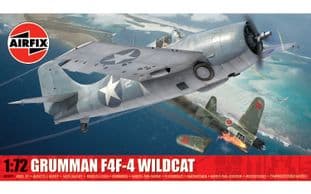
The initial US Navy adversary of the Nakajima B5N Kate once America had been dragged into the Second World War, the Grumman F4F Wildcat wasn’t even initially America’s preferred naval fighter option, as it had been essentially overlooked in favour of the Brewster Buffalo. Nevertheless, once the two aircraft entered service, the rugged attributes and combat survivability of the Wildcat would soon reveal themselves, making this the aircraft the US Navy would use to strike back at their Japanese foes.
The Wildcat would go on to be heavily involved in actions during the early months of America’s involvement in the Second World War, where US Naval strike units were forced to engage in combat with the feared and extremely agile Mitsubishi Zero fighter, one of the world’s truly great combat fighting aircraft. The well trained US Navy pilots quickly learned how best to use the many positive attributes of their diminutive fighter during combat situations, avoiding getting into tight ,turning dogfights with their nimble adversaries, but instead employing high speed ‘hit and run’ tactics instead.
Able to boast robust construction, the inclusion of armour protection and the use of self-sealing fuel tanks, the Wildcat may have been a heavier aeroplane than its celebrated aerial opponent, but this additional weight did ensure that many naval aviators were able to return safely to their carrier, even after suffering quite significant combat damage.
More than 1500 enemy aircraft would fall to the guns of American flown Wildcats during the Second World War.
In contrast to this, where Zero pilots had suffered similar combat damage, if they were still alive to make good their escape, they would probably be destined for a dip in the Pacific, because their own aircraft could be rather fragile and provided nothing in the way of armoured protection for the man at the controls.
As America looked to check Japanese territorial expansion across the Pacific region during 1942 and 1943, the Grumman F4F Wildcat would be at the forefront of that fight, making ‘aces’ of many US Navy and Marine Corps pilots in the process.
As effective as the Wildcat undoubtedly was, engineers at Grumman were already hard at work developing its successor, an aircraft designed around the combat experiences and improvement requirements of US Navy ‘Ace’ pilots. Grumman officials were sent to interview active combat units to find out what they wanted from the next upgraded Grumman fighter. Almost unanimously, they asked for an aircraft that was ‘As tough as the Wildcat, but was faster and possessed greater firepower’.
When the F6F Hellcat eventually arrived on US Carriers, crews were delighted to find that Grumman had delivered on their promise, delivering a supreme fighting machine, one which would go on to be regarded as the ruler of Pacific skies.
An extremely gifted pilot, Marian Eugene Carl received his Marine Corps commission in December 1939 and was initially posted to VFM-1 at Quantico. After twelve months perfecting his craft, he returned to NAS Pensacola to serve as a flight instructor, drafted in to help support the significantly increased flight training program required by Navy air arm expansion.
Keen to fly operationally, he was later posted to VMF-221 at San Diego, where he was when the Japanese launched their surprise attack against Oahu and Pearl Harbor, in the immediate aftermath of which Carl and his fellow pilots embarked aboard USS Saratoga bound for Hawaii as part of a relief force. Their orders would change whilst sailing towards the scene of the attack, and they would eventually disembark at Midway Atoll on Christmas Day 1941.
Captain Carl’s first taste of aerial combat came during the savage fighting of the Battle of Midway the following June, when his unit dispatched 25 Wildcats to engage a strong force of attacking Japanese aircraft. Whilst Carl was able to down at least one Zero fighter and damage two others, 15 of his squadron mates were shot down during what proved to be a chastening combat debut for the unit, and a demoralising experience for the squadron.
That mauling resulted in the remaining pilots from the squadron immediately being sent to Hawaii for a period of rest and additional training, with commanders being conscious of the fact that their young pilots would need some support, support they would not get in a combat situation. Carl was subsequently reassigned to Marine Fighting Squadron 223, and he would be with them when they deployed to Henderson Field, Guadalcanal during August 1942, the first US fighter unit to be based on the Island.
Full scheme details for this Wildcat mount of a top US Marine Corps ace.
It was on Guadalcanal that Carl’s prowess as a fighter pilot really came to the fore and during the course of the following two months, he would see his list of aerial victories increase significantly. Earning the distinction of becoming the US Marine Corps’ first ‘Ace’ pilot, Carl would see his victory tally rising to 16.5 enemy aircraft destroyed, a figure which is thought to have included at least two of the Japanese Navy’s leading ace pilots at that time. When he left Guadalcanal in October that same year, he was something of an aviation celebrity and national hero, occupying the position of America’s second most successful combat pilot.
Marian E. Carl would return to command VMF-223 the following year, but despite the increasing superiority of American forces and having score some decisive victories in the Pacific, he would only increase his score by two, before returning back to the United States.
Before the end of hostilities, Carl accepted a prestigious position as a test pilot and as he had done throughout his flying career, continued to show he had the right stuff. Flying many of America’s early jet powered aircraft, he would capture several records during this period, as he continued to enhance his flying reputation.
Successive promotions would see him serving during the Vietnam War in a command role, but as we all know, you can’t fly a desk, so he engineered as many opportunities as possible where he could fly combat missions alongside his men, regularly flying both combat jets and helicopter gunships.
Thank goodness America and the Allied nations could rely on the services of men such as Marian Eugene Carl.
Scheme B – Grumman F4F-4 Wildcat, VF-6, United States Navy, USS Enterprise (CV-6), 1942.
This beautiful early war representation of a US Navy F4F Wildcat features an aircraft assigned to Fighting Squadron Six aboard USS Enterprise, complete with the national insignia markings which were in use from 1919 until 1942. Although serving as an appealing presentation of the American flag, once US units were engaged in combat with Japanese aircraft, it was quickly discovered that the red central ‘meatball’ could be confused for the Japanese Hinomaru when viewed at distance. For that reason, authorities decreed that the red circle be overpainted in white, leaving the plain white star which would form the basis of America’s insignia until this day.
Following the Battle of Midway and the experiences of US pilots in combat with the Japanese, an evaluation of aircraft and pilot performance was initiated, with the findings making for disturbing reading. Pilots like John Thach developed tactics which helped Wildcat pilots avoid the disasters experience by Marine Corps units based on Guadalcanal, when taking on the Japanese for the first time.
Using the rugged attributes and heavy firepower of the Wildcat, he devised a method of attack which provided mutual protection for fighter pilots if executed correctly, and never to allow themselves to be drawn into a tight, turning dogfight with the agile Zero.
The review also assessed that the only way the US Navy was going to keep their aircraft carrier force operational and protected was to increase the number of fighters available to each vessel. At the time of the Pearl Harbor attack, US carriers would typically be equipped with eighteen Wildcat fighters, but in response to this review, this number was increased by 50%, with 27 fighters typically residing in the hangars of each carrier.
Full scheme details for this USS Enterprise based F4F Wildcat.
The most important attributes the Wildcat possessed were ultimately the fact that they were available in large numbers, and how the production lines were in full swing. It was effective as a fighter, but was unquestionably most effective when committed against Japanese attack aircraft. Attrition rates were quite high and during some periods, almost as many Wildcats were being lost as replacement aircraft were being delivered.
More capable fighter aircraft were in development, however, the F6F Hellcat wouldn’t arrive until August/September 1943 and until then, Wildcat units would have to soldier on as America continued to challenge Japanese forces across the Pacific.
When final victory figures for the aircraft were collated, US Marine Corps units outscored their US Navy counterparts despite the fact that they only had 11 squadrons compared to the Navy’s 28 squadrons. By the time of VJ Day, the Wildcat victory figure attained by US operated units stood at 1514.5 enemy aircraft destroyed.
This particular aircraft was the subject of a series of highly detailed photographs during 1942, where it was pictured lashed to the deck of USS Enterprise whilst armourers tested the aircraft’s guns. With the fighter positioned on the edge of the carrier’s deck with its nose pointing out to sea, the guns were fired and adjusted as required, ready for its next combat appointment with the Japanese.
Another scale representation of Pacific Theatre aircraft which rarely receives the modeller recognition it undoubtedly deserves, the F4F Wildcat is a true battler, a real dogfighter of an aeroplane if ever there was one. Not the most agile fighting aeroplane or the most heavily armed, the F4F was always ready for a scrap and never once shirked from its duty.
The perfect aircraft model to display alongside your Nakajima Kate in a Pacific air war display, this Grumman F4F-4 Wildcat kit is in stock and available now.
We're afraid that's all we have for you in this latest edition of the Airfix blog, but we will be back in two weeks' time with more project development updates and the very latest Airfix kit exclusives. In the meantime, we're always keen to hear your views on all things Airfix and in particular, any thoughts and opinions you may have regarding our Workbench blog. If you would like to drop us a quick line, could we please ask that you use our workbench@airfix.com email for all correspondence.
To re-visit any of the Airfix blogs we have produced over the past TEN years or so, please head to our main Workbench hub, where you'll find our entire blog back catalogue and all the Airfix design projects we have already covered.
All our dedicated official social media sites can be accessed by clicking the respective link icons at the foot of this page, or by heading to the Airfix homepage. Other useful Airfix links are:
Facebook, YouTube, Twitter and Instagram official sites
Please join us for more Airfix updates next week and thank you for your continued support.