We’re pleased to be bringing you this latest edition of our regular Workbench blog, and all the news, updates, and modelling exclusives from the fascinating world of Airfix.
When it comes to recent new tooling additions to the Airfix range, we really have benefitted from some strong kit subject matter over recent years. With some ‘expected’ new models being joined by others which could be described as coming from slightly more ‘ left field’, we like to think that we’ve catered for a wide cross-section of modelling tastes, even if always knowing that you can never appeal to everyone all at the same time.
That being said, a new tooling project we have been covering here in Workbench since the turn of the year has clearly shown itself to possess incredibly wide appeal across the hobby since it was announced, and has therefore left thousands of modellers delighted with its recent release arrival. A larger scale derivative of a popular 1:72nd scale kit subject, we’re delighted to be returning to the subject of our new 1:48th scale ‘British Phantom’ in this latest edition of our blog, a unique, Anglicised variant of a true American aviation classic.
With scheme details, built kit imagery and a further selection of development imagery, this update will serve as a comprehensive introduction for a new kit many are already tagging as the Airfix release of the year, a kit many modellers have been waiting patiently to arrive on their workstations for quite some time. We’re delighted to confirm that this wait is now over, and its time to add arguably the most distinctive British Cold War jet to both our build schedules, and our built model displays.
With the steam catapult armed and afterburners engaged, it’s time to ‘Release the Phantom’!
A CAD screenshot image created using the design files for the new 1:48th scale McDonnell Douglas Phantom FG.1 tooling.
As one of the most successful jet aircraft ever designed, the mighty McDonnell Douglas Phantom earned an enviable reputation within the world of aviation, and even though the first aircraft entered service with the US Navy back in 1960, Phantoms were still in front-line service with the air forces of Greece, Turkey and Japan almost sixty years later. Performing a variety of operational roles during its impressive service career, the Phantom also saw plenty of combat operations over that time, from the savage fighting in the skies over Vietnam, to the Iran-Iraq War of the 1980s, but always proving to be an extremely rugged and highly capable aircraft. Without doubt, as far as the history of jet powered aviation is concerned, the Phantom has to be considered something of a classic aircraft.
As one of the foremost jet aircraft in the history of flight, the Phantom was clearly coveted by many of the world’s air arms, with Britain’s Royal Navy and Royal Air Force being amongst them, even though it has to be said that the UK’s adoption of the aircraft was not without some controversy. Procured at a time of continued national austerity, project cancellations and political turmoil, the Phantom was not the first choice of either the Royal Navy, or the Royal Air Force, who were both looking for towards the development of indigenous designs, to meet their requirements.
The cancellation of several projects, and a government preference for a cheaper ‘off the shelf’ solution, made America’s Phantom an extremely attractive option, however, British’s later adoption of the aircraft would result in the production of a distinctly different aeroplane from those in US Navy service.
Phantoms destined for UK service would primarily be procured as a fleet defence fighter for the Royal Navy, replacing the distinctive, but by that time outdated de Havilland Sea Vixen in this role, but with the ability to undertake secondary strike operations. It was decided that Britain’s Phantoms would be powered by the Rolls Royce Spey engine for a number of reasons, not least of which was because they would provide a valuable power increase to aircraft which would be operating from the relatively diminutive decks of Britain’s aircraft carrier fleet.
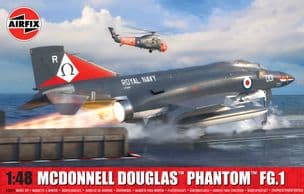
A Cold War icon, Britain was the first overseas customer for the US designed and built Phantom. This artwork image was created to grace the front of the 2017 Airfix catalogue.
Even though this sounds like a perfectly logical undertaking, the installation of these engines required significant design modification to the fuselage of the British Phantoms, including enlarging the engine bays, re-designing the rear fuselage, and equipping the aircraft with larger air intakes at the front of the aircraft, all modifications which gave British Phantoms a very different appearance.
When taking everything into consideration, the additional drag created by these modifications meant that the extra thrust provided by the Rolls Royce Spey engines had little beneficial impact on the overall performance of the aircraft, even if they did create something of an aviation classic.
The initial British order was for an impressive 140 Phantoms destined for the Royal Navy, aircraft which were intended to be operated from four aircraft carriers, two extensively refitted existing vessels, with a further two to be manufactured specifically for the task. Unfortunately, continuing Government austerity measures would eventually dictate that this mighty force would never actually be realized, and with the cancellation of the contract for the two new carriers and a further decision only to upgrade one existing carrier, the Navy’s Phantom order was subsequently slashed to just 48 aircraft.
The Royal Navy received their first F-4K Phantoms (British designation FG.1) in April 1968 and immediately began flying trials with their new aircraft, in preparation for embarkation aboard HMS Ark Royal, the first vessel to be re-fitted to accept these powerful aeroplanes. That first operational embarkation occurred in 1970, when twelve Phantoms of No.892 NAS landed on Ark Royal as part of her air group, beginning a short, but glorious period of British Phantom operation at sea.
More old Airfix artwork delights. With images such as this, is it any wonder that British Phantoms continue to hold such fascination, particularly those which operated from the deck of HMS Ark Royal.
When it comes to iconic images of significant British aircraft, surely nothing comes close to those incredible pictures of a Royal Navy Phantom in the seconds prior to blasting off the deck of HMS Ark Royal. With the aircraft hooked up to the ships steam catapult and with full flap selected, deck handlers would extend the nose wheel oleo to its maximum 40 inch position to increase the launch angle of attack, further increasing the impact of the aircraft’s engine thrust, but making the Phantom look like some huge metal praying mantis.
With full afterburner selected and with the power from the two Rolls Royce Spey engines almost melting the deck of HMS Ark Royal, the Phantom was released to blast into the air, a truly exhilarating experience for those involved in the process, and a spectacle which served as a source of fascination for aircraft enthusiasts the world over.
So, with Phantom launch successfully achieved, now the crews just had the significant task of recovering this hugely powerful aeroplane to the deck of a relatively small British aircraft carrier whilst at sea – no wonder we hold naval aviators in extremely high regard.
Although initially intended as an aircraft to be operated by the Royal Navy, the Phantom would also be later wearing the markings of the Royal Air Force, but not without some controversy. With the RAF’s preferred indigenously designed strike/multi-role aircraft options falling foul of continued project cancellations, and with a deal to buy the American F-111 also falling through, the Phantom already destined for service with the Royal Navy was seen as an excellent, cost-effective option for them, a view which wasn’t shared by Air Force officials.
They felt as if the Phantom was being forced on them, and they would be asked to operate a second rate aircraft in extremely demanding roles, however, it wouldn’t take long for the RAF to appreciate the many qualities possessed by their new Phantoms.
With its nosewheel oleo extended to the maximum, has there been a more appealing sight than this when it comes to post war British aviation?
RAF Phantoms, which were designated FGR.2 (Fighter, Ground attack, Reconnaissance 2), first entered service with Royal Air Force Strike Command in 1969, but would also go on to serve as air defence and reconnaissance platforms, providing the RAF with a significant capability upgrade, as the aircraft were fast, extremely capable, heavily armed and able to stay in the air for longer flight times than the Lightning. Indeed, with the decommissioning of HMS Ark Royal in the late 1970s, the RAF would also inherit the Royal Navy’s Phantoms, using these aircraft to provide air defence support for Britain’s airspace.
An American aviation classic which was given a distinctly British identity, these magnificent aircraft would prove as capable as they were aesthetically appealing, admired and appreciated by those who served on them, and viewed with great affection by aviation enthusiasts everywhere. Despite their American origins, the Phantom is still viewed as one of the most significant British aircraft types of the 20th century, one which would serve with distinction for more than two decades.
Creating a legacy which endures amongst enthusiasts and modellers to this day, it will come as no surprise to learn that the British Phantom’s inclusion in the Airfix range has met with incredible levels of support. That being the case, we’re delighted to confirm that our own construction kit tributes to this magnificent aircraft have just been enhanced, with the release of a newly tooled 1/48th scale version of the aircraft, arguably the scale model kit the hobby has been waiting for.
Our latest Phantom infatuation. Locked and loaded, this stunning new kit is in stock and ready for Workbench lift-off!
Many Airfix fans will probably be only too aware that our scale tributes to the McDonnell Douglas Phantom stem back all the way to 1965, when a newly tooled 1:72nd scale example of this incredible aircraft was released to fuel a vibrant UK hobby market. Although initially released resplendent in US Navy markings, this kit would spend the majority of its early release life presented in Israeli Air Force markings, underlining the international success of one of the world’s most important multi-role jets. Normal US livery service finish options would resume from 1977 onwards, but what British modellers really wanted was an Anglicised version of the Phantom.
Before we proceed much further, we really do have to address the Phantom in the room, that is the name issue itself, because the aircraft the aviation world came to know and love wasn’t the first US jet to inherit the Phantom name. That honour went to the McDonnell FH-1 Phantom in the late 1940s, an early example of US jet power and a very different looking aircraft to the one which followed it into service. Developed during the Second World War, this aircraft occupies a truly historic position within the world of aviation, as it was the first US jet to land and take-off from a US aircraft carrier at sea.
Indeed, when VF-17A became operational with the FH-1 Phantom, they became the first operational jet powered naval squadron in the world. Featuring straight wings and something of a bulbous fuselage, this first Phantom may not have been the best looking aircraft to have ever taken to the skies, but it was an important operational stepping stone to the capable naval jet fighters in service today, and would directly lead to the development and introduction of the highly regarded Phantom II.
Coming back to the classic Phantom shape we all know and love, despite our undoubted affection for this American classic, the one thing British modellers really wanted was an accurate scale representation of our own particular variants of the Phantom, aircraft which possessed all the many qualities of the original, but were given a quintessentially British character. Unfortunately, although various Airfix development teams over the years were only too aware of how popular a British Phantom kit would be in the range, it would take until 2017 before that glorious day came, more than 60 years since a Phantom first joined the Airfix kit family.
A sight soon to be repeated in model display cabinets all over the country, the new 1:48th scale Phantom will be an Autumn project for many over the coming weeks and months.
As you can imagine, this news was the cause of some celebration within the hobby, with only just the odd one or two reservations from a handful of modellers who felt the kit would have been better released in 1:48th scale – if only we could have told them back then!
Although initially released in 1:72nd scale, the Airfix project timeline already had an entry for a larger scale variant of the kit to be produced a little further down the line, and they wouldn’t have to be waiting all that long.
Thankfully, that day has now arrived, and our 1:48th scale Phantom is already in the range landing pattern, and lining up for a hard deck landing. As we fully expected, it seems as if many modellers have been waiting to get some BIG Phantom time in their project logbooks, as the new large scale Phantom is already looking lake being one of the releases of the year.
By way of a new British Phantom celebration, let’s now take a closer look at the three scheme options available to modellers looking to add this spectacular new kit to their Autumn build schedules.
For those of us who have a fascination with aeroplanes, it seems incredible that a human being would want to put themselves in a position to have to land one of these beasts on the deck of a relatively small British aircraft carrier at sea, but that’s exactly what the nation’s top aviators volunteered to do. Videos and still images showing British Phantoms operating from the deck of HMS Ark Royal remain a truly awe inspiring sight for many of us, and despite the final aircraft having left that deck almost half a century ago, the legacy secured by Britain’s naval Phantoms ensures we remain captivated to this day.
With a landing deck approximately 600 ft in length and only 65 ft wide, there could have been no room for error when operating Phantoms from HMS Ark Royal, and it must have taken a very special breed of personnel to both fly and support the operation of these mighty aircraft at sea. With little available space on the deck and a relatively short area available for take-off and landing, Ark Royal would certainly not have been a place for the faint-hearted, and it is difficult to imagine just how intense this experience must have been for those concerned. One thing is absolutely certain, Royal Navy Phantom operations off HMS Ark Royal produced some of the most iconic aviation images in the history of naval aviation, at the same time establishing a modelling phenomenon.
With an appearance often likened to that of a huge metal praying mantis, the Navy’s Phantoms needed all the help they could get when leaping from Ark Royals diminutive flightdeck. With the aircraft connected to the ships steam catapult and full flap selected, the ground handlers would extend the nose wheel oleo to its maximum 40 inch position, giving the aircraft a distinct nose up attitude and further increasing the angle of effective engine thrust.
With maximum afterburner selected and the power almost melting the ship’s deck, the Phantom was finally released to blast itself into the air. This must have been a truly exhilarating experience for those in the aircraft, as well as those lucky enough to be witnessing the spectacle on real time.
As a launch procedure though, it could be argued that there was little input required by a navy Phantom pilot during take off, however landing would be a different kettle of fish altogether.
Landing this mighty jet fighter on the deck of a relatively small aircraft carrier at sea was a different matter altogether, and would have taken every ounce of skill possessed by a very special breed of airmen. To see these huge aircraft slamming down on the deck of Ark Royal would have been both impressive and a little disconcerting at the same time, and would have required every member of the carrier deck teams to bring all their years of training to bear. By their very construction nature, naval aeroplanes are bred to be tough, so they can withstand the punishment of repeated deck landings, but for the Phantom pilot landing on HMS Ark Royal for the first time, could there have been a more daunting task?
With very little room for error or miscalculation, landing this beast of an aeroplane on Ark Royal would be an achievement every time it was successfully completed, and a great many lives depended on you doing so successfully. Approaching the ship with many critical eyes watching your every move, the pilot would attempt an arrested landing, using all his training, combined with indications from the deck landing controller, who’s job was to guide him in for a perfect landing.
Applying full engine power when the aircraft’s main wheels made contact with the ship’s deck, if the arrestor hook had engaged with the ship’s wires, he would quickly have to disengage that power, fold the outer wing sections and follow the deck handler’s instructions for clearing the landing area, allowing the next aircraft to land.
If something went wrong and the wire wasn’t caught, full power setting would allow the aircraft to safely get back into the air and prepare for another landing attempt, known in the trade as a ‘Bolter’. This was clearly not ideal, as he would have to go through the routine at least one more time, with other aircraft potentially being in the landing pattern and the Phantom rapidly running out of fuel - these were fuel-hungry beasts. There was also the small matter of the pilot knowing that the majority of deck landings were filmed, so if he wasn’t having his best day at the office, his travails would be there for all to review at a later debrief.
Perhaps this is why we continue to have a fascination for Royal Navy Phantoms and their operation.
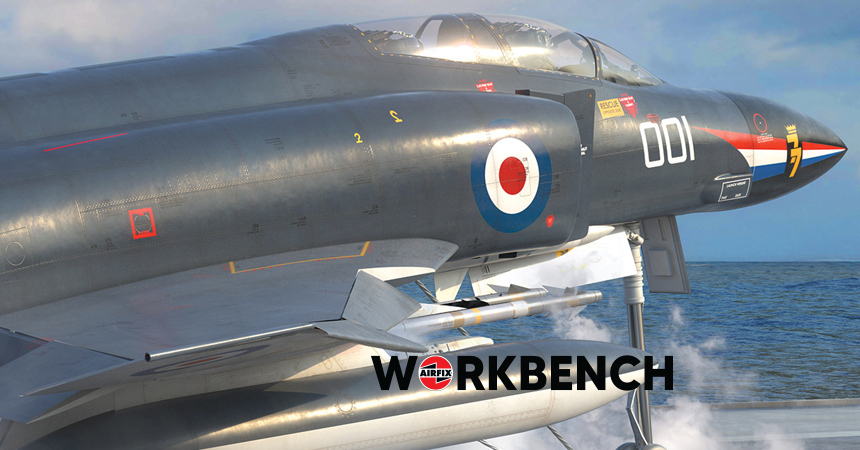
Royal Navy Phantom FG.1 XT868 was ordered as part of the first F.4K production batch in July 1965 and is presented here in the colours of No.892 NAS, the only operational Fleet Air Arm squadron to fly the Phantom at sea. She is seen hear wearing special markings in celebration of the Queen’s Silver Jubilee Fleet Review and aircraft flypast, a significant undertaking which took place in honour of Her Majesty the Queen during 1977, with the distinctive nose markings carried for the rest of the year.
This aircraft was tragically lost in a fatal accident at RAF Leuchars in May 1978. As the aircraft was practicing for a display performance at the airfield, a double engine failure resulted in both crew having to eject at low altitude, with disastrous consequences.
The Royal Navy would be great supporters of the Phantom and couldn’t wait to get their hands on as many examples as possible. The modifications to Anglicise the aircraft were as a direct result of their requirement to boost the take-off performance of the fleet fighter, better equipping them for operation from the relatively small decks of Britain’s aircraft carriers, and whilst these modifications were viewed by many as having only limited performance benefits, they did result in the creation of an enduring aviation curiosity.
Prior to the first production order being placed, the Navy were looking forward to operating a mighty force of some 140 Phantoms, with training and conversion units supporting squadrons deployed aboard the carriers Ark Royal and Eagle, along with a planned new British ‘Super Carrier’. Unfortunately, these ambitious plans were never realised, and the Defence White Paper of 1966 was littered with cuts and cancellations, reducing the Phantom order to 110 aircraft, in addition to also cancelling the proposed new carrier.
Cost pressured would continue to affect the Navy’s Phantom aspirations over the next few years to a point where the Phantom order was reduced to just 48 aircraft, twelve each for Ark Royal and Eagle, with others allocated to training and conversion.
Unfortunately, ministers weren’t finished yet, and the cancellation of HMS Eagle’s refit would see 20 of the Fleet Air Arm’s Phantom FG.1s redirected to the Royal Air Force, but despite this, the Phantoms which did wear the colours of the Fleet Air Arm would become some of the best loved aircraft to have ever seen British post war service, and help us to imaging just how impressive that originally envisaged force of 140 Phantoms would have been.
This scheme option represents a British Phantom from the early days of Fleet Air Arm operations, as she is seen in the colours of No.700P Intensive Flying Training Unit, with their distinctive Phantom ‘Spook’ tail motif. This unit was established at RNAS Yeovilton prior to the formation of No.892 Squadron and intended to provide test and evaluation support in advance of the Phantom being embarked aboard HMS Ark Royal. Formed in April 1968, this unit may have been relatively short lived from an operational standpoint, but worked its aircraft and crews hard in preparing the Phantom for squadron service.
If interested, you can find pictures online which show this very aircraft engaged in inflight refuelling ‘buddy’ trials with a FAA de Havilland Sea Vixen, still wearing its distinctive tail markings, and working hard to prepare the Phantom for front-line Royal Naval service. Indeed, despite 700P IFTU disbanding in March 1969, this aircraft would enjoy a long and active service career, representing this unit and Nos. 892 and 767 Naval Air Squadrons, before passing to the Royal Air Force and ‘Treble One’ (RAF No.111) squadron. She would eventually fall to the scrapman’s axe at RAF Leuchars in April 1992.
Another of the early Royal Navy Phantoms to see service with No.700P NAS, XT864 would also go on to enjoy a long and active service career, and is still preserved in stunning order to this day – more on that a little later.
With so few Phantoms eventually being purchased for the Royal Navy, many of the aircraft would go on to see service with several different Fleet Air Arm units and after being delivered to the Royal Navy in 1968 and serving with the Intensive Flying Training Unit, XT864 would go on to wear the colours of No.767 Naval Air Squadron. Re-forming at NAS Yeovilton (HMS Heron) in January 1969, this unit was tasked with training both Royal Navy and Royal Air Force pilots to fly the Phantom FG.1, with RAF pilots mainly going on to fly with No.43 Squadron ‘The Fighting Cocks’ at Leuchars.
The majority of this training would have taken place at Yeovilton, although 767 NAS also used HMS Ark Royal for carrier deck landing training.
Again resulting in some of the most distinctive aircraft to ever see British service, No.767 Naval Air Squadron adopted an angular sea eagle design as their squadron symbol, one which was colloquially referred to as the ‘Ten Ton Budgie’ and anyone lucky enough to have seen these handsome aircraft in operation will surely have fond memories of the experience. In a fascinating development which was indicative of the uncertain nature of the Royal Navy’s Phantom procurement programme, some of the No.767 NAS aircraft were actually delivered to RNAS Yeovilton wearing RAF camouflage.
Full scheme details for this most famous of preserved Phantoms.
Phantom XT864 served with 700P and Nos.767 and 892 Naval Air Squadrons during a ten year period from 1968, after which time she was transferred to the Royal Air Force and a period protecting the nation from unwanted Soviet air incursion from the QRA station at Leuchars in Fife. Representing RAF No.111 Squadron ‘The Tremblers’, this aircraft would see a further ten years of service with the RAF, before she suffered damage in a ground accident in 1988.
Withdrawn from service, she was allocated the maintenance serial 8998M and restored to static display standard, serving as a squadron gate guardian first for No.111 Squadron, and then for No.43 Squadron ‘The Fighting Cocks’, a unit with which she didn’t actually fly during her service career.
The announcement in 2011 that RAF Leuchars was to close as a front line fighter station brought about an air of uncertainty regarding the base and in particular, the non-operational airframes still in existence there, including Phantom XT864. Many former British Phantoms were unceremoniously scrapped at the end of their service lives, but that was not to be a fate befalling this aircraft, as enthusiast eyes across the Irish Sea had set their sights on her.
Members of the Ulster Aviation Society had long harboured a desire to obtain an example of the British variant of the McDonnell Douglas Phantom, partly due to the aircraft’s links to aviation heritage in the region, and partly down to the reputation these incredible aircraft earned over the years.
When society members heard that the former RAF QRA base at Leuchars were inviting bids for the purchase of their gate guardian Phantom XT864, they waisted no time in registering their interest, and were fortunate to be successful in securing the aircraft. All they had to do now was to head to Leuchars and dismantle their new Phantom, before transporting it back to their museum facility at Maze Long Kesh in Northern Ireland.
Phantom XT864 arriving at Maze Long Kesh still wearing her RAF No.43 Squadron gate guardian plumage.
At her public unveiling ceremony, XT864 was resplendent in new markings, those she wore during her time with No.892 Naval Air Squadron. Doesn’t she look magnificent.
The size of the task which faced the team cannot be overstated, as they are an entirely volunteer run group, relying solely on membership fees, events and charitable donations for their survival. Fortunately, they can also count on the determination and engineering prowess of a committed group of people, many of whom have service experience, and all who clearly feel that no problem is insurmountable, and with honest endeavour always coming as standard.
Thanks to the support of the Leuchars base and the loan of a former Phantom hardened aircraft shelter, over a period of several months and numerous trips between Northern Ireland and Scotland, this monumental task was completed in triumph, and Phantom XT864 arrived at their Maze Long Kesh museum site still wearing her RAF No.43 Squadron markings.
She has since been repainted in striking No.892 NAS ‘Silver Jubilee’ markings, and is one of the prized display possessions at this magnificent museum, one which is well worth a visit if you ever find yourself in this part of the world.
There’s a new classic Airfix kit in town – well, at least whilst stocks last there is!
Three appealing schemes for one incredible aircraft, the arrival of our new 1:48th scale McDonnell Douglas Phantom FG.1 kit really is a cause for modelling celebration, and as these beautiful models continue to fly out of our warehouse as if in full reheat, it appears that our infatuation with British Phantoms is as strong today as it ever was – long may that continue.
As the time of publishing this latest blog, we do still have free stock available via the Airfix website, however, an additional replenishment order has already been placed in order to fuel our Phantom passions. If you do miss out this time, we’ll have more Phantoms inbound in the near future.
We're afraid that's all we have for you in this latest edition of the Airfix blog, but we will be back in two weeks' time with more project development updates and the very latest Airfix kit exclusives. In the meantime, we're always keen to hear your views on all things Airfix and in particular, any thoughts and opinions you may have regarding our Workbench blog. If you would like to drop us a quick line, could we please ask that you use our workbench@airfix.com email for all correspondence.
To re-visit any of the Airfix blogs we have produced over the past TEN years or so, please head to our main Workbench hub, where you'll find our entire blog back catalogue and all the Airfix design projects we have already covered.
All our dedicated official social media sites can be accessed by clicking the respective link icons at the foot of this page, or by heading to the Airfix homepage. Other useful Airfix links are:
Facebook, YouTube, Twitter and Instagram official sites
Please join us for more Airfix updates next week and thank you for your continued support.