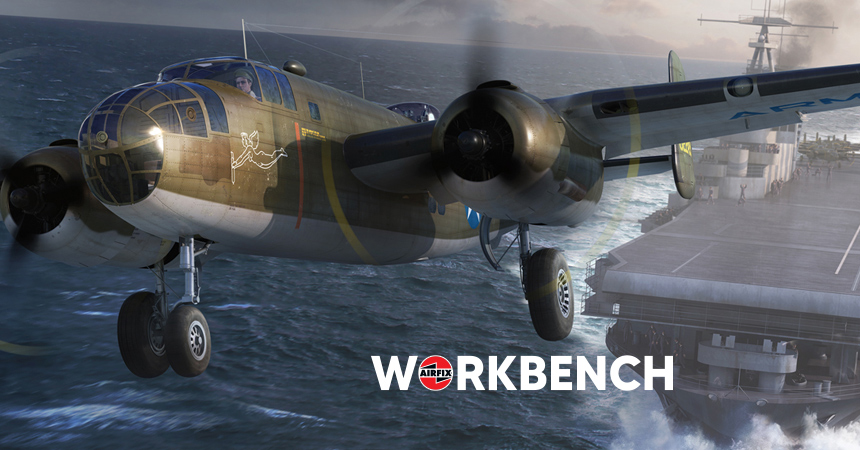
We’re pleased to be bringing you this latest edition of our regular Workbench blog, and all the news, updates, and modelling exclusives from the fascinating world of Airfix.
One of the most rewarding aspects our beloved hobby brings to the modelling community is how it helps to preserve history with the scale representation of some of the machines that helped to shape history, along with the people who built, maintained and operated them. Any Airfix model kit range will be littered with all manner of historic craft just waiting to be discovered, and if you have a particular interest in a machine, operation, or the actions of a crew or individual, a beautifully finished model kit will definitely make for a most appropriate display centrepiece for such a tribute.
In this latest edition of Workbench, we will be marking the reintroduction of a relatively recent tooling addition to the range, but in a very specific guise, a classic US medium bomber from the Second World War which would go on to become one of the most important to see service across all the Allied nations, but made a statement introduction to the conflict in the most dramatic of circumstances. We are, of course, talking about the North American B-25 Mitchell, and how this aircraft was used to demonstrate America’s determination to achieve total victory whatever the cost, now they had been dragged into WWII, when 16 B-25B Mitchell bombers manned by volunteer crews launched from the deck of a US aircraft carrier and into the pages of history.
This week’s subject is what the love of modelling is all about, classic model kits, historic scheme options, and a story that’s so incredible it needs commemorating in scale form.
For those of us who have developed a fascination for history, military history and specifically aviation history, we’re only too aware that the six years of conflict which erupted in Europe during 1939, created a phenomenon of technological advancement which saw the aeroplane being ushered from the basic biplane designs similar to those which contested the Great War, to the highly advanced jet powered aircraft which pointed to the future of aviation.
Amongst that collection of aircraft types which were designed and introduced within this period of aviation development, only a relatively small number stand out as being particularly significant, noteworthy aircraft which went on to make significant contributions to the war effort of the air forces they represented. One aircraft type which must be considered in such terms is the North American B-25 Mitchell, a twin engined medium bomber which would become the most heavily produced American aircraft of its type during the war years, in addition to also being one of the most adaptable and heavily armed aircraft to have seen wartime combat operations.
The aircraft which would go on to become the B-25 Mitchell was originally developed in an attempt to satisfy a US Air Corps requirement for a new, high performance attack bomber in the late 1930s. The North American Aviation company developed their NA-40 design in response to this specification, an aircraft which first flew in January 1939, but ultimately failed to impress officials during flight trials, losing out to the rival aircraft produced by Douglas, their DB-7 (A-20 Havoc).
Undeterred, North American designers continued to work on improving their design, convinced that it had all the qualities to succeed as a strike bomber and as a consequence, following the Air Corps issuing a further requirement for a medium bomber in March 1939, their revised NA-62 design was presented as a potential option.
Now a more mature design, the NA-62 was ordered into production, however, even though the aircraft was now destined for USAAC service, it still underwent continual development throughout production, as the North American designers and engineers were convinced their aircraft could be made even more capable. The most significant performance improvement came ten aircraft into the production run, when stability issues discovered on the first machines demanded a redesign of the outer wing sections.
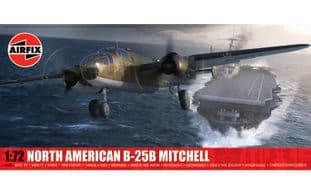
Airfix box artwork which shows a rather idyllic scene over which to operate your B-25. It was very different for the Doolittle Raiders.
Rather than continue with the constant wing dihedral, which was a feature of the earlier machines, designers incorporated a slight wing anhedral outboard of the engine nacelles, a modification which gave the new bomber a distinctive gull-winged appearance when viewed from the front. With several other improvements added to these early production aircraft, the B-25 soon began to show the great potential its designers knew it possessed and show itself to be a highly effective medium bomber.
The new North American bomber was given the name ‘Mitchell’ in honour of Major General William ‘Billy’ Mitchell, a man who was a great champion of air power and a significant figure in the history of the United States Air Force. As an airman serving on the Western Front during the Great War, Mitchell had witnessed the rise of aviation and air power first hand, experiences which convinced him that the aeroplane would play a significant role in any future conflict.
This strong conviction would bring him into some conflict with senior officials in both the US Army and US Navy, as he vociferously argued against continued spending on expensive battleships, particularly as air power had now rendered them almost obsolete in his learned opinion. To evidence his opinion, he famously arranged for a series of dramatic demonstrations to take place, where bomber aircraft attacked obsolete warships to prove the vulnerability of these floating leviathans to attack from the air.
He followed this up by arguing that all future investment which would have been allocated towards the procurement of new battleships, should instead be immediately diverted to the production of powerful new aircraft carriers. Although frowned upon at the time, history would go on to consider Mitchell something of a military visionary in this regard.
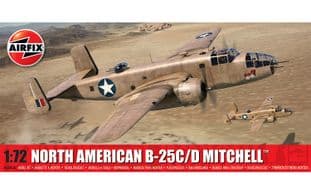
More appealing Airfix B-25 box artwork, a clear illustration of how widely the Mitchell was used across every theatre during the Second World War.
The role of the medium bomber was to prove vital during the Second World War, with aircraft often required to operate at much lower altitudes in support of ground operations, rather than the high altitude operation mounted by heavier four-engined bombers. The effectiveness of the B-25's design had not escaped the attentions of the Royal Air Force, and they would become an early customer for the bomber, securing significant numbers of aircraft via the crucial Lend-Lease agreement between Britain and America.
The first RAF B-25B Mitchells were delivered in August 1941 and were given the British service name Mitchell I, serving with No.111 Operational Training Unit, based in the Bahamas.
These first aircraft were used exclusively in a flight training and crew familiarisation role, never actually achieving operational status, however, the RAF were keen to secure as many of these capable bombers as they were allowed to get their hands on, as the intended replacements for their ageing Wellingtons and less effective Douglas Boston bombers. In total, the Royal Air Force would eventually take delivery of almost 900 Mitchell bombers, the vast majority of which would go on to see service during the last two years of the war, used particularly heavily during the period around the D-Day landings in 1944.
Historically, the Mitchells of the Second Tactical Air Force were amongst the first strike units to transfer to forward operating bases in France and Belgium, as these rugged and capable bombers continued to fly close air support missions in aid of advancing Allied ground forces. The most heavily used variant of the Mitchell in RAF service was the B-25C/D model, of which 538 were received - this variant was referred to as the Mitchell II in British service. Some of these British Mitchells would post impressive mission counts as they fought to underpin Allied gains as they advanced through continental Europe.
With regard to the wider historic reputation of the B-25, perhaps the aircraft's most significant attribute was its versatility and adaptability, and how although it may not have been specifically designed to perform a particular task, it nevertheless took up the challenge and performed it with much credit. Whether that be as a low altitude gunship, VIP transport, or hard working strike bomber, the Mitchell proved itself to be an exceptional aeroplane.
Despite its many achievements and historic plaudits, the B25 Mitchell went on to claim, it could be argued that its most famous role was one for which it was never intended, and was actually totally unsuitable for, that of twin engined carrier borne strike bomber, one of the sixteen aircraft which have attracted our attention for this edition of Workbench.
In the weeks which followed the devastating Japanese surprise attack against the US naval base at Pearl Harbor, American Military planners established the ‘Joint Army-Navy bombing project’, to explore the feasibility of mounting a statement, strategic bombing strike against targets on the Japanese mainland itself. Although such a strike could never hope to match the scale of the Pearl Harbor attack, the phycological impact of hitting targets on the Japanese home Islands could have a profound impact on their enemy, whilst at the same time bolstering support for the war amongst the American population.
With America now fully committed to war, the raid would also demonstrate their fighting resolve to the entire world, particularly those who had already been waging war for over two years at that point. The original plan called for a number of Army Air Force bombers to be launched from the deck of a US Navy carrier, recovering the aircraft to the same carrier on the completion of their mission. The most suitable aircraft for such an undertaking was the relatively new North American B-25B Mitchell bomber, but as plans began to take shape in earnest, the recovery of the bombers to the heaving deck of an aircraft carrier steaming somewhere in the Pacific Ocean was never going to be a viable plan.
The alternative option would be no less challenging for the crews, but at least gave them a fighting chance of making it back to solid ground, and hopefully, to safety. One of the bombers would serve as a pathfinder aircraft, dropping incendiaries to ‘light up’ the target area, with the rest of the force following on and guided by the resulting fires. Each aircraft would then make for landing sites in China, where they would hopefully make successful forced landings and attempt to avoid capture by Japanese troops.
For plans such as these and the extremely hazardous nature of the mission, hero aviators were going to be needed, but thankfully, America could count on such men as Jimmy Doolittle, a daredevil pilot and national celebrity, and a man who intended to lead this important mission himself. All he needed to do now was to recruit around 80 of America’s finest young airmen, and convince them to take part in a top secret mission, a mission which had no guarantee of their survival. As anticipated, he had no shortage of willing volunteers.
Training for the Japan raid began in early March 1942, with Twenty four B-25B Mitchell bombers being drawn from the 17th Bombardment Group USAAF, each one stripped of unnecessary equipment and benefitting from the addition of extra fuel tanks. Crews embarked on an intensive period of training, where they practiced everything from low altitude cross-country flying, to perfecting evasive actions following the bombing of targets at these low altitudes.
Eventually, sixteen aircraft were embarked on the aircraft carrier USS Hornet, as this was the maximum number of aircraft the ship could accommodate – with the Mitchell bombers lashed down on the deck of the ship, there was little room to spare and significantly, the first aircraft to leave the ship would be doing so with just a short length of deck to safely make their take-off run.
The task force would attempt to take the bombers to within 400 miles of the Japanese coast, before turning into wind and launching the aircraft for the attack, but this was only after Doolittle had managed to persuade the task force commander to take his men 200 miles closer than initially intended whilst the force was en route, to give his men the greatest potential for success.
Fearful of detection by one of the many Japanese radio equipped picket boats in the area, the plan also included the option to launch early, should the task force was discovered, to avoid possible attack by enemy land based attack aircraft.
The historic scene aboard USS Hornet as she steamed towards her launch point off the coast of Japan and this significant raid which would send an important message to America’s enemies.
Full scheme details for this most famous aeroplane.
As the USS Hornet task force steamed towards the Japanese coast and aircrews prepared for their historic mission, their worst fears came to pass, and they were indeed detected by an enemy ship. Despite the fact that the enemy vessel was destroyed, they were sure a radio message had been relayed, leaving the mission commander with something of an impossible decision – abort or go! The decision was taken to launch the Mitchells early, and crews prepared their aircraft.
Just after 8am on 18th April 1942, the first of sixteen B-25B Mitchell bombers lifted off the heaving, relatively short deck of USS Hornet and set course for Japan – this would be the first time that any of these airmen had taken off from the deck of an aircraft carrier at sea.
Flying at extremely low over the heavy seas to avoid detection, the raiders had a six-hour flight ahead of them before reaching their various assigned targets, with the strong possibility that they would either be intercepted by enemy fighters and/or subjected to heavy anti-aircraft fire once they reached the coast. If the crews managed to complete their mission, they would then have to set course for China, aware that from this point onwards, it was very much a case of every man for himself.
North American B-25B Mitchell 40-2249 ‘Hari Kari-er’ was the eleventh bomber to take off from the deck of USS Hornet at 08.56, with her crew assigned to bomb targets in the Yokohama area. Approaching the Japanese mainland north of their intended waypoint, the bomber inadvertently flew over an active enemy air base and almost immediately came under fighter attack. Whilst pilot Ross Greening lined the aircraft up for its bombing run, his gunner shot down one enemy fighter and damaged a second, before then turning his guns on any targets of opportunity he could see.
With the bombs dropping on a large oil refinery and storage facility, the aircraft subsequently set course for China, all the time fearful of further enemy air attack. Unable to locate their assigned landing airfield, the crew bailed out of their aircraft some 200 miles inland of the coast and despite sustaining a few minor injuries, all five men landed safely – ‘Hari Kari-er’ flew on un-manned for a while, before crashing in the mountainous region between Zhejiang and Anhui provinces.
A fascinating piece of computer rendered CAD imagery, created by the Airfix design team, and attempting to simulate the view aboard USS Hornet on 18th April 1942.
Although the ‘Doolittle Raid’ was undoubtedly a resounding propaganda success for America, galvanising the nation for the many struggles to come, Jimmy Doolittle actually regarded the operation as a failure. All sixteen Mitchell bombers were destroyed in the aftermath of the raid, and three of his men had been killed during these actions, with others becoming prisoners of war. Tragically, three of these captured airmen were subjected to mock trials by their Japanese captors, and were subsequently executed for alleged war crimes.
When news of this heinous act was delivered to the nation by President Franklin D Roosevelt, the people of America responded in the only way they could, by purchasing more than $11 Billon in war bonds, assisting the war effort, in the hope of avenging the murder of their countrymen.
One relatively unheralded aspect of the Doolittle Raid was the selfless and extremely courageous manner in which ordinary Chinese people helped the surviving raiders, giving them shelter and arranging their safe transportation across the country. Many of these people would pay a heavy price for the part they played in assisting the Americans, as Japanese troops exacted a vicious revenge in the aftermath of the raid.
On reaching safety, most of the Doolittle Raiders eventually returned to active flying duties with the USAAF, with many going on to serve across various theatres of operation. The Doolittle Raid was just a start, but it did serve to set the tone of the years of hard fighting to come.
The 17th Bombardment Group of the US Army Air Force had the distinction of being the first air group to receive the new North American B-25B Mitchell bomber, with the first aircraft arriving at McChord Field on 25th February 1941. Further aircraft would arrive over the next few months and by June, the entire group would be required to re-locate to a new home at the recently constructed Pendleton Field, in Oregon.
During this time, and even though war was already raging in Europe and the Japanese were expanding their empire in South-East Asia, life for the pilots of the 34th BS, 17th BG must have been rather pleasant. Although their flight training programme was intensive, duties would include practice bombing sorties, or cross-country flying to the North American facility at Inglewood, California, where they would pick up the latest B-25 Mitchell additions to their squadron’s numbers. Their growing experience in flying this capable new bomber would be required in an operational sense a little sooner than they thought.
During the second week in September 1941, the entire 17th Bombardment Group relocated to Jackson, Mississippi, where they were scheduled to take part in the largest war game exercise the world had ever seen. Following a root and branch assessment of America’s ability to wage war during 1940, serious shortages in men and equipment had been identified, and plans were immediately put in place to rectify this situation.
Full scheme details for this early training variant of North American’s Magnificent Medium.
More computer rendered B-25 goodness from the design files created in support of the new North American Mitchell tooling.
The Great Louisiana Manoeuvres of September 1941 would test the effectiveness of these remedial actions, and would involve around 470,000 men spread over 3,400 square miles of Louisiana and Texas territory, with two great armies acting out two different operational scenarios over the course of the two week exercise. These simulated battles were conducted in as near combat situations as could possibly be achieved, with American military commanders knowing that their men would be thrust into war in the very near future, no matter what. Officials wanted to equip their troops with valuable experiences which would hopefully stand them in good stead on the battlefields to come.
These mighty battles were fought without a single shot being fired, however some of the tactics used in securing military objectives in Louisiana would later be used on battlefields across Europe and the Pacific.
Following the end of the Louisiana Manoeuvres, the 17th Bombardment Group would spend the next few weeks undertaking a series of further exercises, operating from several bases across the country, and all the time gaining more experience in operating their new Mitchell bombers. Crews were hoping that Christmas 1941 would allow them to enjoy a short period of relaxation and time away from training, however, the Japanese attack at Pearl Harbor would dash such hopes, and ensure a busy period for crews flying anti-submarine patrols along the Washington and Oregon coastline.
They would quickly gain more experience flying the B-25 Mitchell than any other group in the USAAF, skills which would stand them in good stead for a significant operation which would take place in the spring of 1942. Moving base yet again in February 1942, this time to Columbia Army Airfield in South Carolina, the group began practising short take-off and landings, along with low-level cross country flight operations, in preparation for the ‘Doolittle Raid’ and America’s historic strike at the heart of their Japanese enemy.
An extremely welcome re-introduction to the Airfix kit range, the historic credentials of the Doolittle Raid surely require every display of built models to have an example of the B-25B Mitchell within it, one of the 16 aircraft to have taken part in an action which announced America’s determination to secure ultimate victory. With both aircraft having either direct or indirect links to the Doolittle Raid, the choice of which scheme to go for won’t be an easy one.
When you factor in the other decal companies who offer markings to allow any one of the other 15 Mitchells which left the deck of USS Hornet on 18th April 1942, the coming darker evenings could offer us an irresistible Doolittle Raid opportunity, just in time for next year’s 85th Anniversary.
A06020 North American B-25B Mitchell is in stock and available now.
We're afraid that's all we have for you in this latest edition of the Airfix blog, but we will be back in two weeks' time with more project development updates and the very latest Airfix kit exclusives. In the meantime, we're always keen to hear your views on all things Airfix and in particular, any thoughts and opinions you may have regarding our Workbench blog. If you would like to drop us a quick line, could we please ask that you use our workbench@airfix.com email for all correspondence.
To re-visit any of the Airfix blogs we have produced over the past TEN years or so, please head to our main Workbench hub, where you'll find our entire blog back catalogue and all the Airfix design projects we have already covered.
All our dedicated official social media sites can be accessed by clicking the respective link icons at the foot of this page, or by heading to the Airfix homepage. Other useful Airfix links are:
Facebook, YouTube, Twitter and Instagram official sites
Please join us for more Airfix updates next week and thank you for your continued support.