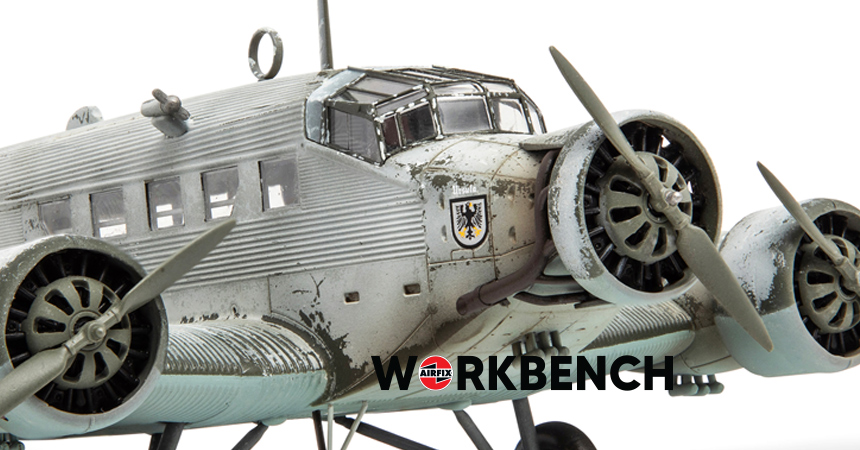
We’re pleased to be bringing you this latest edition of our regular Workbench blog, and all the news, updates, and modelling exclusives from the fascinating world of Airfix.
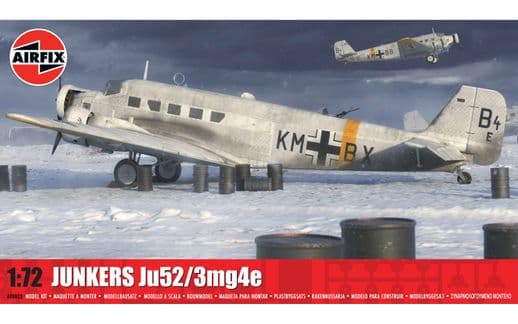
Our new scale kit tribute to one of the world’s truly great aeroplanes of the 20th century is our subject for this latest edition of Workbench, as we will be bringing you a full introduction to our Junkers Ju52/3mg4e, our latest new tooling addition to the 2026 Airfix range. In addition to discovering why the Ju52 has to be considered one of the most important aircraft types in the history of aviation, we will also be seeing how this new kit isn’t our first sortie when it comes to ‘Iron Annie’ kits in this scale, but how our latest scale tribute sets new standards when it comes to creating our own scale tributes to this aviation heavyweight.
In addition to bringing you scheme details for all three options included with this impressive new kit, we will also be sharing an exclusive first look at models finished in all three of those schemes, and if the Ju52 isn’t currently on your build radar for the rest of 2026, prepare to have it force its way into contention, as all three scheme options are as eye-catching as they are engaging.
We’re in tri-motor heaven this weekend, as the famous Junkers airliner turned wartime Luftwaffe stalwart finds itself in the Workbench review crosshairs.
In a development which is already appealing to modelling hobbyists everywhere, the Junkers Ju52/3m has rejoined the current Airfix range in some style, a new tooling project which is surely destined for classic status.
In post Great War Germany, the restrictions imposed on them by the Treaty of Versailles were intended to make the nation incapable of mounting offensive actions of any kind in the future, with Article 198 explicitly preventing them from having an air force. Despite this, the rise of nationalistic leadership in the country during the 1920s and 30s brought with it a great amount of subterfuge and a period of modernisation kept secret from the victorious powers.
With aircraft such as the Fokker D.VII highlighting Germany’s prowess in the field of military aviation at the end of the Great War, that expertise was now brought to bear in the design and production of world leading civilian and transport aircraft, aircraft which could be adapted for more aggressive roles if and when required. This was supported by a secret pact with Russia, which saw German air and ground crews being sent east to train extensively, with the intention of providing them with experience in operating modern aircraft effectively, when the time came.
Back in Germany, aircraft companies were hard at work designing and manufacturing new aircraft types which possessed the ability to adapt to changing role requirements in the years ahead, with perhaps one of the most famous examples being the mighty Junkers Ju52/3m series. Despite being one of the most distinctive aircraft to have ever taken to the skies, the Junkers Ju52 actually started life as a single engined freight carrying aircraft, one which made its first flight in October 1930.
Although this new aircraft showed great promise and incorporated a host of advanced features within its design, most civilian operators at the time preferred the redundancy reassurance of multi-engined aircraft operation, so few were showing solid interest in the impressive new aircraft. Despite this, Chief Designer Ernst Zindel was supremely confident in the potential his new aircraft possessed, and had already started work on an upgraded, three engined variant - the 3m, or three motor Junkers, an aircraft which would make its debut just six months after that of its single engined predecessor.
Although a design from the 1930s, the Junkers Ju52 has always be considered an interesting aircraft, one which easily made the transition to the world of scale model aircraft kits.
Possessing much greater power than the Ju52/1m, and the welcome reassurance of multi-engined operation, these new three engined variants of the aircraft could carry 17 passengers and their luggage in relative comfort for that period, the potential of which was not lost on the German national airline Lufthansa, who used the Ju52 to help them establish early commercial routes throughout the nation, and onward throughout wider Europe.
A reliable and extremely rugged aeroplane, the Junkers Ju52 would also be pressed into service as the personal transport of senior political figures in Germany during the 1930s and with the re-emergence of the Luftwaffe, was also seen as the ideal transport and heavy utility aircraft to keep the Wehrmacht supplied throughout the struggles to come.
Significant in its adoption of Duralumin, a light, yet extremely strong aluminium alloy invented by a German metallurgist at the turn of the 20th century, and a corrugated all-metal construction, this combination endowed the Junkers Ju52 with great structural integrity and load bearing strength, whilst being tough and easy to maintain, but with a trade off in aerodynamic performance – the Ju52 could never be described as a speedy aeroplane.
Taking this a step further, it could even be argued that the Junkers Ju52 appeared a little boxy and slightly cumbersome by late 1930s aviation standards, however, it would prove to be an extremely strong and highly versatile aircraft, one which would go on to see widespread service throughout the Second World War, and in every theatre German troops were deployed.
Used mainly as a troop transport and supply aircraft, the Ju52 would also be pressed into service as an airborne ambulance, paratrooper transporter, glider tug and even as an impressively apportioned floatplane. Highly specialised aircraft were also pressed into service as minesweepers, employing a large metal degaussing ring under the fuselage, which produced a strong magnetic field which detonated any Allied naval mines it flew over.
Early airliner turned backbone of the wartime Luftwaffe, the Junkers Ju52 might have been considered obsolete at the start of WWII, but it would soldier on manfully throughout the conflict.
Despite being effectively obsolete by the beginning of WWII and being incredibly vulnerable to both enemy fighter attack and anti-aircraft units, the venerable old Junkers Ju52 was forced to continue performing its essential roles well into the final year of the war. She was just so effective in the many roles she was asked to perform, and even though newer, more capable aircraft available types were available, they weren’t available in anything like the numbers required.
When production finally ceased in August 1944, it’s thought that around 100 aircraft were still in Luftwaffe service on the battlefields of Europe, even though they rarely flew in contested airspace by that stage.
The Junkers Ju52 was a regular sight in the skies over Europe during the Second World War, although fortunately for the population of Britain, not in our skies. Fighter Command’s success during the Battle of Britain meant that Germany’s ‘Operation Sealion’ was thankfully postponed, but had the Wehrmacht attempted an invasion of Britain, the Luftwaffe’s Junkers Ju52 fleet would have been at the spearhead of that assault.
This and the previous two images all feature computer rendered images produced from the CAD files created in support of this impressive new tooling project.
Waves of these aircraft would have delivered Fallschirmjäger troops onto airfields, road junctions and strategic communication points in advance of the main amphibious assault, later returning laden with reinforcements, supplies and heavier weapons to enable gains to be strengthened and support breakouts. Indeed, history showed us exactly how such an invasion might have played out, as the aircraft were used in a very similar manner during 'Operation Barbarossa' and the invasion of the Soviet Union.
Thankfully, the British population were spared the sight of hundreds of Junkers Ju52 transport aircraft blocking out the sun during the summer of 1940, meaning this was one Luftwaffe aircraft type we got to admire from a distance.
The Luftwaffe could claim to have had many high profile and impressive aircraft types in service during the Second World War, but surely none could be considered as distinctive as the Junkers Ju52 drei motor.
A chaotic scene from the operation to service the beleaguered German troops trapped in the Demyansk pocket, this new box artwork has been modified several times since it was first revealed at range launch at the beginning of this year.
For those of us who were fortunate enough to have lived through the golden age of Airfix, when almost every shop in our home town had a selection of model kits for sale, there will be plenty of individual releases which still hold pleasant memories for us, and one or two which could be described as being ‘extra special’. In my own modelling journey, one such kit was the original 1/72nd scale Junkers Ju52, one of the first models I saved up for and bought myself, purchased on the first day of that year’s family summer holiday, much to the frustration of my dad. Despite my telling off, it was his fault really, because he introduced me to Airfix in the first place, so I was bound to get hooked!
The fascination with this kit started well before opening the box to inspect the parts inside, as it was blessed with some of the classis box artwork from the talented hands of Mr Roy Cross, with the Ju52 release being particularly inspirational for any young modeller. If those paratroopers jumping out of their aircraft at low altitude to attack the enemy airfield below didn’t have you reaching up to take the box from the model shop display, it can only have been because you were still transfixed by the sight of the second Ju52 peeling away with its starboard engine ablaze, surely destined to join the other burning hulks pictured on the ground! Mr Cross, you’ve got a lot to answer for – your artwork has cost us a small fortune over the years.
A final look at one of the computer rendered images produced from the new Ju52 CAD files, although both will surely be considered Airfix kit classics, this new kit could hardly be more different from its 1960s predecessor, and is quite magnificent.
On opening the box, I remember the kit parts being produced in a similar light blue plastic to the shade of blue applied to the underside of many Luftwaffe aircraft models I had made, but of equal significance was the fascinating corrugated finish across the external surfaces of much of this impressively large model kit, one I couldn’t wait to start building. Once finished, despite its slightly ungainly appearance, the Junkers would always find itself at the front of my built model display, simply by virtue of its aesthetic appeal – it was just more interesting than a Mosquito or Beaufighter, and much more impressive than a Spitfire or Mustang.
That original Airfix Junkers Ju52 kit was introduced back in 1965 and must qualify as one of the most popular Airfix kits of the 20th century, manufactured and released many times over the years which followed, and one which Airfix devotees had earmarked for new tooling attention a long time ago. Thankfully, that day has now arrived, and with our new 1/72nd scale Junkers Ju52/3mg4e now in stock and available, isn’t it time you invited ‘Iron Annie’ to visit your workbench?
The new kit is certainly an impressive example of modern modelling design and manufacturing capability, and with three appealing scheme options to consider finishing your kit in, your biggest challenge is likely to be which one of the three will be getting your vote.
Let’s take a closer look at what’s on offer.
Scheme A – Junkers Ju52/3mg4e WNr.2870 KM+BX, 4./KGrzbV500, Pleskau-West, Russia, March 1942.
As the Luftwaffe’s main supply and troop carrying aircraft, the Junkers Ju52 was heavily involved in the fighting on the Eastern Front, initially operating under almost complete air superiority, but later asked to fly some of the most demanding supply missions ever attempted by military pilots in history. The failed attempt to capture Moscow would not only see a heroic defence by thousands of Soviet troops, but would eventually see the exhausted Wehrmacht forces unable to continue their assault, and actually face a Soviet counterattack.
By the beginning of 1942, the ever strengthening Soviet forces had the Germans on the run and at the town of Demyansk, 6 Divisions of the German 16th Army were surrounded by the Soviets, with only challenging terrain, deteriorating weather conditions and a lack of Red Air Force activity preventing an immediate enemy onslaught. German commanders requested that they be allowed to mount a fighting retreat from what was surely going to be a military catastrophe, but they were refused and ordered to fight on.
The retreat refusal came with Hitler’s personal assurance that the Luftwaffe would keep the encircled troops supplied from the air, and arranged for the entire transport aviation inventory of Army Group Centre, along with half of the transport aviation forces across the entire front were allocated to the task, establishing the air bridge on the express orders of the Führer himself. As the first aircraft started to land, the German defenders established an effective defensive ring, one which kept attacking Soviet troops at bay, allowing the transport aircraft of Luftflotte 1 to undertake their perilous work.
This lead scheme from this newly tooled Junkers Ju52 kit will be difficult for many to overlook.
Aircraft arrived at airfields such as Pleskau-West from bases in Germany to take part in the operation, with these serving as vital staging hubs for the supply of troops in the Demyansk Pocket. The salient included airfields at Demyansk and Peski, but crews knew that every Soviet gun in the area would be taking pot shots at them at every opportunity, and if the weather was poor enough to provide them with some semblance of respite, this would bring its own dangerous challenges.
The Luftwaffe’s efforts were almost superhuman and they managed to not only sustain the defensive capabilities of their ground troops, but ultimately to actually allow a breakout counteroffensive by Wehrmacht forces. The breakout was only possible due to the Luftwaffe mounting more than 15,000 individual sorties, delivering at least 270 tons of supplies and carrying troops in and out with virtually each mission flown. Over the course of the entire Demyansk bridgehead operation, it’s been estimated that something like 32,500 sorties were flown in support and in addition to delivering hundreds of tons of supplies and ammunition, several hundred passengers and wounded troops were flown in and out of the two serviceable airfields available to them.
Despite this being a significant victory for Germany and the Luftwaffe, a repeat attempt following the Battle of Stalingrad would have a very different outcome. Despite the confident boasts of Luftwaffe High Command, efforts to mount a similar air bridge operation fell woefully short of what was required, directly leading to an ignominious and costly defeat. The ‘Blood pocket’ of Stalingrad proved to be a significant turning point in the history of the Second World War and the clearest indication yet as to how the conflict would end.
Scheme B – Junkers Ju52/3mg4e WNr.6141 VB+IN, Transportstaffel/II. Fliegerkorps, Russia 1941.
Although hundreds of Ju52 aircraft would eventually fly tens of thousands of sorties under Soviet skies during the Second World War, Tante Ju’s first excursion into Soviet territory was an unusual and fascinating one. With Germany and the USSR operating under the terms of an uneasy pact between the two nations in early 1941, Russia had ordered 10 Junkers Ju52 transport aircraft from their German friends, and a demonstration flight had been arranged to fly an aircraft directly to Moscow to allow military officials to inspect it.
At that point in the European war, Germany had conducted hundreds of unauthorised reconnaissance flights over Soviet territory to plot airfields, military infrastructure and other points of strategic interest, and whilst the Russians knew these flights were taking place, they didn’t want to risk a souring in this already tenuous relationship by ordering an intercept.
On 15th May 1941, the crew of a Ju52 were waiting for Soviet confirmation of their proposed flight-plan, which included a fuel stopover along the way, however, the stop didn’t appear to agree with the Soviets, and no official approval was received. Nevertheless, the aircraft took off from Königsberg and headed for Moscow, deviating from the officially filed flight-plan and running a serious risk of being shot down by the Russians. Despite being detected by Soviet observation posts, the aircraft was not fired upon, or intercepted by Soviet fighters and continued flying towards Moscow.
Communications between the Ju52’s pilot and Soviet controllers can only be guessed at, along with the actual purpose of the flight, but what we do know is that the Junkers flew all the way to Moscow and landed unrestricted at the city’s Airport. Historians have since argued that the crew may have been carrying an official letter from Hitler to Stalin, which may have explained the unusual circumstances surrounding the flight, however, as a raft of sackings and reprimands rippled through the Soviet air defence network in the wake of this incident, this seems a little fanciful to say the least.
Russia would soon come to recognise the shape of the Luftwaffe’s venerable ‘Iron Annie’, as hundreds of aircraft would be deployed during the Soviet offensive which began just a few weeks later.
The classic representation of a Luftwaffe Junkers Ju52.
This particular scheme option is typical of a Luftwaffe Junkers Ju52 at this stage of the Second World War, with a splinter camouflage of RLM 70 and 71 on the upper surfaces, and light blue RLM 65 on the underside of the wings and lower fuselage. The yellow wing tips and fuselage band were applied to the vast majority of aircraft committed on the Eastern Front, and unusually, the aircraft’s codes are also displayed on the leading edge of the wings.
This aircraft was manufactured in October 1938 by Junkers Flugzeug und Motorenwerke AG (JFM) at Berburg, just a few months into aircraft production at the site. During deployment to Russia, the aircraft was damaged by enemy fire at the German held airfield at Schatalowka, most likely the result of a Red Air Force bombing or strafing attack.
The aircraft would eventually be lost the following year in action over the Mediterranean, a theatre of operation which would result in the destruction of so many Ju52 transports, as the increasing strength of Allied air forces made easy work of these lumbering old trimotors.
As Germany extended operations throughout Europe, so the workload of Ju52 crews increased still further. Despite being effectively obsolete at the start of the war, these hard working aircraft would be asked to continue supporting German forces, sometimes operating in extreme weather and having to rely on less effective air cover the longer the war continued. Lightly armed and particularly vulnerable when loaded with fuel and cargo, there’s no doubting the bravery of the crews who flew them operationally, even though they could definitely be described as the unsung Luftwaffe heroes of the European air war.
Scheme C - Junkers Ju52/3mg4e WNr.6657 CA+JY, 1.?KGrzbV102, Neumünster, Germany, April 1940.
We modellers like nothing more than an engaging wartime story to support our latest model build project, and if that’s something that’s been part of your modelling history, then we might just have the scheme option for you.
With the German troops spearheading the invasion of Norway becoming isolated at the port town of Narvik, an audacious plan to resupply them was hastily arranged by military planners back in Germany. Junkers Ju52 transports conducted air supply drops directly for their troops, but what they needed were heavy weapons, and the fuel needed by the transports restricted their load carrying capabilities. On 13th April 1940, thirteen Ju52s loaded with heavy weapons and ammunition left Oslo with just enough fuel to reach the frozen lake at Hartvig. Three other Ju52s would follow laded with fuel drums to allow all the aircraft to refuel for the return flight to Oslo, however, this was an extremely risky operation, even though the situation was desperate.
When the formation approached their makeshift landing site, they attracted the attentions of enemy gunners, with several aircraft taking hits and two reported to have crashed. During the landing procedure, the weight of the aircraft on the slushy, melting snow of the frozen lake caused some aircraft to nose over, however, they had made it and their vital cargo could be unloaded.
The following day, whilst waiting for their fuel carrying salvation aircraft, the large Ju52s were spotted by patrolling Allied aircraft and attacked. A more concerted operation to destroy the German transports was mounted by Swordfish aircraft from HMS Furious on the 15th April, by which time the fate of the Iron Annies was effectively sealed. One aircraft was thought to have made it off the ice by taking fuel from the other aircraft, but the rest were abandoned, soon to come into the hands of Norwegian forces.
Eventually though, it would be the waters of the thawing Lake Hartvik that claimed the German aircraft, and with the ice melting, the heavy transports slipped beneath the water to their icy resting place.
In 1983, attempts were made to recover the aircraft and in June that year, the team successfully recovered a largely intact WNr. 6657 CA+JY, the first aircraft to be rescued from its watery resting place. The aircraft was the subject of an intensive restoration program and in 1999, was placed on display at the Forsvarshistorisk (Defence Historical) Museum at Gardermoen, Oslo.
To add even further interest and authenticity to this fantastic scheme option, we are pleased to add the following information provided to us by Bjørn Olsen, who has been of great help with this project and is a long time aviation enthusiasts linked to the museum at Gardermoen.
Full scheme details for this incredibly historic aircraft.
The ten aircraft in lake Hartvikvatn were well known to the Norwegian aviation historian community. Amateur divers from Bardufoss air base had dived on the wrecks many times and in late 1981, contacted the Armed Forces Museum suggesting that they attempt a recovery operation. A lack of available funds prevented the museum from embarking on such a costly undertaking, so the country’s Armed Forces got involved. Naval divers located five wrecks in 1982, one of them seemingly in fairly good shape and the following year, a recovery operation was set in motion with the Armed Forces Museum in formal charge, but with units from the Army and Navy doing the actual work, with the support of officers of the Royal Norwegian Air Force.
On 10th June 1983, the aircraft which was thought to have been in the best shape, finally broke free from the waters, the aircraft which turned out to be the one represented by this scheme, CA+JY.
The Junkers had been lifted from the bottom using a system of robust air bags, but unfortunately, one of the bags had ripped during the lifting process, which resulted in the aircraft quickly returning to the bottom of the lake and in a less favourable position than it had been previously. The consequence of this was that wires on the remaining lifting bags cut into wings and rudders of the machine, something which would later require the replacement of the wings and considerable additional repair work to the control surfaces. The second lift attempt was successful, and a mobile crane was then used to lift the aircraft ashore.
Notes on the restoration of the aircraft.
Another look at all three of the Ju52 scheme options in completed form, with this Narvik rescue aircraft being top right.
After its recovery in 1983, the aircraft was stored for a couple of years before being brought to Gardermoen in southern Norway on the back of a railway flat car, where it arrived in the autumn of 1985. The aircraft was then brought from the railway line by trailer into a hangar, parts of its undercarriage having corroded during its time in the lake. In 1986 a group of enthusiastic volunteers gathered at Gardermoen to begin the restoration process in earnest. They were from all over Norway but with a strong representation from Sola, the Gardermoen area and Bodø. During the years which followed, they got into a routine of meeting twice a year for a week of restoration work, and were also joined by a group of German volunteers from Lufthansa from 1988 onwards.
The first job was to clean the Junkers thoroughly inside and out, with some of the interior components proving to be in too poor a condition for restoration and having to be discarded. The aircraft was then stripped of paint, had parts removed, was cleaned and primed ready for painting. New instruments components were replaced using original parts and after stripping, the aircraft was given a coat of zinc chromate. The engines were also stripped and cleaned prior to being reassembled.
Whether delivering paratroopers or food and supplies, the venerable Junkers Ju52 was used extensively throughout Germany’s operations during the Second World War.
In 1986, another Ju 52 arrived at Gardermoen for use as spare parts donor airframe, W.Nr. 6134 coded 1Z+BY. During the following winter, this aircraft suffered damage when the hangar roof fell in, but it was later to provide wings for CA+JY which saved a lot of work for the team, as our JU52s wings were damaged during the recovery process. She would also donate numerous other parts to the project, with her remains later being donated to a museum in Germany.
The 1992 decision to establish the Norwegian Aviation Museum in Bodø was somewhat controversial and many volunteers from southern Norway lost their enthusiasm for the project, fearing that the Junkers would be moved there. Fortunately, work resumed in 1995, albeit without the volunteers from Bodø, who by that time were busy helping with projects in their home area.
Many smaller parts were now put back in position following repair, however, the mounting the wings and tail surfaces were the major jobs which marked major advancement of the project, as was the successful successfully reattachment of the engines.
The Norwegian Junkers Ju52 goes on display
Such a fascinating story and an aircraft that’s still in existence, surely this will be a difficult scheme option for many of us to overlook.
The interior of the aircraft received a coat of paint, as did the airframe and wings, as the project headed for its triumphant conclusion, but not before the aircraft had revealed some of its wartime secrets. During the original cleaning process, remains of the standard Reichsluftministerium Schwarzgrün/Dunkelgrün top surface paint shade details were revealed, something which was fascinating for historians and modellers alike.
The building housing Forsvarets flysamling Gardermoen (the Armed Forces’ Aircraft Collection, now part of the Defence Historical Museum) was completed in September 1998 and the Junkers Ju52 was rolled over to its new home on a temporary undercarriage structure, so that the restoration could be completed there. She was finally placed on her actual undercarriage in time for the opening of the Forsvarets flysamling Gardermoen on 22nd May 2000, where she remains as one of their prized exhibits to this day.
We’re grateful to Bjørn for this fascinating insight into the recovery and restoration of this historic aircraft and for giving many of us a suitable scale project to get stuck into over the coming weeks. Hopefully, we can do the work of the actual restoration volunteers justice when producing our model tributes to just one episode in the long service history of this incredible aircraft – we certainly know which scheme you’re going to be choosing.
Such an interesting aeroplane, can you think of a more engaging modelling project for us to consider as we head into the Autumn season?
A magnificent new tooling addition to the current Airfix range, our new 1/72nd scale Junkers Ju52/3mg4e is available now and seems destined to make just as big an impact on the modelling world as the original kit did back in the 1960s.
We're afraid that's all we have for you in this latest edition of the Airfix blog, but we will be back in two weeks' time with more project development updates and the very latest Airfix kit exclusives. In the meantime, we're always keen to hear your views on all things Airfix and in particular, any thoughts and opinions you may have regarding our Workbench blog. If you would like to drop us a quick line, could we please ask that you use our workbench@airfix.com email for all correspondence.
To re-visit any of the Airfix blogs we have produced over the past TEN years or so, please head to our main Workbench hub, where you'll find our entire blog back catalogue and all the Airfix design projects we have already covered.
All our dedicated official social media sites can be accessed by clicking the respective link icons at the foot of this page, or by heading to the Airfix homepage. Other useful Airfix links are:
Facebook, YouTube, Twitter and Instagram official sites
Please join us for more Airfix updates next week and thank you for your continued support.