We’re pleased to be bringing you this latest edition of our regular Workbench blog, and all the news, updates, and modelling exclusives from the fascinating world of Airfix.
Adding a new model tooling to the Airfix range is always of great interest to the modelling community and also an opportunity to excel for one of our talented designers, particularly if the subject in question is one which had been heavily requested by enthusiasts over previous years. That was certainly the case when the SEPECAT Jaguar found itself at the top of our new tooling projects list at the back end of 2023, a new model which we were certain would be a popular addition to the Airfix kit range, and one which offered plenty of design scope when it came to replicating this Cold War classic in 1:48th scale.
In this latest edition of Workbench, we’re going to be returning to the home territory of the Jaguar in advance of welcoming the second release from this popular new tooling to the current Airfix kit range, a release which will allow us to add a very different representation of this classic jet to our display cabinets, a Jaguar which was made for two. With designer input, exclusive CAD imagery, built model images and a full review of the THREE scheme options available with this impending release, we’re going to be risking a bit of a mauling this time around, as we cautiously venture into the domain of the Jaguar once again, only this time for double trouble!
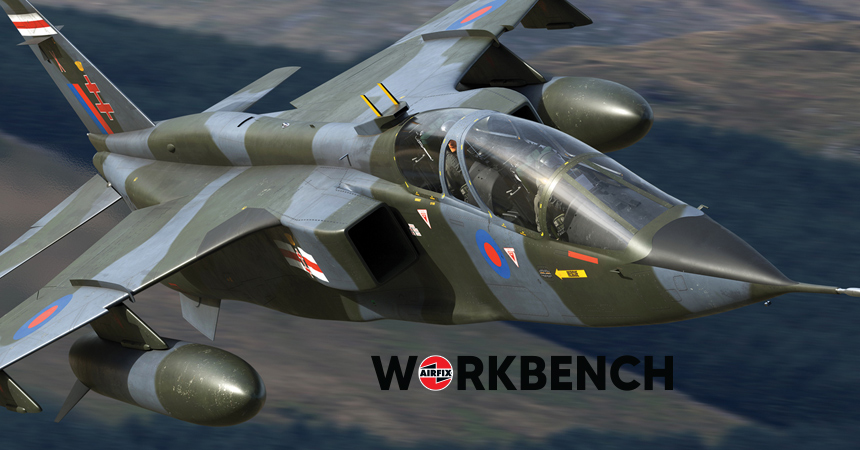
Sleek and beautiful just like the big cat it’s named after, we’re stalking a significant impending release to the 2026 range in this latest edition of Workbench.
A modified tooling release of distinction. Prepare to welcome the RAF’s Big Cat made for two.
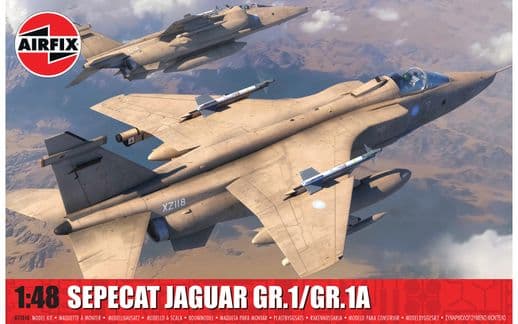
As one of the best loved post WWII aircraft types to see Royal Air Force service, we knew only too well that our new SEPECAT Jaguar kit in 1:48 scale would receive a warm welcome when joining the Airfix range last year, particularly as this Cold War icon was being produced in this larger, much more impactful display scale. Having said that though, the enthusiasm with which the new Jaguar was received even took us by surprise, something which resulted in the need for an immediate re-order of kits, as we struggled to cope with demand which still shows no sign of abating.
As far as Airfix are concerned, all good SEPECAT things always come in two’s and as we prepare to welcome the second release from this impressive tooling, we can all start looking forward to a Jaguar made for two landing on our workbenches, a training variant of this aircraft which was originally envisaged as a modern training aircraft.
For an aircraft which looks every inch the Cold War strike warrior, it can be surprising to learn that the project which eventually led to the introduction of the SEPECAT Jaguar began as one looking to design a high-performance training aircraft. During the 1960s, Britain’s aviation industry was going through a period of great change, as the Royal Air Force were considering their needs for an uncertain future. There were some exciting projects in development at that time, such as the BAC TSR.2 and the P.1154 and in support, they were in need of an advanced new training aircraft to produce pilots to fly them. Looking for an aircraft to replace the diminutive Folland Gnat and ultimately, the Hawker Hunter, it was clear such a project would be expensive and place further strain on the nation’s finances.
Across the English Channel, the French found themselves with a similar need for a new training aircraft, but one which also possessed a light strike and battlefield support capability, and whilst both projects progressed independently at first, they did appear to be very closely aligned. With several projects later falling victim to cancellation and worries about spiralling costs being the most pressing concern, it appeared that the only way the RAF were going to get their new trainer was if they embraced the cost saving potential of a collaborative project. In a similar arrangement to several recent collaborations which had gone before it, BAC in the UK and Breguet in France came together to form the company SEPECAT.
This arrangement really did appear to suit both parties with regard to their aircraft requirement, and clearly from an affordability perspective, however, it soon became apparent that the British and French had some differing requirements for the new aircraft. As development got underway, five different variants were being proposed, with the French looking for single seat strike, trainer and naval variants, whilst the British needed a trainer and light strike variant. Running concurrently with this, Rolls Royce in the UK and Turbomeca in France were jointly developing the Adour engine which would power the new aircraft, something which would create its own problems and result in some protracted delays. This situation wouldn’t be helped when the British insisted the aircraft possess supersonic capability.
Is there a more appealing sight to be found in the world of aviation? CAD screenshot images from the new Jaguar T.2/T.4 project.
Nevertheless, both Britain and France placed sizeable orders for the new aircraft, with both committing to 200 aircraft each, with Britain’s order being weighted in favour of 110 trainer aircraft and 90 light strike variants.
The aircraft would endure a relatively long period in development and even as the first prototype aircraft was unveiled in April 1968, the operational landscape the aircraft was heading into was already beginning to change, and the RAF were about to change their order requirements. In 1970, they decided to abandon the trainer requirement for the new aircraft, other than for trainer variants destined to provide conversion support for the Jaguar in service, and subsequently modified their order requirements to 165 strike jets and just 35 two seat trainers. A separate project would be placed with Hawker Siddeley to develop a new training jet, one which would eventually result in the introduction of the highly successful Hawk.
Entering Royal Air Force service in 1973, the Jaguar GR.1 (Ground Attack/Reconnaissance Mk.I) would prove to be a more sophisticated and technologically advanced aircraft than their French counterparts, and immediately showed itself to be a potent performer. It would become one of the most important British aircraft throughout the Cold War era, with pilots always training for a role at the spearhead of any future military engagement and therefore, serving as a significant deterrent to possible Eastern Bloc aggression. A vital component of RAF Germany’s offensive inventory, they maintained four squadrons of Jaguars for strike and battlefield support operations, with a further squadron performing the tactical reconnaissance role. Further squadrons were based in the UK, and served as a deployment ready mobile force, should their services be required.
Big Cat on parade. Don’t go messing with this training feline, cause this beast bites!
From a design perspective, the Jaguar’s distinctive undercarriage was specifically developed to allow this capable performer to operate from damaged airfields, roughly prepared grass strips and even larger roads, as the RAF assumed that in times of war, any first strike by the enemy would be directed towards known operational airfields. This ability was regarded as a valuable deterrent asset and was ably demonstrated to the nation’s media on 26th April 1975, when the second production development Jaguar GR.1 XX109 made a parachute assisted landing on the carriageway of the soon to be opened M55 motorway near Blackpool. Pushed under a bridge over the carriageway, the aircraft was fitted with bombs, before taking off again, demonstrating the impressive operability of the Jaguar.
The Jaguar would go on to enjoy an impressive 34 year service career with the Royal Air Force, undergoing regular upgrades to improve and perfect its operational capabilities during that time. It would earn a reputation as a hardworking and reliable strike and reconnaissance platform, something which was illustrated by its performance during the first Gulf War. The twelve Jaguars deployed during Operation Granby flew 612 combat sorties, with one Jaguar flying 47 missions, the most of any aircraft in theatre.
Although starting out as an Anglo-French training aircraft project, the RAF’s Big Cats certainly went on to live up to their name, proving these were aircraft not to be messed with. If the Jaguar showed its offensive claws, you were in big trouble.
Quite magnificent. If this new Airfix box artwork doesn’t float your boat, it’s time to check if you still have a pulse.
Although the original training aircraft requirement for the Jaguar program ended well before this Anglo-French design advanced towards production, the highly advanced capabilities of Britain’s Jaguar strike, ground support and reconnaissance aircraft did dictate that a dedicated training variant was also going to be required. A much more capable attack aircraft than had originally been envisaged, this trainer variant would be needed to allow those converting to the Jaguar to already be conversant with its many systems and technological innovations, in addition to being able to handle what was actually a fast and extremely robust aeroplane.
As much of the Jaguar’s operational work would be undertaken at low level and at speed, pilots would have to be well versed in such environments well before getting behind the controls of one, so plenty of time spent in a two seat training variant, with the support of an instructor would be a significant factor in welcoming the Jaguar into Royal Air Force service.
Breaking with the tradition of positioning student and instructor side by side in aircraft such as the Jet Provost, Lightning and Hunter, the Jaguar T.2 trainer had a tandem arrangement for its crew, something which actually resulted in the introduction of one of the most attractive jet aircraft to ever see Royal Air Force service. The design changes required to allow the second seat position to be installed may have only increased the overall length of these aircraft by just over two feet, but this modest increase created an optical illusion which made these trainers appear much longer in profile and with incredible aesthetic appeal – they were real lookers.
We’ll have more Jaguar trainer built model imagery to bring you a little later.
These most attractive aeroplanes were not just working hard to produce a constant stream of new and converting pilots destined for the RAF’s Jaguar force, but were also capable of similar performance to that of their more numerous single seat siblings, and were therefore to a large extent, combat capable. They were missing some electronic capabilities, but in times of crisis, these two-seat variants were more than able to bolster Jaguar numbers heading for combat zones.
The Jaguar T.2 entered Royal Air Force service with the Jaguar Conversion Team at RAF Lossiemouth in early 1974, with this unit later being renamed No.226 Operational Conversion Unit. They would retain their links with this aircraft until it was withdrawn from service in 2007, although the unit would be re-designated No.16 (Reserve) Squadron in 1991, posting an impressive 33 years of Jaguar association.
In addition to supporting training of new pilots for postings to Jaguar Squadrons, many T.2s (along with the upgraded variants which subsequently entered service) also served alongside operational units, providing ongoing training for their assigned pilots and currency/conversion support for those pilots returning to the Jaguar after some time away. The original T.2 trainers underwent update over the years, first to T.2A and then to T.4 standard.
These training Jaguars really do have to be considered some of the most attractive aircraft to have ever served with the Royal Air Force.
Airfix fans and Workbench regulars will already be well versed in the design details relating to this impressive new tooling addition to the range, as we posted a double Jaguar edition of our blog at the beginning of last year, one which included significant input from the model’s designer Paramjit Sembhi. We’re pleased to say that Paramjit’s kindly back to help us once again, and has furnished us with a selection of exclusive design screenshots to help welcome this training Jaguar to the range.
With the T.2/T.4 being such appealing variants of the Jaguar, it will come as no surprise whatsoever when we tell you that the two seat trainer variant of the aircraft was always in the design brief handed to Paramjit, and even though he wasn’t in a position to say so during that first interview, the design of the separate nose parts for each variant was one of the first phases he completed. Although this looks quite complicated to the non-designer, Paramjit told us that it really didn’t present him with too many problems, as the design of these different nose parts essentially followed the design flow of the actual aircraft, and how everything was really logical and just a matter of time and attention.
When you look at some of the design images PJ kindly sent us, they help to explain his point that the rear seat of the T2 variant is effectively in the same position as the cockpit of the GR.1/3 variant of the Jaguar, meaning that in design terms, this training variant option was much less problematic for him to work with than we might imagine. It’s obvious that there’s a significant amount of design/part commonality between to two versions, however, that does not extend to the cockpit sections, which have both been designed as separate, autonomous sections.
Designer extraordinaire Paramjit Sembhi sent us this selection of CAD screenshots to help illustrate this section of the blog. The first two images show the differences between the single seat and two seat trainer noses in the kit’s design, with the orange sections being the single seat variant.
Here we see the same again, only in complete profile form, single seat, then trainer.
As we always like to do with these designer interviews, we broached the subject of project challenges with Paramjit, and he told us that there was one major challenge with the Jaguar trainer’s design, but also with the usual collection of smaller issues. One area which took quite some thinking about was the design of the front undercarriage bay. Despite the fact that the nose assembly sections for the single seat and trainer versions of the Jaguar were completely separate, he had to design the nose undercarriage to include as many common parts as possible, to keep the kit’s part count to a manageable level and to keep the final cost of the model down.
Although this sounds like it wouldn’t have troubled one of our most talented designers too much, Paramjit told us that it was actually quite a demanding process, with components having to be amalgamated to achieve the reduced part count, with great care and attention needed to ensure both assembly integrity and ease of construction. As you will see when inspecting your example of the kit, he ultimately managed to achieve this, but does remember it being a little more problematic than he had anticipated.
The cockpit design for the standard and upgraded variants of the Jaguar trainer provided more than a fair share of design challenges for Paramjit.
By far the hardest and most time consuming aspect of the Jaguar trainer’s design phase was replicating the aircraft’s cockpit detail effectively. The cockpit is always a design challenge no matter which aircraft type you find yourself working on, as there is just so much fine detail to include in such a confined section of the design, and in the larger 1:48 scale, has become such an important appeal feature of any kit. For the Jaguar trainer, as the upgrades to the later variants of the aircraft included enhanced equipment layout for both the front and rear cockpits, Paramjit had to design accurately replicate two cockpits for the T.2 variant, and a further two for the T.4.
This proved to be frustrating, challenging, and rewarding in equal measure, and Paramjit hopes that will all the impressive build and display options included with this kit, the cockpit detail will prove to be an appealing feature for modellers intending to display their Jaguar with open canopies, and how the equipment development of these aircraft can be viewed in scale form.
Another area of the kit’s design which challenged Paramjit during his time with this project was the accurate surface detailing around the lower front fuselage and specifically, the prominent bulged skirt sections which house the aircraft’s 30mm Aden cannon. On the single seat variants, the aircraft feature 2 of these powerful guns, one either side of the lower front fuselage, but on the two seat training variants, the starboard cannon was removed. The housing bulge was retained, but the muzzle opening for the gun was faired over to become one of the significant identifiers between the two variants.
The gun fairing blisters look like complicated shapes to replicate in the design of a plastic scale model kit, and Paramjit confirmed that they very much were.
As we have seen in many previous designer reviews, the accurate replication of surface detailing like this is where a designer really earns their money, and is not only a question of getting the shapes, curves and various bulges replicated accurately to reflect this detail on the subject aircraft, but also to ensure this replication can be moulded effectively during the manufacturing stage, and not create any issues with either the injection of plastic, or the ejection of the frame from the tool after production. Thankfully, all this highly technical stuff is all in a day’s work for an Airfix designer.
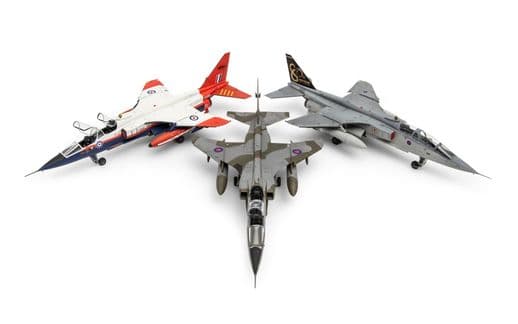
This seems like the perfect natural break for us to actually take a look at the three SEPECAT scheme options which will be available to modellers on receiving their example of this spectacular new kit, in the hope that it will give us all just a short time to make our selection prior to the imminent arrival of our new 1:48 SEPECAT Jaguar T.2 & T.4 kit.
As one of the RAF’s most famous units, No.41 Squadron can trace its origins back to the Great War and operations from Saint Omer in Northern France, where they made a significant contribution to the Allied war effort, remaining on the continent after the end of the conflict, until returning to a new base at Tangmere in early 1919. The distinctive double barred cross emblem adopted by the squadron calls on the period operating from St Omer, as this is a distinctive feature of the town’s coat of arms was incorporated into the unit’s own crest from 1937 onwards.
As the RAF entered the jet era, the aircraft types operated by No.41 Squadron read like a double page spread from an Airfix kit catalogue, as the Gloster Meteor, Hawker Hunter, Gloster Javelin and McDonnell Douglas Phantom all wore the colours of the squadron, with just a short break when they were tasked with operating Bloodhound surface to air missiles in a home defence role.
No.41 Squadron went through something of an unusual transition from Phantom to Jaguar at the back end of 1976, with Phantoms still operating out of Coningsby, whilst a designate unit was working up on the Jaguar GR.1 in the same tactical reconnaissance role. This particular aircraft made its first flight in October 1976, one of 35 Jaguar T.2 aircraft produced, initially entering service with No.226 Operational Conversion Unit at RAF Lossiemouth. During a long 30 year career, XX847 would see service with No.20 squadron in Germany, with No.41 Squadron at Coltishall (the service period which is covered by this scheme option), and with No.16 Squadron.
During her time with No.16 Squadron, it’s thought that this aircraft served as the reserve display aircraft during that year’s Airshow season, which is unusual in that Jaguar displays were almost always the domain of single seat Big Cats, but does go some way to illustrating the excellent serviceability of the Jaguar. She ended her service career with No.6 Squadron at RAF Coningsby, making her final flight from Coningsby to Cosford on 18th May 2007.
On her arrival at Cosford, she became one of the many RAF Jaguars coming under the care of RAF no.238 Squadron, a non-flying training unit affiliated to No.1 School of Technical Training. Initially at least, many of these aircraft still regularly fired up their engines and taxied under their own power, as they were used for aircraft flightline handling training, and indeed were even seen taxiing down the length of Cosford’s runway during their annual Airshow. The aircraft were also used as ground instructional airframes, helping to train the next generation of highly skilled aircraft technicians destined for military service.
SEPECAT Jaguar T.4 XX847 (upgraded from T.2A configuration) is still at RAF Cosford, where she continues to serve in this vital training role.
Scheme B – SEPECAT Jaguar T.2 XX145, Empire Test Pilots’ School (ETPS), AAEE Boscombe Down, 1992.
Within the aviation enthusiast community, aircraft which have worn the iconic and unmistakable ‘Raspberry Ripple’ colours of the Empire Test Pilot’s School have always been amongst the most popular of their type, be they fast jets, helicopters, or transport aircraft. Established in 1943, the ETPS quickly earned a worldwide reputation for excellence in the training of test pilots, taking already exceptionally gifted aviators, and taking their skills to a new level altogether – only the most exceptional airmen could become leading test pilots.
Embarking on an intensive and incredibly demanding 10 month course, student pilots were required to fly a selection of fixed wing and rotary aircraft, each one with very different handling characteristics, but all needing to be flown and flown well by the students, who were also required to evaluate every aspect of its performance, preparing them for the job of flying new aircraft for the very first time.
This particular Jaguar flew for many years with the Empire Test Pilot’s School, and even starred in the BBC documentary series 'Test Pilot' which was aired in 1986. During filming, the aircraft was still in her standard RAF camouflage, prior to being adorned with this stunning scheme, and was being flown by a student pilot from Australia, with the programme giving us viewers a sense of the incredible pressure these exceptional pilots were placed under during their time at Boscombe Down. The ‘Raspberry Ripple’ colour scheme was selected as a high visibility scheme to allow the aircraft to be noticed by those observing and other aircraft in the skies at the same time, warning them of the demanding flying these aircraft would often be engaged in.
Jaguar XX145 made her first flight towards the end of May 1974 and was delivered to the RAF at Lossiemouth on 14th June the same year. During her career, she flew with the Jaguar Operational Conversion Unit, No.226 OCU and No.31 Squadron, but also flew for many years in support of Empire Test Pilot operations, from where she was retired in 2006.
Following retirement, this distinctively presented Jaguar was moved to Cranwell as a ground instructional airframe, but also as a source of spares for other aircraft, however, she would later be moved to a private collection at Bruntingthorpe and the hope of a return to taxiable condition. Unfortunately, as this work got underway, some confusion about the aircraft’s ownership saw the project stall, and with the situation not resolving itself, the Jaguar saw itself on the move again, this time to RAF Cosford and the School of Technical Training.
Once at Cosford, the aircraft was reassembled and used as a rather impressive training aid for the student technicians under tuition there, and would star at several Airshow static displays and specially arranges photo events there.
During the summer of 2023, Cosford alerted the historic aviation world that this beautifully presented Jaguar Trainer was surplus to their requirements and was due to be put up for auction, however, it subsequently transpired that she was donated to the growing Boscombe Down Aviation Collection, who arranged to have the aircraft transported to their Old Sarum museum site, which was just a stone’s throw from where this aircraft used to ply her ETPS trade.
If you find yourself looking for a Jaguar scheme that’s guaranteed to grab the display limelight, look no further than XX145.
For those with an interest in Britain’s aviation heritage, Cosford has long been a destination where people know they can get close to some of the most significant aircraft to have worn the roundel of the Royal Air Force, but also some enemy types RAF pilots were required to intercept. With the RAF Museum Midlands being the home for a world class collection of historic aircraft, and the impressive National Cold War Exhibition, and Cosford’s annual Airshow now being the only RAF organised Airshow event remaining, this location always looks forward to welcoming visitor numbers in the hundreds of thousands each year, but whilst we’re all admiring the unmatched collection of aircraft under their care, the future of many RAF trades is being assured on the other side of the museum, with some classic British Cold War jets helping them in this undertaking.
Steeped in RAF history, Cosford is also now an important training and engineering facility for trades within the Royal Air Force, helping to maintain the future development of the Force, with flying training operations still being carried out here under the control of No.6 Flying Training School, whilst the various disciplines of the Defence College of Technical Training prepare engineers and technicians for a future career across Britain’s armed services.
Cosford is also home to an impressive collection of former Royal Air Force SEPECAT Jaguar jets and during their annual International Airshow, it’s often possible to see several of these beautifully maintained aircraft at various positions around the airfield and within the hangars used by No.1 School of Technical Training.
Jaguar T.2 XX835 made her first flight on Valentine’s Day 1975 and was delivered to RAF No.226 OCU at Lossiemouth the following month. During her long service career, she would also fly in the colours of Nos 6, 41 and 54 Squadrons, but would also spend time on loan with the Royal Aircraft Establishment. Upgraded to T.4 standard at RAF St Athan in 1999, she returned to her parent unit No.41 Squadron on her return to service, but would end her flying days in the care of No.6 Squadron at RAF Coningsby, the last RAF squadron to fly the Jaguar.
One of the final Jaguars to arrive at Cosford following retirement, XX835 landed at the Shropshire airfield on 2nd July 2027, to begin a new career as a ground instructional aircraft with the Defence College of Aeronautical Engineering, as it was known at that time.
The unusual presentation applied to this aircraft in 2018 is still worn by the aircraft to this day, and can catch people out, if they don’t view the aircraft from both sides. Jaguar XX835 sports TWO different special tail finishes, which whilst both applied at the same time in 2018, celebrate different anniversaries.
The starboard side boasts a smart black and gold design created to commemorate the 80th Anniversary of RAF Cosford, whilst the port side is resplendent in a centenary scheme commemorating the history of RAF No.238 Squadron. Their dragon insignia looks spectacular on the tail of this Jaguar, and as she now resides at an airfield which is just a few miles from the Welsh border, this tail artwork could hardly be more appropriate.
With all three schemes possessing bags of appeal and the Jaguar trainer being such a handsome looking aircraft, we wish you good fortune in trying to pick just one of the schemes on offer in which to finish your model – we do make these decisions difficult, don’t we.
Visitors to the Airfix website will be greeted with a new SEPECAT homepage banner this weekend.
With regard to the Jaguar T.2 & T.4 kit project, our research and development teams would like to place on record or sincere thanks to Corporal David Jones of No.1 School of Technical Training at Cosford and Corporal Graham Hall from the paint shop at RAF Coltishall for the invaluable assistance they provided our team throughout – we really couldn’t have done it without you chaps, so thank you once again.
By way of breaking news, we’re delighted to say that whilst this latest blog was in production, the new Jaguar T.2 & T.4 kit has actually come into stock and will therefore be available on the Airfix website for the very first time this weekend – happy hunting!
We're afraid that's all we have for you in this latest edition of the Airfix blog, but we will be back in two weeks' time with more project development updates and the very latest Airfix kit exclusives. In the meantime, we're always keen to hear your views on all things Airfix and in particular, any thoughts and opinions you may have regarding our Workbench blog. If you would like to drop us a quick line, could we please ask that you use our workbench@airfix.com email for all correspondence.
To re-visit any of the Airfix blogs we have produced over the past TEN years or so, please head to our main Workbench hub, where you'll find our entire blog back catalogue and all the Airfix design projects we have already covered.
All our dedicated official social media sites can be accessed by clicking the respective link icons at the foot of this page, or by heading to the Airfix homepage. Other useful Airfix links are:
Facebook, YouTube, Twitter and Instagram official sites
Please join us for more Airfix updates next week and thank you for your continued support.