We’re pleased to be bringing you this latest edition of our regular Workbench blog, and all the news, updates, and modelling exclusives from the fascinating world of Airfix.
Although Airfix have established a proud reputation for the wide variety of subject matter we have committed to the world of scale model kit creation over the years, there are some subjects which are just so much more interesting than others. When it comes to the modelling of aeroplanes, Spitfires and Mustangs may well be some of the most popular kit projects our hobby has ever known, but when it comes to pure interest value, they don’t even come close to a certain British Army cooperation aircraft turned nocturnal spy taxy.
In this latest edition of Workbench, we will be preparing our makeshift landing ground for the arrival of a 1:48th scale kit which is certain to become one of the most popular releases in many a year, our scale tribute to one of the most interesting aircraft types to have served during the Second World War, the Special Duties Westland Lysanders of the Royal Air Force.
The work of these clandestine couriers is as fascinating as it must have been dangerous, however, even this pales into insignificance when you learn about the dangers faced by the heroic SOE operatives who were being delivered into enemy occupied Europe. We will be bringing you the story of one such agent, who has links to the Lysander, but also happens to be one of the bravest human beings to have ever walked this earth.
We’ll be flying by moonlight and engaging in clandestine activities in this latest edition of the Airfix Workbench blog.
The Westland Lysander possessed all the qualities needed for the clandestine servicing of SOE agents into continental Europe, but still needed to be flown by heroes. This airworthy example is operated by the Shuttleworth Collection and is configured ad an RAF No.161 Squadron Special Duties aircraft engaged in clandestine operations.
When Britain’s Air Ministry initially communicated their requirements for a new Army cooperation aircraft to replace the Hawker Hector and Hawker Audax in this role, they invited proposals from the Hawker, Avro and Bristol companies, whilst ruling out Westlands, by virtue of the relative inexperience of their design team. After some internal wrangling and after officials had seen the impressive automatic slat and flap system the company had been developing, they relented and allowed the Westland Aircraft Company of Yeovil to also submit proposals.
Under the direction of Westland’s relatively inexperienced design manager William ‘Teddy’ Petter, the company embarked on an exercise which saw officials spending a great deal of time interviewing pilots who were currently engaged in Army cooperation flying, in an attempt to find out what they liked about their aircraft and more importantly, what they thought could be improved. These discussions helped to build a picture of what capabilities the new aircraft must possess and what Westland’s design team had to deliver, if their new aircraft was going to prove successful.
The Army wanted an aircraft which could take on a variety of roles, including reconnaissance, artillery observation, general duties and light bombing, whilst the pilots who were already serving in these roles wanted a capable new aeroplane which offered excellent ground visibility at all times, was rugged in operation and possessed excellent short field capabilities. Petter and his team at Westland set about designing an aircraft which could satisfy both.
What they produced was an unusual looking, yet rather advanced aeroplane, but one which wasn’t without its vices. The high-set cockpit and extensive glazing afforded both the pilot and his observer an exceptional field of view, with the high mounted, unusually shaped wings not only helping to support this, but also incorporating a few little design tricks of its own. The wing design included the introduction of an automatic slat and flap arrangement which gave the aircraft exceptional low speed and short field performance, but due to its design, did have to be managed carefully.
The Lysander afforded both pilot and observer an excellent view of the ground in all phases of flight and included some technical innovation which made its slow speed performance exceptional. This picture again features the Shuttleworth Collection’s Lizzie, as it heads out for a dusk sortie.
During the landing phase, if a pilot attempted to make a three-point landing at slow speed, the angle of attack at such a speed would immediately deploy the automatic slats and flaps, causing the aircraft to rear up and potentially stall, something which could have a catastrophic outcome for both the crew and their aircraft. With the power of the Bristol Mercury radial engine though and with careful handling, the Lysander could be an impressive performer, with a stalling speed of just 65 mph allowing this aircraft to be operated in incredibly short distances.
Another significant design feature of the Westland aircraft was its rugged, fixed undercarriage, something which made it easy to operate whilst on the ground, with the rigidity to allow it to be operated from all but the roughest of landing grounds. The wheel spats themselves were streamlined, but also housed a pair of fixed, forward firing Browning machine guns, which were away from the arc of the propeller and therefore didn’t require the use of interrupter gear.
These wheel spats were strong enough to allow small stub wings to be fitted to each outer section, so that if the aircraft was to be used in an offensive or supply capacity, their hardpoints could be used to deliver small bombs, supplies or as would later prove to be the case, rescue equipment. An additional Light Series bomb carrier could be fitted under the rear of the aircraft’s fuselage to allow a further four 20lb bombs to be carried and defensive armament consisted of a plinth mounted single or twin Browning/Lewis machine gun arrangement in the observer’s section of the aircraft, behind the wings.
Westland submitted their design proposal during the summer of 1935 and a contract to produced two prototype aircraft (which would carry the internal designation P.8) was duly awarded. Almost exactly twelve months later, the new aircraft made its maiden flight from the Westland airfield at Yeovil and before that month was out, the aircraft had also been exhibited at that year’s Society of British Aircraft Manufacturers Display at Hatfield. The following month, the aircraft flew to Martlesham Heath, where it was put through its paces by the Aeroplane and Armament Experimental Establishment, to discover if the new aircraft possessed the qualities needed for the intended role.
In competition with the Bristol Type 148 monoplane for the contract, the Westland aircraft quickly emerged as the most suitable aircraft and a subsequent order for 144 production aircraft would be placed even before the second prototype aircraft had flown. Trials at Martlesham Heath and Farnborough continued, but with a view to testing the proposed armament arrangement for the new aircraft, which would subsequently be named Lysander, after the historical Spartan military leader.
The Lysander was equipped with an offensive capability which included two fixed forward firing Browning machine guns in the wheel spats and the ability to carry a selection of bombs.
The new aircraft was introduced to the public at the Hendon Air Pageant in June 1937, where it was celebrated as a ground-breaking new type, one which proved that Britain’s aviation industry led the world at that time, and that the RAF would be equipped with the most capable aircraft in the skies in the event of war, or so they would have the public believe. When Movetone images of the Lysander were shown, they described the aircraft as having world-leading short field performance, with a top speed which whilst still being secret at that time, could rival the world’s most capable single engined fighters. Unfortunately for Lysander crews, that boast proved to be something of an exaggeration and even though the Lysander was an excellent aeroplane, it was no match for the Luftwaffe’s latest fighters.
Lysanders would enter Royal Air Force service with No.16 Squadron during the summer of 1938 and by the start of the Second World War, seven squadrons of Lysanders were in service, having worked up to perfect this excellent aircraft’s capabilities in a cooperation/general duties role. As part of the air component of the British Expeditionary Force sent to France in October 1939, four squadrons of Lysanders operated in support of this force, flying reconnaissance, spotting and light bombing duties in advance of the German onslaught. Despite the many admirable qualities the Lysander possessed, the aircraft was not one that could be used effectively in contested airspace, and France would prove to be a baptism of fire for Lysander crews.
Often operating in areas close to the fighting, if Lysanders were caught by marauding Luftwaffe fighters, they were incapable of defending themselves, not manoeuvrable enough to evade the attentions of the agile Messerschmitt Bf 109, whilst at the same time making for a rather large and tempting target for them. Even when protected by RAF Hurricanes, the Lysanders were too slow to evade their attackers, once they had dealt with the Hurricanes sent to protect them. Ultimately, of the 175 Lysanders sent to operate in France and Belgium, 118 would be destroyed either in the air or on the ground and by the time the RAF flew back to Britain to prepare to face their own onslaught, plans were put in place to replace the Lysander in the Army cooperation role with aircraft which were significantly faster.
The initial box artwork produced in support of this spectacular new model kit.
Lysander crews would have to soldier on as Britain prepared to face invasion and despite their mauling at the hands of the Luftwaffe during their time in France, would remain in an offensive role for the time being. Mounting coastal patrols looking for signs of enemy commando landings, U-boat incursions, or any German shipping activity, Lysanders were in the air around the clock and in the event of invasion, would have been hurled against the invasion beaches to unleash everything they had! Rugged and dependable, Lysanders would have operated from bases as close to the landing beaches as possible, and would more than likely have given a good account of themselves in such a situation.
The Westland Lysander would be produced in three major variants during its production life, each one using a different engine, with the Bristol Perseus XII equipped Mk.II being the fastest of them all at 230 mph. In addition to performing the duties for which it was intended, the Lysander helped to establish a cohesive Air Sea Rescue service for airmen downed in the seas around Britain, with earlier variants also going on to see extensive service overseas. It would also find an operational niche as a Special Operations aircraft later in the war, serving as an agent taxi and clandestine supply aircraft, as the Allies prepared for D-Day.
A total of 1,786 Westland Lysanders were built before production halted in 1942, a figure which included 104 sent to Canada and a further 225 which were built under licence in the country. Several other nations would operate the Lysander both during WWII and after, however, of this number, only two remain in airworthy condition in Europe today, with both being incredibly popular performers on the UK Airshow circuit.
An impressive looking aircraft from any angle, the Westland Lysander can be a surprisingly agile performer in the air, and it doesn’t take much to see why this aircraft was pressed into service as a clandestine, cross-Channel agent shuttle aircraft, relying on a compass, map, moonlight and piloting skill to arrive at a designated field in France in the dead of night. All this had to be attempted in the knowledge that German troops would likely be in the vicinity of the landing zone, and they would be desperate to stop such incursions taking place.
It’s aircraft involved in this vital work that have attracted our attention for this second release from our larger scale Westland Lysander tooling.
The initial box artwork created in support of a release we know a great many modellers have been looking forward to getting their hands on.
Talk about making a new tooling announcement splash.
Visitors to the Airfix stand at Scale ModelWorld 2024 were excited to see built model samples of a new Westland Lysander kit in 1:48th scale just waiting to infatuate visitors, something it managed to do with ease, not least because this was surely the perfect scale in which to recreate this most interesting of aeroplanes. With two appealing early war scheme options available with this initial release, modellers were keen to add the Lysander to their 2025 build schedules, but also had their sights set on the later clandestine operations undertaken by these magnificent aeroplanes.
With its reputation as one of the more interesting, and certainly most distinctive aircraft of the Second World War, it will come as no surprise to learn that the Westland Lysander found itself inducted into the Airfix scale model kit ‘Hall of Fame’ relatively early in the hobby, with its 1956 introduction marking it as one of the first 1/72nd scale aircraft kits introduced. Back then, the kit was released in the original bagged form, featuring the paper header/instruction format which has become so sought after by collectors these days.
Continued sales success, and ever improving design and manufacturing techniques would result in the introduction of a newly tooled Lysander kit in 1972, again in 1/72nd scale, but this time in boxed series 2 configuration, with the box artwork making the clear association between the aircraft and its use in transporting agents to and from secret locations in continental Europe. Always a popular addition to the range whenever it was included, this second Lysander kit continued to be a top performer well into the 21st century, underlining the popularity of the Lysander as a modelling subject, and highlighting its suitability for further new tooling development.
We’re therefore pleased to now be in a position to confirm the imminent arrival of our second release from the new 1:48th scale Westland Lysander kit by looking at the three scheme options available with this impending release, with all three aircraft serving in the Special Duties role, and all configured for agent delivery and extraction.
Positioned just a stone’s throw away from where the Shuttleworth Collection thrill aviation enthusiasts with spectacular Airshows at their picturesque Old Warden home, the former RAF airfield at Tempsford was arguably the most secret operational airfield during the Second World War, where crews and their aircraft specialised in the delivery of SOE agents into occupied Europe, along with their re-supply and retrieval, as and when required.
The highly secretive nature of these operations dictated that security around the airfield was understandably tight, and little of what went on there was allowed to be spoken about until well after the war had finished. This is also the reason why in many cases, it can be difficult to tie down a particular Lysander to a specific agent drop on a specific date, as accurate record keeping was certainly not the priority at Tempsford, but the safety and security of pilots and agents most definitely was.
The men who flew these agent shuttle runs in aircraft with only moonlight to guide their way, along with their trusty map and compass, were very special people indeed, playing a vital, if often unheralded role in preparing Europe for invasion, working with some of the bravest people humanity has ever known. One such person was Lise Marie Jeanette de Baissac, the first female Special Operations Executive operative to be parachuted into France who often worked with her brother Claude and during two missions into enemy occupied France, worked to undermine German infrastructure at every opportunity, preparing the way for the Allied invasion of Europe.
Lise de Baissac was born in British Mauritius to wealthy landowner parents, the only daughter amongst three children, but all British subjects under this multilingual Crown colony, however in 1919, the family took their wealth and moved to Paris. Enjoying life in this vibrant city, the German occupation of France immediately resulted in her elder brother joining the British Army, with Lise and her other brother Claude making their way to southern France, prior to arranging onward passage to Britain.
A story this good really does require the creation of smart new Airfix box artwork.
Once they had arrived, Claude immediately attracted the attentions of the Special Operations Executive, primarily because of his language skills, but also because he was a gifted scientist. It didn’t take long for officials to also realise that his sister possessed many of the qualities they were looking for, and when they were in a position to accept women into the force, Lise was one of the first to be recruited. Once this work began, it was usual for women operatives to provide support for others in the network, but Lise de Baissac was clearly a very special person, and whilst she was more than happy to do anything to help the Allied war effort, she was clearly capable of administering her own spy network.
Her first mission took place on the night of 24th September 1942, when she boarded an Armstrong Whitworth Whitley bomber at RAF Tempsford in Bedfordshire, from which she later parachuted into the dead of night over France, the first woman SOE agent to have done so. Her mission was to support her brother in any way she could, but often saw her working alone and at great personal risk, but always dedicated to her duty.
A smart, confident lady who gave the impression of being from a high social standing, but definitely not someone who took any messing, Lise was often in the company of Germans, and even though this posed obvious risks for her, showed no trepidation whatsoever, interacting with them as if she was just going about her business. If they knew what that business was, they would have been furious.
Full scheme details for a Lysander replication that will prove difficult to resist.
Much of the work during this initial infiltration was to identify potential landing areas for agent drops, be they parachute landing sites, re-supply drop sites, or indeed landing fields for the use of Lysander pilots. On the night of 16th/17th August 1943, Lise and her brother Claude were picked up themselves by a Lysander and flown back to Britain, where they provided as much information as they had gathered to those now planning for the amphibious invasion of Europe.
Once back in Britain, their clandestine preparations continued apace, with Lise being sent to the parachute training school at Ringway, near Manchester, during which time she was unfortunate to break her leg. This meant that when she was required to go back to France on the night of 9th/10th April 1944, she required the services of a Lysander and Special Duties pilot once more, intent on causing even more havoc in her home country.
Once again working for and with her brother, the workload was greatly increased during this period, as everything was gearing up towards invasion. Her work now included identifying larger open spaces where Allied paratroopers could land and be re-supplied, but also reporting on German troop movements and concentrations, and anything unusual happening around transport hubs across the area. She was so utterly effective in her role that she often shared buildings with German troops and even got into arguments with any of them who caused her problems – they were utterly oblivious to the activities this lady was actually engaged in.
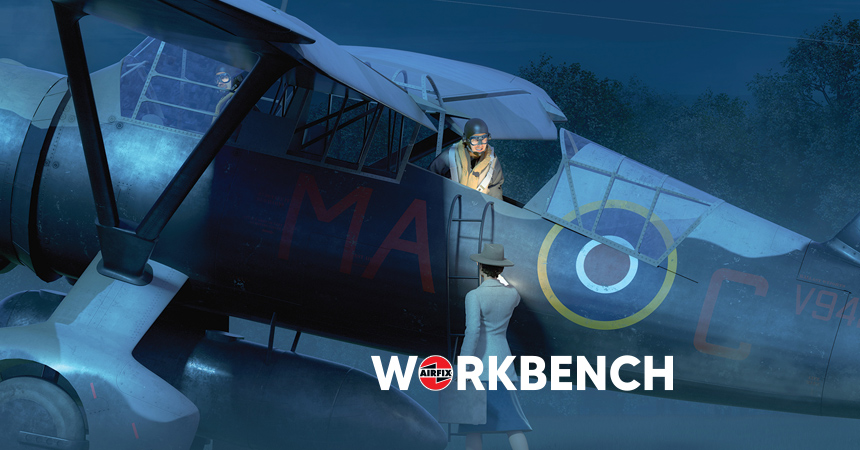
Lysander kit builds featuring No.161 Squadron V9428 and a female agent figure preparing to wreak havoc across Northern France.
In the days immediately prior to the D-Day landings, she was cycling more than 60 miles each and every day, shuttling messages and information between clandestine operatives, with much of this information finding its way back to their handlers in Britain. She would often be riding through enemy troops on the move, developments which were duly reported back in the final hours before invasion.
Once the invasion was underway, the work of this network was just as vital, sending live update messages to handlers, disrupting German reinforcements to the Normandy region and collecting weapons canisters for distribution amongst the French resistance fighters.
Following the end of WWII, Lise and her brother remained in France helping to locate lost and captures SOE agents, knowing only too well the dangers they had faced whilst undertaking their important work.
Brave and fiercely patriotic, it’s difficult for us to imagine what it must have been like to operate in such dangerous circumstances, right under the noses of the enemy. One wrong turn, a word out of place, or being compromised by someone under interrogation would have resulted in unthinkable retribution by the Germans, yet a great many of these brave people embraced the risks to play their own, specialist role in the Allied war effort, and thank goodness they did.
Highly decorated and even more highly thought of, Lise Marie Jeanette de Baissac can only be described using one word – hero.
The Lysander is often lauded as an exceptionally capable and robust aeroplane, possessing many impressive qualities that really did set it apart from other aircraft, however, those who spent time at the controls of one which to point out that this was not an easy aeroplane to fly, with more than a few vices lurking to catch out the unwary. As you would expect from an aircraft designed to perform the Army cooperation and Observation roles, the view from the Lysander’s cockpit was exceptional, with the high mounted wing allowing an unobstructed view for the pilot, something they must have been thankful for when operating in a Special Duties role.
The automatic slat and flap system the Lysander was equipped with was equally impressive, allowing the aircraft to fly controlled at low speed, freeing the pilot to concentrate on other aspects of the aircraft’s control, just in case one interfered with the other. The aircraft may have been attempting to assume what a pilot was intending to do, but in some instances, it’s automatic systems might actually be working against him, requiring understanding and experience in order to coax the aircraft into doing what you wanted it to.
When using the Lysander in the Special Duties role, the aircraft was without doubt the right aircraft for the job, however, its known handling challenges required that only the most experienced pilots were considered for these flights, leaving us with an even greater appreciation of the resolve and capabilities of these exceptional airmen.
In 1941, the RAF issued a requirement for around forty of their Westland Lysander communications aircraft to undergo modification in support of a new clandestine role, one which they described as ‘Special Duties’. The aircraft were to have defensive armament removed and have their range increased by adding a larger oil tank internally, and an external 150 gallon fuel tank under the fuselage. The gunner’s compartment was also modified by adding a rear-sliding single piece canopy, and room to accommodate up to three people inside.
Full scheme details for this SEAC operated clandestine operations Lysander.
This female agent appears a little overdressed for operations in South East Asia.
A robust ladder was fixed to the port side fuselage to allow passengers to quickly enter and exit the aircraft, when they were engaged in this new ‘Spy Taxi’ role. Operating under cover of darkness and with the support of the French Resistance, specialist crews bravely flew these unarmed aircraft across the English Channel at night, delivering and extracting agents at great personal risk to all involved, operations which proved crucial to the eventual outcome of the Second World War.
The attributes which made the Lysander perfect for ‘Special Operations’ in continental Europe also made it the ideal platform across many other parts of the world, particularly in India, where these operations were vital in keeping SOE and resistance groups supplied from the air. No.357 (Special Duties) Squadron Far East began operations in 1944, flying a collection of aircraft types in support of embedded troops and resistance forces across the wider region.
Operating from the major airfield at Drigh Road in India, this location not only served as a base for extensive resupply operations, but it was also a major maintenance depot and the drop off point for most new aircraft destined to operate with South East Asia Command.
Significantly, No.357 (Special Duties) Squadron dropped more weight of supplies in the Far East than any other RAF unit dropped in bombs throughout WWII, highlighting just how vital this relatively unknown aspect of the Second World War actually was.
With the agents of the Special Operations Executive extending their areas of operation far and wide, so the support they required moved with them, with RAF No.148 (Special Duties) Squadron being created to cover Mediterranean operations, and initially at least, to support the activities of and SOE unit operating in the area around Algiers. Once established, the unit used heavy aircraft to keep partisans in Italy, Southern France and the Balkans supplied, at great risk to all involved. Indeed, whilst they may have to utilise the few aircraft and support equipment they were provided with, they did become some of the most effective aircrews in terms of just getting this vital job done.
Experienced Special Duties airman Peter Vaughan-Fowler returned to this kind of work following a tour flying night intruder operations in Mosquitoes with his friend Percy Pickard, having been charged with establishing a Lysander pickup flight to work across the Mediterranean. If they needed a man who could deliver instant results, Vaughan-Fowler was definitely their man. Having initially expected to be working in Southern France, this force of just four Lysanders started operation in support of Greek and Yugoslavian partisans, delivering and recovering agents and liaison officers, bringing in supplies and when required, evacuating casualties.
There is a famous wartime picture showing one of the No.148 Squadron Special Duties Lysanders on rough ground in the mountains of Northern Italy, surrounded by a great many partisans as they attempt to bundle three of their injured comrades into the rear section of the Lysander. Clearly, this aircraft was one that could go where the vast majority of others couldn’t and once there, had quite some load carrying capabilities.
Full scheme details for a Mediterranean based Lysander which may well have been flown by famous Special Duties specialist pilot Peter Vaughan-Fowler.
Following the Allied landings in Normandy, Vaughan-Fowler and the Lysanders of No. 148 (SD) Squadron were heavily committed flying spy taxi missions into Southern France, particularly in the weeks leading up to Operation Dragoon and invasion itself. The strength of allied air power and the effectiveness of the well organised resistance movement resulted in the swift retreat of German forces and them having to face yet another enemy force placing strain on their operations.
We described at the very beginning of this article how some modelling subjects are just so much more interesting than others, and when re-acquainting yourself with the work of the Special Duties Lysander pilots of the Second World War and the heroic actions undertaken by those they delivered and extracted, could there possibly be a more engaging build project this winter?
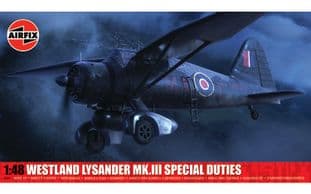
The soon to be released 1:48 Westland Lysander Mk.III Special Duties includes an additional frame of parts to allow this specialist variant of the Lysander to be constructed, and is also supplied with detailed pilot figure and a female Special Operations Executive agent figure. This is surely destined to become one of the most popular additions to an Airfix range for many a year.
A first look at the box artwork presentation that will have us all rushing to model shops and the Airfix website over the next few weeks.
We're afraid that's all we have for you in this latest edition of the Airfix blog, but we will be back in two weeks' time with more project development updates and the very latest Airfix kit exclusives. In the meantime, we're always keen to hear your views on all things Airfix and in particular, any thoughts and opinions you may have regarding our Workbench blog. If you would like to drop us a quick line, could we please ask that you use our workbench@airfix.com email for all correspondence.
To re-visit any of the Airfix blogs we have produced over the past ELEVEN years or so, please head to our main Workbench hub, where you'll find our entire blog back catalogue and all the Airfix design projects we have already covered.
All our dedicated official social media sites can be accessed by clicking the respective link icons at the foot of this page, or by heading to the Airfix homepage. Other useful Airfix links are:
Facebook, YouTube, Twitter and Instagram official sites
Please join us for more Airfix updates next week and thank you for your continued support.