

Welcome to this latest edition of Aerodrome and our regular look at the fascinating world of aeroplanes and the historic aviation scene around the UK.
We are excited to be embarking on another year of covering interesting aviation related events across the UK by making our first visit to the Avro Heritage Museum at night, where we were fortunate enough to be one of the photographers lucky enough to secure a place on an event to capture their magnificent white Avro Vulcan after dark. Although this was the second time an event such as this had been arranged, I was unable to make their first nightshoot, so was excited to be heading down to the former Avro airfield at Woodford in Cheshire, to capture this magnificent aircraft under the cloak of darkness.
Throughout the course of this review, we will be bringing you a selection of images taken during the event, which will also include an unexpected bonus aircraft made available for us to photograph on the night, another Avro type which has strong links to the development story of the Vulcan. We will also be taking this opportunity to indulge in a little reminiscing about the Woodford site itself, and how the Avro Heritage Museum staff and volunteers now work hard to keep the very heart of the Avro story beating strongly.
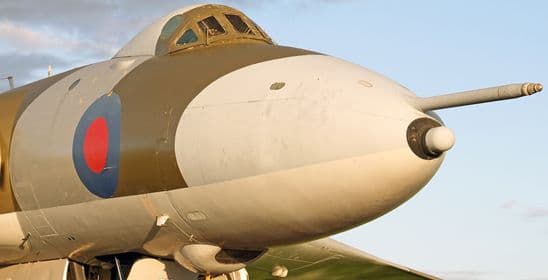
We’re fortunate to be in the company of the world’s only surviving anti-flash white presented Avro Vulcan B.2 in this latest edition of Aerodrome.
Just part of the display at the Avro Heritage Museum, which spans the entire history of this famous aviation company.
For someone who was born and raised in the North of England, any visit made to the Woodford area of Cheshire these days is definitely something of a bittersweet experience. Where we once spent many a happy hour either attending one of the many open days held at this location, or enjoying one of the hugely successful Airshow events which ran for fifty-one years from 1949 onwards, the airfield now lies beneath a sprawling housing estate. Granted the houses are really very nice and there are still a few telltale signs of what used to be there if you know where to look, but in the main, all we’re left with now are our memories.
Referring back to the old pre 1974 county boundaries for a moment, Lancashire can boast a long and impressive heritage in the world of aviation, with many of the nation’s most famous aircraft types designed and constructed in the county. Born and raised in Oldham, hardly a day went by during my youth, without our local evening paper carrying a story with aviation links, either recounting the exploits of a local airman who saw service during the Second World War, or carrying pictures of major aircraft components being transported by road from one local Avro site to another.
Historically, the old Avro factory at Chadderton not only became the headquarters of this famous aviation company, but also went on to become one of the largest aircraft manufacturing facilities in Britain following its construction in the late 1930s, and as it was located just a few miles away from my home during my youth, was always a source of fascination for me as an aviation fanatic. Producing major components for such famous aircraft as the Manchester, Lancaster and later the Vulcan and Shackleton, completed sections of these famous aircraft had to be transported by road the twenty miles or so from Chadderton to Avro’s Woodford airfield facility in Cheshire, where they would undergo final assembly and flight testing.
Pictures of the Avro production lines and sections of Lancaster and Vulcan bombers negotiating bridges and tight turns as they made the road journey to Woodford appeared regularly in our local press and in addition to this, relatives and family friends could still remember seeing such historic sights first hand and were more than happy to indulge my curiosity. With almost 3,000 Lancasters eventually produced at Chadderton, there must have been plenty of occasions when Avro aircraft traffic jams disrupted the daily life of Lancastrians during the war years and beyond.
Woodford’s annual Airshow was always a highlight of the area’s events schedule and for a young and impressionable aviation enthusiast, could be easily reached by bus, so I didn’t have to rely on anyone else. Initially taking place in 1949, it was the 1970s and 80s when Woodford played such an important role in my own life, when it allowed a young enthusiast to indulge his passion for aeroplanes, and to get close to some of the most impressive types Britain’s aviation industry had ever produced.
A rather sad view of Avro Vulcan B.2 XM603 standing forlorn at a Woodford site which at that time, had an uncertain future.
Becoming a truly international affair, Woodford Airshow could always rely on interesting and exotic display aircraft attending the show and as a consequence, could always rely on a sizeable percentage of the local population turning up to admire them. Unfortunately for show organisers, the final three shows were marred by poor, some might say typically Greater Manchester type weather, which turned out to be a real run of bad luck for them. Combined with the ongoing burden of spiralling costs and increased legislative pressures, the final Woodford Airshow took place in 2000, a sad end to one of the area's most cherished events.
As time moved on, the UK Government decision to scrap the Nimrod MRA4 project at what has to be described as an advanced stage of development, would see the Woodford site receiving national press coverage for all the wrong reasons, and the distressing sight of witnessing these advanced maritime patrol aircraft being unceremoniously cut up and sold for scrap with undue haste. With the end of the Nimrod project, aircraft production and testing at Woodford also ended and this historic airfield site was subsequently sold by British Aerospace in 2011. In a move which came as little surprise to many in the area who had long opposed such proposals, council approval for the site to be developed as a major new housing project request was granted in 2014, meaning much of Woodford's rich aviation heritage would soon disappear under houses and gardens, but thankfully, not all of it.
The Museum’s website banner, one which could hardly be more impactful.
There can be no disputing the fact that the aviation legacy of the Avro Aircraft Company is famous the world over, and for those people who played their own small part in creating this proud legacy, they have always seen the preservation of this history as carrying national importance. The Avro Heritage Trust was established to locate, secure and preserve as much original Avro related material, artefacts and exhibits as possible, originally housed in the modest surroundings in the old personnel block at the Avro Woodford factory site. Their original Heritage Centre was staffed and administered by a small team of volunteers and at that time wasn't usually open to the public, and even though the collection was continually growing and gathering new material, viewing and research requests were strictly on a prior appointment only basis.
The closure and subsequent sale of the Woodford site was clearly the cause of much consternation amongst Heritage Centre volunteers, however, as a result of their undying commitment and constant lobbying, their message started to get through to the right people. With support from the site developers and an incredibly generous commitment by BAE Systems, the allocation of funds to establish of a permanent and more ambitious home for the collection soon had their spirits soaring skywards. For the first time, this incredible support offered the prospect of a more appropriate home for the collection, one which would allow them to preserve the heritage of the Avro Company at their former Woodford airfield site, and importantly, to make it accessible to members of the public.
Established on land near the former Woodford airfield fire station, the Avro Heritage Museum is now a permanent home for some of the most important artefacts in the history of British aviation, but rather than simply house the collection in a renovated old fire station, BAE Systems kindly supported the creation of something which was altogether more ambitious, a beautiful, modern museum building to be proud of. Not only does this serve as a purpose built centre for the preservation of Avro's rich aviation heritage on their former airfield site, it also now serves as a fully functioning resource and educational centre, one which will serve the local community for many years to come.
Another view of a slowly deteriorating XM603, taken on the day I went to try and get a last look at the Nimrods before they were all cut up. As you can see from the image below, thankfully, I avoided that distressing sight, as the work had been completed by the time I made this visit and, in any case, it was done behind a sheeting wall, to keep prying eyes out.
This modern and extremely attractive facility is now an established attraction, regularly welcoming visitors to explore their exhibitions and displays, to attend talks and lectures, to enjoy a cockpit experience, or just to marvel at Avro Vulcan B.2 XM603 in all her glory, just a few hundred yards from where she was assembled and test flown.
The Museum itself is a real credit to the people who work and volunteer there. Spotlessly clean with ample parking available, the museum itself is fantastic, with interesting displays and artifacts waiting to be discovered at every turn. Even if the weather takes a turn for the worse (which of course it never does in this part of the world), Vulcan XM603 makes for the best rain shelter in the world, as she continues to provide the same service she always did for the crowds attending Woodford Airshows in years past.
First opened to the public back in November 2015, the Avro Heritage Museum is a self-funding registered charity, relying on revenue from visitors, shop sales and generous donations to ensure their continued operation, in addition to receiving support from businesses and individuals who are equally concerned about the continued preservation of Avro heritage. For those of us who have already discovered this fantastic place, enjoying our latest visit is always something to look forward to, but for those who have yet to discover its delights, you really should plan your visit and head to Woodford, because you certainly won’t be disappointed.
The star of the nightshoot show. The following images were all taken during this specially arranged event, at various points during the proceedings. In this image, you can see the evidence of ongoing site development, as it edges ever closer to the Museum.
Although I have enjoyed visits to the Museum on several previous occasions, my latest trip to Woodford had me even more excited than usual, as I had secured my place on a special nightshoot event arranged by the Threshold.aero team, where Vulcan XM603 would be the main focus of our attentions. This was the second such event arranged by Threshold at the Avro Heritage Museum and whilst I did have a ticket for their inaugural event last year, something came up at the last minute and I was unable to attend.
In advance of attending the event, the organising team informed photographers that they were also hoping to make another Avro delta aircraft available on the night, one which I don’t think has been part of any previous nightshoot event to date, and one which is housed in the old Thomas Cook training building situated a few hundred yards away from the main Museum building, and one which only served to increase the appeal of this event. The scene was set for a night to remember, if only Threshold could also arrange for decent weather, for me not to mess up my camera settings and for the Museum café to stay open for the event – come to think of it, they actually did all three!
Although we did have the Heritage Museum as our base for the event and all the exhibits within, we were essentially there to photograph just two aeroplanes and one in particular, Avro Vulcan B.2 XM603. As the world’s only Vulcan preserved and on display wearing an all-over white anti-flash paint finish, XM603 really is quite the aviation celebrity, not to mention the fact that she is the only complete Vulcan displayed on the former airfield site where she was assembled and test flown. With the prospect of coming away with some pictures which would hopefully be as spectacular as they were unique, you can see why so many of us were excited to be taking our place amongst this gathering of aviation photographers on the night.
I think the best format to proceed with is to let the photographs speak for themselves, but to include a few details about the respective aircraft which managed to attract such attention during this enjoyable event, starting with the pride of the Avro Heritage Museum, their famous white Vulcan.
A celestial event, even the stars came out to admire Woodford’s Vulcan as she hosted her nightshoot party.
For thousands of former Avro employees, Airshow attendees, local residents and the wider aviation enthusiast community, the most famous aviation resident at the former Woodford aerodrome site and therefore now the Avro Heritage Museum, is Avro Vulcan B.2 XM603. This distinctive aircraft was constructed at Woodford during 1963, and would make her first flight from the airfield that same year, wearing a scheme similar to the all-over white anti-flash finish she does today. On delivery to the Royal Air Force, she would initially be allocated to No.12 Squadron at RAF Coningsby, where she became part of Britain’s formidable V-Bomber force.
She would go on to see extensive service in both British skies, and on many overseas deployments whilst with the Royal Air Force, and would wear the colours of Nos 50, 101 and 44 Squadrons during her service career.
In a later reflection of the changing operational environment for Britain's Cold War Avro Vulcans, XM603 was forced to shed her high-altitude, anti-flash white scheme when advances in Soviet surface to air missile technology required Vulcan operations move from high to low altitude strike missions, trading white (initially on upper surfaces) for the disruptive camouflage scheme which marked the later careers of RAF Vulcans. Finally retiring from Royal Air Force service in early 1982, she may not have seen service during the Falklands War, however, she would go on to provide invaluable support for the Force.
No longer required by the RAF, Vulcan XM603 was sold to British Aerospace and earmarked for future preservation at their Woodford airfield site, arriving back at her birthplace in March 1982. Although no longer in service, the aircraft continued to provide support for Royal Air Force operations, working as a trials mock up aircraft for converting Vulcans to K.Mk.2 tanker configuration. With the Falklands War requiring the commitment of the nation’s Victor tanker fleet in support of South Atlantic operations, work to convert Avro Vulcans to perform an airborne refuelling role was vital in allowing continued operation at home and in European skies.
In an extension of her new support role, XM603 was also forced to act as a spares donor aircraft, surrendering vital and much needed components to allow the RAF’s ageing fleet of Vulcans to remain in the air.
Not long after her arrival at Woodford, XM603 was returned to as near to her original and highly distinctive V-Bomber white anti-flash scheme as possible, and was maintained to a high standard by volunteer members of the Heritage Trust, under the ongoing support of BAE Systems. Always appearing to be maintained in extremely good order, the aircraft would go on to become something of a local aviation celebrity, always visible from the airfield perimeter at the far end of the site, and always a star attraction at the annual Woodford Airshow events.
Long exposure night photography certainly makes for some unusual, almost eerie shots.
Such a beautiful looking aeroplane, how many times have I stood under that wing sheltering from the weather over the years?
During that time, many local enthusiasts will no doubt have fond memories of seeking shelter under the huge delta wing of XM603 on Airshow Day, either using her as a sunshade on one of the rare good weather days the show enjoyed, or more likely, as a convenient huge metal umbrella to avoid another deluge. With her engines maintained in serviceable condition back then, there were ambitious plans in place to allow the aircraft to be taxied down the length of the runway at the Airshow for the year 2000. As we now know, these plans didn’t materialise and actually heralded a significant downturn in the fortunes of Vulcan XM603.
With the future of the Woodford site becoming increasing uncertain and access to the airfield and its famous Vulcan becoming ever more restricted, members of the Heritage Trust were unable to care for their beloved Cold War leviathan in the manner they used to, and as a consequence, she began to slip into a state of disrepair. Still visible from the perimeter of the airfield, pictures began to circulate which showed the aircraft in an increasingly sorry state, even appearing to have been condemned as unsafe at one stage, with high metal fencing actually preventing anyone from getting too close to her.
The future for XM603 certainly appeared bleak back then, and it seemed almost inevitable that something like an undercarriage collapse would be the precursor to an unfortunate appointment with the scrap man and the loss of another significant piece of Britain’s aviation heritage. Thankfully, that didn't prove to be the case, and the sale and development of the Woodford site also brought with it a commitment to find a permanent home for Vulcan XM603 and despite her distinctly dishevelled appearance, her future seemed now appeared to be much brighter.
Once dragged over to the new museum site and with the new Avro Heritage Museum open to the public, discussions started to take please regarding plans to give the Vulcan some much needed TLC, particularly as she was their most impressive exhibit, however, there was a significant stumbling block - money, or more specifically, the lack of it. Preparing and re-painting this 40 ton aviation behemoth was clearly going to be a logistical nightmare and would come with a hefty price tag. Fortunately, the work of the museum and their plight with this particularly famous aircraft had attracted plenty of local media attention, and interest from some influential people who had the ability to help. A number of local businesses contacted the museum, with a view to helping them with the Vulcan repaint project, which eventually resulted in an offer to fund the project completely.
Following an official unveiling ceremony which took place a few days earlier, Avro Vulcan XM603 was back on public view for the first time following completion of the refurbishment work on Friday 28th October 2016, looking resplendent in her new plumage and ready to receive her adoring public. As if majestically standing guard, protecting the aviation legacy of her birthplace, she is currently the only surviving Vulcan preserved in this distinctive anti-flash white scheme, markings synonymous with Britain’s nuclear deterrent V-Bomber force during the Cold War years.
With her position at the museum being open to the elements, and with this part of the world not being known for particularly good weather, XM603 is just now starting to look like she might be in need of some further presentation TLC, so if the scaffolding is to return again in the future, this was yet another reason why this latest nightshoot opportunity was one to be seized upon. A proud example of the region’s rich aviation heritage, the Avro Heritage Museum’s Vulcan still looks absolutely magnificent!
Making a special guest appearance, could Avro 707C WZ744 be described as a baby Vulcan?
Another of the historic aviation assets on site, but which isn’t currently on display within the main museum building, Avro 707C WZ744 was one of a series of aircraft designed and produced as part of the wider Avro Vulcan programme, built to provide important research data for engineers exploring the flight parameters their ambitious new bomber design would need to overcome if it was to enter RAF service. A long time resident at the RAF Museum Midlands site at Cosford, this extremely distinctive aircraft was acquired by the Avro Museum following a review of exhibits at Cosford, with the aircraft arriving at Woodford in mid-November 2022, a most fitting new home for her.
The 707C has the distinction of being the only two seat, dual control equipped variant of this proof-of-concept series of aircraft produced, which were essentially one-third scale single engined versions of a full-sized Avro Vulcan. Looking closely at the aircraft, you can clearly see how its design incorporates such features as a thick delta wing, wing root mounted engine intakes and lack of horizontal stabilisers, all features which would eventually be incorporated in the design of the Avro Vulcan bomber. Those very first Vulcans also featured the same straight leading edge delta wing as can be seen on the Avro 707 aircraft.
All the aircraft in this series were intended to provide research data in support of the Vulcan project, particularly around the low speed handling of the aircraft in this unique configuration, however, they would all go on to be used to provide flight research data beyond the Vulcan program, as Britain attempted to keep pace with the latest technological developments occurring across the world. A total of five Avro 707 aircraft would eventually be built, with 707C WZ744 being the only one produced in two seat trainer variant configuration.
The Avro 707C was the only two seat variant produced in this development aircraft series.
This aircraft would make her first flight at RAF Waddington on 1st July 1953, but was later flown to Avro's Woodford factory, where she completed her flight trials program, and once at Woodford, she was presented in the silver paint finish she still wears to this day. In September 1953, she was famously flown to the Farnborough Airshow in formation with three of the other 707 research aircraft and two Vulcan prototypes, a unique formation of delta configured aircraft which must have been a sight to behold back then.
Later that same year, the aircraft operated with the A&AEE at Boscombe Down, where she was used to familiarise test pilots engaged in flight research studies with the handling characteristics associated with operating delta winged aircraft. She would later be used by the RAE in trials aimed at perfecting fly-by-wire control technologies and to examine the flight stability parameters of aircraft in a similar configuration.
Underlining the critical need and heavy test program schedule this and all the other 707 research craft were produced to support, WZ744 was forced into retirement in the September 1966, with her airframe fatigue life expired. She would later pass through the care of several Royal Air Force stations, before arriving by road to take its place amongst the Station Collection at RAF Cosford in April 1973.
In a relatively recent development, Avro 707C WZ744 was put up for disposal by the RAF Museum, with the reason given that it was a duplicate airframe, therefore throwing its immediate future into some doubt. Thankfully, the aircraft was secured by the Avro Heritage Museum, yet another Avro aircraft type coming home to Woodford to be saved for preservation in the name of Britain's aviation heritage.
Unique amongst the Avro 707 research aircraft airframes, WZ744 has a wider front fuselage section to accommodate the side-by-side arrangement of the dual seat arrangement, making this aircraft the closest to being something of a Baby Vulcan and therefore, of huge interest to the Avro Heritage Museum. Hopefully, with ambitious expansion plans they have in place, it won’t be too long until this incredibly distinctive aircraft can take its place on display along side its larger aviation relative, making a visit to this impressive museum all the more memorable.
I have to say that my first night photography visit to the Avro Heritage Museum was an extremely enjoyable one, and I would like to thank everyone involved for helping to make this such a success. I am particularly grateful to those who arranged for us to see the Avro 707C, as this is maintained in security controlled, separate location and would have needed the support of even more members of staff. This was a real treat, so thank you.
As for the white Vulcan, she really is a beauty and as I know her so well from the many times I’ve visited Woodford over the years, it’s comforting to think that there are a group of people who love her even more than I do and are dedicated to ensuring her long-term wellbeing.
The staff and volunteers here at the Avro Heritage Museum are to be commended for the work they do in preserving the legacy of this famous aviation company, and if you find yourself in need of some aviation indulgence, and could benefit from one of the friendly welcomes we Northerners are famous for, why not put a visit to the museum in your diary, because they’d be only to pleased to show you all the latest developments.
They would also be grateful for any support you could give them, so if you can’t make the trip in person this year, why not visit their website and make an Avro purchase, or two!
A final look at the pride of the Avro Heritage Museum and something of a local aviation celebrity.
That’s it for another edition of Aerodrome, however, we’ll be back again in four weeks’ time with more news and pictures from the fascinating world of aviation. Thank you for your continued support and as always, if you would like to comment on anything blog related or suggest a subject you would like to see covered in a future edition of Aerodrome, please do drop us a line at aerodrome@airfix.com, where we would be delighted to hear from you.
Should you wish to continue the aviation discussions between editions, you will always find something of interest over on the Airfix Aerodrome Forum and if social media is more your thing, please use the respective official social media icon links at the foot of the main Airfix and Corgi website homepages to access our official sites.
The next edition of Aerodrome is scheduled to be published on Friday 28th March, when we will be bringing you more news from the fascinating world of aviation.
I hope to see you all back here then.
Michael