When discussing the subject of post war British aviation success stories, there are quite a number of aircraft that could be considered as ground-breaking and ahead of anything else in the world. Many enthusiasts would probably include the English Electric Canberra and Hawker Hunter amongst this group of aircraft, with the De Havilland Canberra and English Electric Lightning also high on this list of British aviation classics. Despite the undoubted credentials of these aircraft, there is arguably one aeroplane that stands above even these, which made full use of aviation technologies that were simply astonishing at the time of its first test flight - its unique flight characteristics made it the pride of the British aviation industry and capable of doing things that other jet aircraft simply could not do.
In the latest edition of Aerodrome, we take a closer look at an aircraft that arguably demonstrated the capabilities of the British Aviation industry more than any of its contemporaries and went on to become the envy of the aviation world. We will also see how this spectacular aircraft was unceremoniously withdrawn from service over five years ago without an adequate replacement on the horizon, leaving Britain’s military without one of its most useful aviation assets. We will also be featuring the latest in our reader pictures series and include news of our first overseas Aerodrome museum review – hopefully there will be something for every reader, so let’s make a start.
At a time of swingeing national austerity in Britain and with the world of aviation seemingly preoccupied with the production of ever faster aircraft, the designers at Hawker Siddeley Aviation were engaged in pursuing a different development path during the late 1950s. Working with the Bristol Engine Company, they were building a totally new type of jet aircraft which would be powered by a vectored trust engine, potentially making their aeroplane more flexible than anything that had gone before it. Significantly, the lack of Government investment dictated that the project would have to rely on private money in the first instance, but as the project progressed and the potential of the aircraft became clearly apparent, international interest soon followed.

Hawker Siddeley P.1127 test aircraft on display at Brooklands Museum
It is difficult to imagine how the aviation world would have viewed the strange looking Hawker Siddeley P.1127 jet when it first took the the skies in 1960. Designed to meet a NATO requirement for a new light tactical support fighter, the vectored trust Pegasus engine allowed the jet to almost perch on a column of hot air and by the end of 1960, the new aircraft had already achieved vertical take-off and traversed to horizontal flight. The new Hawker aircraft was already showing great potential, but such ground-breaking aviation technology would never be developed without some significant challenges along the way. As the weight of the aircraft began to increase, the power generated by the Bristol Siddeley Pegasus engine also needed to increase and the quest for greater thrust was always a major concern throughout the project. The ability to effectively control the aircraft at slow speeds and during the vertical phase of flight would constantly challenge the expertise of the Hawker design team, who were very much working in uncharted aviation territory. Despite a number of the early development aircraft suffering crashes, including a high profile accident at the 1963 Paris Airshow, this unique aircraft had already shown itself to be a winner and constant airframe and engine improvements resulted in the RAF placing a significant order for the aircraft in 1965, which was now given the name Harrier.
The new ‘Jump Jet’ was an instant hit with the British public, who marvelled at the ingenuity of their aviation industry, which was once again proving to be the most accomplished in the world. As the consummate performer, the Harrier was an instant hit with aviation enthusiasts and Airshow crowds alike, which was a relationship that was to last right through its long service career – no Airshow was complete without a display from Britain’s world leading Harrier.
From the very early stages of Hawker’s new V/STOL aircraft development programme, the US military had shown great interest, particularly as their own aviation companies were also working on VTOL and V/STOL (vertical and/or short take off and landing) aircraft. Initially, this interest would have certainly been with a view to incorporating British technical developments into their own home grown designs, but as the Hawker aircraft progressed towards acceptance by the RAF, their interest increased in securing the aircraft for their own forces. US interest was backed up with significant financial support and a sharing of development testing work, with a number of prototype aircraft heading to the US for test and evaluation purposes - if Britain’s Harrier was going to work, the American’s would be looking for a piece of the action.

Evocative Airfix box artwork showing an early RAF Harrier GR.1
As the Harrier GR.1 entered Royal Air Force service with No.1 Squadron at Wittering, the US military stepped up their interest in this unique aircraft as they had a requirement for a close air support fighter for their Marine Attack Squadrons. This interest encouraged Hawker Siddeley to continue developing the aircraft, ensuring that they improved and perfected the already successful Harrier design to ensure it was the best combat aircraft it could be. Many political commentators on both sides of the Atlantic criticised the aircraft as something of a white elephant – yes it could take off and land vertically, but was this just a party trick for an aircraft that possessed little in the way of operational strike capability. Thankfully, undeniable potential of the Harrier won the day and the Harrier (which was referred to by the US military as AV-8A) entered service with US Marine Corps Attack Squadrons in 1971. The aircraft would be used as fast, fixed-wing close air support for amphibious US Marine operations, based on amphibious assault ships for the initial strike, then operation from forward air bases on land. The flexibility of the aircraft meant that they could be operated from even the most basic of landing areas, operating as single aircraft, or in small groups to support ground based Marine operations. As they would be stationed so close to the front line, AV-8A pilots would gain a much clearer picture of the battlefield which would greatly enhance their effectiveness. Being much closer to the action, they could quickly re-fuel and re-arm to be back on station much more rapidly than conventional jet aircraft. Usually relying on helicopters for their close air support, the AV-8A could now provide Marine forces with hard hitting, fast jet strike support in a variety of situations.
The unique nature of the Harrier design dictated that operational aircraft would rarely be stationed too far away from potential combat areas. Throughout the service life of the aircraft, if a Harrier was required to begin any mission by means of a vertical take-off, the aircraft would burn so much fuel that the weight available for offensive stores and additional fuel would limit operations to those of very close air support, or reconnaissance missions. A series of upgrades and improvements throughout the life of the aircraft would address many of these issues, transforming the Harrier into an extremely effective close/medium support platform, however aircraft would rarely be required to take off vertically in a combat situation. In most instances, the aircraft would either take off in a conventional manner, or use a short, rolling take off, which whilst still using a much shorter length of runway, allowed the aircraft to carry much more weight in the form of fuel, or weapons. Significantly though, the Harrier always possessed the ability to take off and land vertically which gave the RAF and other military operators a huge strategic advantage and any potential adversaries something of an unwelcome battlefield uncertainty.

Image D – Falklands War veteran Hawker Siddeley Harrier GR.3 XZ133 on display at the Imperial War Museum Duxford
As the Harrier GR.1 finally entered RAF service, many early machines were stationed in West Germany, at bases close to the so called ‘Iron Curtain’ and the perceived threat from Eastern Block forces. In the event of conflict, Harriers could be dispersed at sites all around the potential combat area, giving the RAF and NATO a flexible, potent and extremely valuable deterrent against attack. With Soviet missiles and fast attack aircraft more than capable of reducing most NATO airfields to rubble, the RAF Harrier force would simply not be there – they and their ground support crews would be hiding in forest clearings, school playgrounds and industrial units, ready to strike at a moments notice. Able to operate from motorways, any length of reasonably straight road and even school playing fields if required, fully armed Harriers could strike at encroaching Soviet armour before returning to their lair for more fuel and weapons and quickly entering the fray once more. As NATO forces launched their defence and began to drive the Soviets back, RAF Harriers would advance with them, again operating from any suitable location, or from captured enemy airfields. Thankfully, all these theoretical plans were never called upon in anger, although they do demonstrate how important the Harrier would have been in this situation.

Sea Harrier operations were enhanced by the use of a ‘ski jump’ launch procedure
The operational flexibility offered by the Harrier design had attracted the attention of the Royal Navy from very early on in the development programme, with a Hawker P.1127 landing on HMS Ark Royal as early as 1962 and demonstrating great potential. The relatively small British aircraft carriers were not particularly suited to the operation of large, fast fixed wing jet aircraft and the Harrier clearly offered them something entirely more suitable to their needs. Although any Harrier would easily be able to operate from the deck of an aircraft carrier, the navy required an aircraft whose primary task was that of fleet defender and their Sea Harrier would have to be a fighter aircraft first and foremost. Development of the new Sea Harrier continued apace, whilst lessons learned from early Harrier operations were incorporated into the new aircraft’s design – to aid carrier operations, the ships were equipped with ski jumps at the end of the flightdeck, which allowed Sea Harriers to use an extended take off run and thus carry greater payloads, which in the case of Navy machines would be extra fuel for longer combat air patrols. Entering Royal Navy service as the FRS.1 in April 1980, the Sea Harrier would soon be tested in a combat situation that very few military planners would have envisaged.
The Falklands War of 1982 proved to be arguably the Harrier's ‘Finest Hour’, as a large British task force headed for the South Atlantic and a showdown with Argentinean forces who had occupied the Falkland Islands. On board the British aircraft carriers Invincible and Hermes were 28 Sea Harriers and 14 RAF Harrier GR.3s, which would be central to the military effort to return the Islands to British rule. They would be facing not only a hostile operating environment, but an enemy that was superior in both numbers and equipment, with strike aircraft that could operate from bases on the Argentinean mainland. The primary role of the navy Sea Harriers would be that of protecting the task force from air attack, with a secondary close air support role as and when required – clearly the RAF GR.1s would bear the brunt of the offensive strike requirement, with their naval counterparts providing fighter cover against Argentinean attack.

Enthralling the Airshow crowds, Sea Harrier FA.2 (ZH809) wearing special anniversary markings. This was a much later version of the Sea Harrier than the aircraft used during the Falklands War
Proving both the flexibility and the operational effectiveness of the Harrier design, both the RAF and Navy Harriers acquitted themselves extremely well during the Falklands War, with the Sea Harriers destroying 20 Argentinean aircraft during air to air combat without incurring any losses of their own, although two were lost to anti-aircraft ground fire and a further four to accidents. Valuable lessons were also learned during this conflict, which would influence both the operation and the future design and development of Harriers over the coming decades. A series of major airframe, engine and avionics upgrades further enhanced the capabilities of the Harrier, which went on to become arguably the most useful and certainly the most flexible aircraft available to any air arm that operated the type.

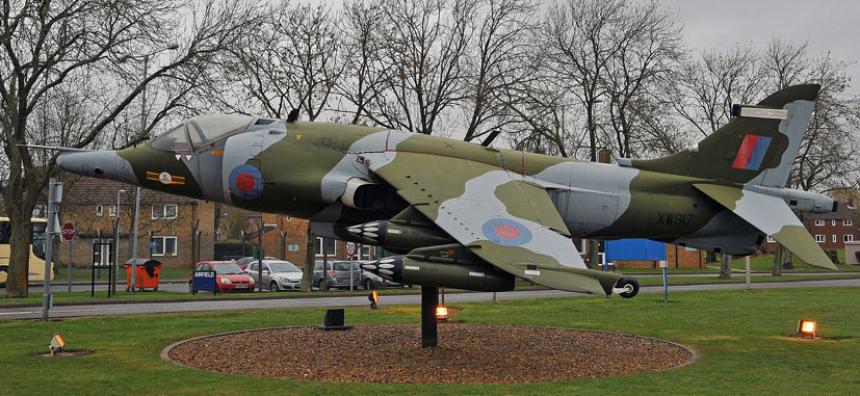
Museum exhibit - it is now quite rare to see a Harrier displayed outside a museum hangar
With the changing face of the political landscape in Europe and around the world during the 1990s, the traditionally perceived military threats faced by Britain had altered significantly. The close air support capability and the ability to operate from aircraft carriers anywhere around the world made the British Aerospace (as it was now known) Harrier arguably the most useful asset available to military planners and it was to be deployed successfully on numerous occasions in the years following the Falklands conflict. It was with this knowledge that the Government issued their Strategic Defence and Security Review in October 2010, which amongst other cost saving measures announced the early retirement of the highly capable Harrier force – this was surely a mistake and would have be changed well before the intended date of retirement. Despite almost immediate lobbying by aircrew and RAF commanders alike and the acceptance that this move would effectively leave Britain without a naval surface strike capability for many years to come, the proposed withdrawal date for Harrier was actually moved forward. In a move that still causes military observers and aviation enthusiasts alike to scratch their heads, less than two months after the SDSR was delivered to Parliament, the Harrier had been wrenched from service.

It was a cold day for Harrier enthusiasts gathered for the last flight event
In a situation that appeared to arrive with undue haste, the 15th of December 2010 is a date that will live long in the memory of the UK aviation enthusiast. Whilst most of the country was preoccupied with last minute Christmas shopping, large numbers of aviation enthusiasts headed for RAF Cottesmore to witness the final flights of the RAF operated Harrier and pay their own personal respects to an aircraft that many of them had grown up with. In the weeks leading up to this day, the weather across Britain had been extremely poor and the remaining pilots of Joint Force Harrier had seen opportunities to fly their aircraft seriously curtailed – thankfully, they had no intention of letting this magnificent aircraft disappear into the history books without planning a spectacular send off. It is with this knowledge that I and many other enthusiasts headed to Cottesmore on a cold and wintery December morning, in the hope of witnessing a Harrier spectacular and the final flight of an RAF Harrier.
I have to admit that even whilst I was making my way to Cottesmore at some seriously ungodly hour on 15th December 2010, I was thinking that this surely could not be the end of the Harrier. My opinion at the time was that the RAF Harrier (actually Joint Force Harrier) was still one of the most useful aircraft available to any air arm and in this age of military flexibility, the Harrier was an extremely effective strike and close support aircraft, able to be deployed at relatively short notice. With a number of senior British military officials vociferously lobbying the Government to reverse what they saw as a foolhardy decision, many were thinking that the Harrier would be granted an eleventh hour reprieve and the cost-cutting axe would be wielded elsewhere. Having said that, if there was no such reversal, the thought of not being present for the last Harrier flights was one too uncomfortable to contemplate, so this sad journey simply had to be made.

The first Harrier to come down to the far end of the runway was this T.12 trainer (ZH657)
I had only actually been to RAF Cottesmore on one previous occasion, but had managed to find a really great viewing spot at the very end of the 22 end of the runway and very close to the action. I remembered having to park my car on a country road some distance away from the spot and walking across some very muddy fields to get there – in view of the potential importance of my second visit, I was very much hoping to find the same spot again. Unfortunately, my previous visit was made under clear blue skies, so on this cold, dark winters morning, I was really struggling to find my bearings and my stress levels were beginning to rise. Following the signs for RAF Cottesmore, I eventually ended up at the guardroom and a rather stern looking soldier toting a large machine gun – I was left in no doubt that as an uninvited enthusiast, I was not at all welcome and advised to move on with some haste. Driving around the airfield for what seemed like an eternity, I was really beginning to panic by now, fearing that my lack of planning would result in a less than advantageous position and my early start being for nothing. I spotted another car ahead, who appeared to be having similar problems to those of my own and I stopped to have a word – ‘Follow me’ he said and within minutes, we had arrived in the grounds of a large farm, which already had a great many cars parked on the land. Although this was clearly not the place I had parked before, it actually proved to be closer to my intended viewing spot, so I quickly grabbed my camera gear and headed off to record the day’s events.

Although many of the Harriers landed short, a handful allow us to pay our respects

One final wave - Harrier ZD433 displays an interesting selection of munitions markings on the side of the fuselage
Happy to be in position, I waited in excited anticipation with a vast crowd of enthusiasts who had made the same pilgrimage, determined to pay their respects to the last of the British Harriers. The airfield was eerily silent and shrouded in a blanket of low, dense cloud and for the first time I remember thinking to myself that nothing would be taking off in this. And then there was the cold – it was absolutely freezing. With no sign of movement on the airfield and depression beginning to take hold, the cold started to eat into our bones and we were forced to endure snow and hail showers during the morning. I can honestly say that this is the coldest that I have ever been in my life. To make matters even worse, some evil individual further up the line of enthusiasts was cooking sausages for his Harrier brunch and I am sure I have no idea how he managed to survive that day in one piece – they smelt so good and they were warm too.

The unmistakable profile of a late mark Harrier. This image was taken on my previous visit to RAF Cottesmore
Eventually, the dark grey skies changed to a lighter shade and a kind soul on the airfield side of the fence drove over to tell us the prospective take-off times for the Harrier flypast event we had all turned up to see. Even though the weather was still less than ideal, RAF Cottesmore intended to launch at least 16 Harriers, which would later fly a formation flypast at 100 feet over a number of RAF bases across the country. The formation would return to Cottesmore for a couple of passes, before breaking up for landing and the symbolic end of Harrier flying operations in the UK. As the 1.30 take-off time approached, we were encouraged by the tell-tale sound of Pegasus engines whining into life on the airfield and although the weather conditions had failed to improve markedly, it appeared as if the flypast would be taking place. With a two seat Harrier T.12 taking off first to provide a weather update, the planes began to take to the grey skies in groups of four aircraft. Unfortunately, the renowned VSTOL capabilities of the Harrier dictated that the aircraft were high above us by the time they reached the airfield threshold and whilst we all continued to take photographs, they would prove to simply be a record of this significant occasion, rather than anything more spectacular.

The much missed Bae Harrier was an extremely capable close air support/strike aircraft
With all sixteen aircraft in the air, we hoped for the cloud base to lift and waited for the formation to return. It transpired that the conditions across the country were equally poor and the planned formation flypasts could not be flown safely and were cancelled, with the Harrier pilots obviously taking this opportunity to enjoy their final flight in the Harrier. Just over an hour after take-off, the Harriers returned to Cottesmore in groups of four aircraft and broke for landing. With thousands of dignitaries, station personnel and pilots families on the airfield concourse, most of the Harriers landed short and did not come down to our end of the runway, but one or two did and were met with much waving and enthusiast adulation. The crowds on the airfield were treated to one last display from a specially presented Harrier, which included one of its trademark bows to the crowd, before the last aircraft turned off its engine and with it bringing an end to Britain’s unique and much loved Harrier jump jet. As RAF Cottesmore again fell silent, the enthusiasts gathered around the airfield perimeter began to pick up their belongings and make their way back to their vehicles, again in almost total silence. It really was quite noticeable how sombre this walk back to the car actually was, almost as if we had been at the funeral of a much loved friend. Although this would never be remembered as a pleasant experience, at least the enthusiasts gathered at RAF Cottesmore on 15th December 2010 can say that they were there when Britain’s Hawker Siddeley (British Aerospace) Harrier made its final flight in UK skies.

Up where it should be - an RAF Harrier GR.9 armed and ready for action
In a move that infuriated a great many people at the time, the remaining British Harrier fleet of around 74 airframes, plus all available spares were sold as a single lot to America in 2011, who intended to use them to keep the US Marine Corps Harriers flying for many years to come. With many of the British aircraft only recently undergoing upgrade and re-fit at significant expense to the treasury, the Americans were getting a bargain – one knowledgeable commentator at the time described how the US were taking advantage of this situation and all the money the Brits had spent on their Harriers recently. ‘It’s like we are buying a car with only 15,000 miles on the clock’ and at a cost of just £110 Million pounds, the USA certainly bagged themselves an aviation bargain.
The revolutionary Hawker Siddeley/BAe Harrier was once the pride of the British Aviation industry and one of the most significant aircraft to ever take to the skies, but British aircraft would end their days lying in an American aviation boneyard, being cannibalised for spares to keep their American cousins flying. Their premature withdrawal from service left a gaping hole in Britain’s military capabilities, which will not be filled until the arrival of two new aircraft carriers and the much lauded Lockheed Martin F-35 Lightning II in around 2020. With the F-35 programme continuing to experience difficulties and production costs spiralling from those initially quoted, it is now clear that a single F-35 will cost significantly more than Britain sold their entire Harrier fleet for in 2011, which really is a shocking indictment of this sorry situation. The fact that the US Marine Corps still operates large numbers of Harriers only serves as a poignant reminder that the Harrier design remains capable and relevant to an extremely effective military air force and serves as a fitting legacy to the first Hawker P.1127 prototype flights, back in the early 1960s.

Bidding the crowds farewell – RAF No.4 Squadron Harrier GR.9 ZG858 performing its unique display
From a jet powered perspective, the Hawker Siddeley Harrier has to be considered as one of the most important aircraft ever produced by Britain’s aviation industry and certainly one of the most impressive. As most people only ever come into contact with aircraft at Airshow events around the country, the Harrier will be remembered as the consummate performer and was always an Airshow favourite. With its unique demonstration of hovering and bowing to the crowd, before traversing to normal flight and blasting through the air at high subsonic speeds, the Harrier certainly knew how to please and gathered an army of admirers in the process.

Airfix currently have a fine selection of Harrier kits available for modellers
In addition to its undoubted showmanship, the Harrier was also one of the most effective aircraft available to both the RAF and Royal Navy for over forty years, with a number of successive upgrades transforming the appearance of the aircraft from the original GR.1 version to the final GR.9A. These magnificent aircraft have long been a favourite with the modeller and an example of Hawker’s VSTOL P.1127 aircraft has been in the Airfix range in one form or another since around 1963. The current Airfix line up includes a number of Harrier options for the modeller to consider and even commands its own themed section on the Airfix website. With too many models to mention individually, a trip to the Harrier Section of the Airfix website will allow you to see all the currently available models, including a number of newly tooled kits.
Although the Corgi collector has also benefited from a number of die-cast Harrier releases over the years, the current Aviation Archive catalogue does not include an example of this magnificent aircraft. The Harrier was added to the Corgi line-up in 2001 and included examples of both the Harrier GR.1 and GR.3, along with the beautiful Royal Navy Sea Harrier FRS.1, which all proved popular with the collector. As many of these models would now probably be described as classic releases, collectors wishing to add an example to their collection will have to look long and hard, but there is always a chance that this popular tooling may appear in a future catalogue. The closest thing to a Harrier currently available to Corgi Collectors are probably the trio of Operation Granby RAF jets, which mark this year’s 25th Anniversary of the first Gulf War.
Over the past few days, one of our Aerodrome readers has offered us the opportunity to include a report from his recent visit to Malta and in particular the aviation museum. Although this offer came just too late to make this current edition, we will certainly be looking to include the feature in two week’s time, which is certainly something to look forward to.

RIAT heavy metal – the awesome Boeing B-52 Stratofortress

More American muscle - the F-22 Raptor will be making a welcome return to Fairford in 2016
For this week’s Readers' Pictures section, we are indebted to Bruce Wood, who kindly sent us a selection of images from one of his many visits to the Royal International Air Tattoo at Fairford. As one of the largest Airshows in the world, RIAT is like a magnet for aviation enthusiasts and large crowds can be expected at this Gloucestershire airfield not only on show days, but also for arrivals and departures. For many enthusiasts, the one show that definitely cannot be missed is the Air Tattoo, particularly if your interests are for modern military types.

The Airbus A400M Atlas is one of the latest aircraft to enter RAF service
Bruce told me that he has been an aviation enthusiast for as long as he can remember and combined this passion with photography at a very early age. His father was a professional photographer and actually spent some time working with the RAF, so it was almost inevitable that he would catch the bug. He started to get serious about his aviation photography in around 1984 and spent much of his time travelling to Airshows and civilian airports around the country, as his interest is not just restricted to military aviation.

Always a favourite with Airshow crowds, the magnificent Red Arrows. All images kindly supplied by Bruce Wood
Bruce also describes himself as a keen modeller, who has very much enjoyed making Airfix kits over the years and has a nice little collection of Corgi die-cast as well – the Eurofighter Typhoon being the latest addition to his collection. Bruce told me that he had recently moved to the Isle of Wight, which is a place I know extremely well and we were able to spend a few pleasant minutes extolling the virtues of this beautiful island – hopefully Bruce will still be able to visit a number of Airshows during the summer, although a ferry trip will definitely form part of his travel plans in future. I would like to thank Bruce for sending us his pictures and for the enjoyable chat we had recently. If you would like to send us a selection of your own pictures, or even an interesting aviation related story from your part of the world, please make contact with us at aerodrome@airfix.com or aerodrome@corgi.co.uk where we can make all the necessary arrangements.
I am afraid that is all we have for you in this latest edition of Aerodrome. As we have seen, our Readers' Pictures feature is really becoming popular now and we are always happy to receive any images you care to send in – although we can’t promise to use every picture we receive, we will certainly try to feature as many as we can. Please send any aviation related pictures to the email addresses above and we will be sure to include your photo credit details if we include them in a future edition.
As usual, if you would like to discuss our latest blog, you can head for either the Airfix Aerodrome Forum or our Corgi Aerodrome Forum and join the chat. If you have any specific comments, questions or suggestions for future editions of Aerodrome, please do feel free to let us know by using either the Airfix Facebook or Corgi Facebook pages, our Airfix Twitter or Corgi Twitter accounts, using #aerodrome.
Please spread the Aerodrome word! If you have any friends or acquaintances who you feel would enjoy reading our aviation related blog, please let them know that they can find us at either http://www.airfix.com/uk-en/news/aerodrome or http://www.corgi.co.uk/news/aerodrome. You can also pick up Aerodrome on both the Corgi and Airfix Facebook pages.
Thank you very much for reading our latest blog and I look forward to posting the next edition of Aerodrome in two weeks’ time.
Michael
© Hornby Hobbies Ltd. All rights reserved