Welcome to the latest edition of Aerodrome and our regular look at the fascinating world of aviation. Before we get started on this week’s blog, could I please take a moment to thank all our readers who contacted us regarding the previous edition, which featured the aviation pictures of Aerodrome readers from around the world. It seems as if this was quite a popular edition and we will certainly be looking to repeat this kind of edition later in the year, perhaps with a selection of readers' ‘Favourite Images’ from the 2016 Airshow season. Please do keep sending us your pictures, particularly as you might find yourself featuring in the next Readers' Images edition of Aerodrome – as usual, all our contact details will be included at the end of this latest blog.
For Aerodrome 53, we are going to be looking at one particular Airshow from the 2016 calendar and how it can trace its lineage to the glory days of the British Airshow. Many Aerodrome readers will remember with some fondness the huge RAF organised air displays of years past, which would take place at various RAF stations across the country and were some of the most memorable events of our youth. Boasting exciting display programmes, extensive static displays and a real opportunity to experience a day with the Royal Air Force, these events would always attract huge crowds, with both local people and enthusiasts from further afield making up the numbers. In those good old days, it really did seem like the RAF were desperate to impress the general public and prospective future recruits alike and seemingly no expense was spared in serving up a memorable aviation experience for all who attended these magnificent shows.
Although RAF stations up and down the country would hold their own ‘At Home’ events, the most prestigious shows were always the annual September ‘Battle of Britain Airshows’, which went on to become flagship events for the RAF and were usually televised for the many people not fortunate enough to be in attendance. Again, this illustrates how these shows attempted to reach as many members of the general public as possible and how the RAF were keen to promote the important work that they do. Unfortunately, over recent years, things have been very different. Swingeing defence cuts and a changing threat environment have altered the relationship between the RAF stations that still remain and their interaction with the general public. The once impressive list of annual RAF Airshow events has steadily diminished over the years, to a point where the 2016 season could boast only one such event – in this latest edition of Aerodrome, we will look at this last surviving RAF organised Airshow event and how it still flies the flag for the impressive Airshows of yesteryear.

British Aerospace Harrier GR.3 XZ991 was given a temporary winter camouflage for the 2016 Cosford Airshow
One of the most unwelcome developments to hit the UK Airshow scene over the past thirty years has been the steady decline in the RAF organised air display. As described earlier, these events were hugely popular in their day, allowing the general public to get close to the aircraft and airmen that they held in such high regard and for the various RAF stations across the country to engage in some valuable and highly effective public relations opportunities. Unfortunately, this steady decline has brought us to a situation where the only RAF organised event of the 2016 Airshow season would be taking place at the RAF museum airfield site at Cosford in the West Midlands, but as arguably one of the most accessible venues in the UK, the organisers can always rely on the unstinting support of local people and enthusiasts travelling from further afield. As if paying their respects to the legacy of the much loved RAF Airshows of the past, the Cosford shows always attract crowds in large numbers and Aerodrome was in attendance for this latest event.
For many enthusiasts, the annual Airshow at Cosford is one of the first events they look for when the calendar of events is published early in the new year and as many shows have now moved to advanced ticket purchase only, are quick off the mark when it comes to securing their attendance. The venue itself is quite unique, as it plays home to the extensive aviation collection of the RAF Museum and is still an active airfield, with the various components of the Defence College of Technical Training resident at Cosford. The home based No.1 School of Technical Training has seen Cosford benefit from the acquisition of large numbers of former RAF SEPECAT Jaguar aircraft and enthusiasts are always keen to spend time with these classic and highly attractive strike aircraft, a number of which are preserved in pristine, taxiable condition and used in ground handling and aircraft marshalling training exercises.

Programme cover from this year’s only RAF organised Airshow
The RAF Museum at Cosford also houses a magnificent collection of aircraft exhibits, including machines that served during the Cold War and an extensive display of experimental and research aircraft, which were used in the development of some of Britain’s most famous aircraft designs. One of the huge benefits of attending a Cosford Airshow is that there is always the possibility that some of these rare aircraft could be wheeled out of their respective hangars and arranged alongside more contemporary aircraft, offering enthusiasts a unique opportunity to take some memorable aviation photographs. This was definitely one of the show highlights for 2016, as Cosford marked the 75th anniversary of the first flight of a British jet powered aircraft (the Gloster 28/39 Pioneer) by bringing some of their rare and distinctive jet powered Research and Development aircraft out into the open. This was an opportunity that was simply too good to miss and this particular review of the 2016 show will be based around these striking aircraft and the unique static display at Cosford – we will cover the rain affected flying display element of the show in a future edition of Aerodrome.

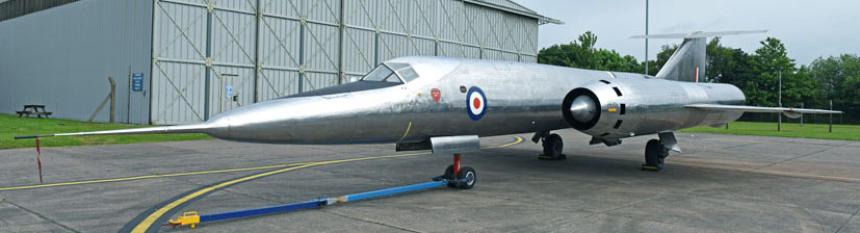
The futuristic looking Bristol Type 188 high speed experimental aircraft
As far as aircraft on display at the 2016 Cosford Airshow are concerned, there can be little doubt that the sleek Bristol Type 188 was one of the most futuristic looking. Appearing to come straight from the mind of Gerry Anderson and an episode of Thunderbirds, this beautiful looking aircraft was designed to investigate the effects of extreme heat on aircraft structures, when travelling at sustained high speeds. It has to be remembered that aircraft such as this were developed in a particularly challenging era of aviation and certainly in the days before powerful super computers and interactive flight simulators. Britain’s aviation industry relied very much on the expertise of the design teams and the skill and professionalism of the test pilots, as both were breaking new ground in aviation technology. As these pilots took new aircraft designs into the air for the first time, they were as crucial to the development of aviation, as they were brave, using their experience and flying skills to evaluate flight data and aerodynamic deficiencies in real time – they were putting their lives on the line with every new test flight. There is no doubting that these men were aviation pioneers in every sense of the word and were instrumental in taking aviation into the supersonic age.


As you can see from this collection of Bristol Type 188 images, the aircraft has something of a unique appearance, having been designed to fulfil a specific task. As jet power was pushing the speed of aircraft ever higher, scientists needed to obtain a better understanding of high speed flight and its effects. The Bristol 188 would have to attain speeds in excess of Mach 2.75 for sustained periods, allowing the effects of kinetic heating to be examined, yielding valuable data for the future of high speed flight. Central to the appearance of the aircraft was the metal used in its construction – to cope with the extreme temperatures the aircraft would be subjected to, a special type of hardened stainless steel was used, which was capable of withstanding temperatures of 500º C. More difficult to work with than traditional aluminium, new construction techniques had to be developed, which allowed the separate panels of the aircraft to be welded. ‘Puddle welding’ used a welding arc that was surrounded by inert argon gas and allowed this distinctive aircraft to take shape. With a thin fuselage designed around the width of the ejection seat and two large wing mounted engine nacelles to house the somewhat problematic jet engines used on the aircraft, the Bristol Type 188 was given the nickname ‘The Flaming Pencil’ and must have been a particularly impressive machine to see in the air.

The ‘Flaming Pencil’ failed to achieve its potential as the fastest British jet aircraft
Ultimately, the Bristol 188 was to be judged a failure. Persistent problems with both engines and general construction resulted in serious delays to the project and the aircraft failing to achieve its design targets – the highest speed it was able to achieve was Mach 1.88 in 1962, when the English Electric Lightning was already capable of Mach 2+ performance and the fuel consumption of the 188 was horrendous. Of the three aircraft constructed, only XF926 survives and for one glorious weekend in 2016, it was allowed outside the Test Flight hangar, to captivate a new audience of aviation enthusiasts. It stands as both the fastest and the final aircraft design produced by the Bristol Aeroplane Company, which was later amalgamated into the British Aircraft Corporation during the late 1950s.

The world’s only Avro Type 707C was displayed outside at Cosford 2016
As far as rare and unique British research aircraft are concerned, if you are fortunate enough to be looking at the only example of an aircraft ever constructed, you certainly know that you are looking at a piece of aviation history. This beautiful Avro Type 707C was to be the first of four aircraft constructed to aid in the training of pilots destined to fly the new (at the time) Avro Vulcan bomber, but after the construction of WZ744, the contract was cancelled, leaving this as the only two seat training version of the Avro 707 development aircraft series.
The Avro 707 series of aircraft were designed to help gather valuable data regarding the handling characteristics of delta-winged aircraft and proved particularly valuable in the development of the Avro Vulcan program. The first of the Avro 707 aircraft to fly was VX784 on 4th September 1949 and became the first delta winged aircraft to fly in Britain – tragically, it was destroyed in an accident less than a month later, due to a loss of control during a slow speed manoeuvre. Subsequent aircraft would include a number of design modifications to aid handling during the critical slower speed phases of flight. The 707 series were basically 1/3rd scale versions of the first Vulcan bombers and are often simply referred to as ‘Baby Vulcans’ – the five aircraft constructed were designed very much with the Vulcan programme in mind, although each aircraft would be assigned a specific envelope of flight to evaluate. The 707A was used for high speed handling tests, whilst the 707B would be used for low speed handling. The only two seat 707C constructed (WZ744) was intended to provide conversion training for future Vulcan pilots and introduce them to the flight handling characteristics of delta-winged aircraft, which was extremely new aviation technology in the early 1950s.


Intended as a Vulcan pilot trainer, the Avro 707C was just 1/3rd of the size of Avro’s mighty delta
Amongst the research and development aircraft currently displayed at RAF Cosford, this Avro 707C is the only aircraft of its type ever constructed and is basically a 1/3rd scale Vulcan trainer. Although intended to fulfil a familiarisation and orientation requirement for future Vulcan pilots, the 707C was never actually used in connection with the Vulcan development programme, but went on to become one of the first aircraft in the world to be operated using a fly-by-wire control system. Flown regularly throughout the mid 1950s and early 1960s, it provided valuable flight data which would be used on some of the most important aviation projects in the coming years. Struck off charge at Farnborough in late 1966, the aircraft was released as a museum exhibit, but only arrived for display at RAF Cosford in 1973. This is a particularly pretty looking aircraft and its links to the much loved Avro Vulcan ensure that this diminutive little delta jet always receives plenty of attention. It was a real treat for enthusiasts to see the 707C under blue skies at Cosford, although we had to be quick with our photographs, as these favourable conditions did not last long.

The beautiful Fairey Delta 2 was the fastest aircraft in the world for a twelve-month period
Without doubt, one of the most striking aircraft on display at the 2016 Cosford Airshow was the majestic Fairey Delta 2, which looked all the more appealing courtesy of its smart dark blue and gold livery. This has to be considered as one of the most important British jet aircraft of the post war years and many people admiring it at Cosford would not have been aware of the historical significance of the Fairey Delta 2. In the years following the Second World War, Britain was very much lagging behind in the area of supersonic aviation development and the government were keen to do something about the situation. They issued a specification for the construction of a supersonic research aircraft which would challenge the progress made by the Americans and Fairey aviation answered the call. Their beautiful Fairey Delta 2 aircraft was a single-seat, delta-winged bullet, powered by a single Rolls-Royce Avon engine, with afterburner, which was designed from the outset to be a real speed machine. The aircraft adopted a nose high attitude when on the ground, which was designed to give it better performance in the take off and recovery phases of flight, but this did create a problem regarding ground visibility for the pilot. The solution was to allow the nose and cockpit area to be hinged, with a 10-degree deflection allowing for much greater pilot visibility during low speed manoeuvring and ground handling, a development that would later appear on the Anglo-French Concorde supersonic jetliner.


The FD2 still looks as if it could break a few records today
The first flight of the impressive Fairey Delta 2 took place on 6th October 1954, in the capable hands of Peter Twiss, Fairey Aviation’s chief test pilot. Over the course of the next few months, the aircraft was flown extensively, with much information being gained about high speed delta flight and the operation of this highly specialised aircraft. By March 1956, the Fairey Aviation team were ready to make their assault on the world air-speed record and a potential place in the aviation history books. Nothing could be left to chance and the finest brains in aviation ensured that everything was in place to record this momentous attempt. Using the RAF facility at Boscombe Down as their base, the team launched their bid on 10th March 1956 and again with Peter Twiss in the pilot’s seat, the Fairey Delta 2 set off on its historic flight. Streaking across the skies high above Chichester, Twiss made the obligatory two high speed runs and smashed the current world airspeed record, with a speed of 1139.2mph – amazingly, this was over 300mph faster than the existing record, held by a USAF North American F-100 Super Sabre. This record would be held by Twiss and the Fairey Delta 2 for over twelve months, at a time when being the fastest was the only thing that seemed to matter – this was also the last time that a British aircraft would ever hold the World air speed record, which has been dominated by the US and Soviet Union ever since.
The example on display at Cosford is WG777, which was the second of only two Fairey Delta 2 aircraft produced. It was first flown at Boscombe Down on 15th February 1956, again in the hands of Peter Twiss and was used extensively on test and evaluation sorties during 1956/57. It was eventually released from flights trials work in June 1966, having made no less than 429 flights, which would yield valuable data for a multitude of aeronautical uses. Its sister aircraft and world air speed record holder WG774 was later converted to BAC 221 configuration and was used extensively during the Concorde development programme. This aircraft is now displayed next to the Concorde prototype at the Fleet Air Arm museum at Yeovilton.

The nose and cockpit section of the aircraft could ‘droop’ by 10 degrees
Although this particular Fairey Delta 2 was not the actual aircraft that managed to capture the world air speed record in 1956, it is displayed in the same configuration and is an extremely important British aircraft for that fact alone. Despite the presence of much more modern aircraft and ones which would be much more familiar to the majority of aviation enthusiasts, the Fairey Delta 2 was definitely one of the most significant British aircraft on display at Cosford 2016 and certainly one of the show highlights.
I can hardly believe that it is now nine years since the SEPECAT Jaguar was withdrawn from RAF service, in yet another episode that seemed to take place with undue political haste. As well as being one of the best looking jet aircraft to fly in the colours of the Royal Air Force, the Jaguar proved to be an extremely effective one, providing over thirty years of front-line service, including deployment to the Persian Gulf during Operation Granby. The Jaguar is still very much missed by aviation enthusiasts, but one of the undoubted highlights of a trip to Cosford is the opportunity to see large numbers of former RAF Jaguars at various locations around the site. Used as instructional airframes by the engineers of the Defence College of Technical Training, many of the machines can often be seen in various stages of being dismantled by the students, which makes for a fascinating insight into the essential work they do – fortunately, an impressive number of Jaguars still look to be kept in remarkably good condition. These aircraft are highly prized amongst aviation photographers and could almost pass as still being Squadron aircraft, still residing at their spiritual home RAF Coltishall. Here is a selection of images featuring some of the Big Cats that can still be seen at RAF Cosford.

This beautifully presented Jaguar GR.3A is always popular with enthusiasts

Another view of former RAF No.6 Squadron Jaguar XX119

The business end of a former QinetiQ Jaguar T.4 trainer

Jaguar T.2 ZB615 wearing the distinctive livery of the Empire Test Pilots School
Although we have only looked at a few of the static aircraft displays at this year’s Cosford Airshow, I think this gives a good indication as to why this is always such a popular event, attracting large crowds from the West Midlands and further afield. As the only remaining RAF organised Airshow, Cosford is carrying on a proud tradition that is missed by so many aviation enthusiasts of a certain vintage, but with plans announced to stage a new show at RAF Scampton in 2017, hopefully we may see greater RAF participation at Airshow events in future years. Of course it is important to stress the Cosford is a fantastic place to visit at any time of the year and not just during their annual Airshow, as there are a great many aviation delights on show and plenty of other interesting attractions for the whole family. As you have seen from some of the aircraft in this review, RAF Cosford is home to some of the most important aircraft in the history of British aviation and can boast impressive displays commemorating research and development aircraft, as well a collection of jet aircraft of the Cold War era. Although I have not enjoyed a visit to Cosford on a non Airshow day for a number of years, I think I am talking myself into a visit in the very near future.
Although this has been something of an unusual Airshow review, I do hope that it has been an interesting edition and allowed readers to see some of the more unusual Cosford based aircraft, on a rare outing outside the hangars. As these are extremely valuable examples of our aviation heritage and the weather was less than kind during the show itself, it could be many years before this opportunity arises again and it is unlikely that the same combination of aircraft will be arranged for our viewing pleasure.

A last look at the beautifully presented Fairey Delta 2
We are always interested to hear from our readers, particularly if you have any interesting aviation related stories to share, or unusual photographs to send us. We are also already building the next ‘Readers Pictures’ edition, so please do let us have your Airshow and museum pictures from the 2016 season. As usual, you can send us your aviation pictures and stories to our direct e-mail address at aerodrome@airfix.com or aerodome@corgi.co.uk or by posting them on our Forum, or social media accounts detailed below. Please do get involved and help to shape the direction of future Aerodrome blogs.
To join in with all the latest social media discussions regarding Aerodrome and aviation matters in general, please head for either the Airfix Aerodrome Forum or our Corgi Aerodrome Forum and have your say. If you have any specific comments, questions or suggestions for future editions of Aerodrome, please do feel free to let us know by using either the Airfix Facebook or Corgi Facebook pages, our Airfix Twitter or Corgi Twitter accounts, using #aerodrome.
To join in with all the latest social media discussions regarding Aerodrome and aviation matters in general, please head for either the Airfix Aerodrome Forum or our Corgi Aerodrome Forum and have your say. If you have any specific comments, questions or suggestions for future editions of Aerodrome, please do feel free to let us know by using either the Airfix Facebook or Corgi Facebook pages, our Airfix Twitter or Corgi Twitter accounts, using #aerodrome.
Thank you very much for reading our latest blog and I look forward to bringing you more aviation related content in two weeks’ time.
Michael
© Hornby Hobbies Ltd. All rights reserved