During the summer of 1940, the fighter pilots of the Royal Air Force were carrying the weight of Britain’s very survival on their young shoulders. Day after day, they would be forced to risk their lives in the seemingly futile task of attempting to repel the overwhelming numbers of Luftwaffe aircraft that were intent on their destruction. Wracked with fear and apprehension, it is difficult to imagine what these men must have been forced to endure, but as the latest raids were approaching Southern England, the Spitfires and Hurricanes of Fighter Command would be there to challenge them.
The achievements and sacrifices of the glorious ‘few’ are now the stuff of WWII legend, but for some of these brave pilots, the Battle of Britain was actually the third time that they had faced the unnerving onslaught of the all-conquering Luftwaffe. In the latest edition of Aerodrome, we will look at the brave pilots of the Polish Air Force and how they made a significant contribution to the RAF victory in the Battle of Britain.
The German invasion of Poland on 1st September 1939 marked the beginning of the Second World War and put an end to any hopes of a diplomatic solution to the unrest in Europe. There is no doubting that Poland was ill-prepared for war, but this situation was compounded by the fact that larger European nations had deterred the Polish military from mobilising her forces, despite reports of German troop concentrations near the border with Poland. Britain and France were still hoping to avoid war and they did not want a Polish mobilisation to be used as provocation by Herr Hitler in launching military action. These futile delays, combined with the ruthless effectiveness of Blitzkrieg ensured that Poland would suffer terribly at the hands of the Wehrmacht.
It is a common misconception that the Polish Air Force at the beginning of WWII suffered from a lack of trained pilots and poor morale, but this could not be further from the truth. Poland had developed an excellent pilot training programme and her squadron pilots were both extremely capable and highly motivated airmen. What they did lack was an effective and modern fighter aircraft, with which to face the impending German onslaught. The main fighter aircraft available to the PAF was the PZL P.II parasol fighter, which was a contemporary of the British Gloster Gauntlet. When this fighter was introduced in 1934, it was considered potentially the most advanced fighter aircraft in the world, but as it prepared to face the highly capable Messerschmitt fighters of the Luftwaffe, it was woefully outclassed. Despite its obsolescence, the Polish pilots took the PZL P.II into battle against the Luftwaffe and managed to score some significant victories against their hated foe. In fact, the Polish Air Force managed to shoot down 126 Luftwaffe aircraft during the invasion of 1939, despite the overwhelming superiority of the Germans.

Damaged Polish Air Force PZL P.II parasol fighter
By the time the Soviet Union attacked Poland on the 17th September, any further Polish Air Force resistance was futile and all remaining aircraft were immediately withdrawn to Romania. Initially it was hoped that they would receive better aircraft from other European nations and could use these to launch a counter offensive against the Germans – it soon became clear that the only way that Polish pilots would be able to continue fighting would be for them to make their way to either Britain or France. If they managed to achieve this, they would surely have access to more capable aircraft and could then avenge their Country in combat.
As Europe descended into armed conflict, Polish pilots attempting to travel from Romania to France would face some significant difficulties, not least of which was the fact that they were now interned in Romania. Before they could even embark on their journey, they would have to commandeer civilian clothing and arrange for false documents to be produced, whilst the exiled Polish Government attempted to re-establish in France. Using a number of travel routes, approximately 8,000 Polish airmen had arrived in either France or Britain by the end of April 1940 and following agreement with the Polish Government, it was decided that Polish fighter units would stay in France, whilst bomber units would begin training with Bomber Command in Britain.
Despite the undoubted capabilities of the Polish pilots, they would clearly have to undergo an intensive period of training to allow them to convert to French fighter types. The language barrier was not so problematic, as many of the airmen could speak some French, but they did find some resentment amongst a French population, desperate to avoid another war. During this period known as the Phoney War, the Polish airmen were forced to endure terrible stories from their loved ones about what was happening back in their homeland, whilst their hosts tried to desperately avoid combat with Germany. They were also trained to fly some of the less capable fighter types in French Air Force service, such as the Caudron C.714 light fighter, which resembled more of a racing aircraft than a fighter. Many Polish units were assigned to airfields defending factories and military installations and whilst their French counterparts could not contemplate a German attack, the Poles prepared to face the inevitable onslaught for a second time.
 A restored Caudron light fighter at the La Ferte-Alais Airshow
The German invasion of France began on 10th May 1940 and as the Polish forces had experienced only months before, the Wehrmacht had perfected their ‘lightning war’ and they quickly began to overrun French units. The Luftwaffe formed the spearhead of the German offensive and French Air Force units were involved in savage fighting from the first day of the conflict. The experienced and battle hardened Polish pilots were thrust into battle once more and despite flying aircraft that were inferior to the Messerschmitts of the Luftwaffe, they fought with bravery and tenacity. In a development that truly illustrated the mentality of the Polish pilots, following heavy losses and the total combat inadequacy of the Caudron C.714 fighters, French military officials decided to withdraw the aircraft from combat, which left many Polish pilots without an aircraft to fly. This was a situation that the Poles found totally unacceptable and they continued to fly the Caudron - despite the aircrafts inadequacies, they still managed to score a number of notable victories against the Luftwaffe.
As French forces stopped fighting in the middle of June, all remaining Polish military personnel were ordered to evacuate to Britain. For many, this would result in a dash to one of the French Atlantic ports and a rather uncomfortable voyage to the UK. For others, this would prove to be a much more arduous undertaking, as they were forced to take something of a scenic route, via North Africa and Gibraltar. In a display of great daring, or absolute desperation, a small number of pilots simply flew their French fighters across the Channel and landed at RAF airfields, at great personal risk of being shot down in the process. They certainly did their nation proud in displaying an absolute determination to continue fighting at all costs.
 Polish pilots of RAF No.303 Squadron pose for the cameras
On their arrival in Britain, Polish pilots must have thought they would finally have an opportunity to take on the Luftwaffe at something close to equal terms. The RAF were equipped with Spitfires and Hurricanes, which were more than a match for the German Messerschmitts, but it was not going to be quite as simple as that. Once again, they would have to adapt to a new command structure and learn to fly completely new aircraft, all in wartime conditions.
After the RAF had lost valuable pilots and aircraft in the defence of France, they were desperately in need of new pilots for the coming onslaught against Britain. The hundreds of Polish pilots arriving from France were capable airmen and eager to fight, but initially they were to face some of the problems they encountered whilst serving in France. They would obviously have to undergo an intense period of training, but unlike their time in France, they also had the distinct disadvantage of the language barrier. Fighter Command operated a strict system of ground control for its aircraft and a command of the English language was seen as being essential. In addition to this, many RAF senior commanders were sceptical of the fighting capabilities of the Polish airmen, due to their perceived poor performance in defence of both Poland and France. Nevertheless, two Polish fighter squadrons – Nos 302 and 303 were eventually formed, with other pilots joining the ranks of existing RAF squadrons, so that they could gain valuable experience in both RAF procedure and flying British fighter aircraft.
When considering that many of the Polish pilots arriving in Britain were well trained and extremely capable airmen, the early months of their British experience must have been incredibly frustrating. Still reluctant to introduce them to combat flying, the time between June and August 1940 was one of incessant training, with the language barrier continuing to cause significant difficulties on both sides. As the Battle of Britain was being fought in the skies above southern England, the Polish pilots were forced to practice RAF combat tactics and radio procedure, riding specially equipped tricycles on their home airfields. Armed with British radios, airspeed indicators and compasses, they cycled around RAF Northolt, whilst young men were fighting and dying in defence of Britain. Although this exercise was seen as being essential to integrate the airmen into Fighter Command procedures, it only served to frustrate and annoy the Poles, most of whom were already combat veterans.
 A Battle of Britain era Hawker Hurricane Mk.I
Despite these setbacks, it soon became clear to RAF commanders that the Polish pilots were extremely accomplished airmen, who were desperate to enter the battle. Britain was also losing pilots at an alarming rate and they were forced to cut the training time for new recruits to just two weeks – during this time, newly qualified pilots would have to learn to fly one of the most demanding machines on earth, at speeds exceeding 300 mph, before entering the melee of a dogfight and fighting for their lives. They also needed to shoot down the enemy at a rate of approximately four to one – here the Polish pilots had a distinct advantage, as they were already trained, experienced in combat flying and were very much ready to fight.
Finally, in the middle of August 1940, the first RAF Polish squadron (No 302 Squadron) was declared operational at RAF Leconfield, in the East Riding of Yorkshire. They were charged with relieving the battle weary squadrons of 11 Group, who were heavily engaged in fighting the Luftwaffe and it would not be long before the squadron was involved in the savage fighting over southern England.
 Famous Polish pilots of No.303 Squadron at RAF Northolt
Additionally, the performance of Polish pilots attached to other RAF squadrons was beginning to highlight their undoubted fighting qualities. On 24th August, Sergeant Antoni Glowacki of No. 501 Squadron was credited with shooting down five German aircraft on the same day. During three different sorties, he accounted for two Junkers Ju 88 bombers and three Me 109 fighters, to become the Battle of Britain’s first ‘Ace in a Day’. Many of the other experienced former Polish Air Force pilots also began to score victories and stories began to circulate of their tenacity in battle and total disregard for their own safety – importantly, they were helping to turn the tide of the battle at a crucial point.
The combat successes of their countrymen were a source of great pride and immense frustration to the training pilots of No.303 Squadron, to a point where their discontent was beginning to boil over – they were constantly requesting operational status, but for them, the training continued. On 30th August 1940, this situation was brought to a head, whilst flying a routine interception training exercise from their base at RAF Northolt. Six Hurricanes from 303 Squadron took off on a sortie to intercept a flight of Bristol Blenheims, led by their experienced British Flight Commander Squadron Leader Ronald Kellet. During the sortie, Flying Officer Ludwik Paszkiewicz spotted a number of enemy bombers in the distance and requested permission to attack them. For whatever reason, there was no reply from his commanding officer, but the Polish airman peeled away and pressed home his attack – closing in on the German bomber, Paszkiewicz waited until he was at short range before opening fire, bringing all eight guns of his Hurricane to bear on the enemy aircraft. The bomber burst into flames and was seen spinning towards the ground – this was the first time that Paszkiewicz had ever fired his guns in anger and he was elated to have scored his first kill.
 HAC Hurricane Mk.XIIa wearing new RAF No.303 Squadron markings
On landing back at Northolt, there was something of a different atmosphere. Sqn. Ldr. Kellett gave the Polish pilot a public dressing down in front of his comrades, for leaving formation without permission and in the process, endangering his own life and risking a valuable aircraft. Once the pair were in private, Kellett congratulated Paszkiewicz on his achievement and sought official authority to change the status of the squadron. The following day, Kellett informed the pilots of No.303 Squadron that they were now fully operational and they were now one of 21 RAF Squadrons defending London and the vital ports of Southeast England.
Once committed to battle, the pilots of No.303 Squadron immediately displayed their undoubted flying skills and Luftwaffe aircraft were made to pay a heavy price for their incursions into British airspace. As the victory tallies of No.303 Squadron pilots began to rise steadily, it soon became clear that this was an exceptional group of airmen. On one particular sortie over London on 7th September (the first day of the Blitz), 303 Squadron pilots managed to shoot down 14 enemy aircraft, with a further 4 claimed as probable, without incurring a single loss to their own number.
Despite entering the Battle of Britain relatively late, the Polish pilots of No.303 Squadron managed to post an impressive combat record during the battle – with 126 enemy aircraft destroyed and a large number of probables, they managed to destroy more enemy aircraft than any other Hurricane equipped unit. Indeed, in only 42 days of combat, No.303 Squadron were the most successful Fighter Command unit of the Battle of Britain. Nine of the Squadrons pilots achieved ‘ace’ status (shooting down five or more enemy aircraft) and Sergeant Josef Frantisek became the leading ace of the Battle of Britain, with 17 confirmed victories. Frantisek was actually a Czech pilot, but he preferred to fly with the Polish airmen, as it better suited his fighting style.
 A Messerschmitt Bf 109E brought down during the Battle of Britain
The Polish pilots who fought during the Battle of Britain made a significant contribution to the eventual RAF victory and wrote a glorious chapter of gallantry in the annuls of both Polish and British history. Air Chief Marshal Sir Hugh Dowding said of the Polish airmen, “Had it not been for the magnificent material contributed by the Polish Squadrons and their unsurpassed gallantry, I hesitate to say that the outcome of the Battle would have been the same”.
In the months following the end of the battle, the Polish airmen of the Battle of Britain enjoyed something of a celebrity status, with journalists desperate to hear of their combat exploits and a grateful public refusing to allow them to pay for their beers. They also proved to be rather popular with the ladies and were often reported as having a girl on both arms, when enjoying some time off in London. In a short period of time, the former Polish Air Force airmen had experienced so much and had finally been given an opportunity to show what they could do – they proved to be exceptional airmen and brave fighters. They were a credit to their proud nation.
Epitomising the spirit and determination of the Polish airmen of WWII, Flt. Lt. Henneberg was one of the pilots forced to flee the advancing Germans in September 1939. A qualified flying instructor at the Deblin Flight Academy, he was an accomplished aerobatic pilot and represented his country at international gliding competitions throughout the 1930s. He was one of the many pilots inducted to the ranks of the French Air Force, where he was eventually given command of a flight of nine Bloch MB.152 fighters and charged with the defence of Chateauroux airfield and the nearby Bloch aircraft assembly factory.
With the collapse of France, Henneberg was one of the few intrepid pilots who actually flew to Britain – at the risk of being shot down at any moment, he flew his Bloch fighter across the Channel and landed at RAF Tangmere. He was processed through the RAF training programme, joining No.303 Squadron at Northolt, where he would go on to score eight victories during the Battle of Britain.
Henneberg would go on to command No.303 Squadron in 1941, as the unit began mounting strike operations against German airfields in Northern France. He was tragically killed returning from one such operation on 12th April 1941 - Flying Spitfire Mk.IIa P8029, his aircraft was hit by ground fire and ditched into the Channel, some ten miles off Dungeness. Although he was seen swimming away from his sinking aircraft, he was never found and was presumed to have drowned. Like so many airmen of WWII, Zdzislaw Karol Henneberg paid the ultimate price for his devotion to duty, aged just 29 years. - He is remembered on the Polish Air Force Memorial at Northolt.
 The latest Hurricane release is an RAF No.303 Squadron Hurricane Mk.I
One of the latest releases in the Corgi Aviation Archive range marks the exploits of the famous Polish No.303 Squadron and pilot Zdzislaw Karol Henneberg, during the latter stages of the Battle of Britain. This newly tooled 1/72nd scale Hawker Hurricane Mk.I die-cast model has been developed using the very latest computer aided design technology and is a fine representation of this famous British fighter. Interestingly, it is almost 80 years to the day that the prototype Hurricane (K5083) made its first flight from Brooklands aerodrome!
AA27602 is presented as Hurricane Mk.I P3120, RF-A and was flown by Polish pilot Zdzislaw Karol Henneberg from RAF Northolt in September 1940. During the intense air battles at the height of the Battle of Britain, Henneberg managed to score a number of victories against Luftwaffe aircraft and helped to ensure that No.303 Squadron became the most successful RAF fighter Squadron of the battle. This fine die-cast example of a No.303 Squadron Battle of Britain Hurricane is a fitting tribute to the brave Polish pilots of the RAF and in particular to Flt. Lt. Henneberg. This beautiful Hurricane model is available now on the Corgi website.
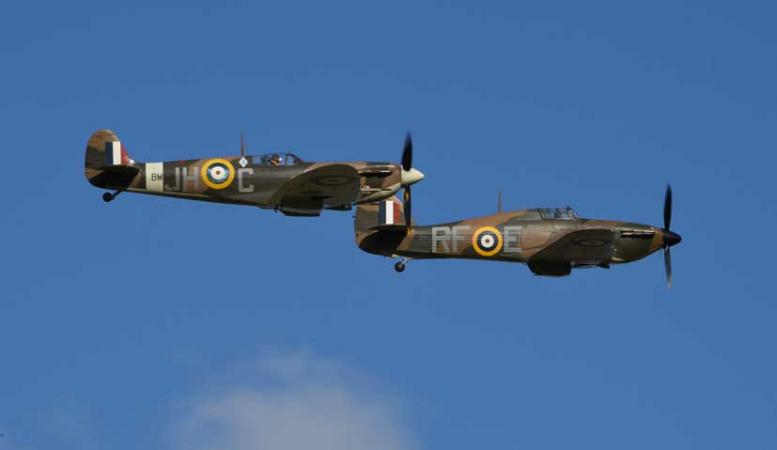
As Britain commemorated the 75th Anniversary of the Battle of Britain this summer, the Historic Aircraft Collection, based at Duxford made a poignant tribute to the brave Polish airmen who took part in this conflict. Their famous Hawker Hurricane Mk.XIIa (G-HURI) is a regular performer at Airshows around Europe and in this significant anniversary year, they decided to pay their own unique tribute to the Polish pilots of Fighter Command. With the support of the Polish Embassy, the Hurricane was repainted in the markings of a Northolt based No.303 Squadron Hurricane of the Battle of Britain. Presented as Hurricane P3700 and coded RF-E, this aircraft was the mount of Sgt. Kazimierz Wunsche, when he engaged in combat with a large number of Luftwaffe aircraft on 9th September 1940. After sustaining significant damage, Wunsche was forced to abandon his aircraft, which crashed near Poynings, in Kent – the crash site was the subject of an archaeological recovery operation in 1979, where substantial aircraft parts were located. Interestingly for the 2015 HAC Hurricane project, the crash site of Wunsche’s aircraft was to be the subject of a much more detailed inspection this year!

During 2015, HAC Hurricane Mk.XIIa carried markings to commemorate the Polish pilots of the Battle of Britain
This fantastic project certainly proved to be one of the most fitting Battle of Britain tributes of 2015 and helped to mark the significant contribution made by the Polish pilots of Fighter Command. You can find out more about the Historic Aircraft Collection and their Polish Hurricane by clicking on this link http://www.historicaircraftcollection.ltd.uk/hurricane/
I hope that you have enjoyed this slightly different look at the Battle of Britain this week and how the former Polish Air Force pilots fought their way through war torn Europe to make their significant contribution. They certainly highlight the fact that the non-British pilots of Fighter Command were absolutely essential to Britain’s eventual victory.
As usual, you are welcome to discuss our latest blog either on the Airfix Aerodrome Forum or Corgi Aerodrome Forum. If you have any specific comments, questions or suggestions for future editions of Aerodrome, please feel free to let us know via Airfix Facebook or Corgi Facebook, or on Airfix Twitter or Corgi Twitter using #aerodrome. If you have any pictures of the HAC Hurricane wearing its No.303 Squadron markings, please upload them for other readers to enjoy!
Until next week, thank you very much for reading.
Michael
© Hornby Hobbies Ltd. All rights reserved