
Welcome to this latest edition of Aerodrome and our regular look at the fascinating world of aeroplanes and the historic aviation scene around the UK.
There are some days when representing the Airfix and Corgi brands turns out to be much more than spending long hours working at a computer with punishing deadlines to meet, days when you have the opportunity to spend time with real aeroplanes and not scale representations of them. One of those days occurred earlier this year, when my association with these iconic brands allowed me an opportunity many thousands of fellow aviation enthusiasts would love to experience for themselves, a visit which is the subject of our latest edition of Aerodrome.
One of the most famous names in aviation, Rolls Royce are and continue to be a driving force in the world of aviation history, with their heritage spanning from the Eagle engine which powered British aircraft of the Great War, to the latest ultra-efficient variants of the Trent turbofan, arguably the most important engine family in the history of civilian aviation. Making a significant contribution to the Allied war effort during Second World War, it's entirely appropriate that the company has decided to commemorate this proud heritage by operating two of the most famous single engined aircraft of WWII on the UK Airshow scene, both of which were powered by different variants of Rolls Royce engine designs. Based inside a pristine hangar complex at East Midlands Airport, both aircraft were 'At Home' during my visit and our friends at Rolls Royce graciously allowed me to document my visit for the benefit of Aerodrome readers.
Please join me as I spend some time with a pair of beautifully restored WWII era aircraft, both of which are now extremely active participants on the UK Airshow circuit, and a third which possesses real RAF service provenance.
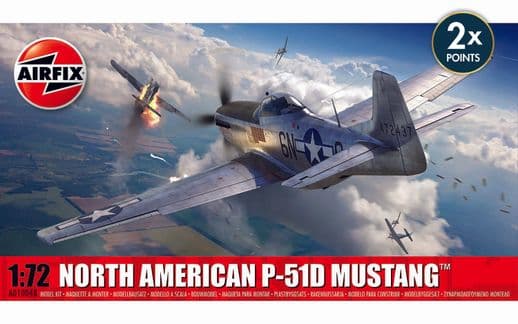
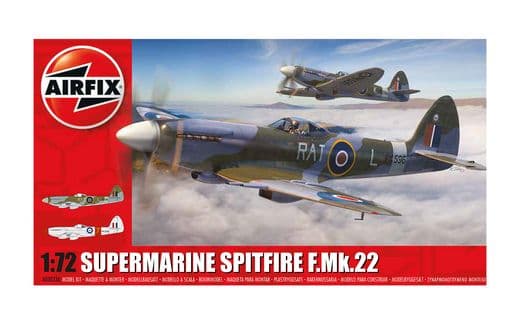
It's amazing how models turn up where you least expect them. This collection had a rather specific task to perform, as they were in the display offices of the Rolls Royce Heritage Flight team.
Fellow aviation enthusiasts will no doubt experience the same strange feelings that I do whenever I'm fortunate enough to spend time in the company of aeroplanes, whether that be taking my place in an Airshow crowd, or visiting a museum or active airfield. Irrespective of how many times I've done this before, the same sensation of excitement and anticipation still consumes me just as it did when I was a teenager, and serves as undeniable confirmation that that I am still completely infatuated with anything to do with aviation and aeroplanes.
To be honest, we are all really rather fortunate to have something so important in our lives, a passion which is so all consuming that no matter how stressful and hectic our lives might be, just a few minutes in our aviation world can take us to a much calmer and thoroughly enjoyable 'happy place'. This is something other people have to pay therapists a great deal of money to even get close to.
That being the case, you can therefore imagine my excitement as I headed down for an early morning appointment at the Rolls Royce Heritage Flight hangar facility at East Midlands Airport a few months ago, a pre-arranged visit to meet a chap called Dean who I had been working with over the previous few months and who had been extremely helpful on numerous occasions. Dean invited me to come and see where he worked, probably in part due to the fact that he felt a little guilty about how he always signed off our conversations by telling me that he was currently looking at a gleaming photo reconnaissance Spitfire in the hangar, a real case of aviation one-upmanship between us. Whatever the reason, I was delighted to have the rare opportunity to visit this intriguing location and to look round Dean's rather special place of work.
Having completed all the necessary visitor formalities in a very plush reception area, Dean came to collect me and take me through to a much more interesting part of the building, the main hangar. Having already checked that photography would be permissible during my visit, I knew I was in for an extremely enjoyable day, even though Dean did warn me that there were some items and areas which must not be photographed or mentioned in our blog, but for my main areas of interest, we were good to go!
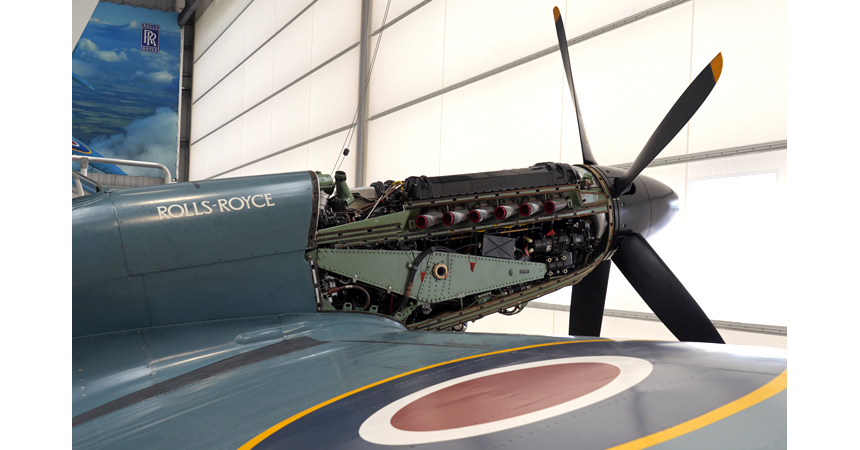
Not a Trent turbofan, but classic Rolls Royce engine technology from a previous era of flight.
The first thing that really jumped out at me was just how clean the hangar floor was, it was absolutely pristine. You often hear the saying that a floor was so clean that you could eat your dinner off it, however in the case of the Rolls Royce Heritage Hangar floor, this was no exaggeration, this floor was surgically clean. My visit started with Dean talking me through the impressive sight of a Trent jet engine, detailing how this technological marvel operates and how computers are constantly monitoring every aspect of its performance, feeding back information in real time. As fascinating as this was, the Rolls Royce engines I was really excited about seeing were from a previous generation of flight and in the adjoining hangar - we moved on.
Once next door, despite the fact that there was an impressive collection of classic Rolls Royce piston engines laid out for visitors to admire, my attention had already shifted and I only had eyes for one thing, Supermarine Spitfire PR.XIX PS853, pride of the Rolls Royce Heritage Flight fleet and superstar performer on the UK Airshow scene. She was positioned at the front of the hangar with her engine panels removed and looking as if she was prepared to receive visitors - this really was like being granted an audience with aviation royalty.
An example of what many people consider to be the ultimate incarnation of the Spitfire, this magnificent machine was one of the unarmed Spitfires which relied on speed, stealth and its pilot's abilities to successfully complete its missions, with the additional responsibility of having to secure detailed photographic records of the target they were sent to capture for good measure. A real exercise in form and function coming together in perfect synergy, I almost felt too dirty to get close to this aviation beauty, as if my natural body oils would somehow sully the gleaming finish on this lovingly cared for aircraft. Thankfully, Dean wasn't about to let me get away with any such thoughts.
Despite my misgivings, I was invited to climb into the cockpit of this icon of the air, something I really wasn't at all sure about, as I'm quite a big unit, you see. Nevertheless, Dean insisted and I dutifully climbed into what I had expected to be a rather restricted environment for a man of my proportions, however, I have to admit that I was very pleasantly surprised - it was actually quite roomy, very comfortable and not at all claustrophobic. Invited to move the controls, it was interesting to note just how smooth this was to do and how the Spitfire's control column was hinged towards the top, meaning that operating the ailerons didn't require the entire column to be moved as it did on other aircraft types.
As I sat there, I really felt myself quite the Spitfire pilot, except of course that my first sortie was taking place on the ground, inside a hangar and with the engine not growling away in front of me - I find it's always best to leave this kind of work to the experts.
Supermarine Spitfire PR.XIX PS853 was built by Vickers Supermarine at their Southampton factory works towards the end of 1944 and delivered to the Central Photographic Reconnaissance Unit at RAF Benson on 13th January 1945. She would see active service with No.16 Squadron before the end of the Second World War, flying sorties over Belgium and Holland, trying to locate possible German V1 and V2 launch sites in northern Europe. Spending time with No.268 before returning once again to No.16 Squadron, she would be damaged following her involvement in a flying incident in early 1949 and was sent back to Vickers Supermarine for repair.
A place for everything and everything in its place - is it any wonder the floor space at the Rolls Royce Heritage Flight Hangar is spotlessly clean.
PS853 would later join the civilian operated Meteorological Research Flight at RAF Woodvale, where she would be involved in another accident in June 1957. After experiencing engine problems soon after take-off, the pilot made an immediate return to the airfield, only to have the Spitfire nose over at the end of its landing run, damaging its propeller in the process.
With the disbandment of the flight occurring not long after, PS853 was allocated to the RAF's new Historic Flight, transiting to RAF Biggin Hill later in 1957 - this unit would later become the Battle of Britain Memorial Flight. She would later serve a three year period as a station gate guardian, after which time she embarked on a painstaking restoration programme, with the intention of returning her to airworthy condition.
She was purchased by Rolls Royce in 1996 and since that date, has become a much loved component of their heritage preservation initiative, used extensively for promotional and ceremonial purposes, in addition to now being a regular on the UK Airshow circuit. She can be seen thrilling audiences throughout the summer months, with her displays of grace and power allowing those in attendance to experience this ultimate incarnation of the famous Spitfire. Using history and their proud heritage to inspire the skills and technologies of today, Rolls Royce are rightly proud of their beautiful Spitfire.
PS853 has been finished in a scheme which is as close to the one she wore whilst flying operationally with No.16 Squadron at RAF Benson back in 1945 and if it were not for the Rolls Royce wording carried on her nose, looks for all the world like she could set off on a V2 launch site hunting mission at a moment's notice.
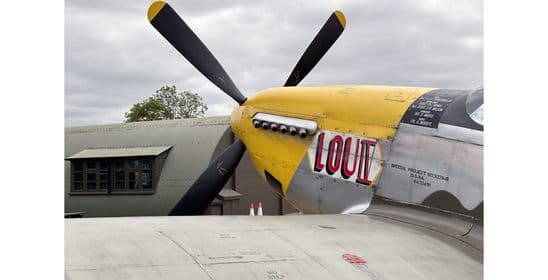
An undoubted rival to the Spitfire in terms of its iconic aviation status, the North American Mustang has to be regarded as one of the most effective fighting aeroplanes in the history of flight, a thoroughbred aeroplane which owed much of its success to the talented technicians at Rolls Royce. An aircraft which was originally designed to fulfil a British requirement, the original Royal Air Force Mustangs were powered by American Allison engines, however, the performance of this promising new fighter was completely transformed once it had been married with the Rolls Royce Merlin engine, with the rest, as they say, being the stuff of aviation legend.
Later variants of the Mustang would be powered by licence built US manufactured Merlin engines and from late 1943 onwards, they terrorised the Luftwaffe every time they met in combat. Able to escort USAAF bombers deep into enemy territory, the Mustang helped to make aces of many American pilots and more importantly, helped to clear the skies of enemy aircraft, during the latter stages of WWII.
This particular Mustang was produced at the North American manufacturing plant at Inglewood, California during the summer of 1944 and allocated the serial number 44-73877. She would go on to see quite extensive service with the USAAF following acceptance, but in a training role and exclusively based in the US. Following her disposal, she was sold to the Royal Canadian Air Force, where she served with No.403 'City of Calgary' Squadron.
Following retirement, she was sold into the civilian Warbird market, passing through the hands of several different owners in the US before eventually moving to Europe in 1986, where she became part of the Scandinavian Historic Flight. Following restoration, she emerged wearing the scheme of a Mustang flown by USAAF ace Bud Anderson, with 'Old Crow' going on to be a star of the European Airshow scene. Later given a temporary scheme for her starring role in the 1990 movie 'Memphis Belle', she was given another permanent livery change in 2014, this time to represent an RAF No.112 Squadron Mustang from the Mediterranean Theatre during WWII, one which came complete with sharks teeth. A much loved Airshow performer, in this striking livery, enthusiasts simply referred to her as 'Sharky' and everyone knew exactly which aircraft you were talking about.
Now owned by Warbird Experiences at Biggin Hill, the aircraft is presented as the famous Mustang mount of one of the most accomplished airmen of the Second World War, a leader of men and exceptional fighter pilot, Colonel Don Blakeslee, commander of the USAAF 4th Fighter Group. Blakeslee flew more combat missions than any other American fighter pilot and was credited with 15.5 aerial victories, in addition to being an influential figure in the success of many of the pilots under his command. He was described by RAF ace Johnnie Johnson as one of the best fighter leaders to have ever flown missions over Germany.
Despite his reputation as an ace pilot, Blakeslee chose not to decorate his Mustang in a flamboyant manner and with all his victories prominently displayed on the side of his fighter, like so many others in the USAAF. Instead, he let his actions do the talking in combat and if a Luftwaffe airman made the mistake of thinking the lack of victory markings on this Mustang identified it as the mount of a novice pilot, he was probably about to become the next victim of Col. Blakeslee. It is strange however, that an aircraft flown by such a famous airman would be presented in such a standard manner, but I suppose that just helps to tell the story of the man and not the aeroplane.
Having the opportunity to get close to this magnificent aircraft was a real treat for a modeller and proved fascinating from a research perspective. I know this is a restored, Airshow performing aircraft, but it was interesting to see the very different shades of metal in evidence across the airframe and how model paint references claiming an overall natural metal finish for Mustangs really does need further investigations. With dull sections, brighter sections and those which appeared polished, there was quite a variation in metal colours in evidence and didn't they just look fantastic!
This aircraft has been fitted with a second seat and when not thrilling Airshow audiences right across the country, she is offering experience flights to those in the fortunate position to enjoy them. If you would like to fly in one of the premier fighter planes of all time, presented in the markings of one of the most inspirational fighter leaders of the Second World War, you need to give our friends at The Biggin Hill Heritage Hangar a call.
An aircraft I wasn't expecting to see during my visit, this Harvard IIB actually possesses even more aviation heritage than either of its current hangar mates and has a genuine claim to being arguably the most significant individual aircraft in post war Royal Air Force history. Built by the Noorduyn Aircraft Company of Montreal in 1944, the aircraft was directly funded by the British Government, as opposed to being procured via the Lend-Lease agreement, which explains its classification as a Noorduyn Harvard IIB.
After arriving in the UK on board the freighter SS Cliona, she entered Royal Air Force service with No.7 (Pilots) Advanced Flying Unit at Conington in early 1944, before subsequently moving on to No.3 Service Flying Training School.
At the end of November 1947, the trainer was transferred to the aircraft fleet operated by Controller Services, where she embarked on a long and successful career undertaking test and evaluation flying. She would spend the next few decades serving both the Aeroplane & Armament Experimental Establishment at Boscombe Down and the Empire Test Pilot's School, where she performed roles as varied as project chase aircraft, photo ship and currency training aircraft for pilots in need of 'tail-dragger' type hours.
When KF183 was finally relieved of her military flying duties, she had an astonishing 72 years of service to her name, something which must surely single her out as one of the most important and hard working aircraft in Royal Air Force history. With over 15,000 flying hours to her name, the aircraft still proudly wears her RAF livery, even though she is now lovingly cared for by a private owner. She can now often be found gracing one of the hangars in service with Rolls Royce Heritage Flying, keeping the young upstart aircraft she shares the hanger with in their place.
Still providing similar flying support as she did during her lengthy service career, the Harvard provides currency and training support for pilots flying the Spitfire and Mustang, in addition to being on hand to ferry spares, equipment and crew members to and from events where the two Rolls Royce Heritage aircraft are scheduled to display. Rather than feeling overwhelmed by sharing a hangar with the Spitfire and Mustang, it's they who should be paying their respects to this aviation heavyweight.
With this trio of aviation legends to admire, I have to say that my day at East Midlands Airport was a most enjoyable one and thanks to the hospitality afforded me by Dean in particular, it's a day which will live long in my memory. If only I'd asked him to take a picture of me sat in that Spitfire! On second thoughts, the stupid grin I couldn’t wipe off my face for hours is probably not the sort of thing that should ever be documented.
I would like to thank Dean and the entire Rolls Royce Heritage Flight team for allowing me to visit their spotless hangar facility and for granting me access to their magnificent collection of aircraft. What a fantastic day that was. I would like to wish you all every success for the remainder of this Airshow season, which I hope had already proved to be a memorable one for the team and for wider Rolls Royce Heritage.
I’m afraid that’s all we have for you in this latest edition of Aerodrome, but please keep checking back throughout the year as we endeavour to bring you a series of topical aviation related reviews and features from around the country. As always, if you would like to comment on anything blog related or to suggest a subject you would like to see covered in a future edition, please do drop us a line at aerodrome@airfix.com, where we would be only too pleased to hear your views.
Should you wish to continue the aviation discussions between editions, you will always find something of interest over on the Airfix Aerodrome Forum and if social media is more your thing, please use the respective official social media icon links at the foot of the main Airfix and Corgi website homepages to access our official sites.
The next edition of Aerodrome is scheduled to be published on Friday 15th September, when we will have more aviation features to bring you.
Thank you so much for your continued support of our Aerodrome blog.
Michael