During this month, Airfix is proud to highlight some key contributions of women throughout history, as part of an exciting campaign celebrating Women’s History Month, March 2023.
As part of this campaign, aimed to inspire young people, especially young women to strive for their dreams, we throw a spotlight on women in aviation. Over the course of the month, we will speak with some aviation icons and share key dates and accomplishments of women who changed the face of the aviation industry forever.
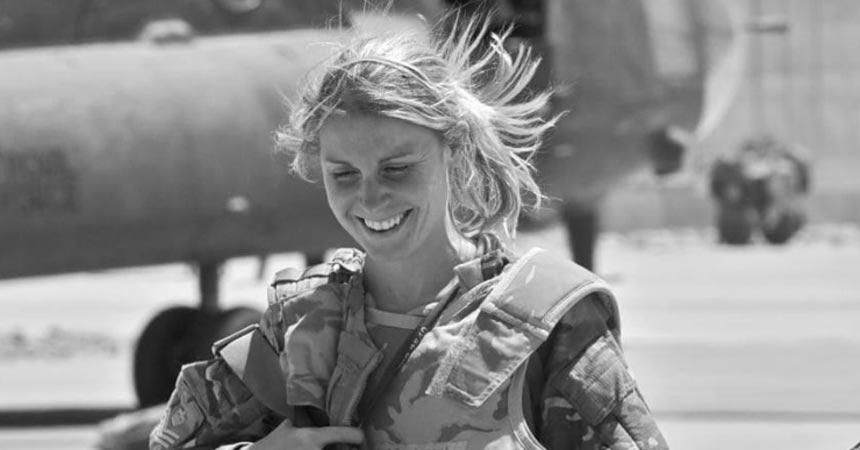
In an exclusive interview with Liz McConaghy, the longest serving female RAF Chinook Force Crew member, Liz describes how it all started, and the challenges she faced during and after leaving the RAF.
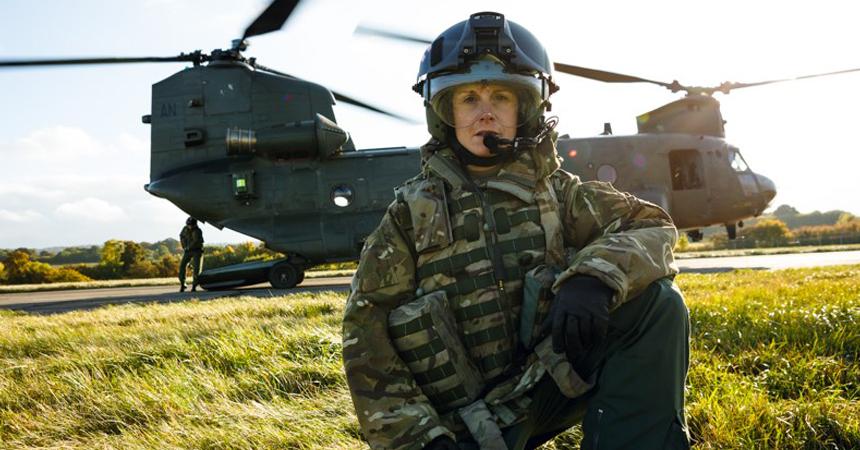
Starting from such a young age, Liz reflected on where it all started, going with her brother to his BARB test. BARB stands for British Army Recruit Battery and is a computer-based psychometric test someone must take before they can serve in the Army, to decide if they are suitable.
Liz explained, “my brother was two years older, and he went up to join the army at a place called Police Barracks in Northern Ireland. I went with him the day he went to his BARB test. I was sat in the foyer of the Careers office and there was a magazine on the table with a guy hanging out the side of a helicopter on what I thought was a rope. I said to the chap in uniform, ‘what is this?’ I thought it was the coolest job ever. I said, ‘What’s the job? The guy on the rope?’ And he said ‘well, actually, it’s a wire, and the job is in helicopter recruitment’ and I was like I want to do that job.
On one of the days, I went up to Police Barracks for an interview, I pulled my little car into the layby to get past and a Chinook went thudding over the top. I remember looking up and seeing the belly of the aircraft. Obviously, Chinooks are so distinctive and so loud, it just hit me right in the chest. That’s when I went ‘that’s what I want to work on, it’s so cool’.
I only found out years later when I was chatting to someone in the crew room on the squadron, like 10 years later they actually never went into Police Barracks, it was really rare because the landing site there is really small, and it meant they had to clear the whole car park. There was me thinking this must be routine, these helicopters coming in at night, but it wasn’t. It was very unique.
Liz thought back on being at school and flying the Chinook to her old school.
“My proudest day in the RAF, despite all the things I’ve done; [is when] I took the Chinook into my old high school, and it was a grammar school back in Northern Ireland. When I was doing my kind of GCSE’s, bumbling into my A levels that was just about the time that I [saw] the magazine and wanted to follow into the RAF. I’ve never been a cadet or anything because I played hockey and you had to do one or the other at school, you know, you can’t do everything.
So, there I was, being encouraged by the teachers to fill in new cast RAF forms and they said, ‘you’ll never make anything of your life if you don’t go to university and get a degree.’ I was dead set on joining the RAF at this point. Then in 2002, we were over there doing some tasking and I said, ‘can we go back and take the aircraft in the school?’ Within 24 hours, someone had said ‘you know what, this would be a really good thing for the kids in Northern Ireland.’
Around 1500 kids came and looked around that day, and my little brother was still at school, he got to look around, but the best bit was the teachers that had said to me that ‘you’ll never amount to anything if you don’t get a degree’ are suddenly asking me is they can look around the Chinook. So, it was really to show kids that day that you don’t have to have a degree to have an amazing life, amazing career and something that challenges you every day.”
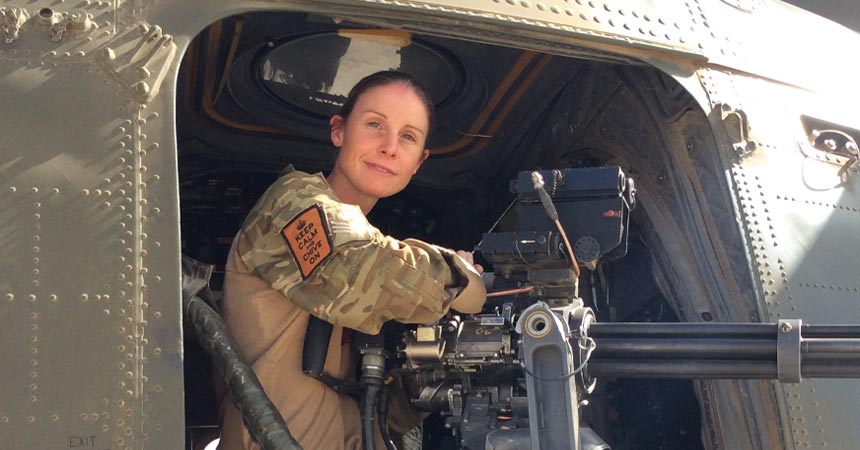
Liz was only 21 when she became the youngest Chinook crewmember to serve in Iraq, and then became the longest serving female member.
“When I went to Iraq, I was the youngest aircrew member. Not only that, but I was limited combat ready. You learn to fly on a little helicopter, which is the Griffon (training helicopter) and then you get posted to whichever helicopter type you want to go on, and for me, that was always the Chinook.”
“You do a six-month school called the UCF, which is where you work up to learn how to operate and then you get sent to your first squad, which for me was 27 and then you have to do what’s called a combat ready work up. So that is essentially learning how to operate the Chinook when you’re getting combat ready. You learn what rules you can bend when you’re at war; if you’re getting shot at, what you can and can’t get away with.
I was only halfway through my first operation when I went to Iraq; I ended up getting my first Iraq medal and came back. It had aircrew cadet written on the edge of it and there’s only me and one other person who got that because we were still not substantive sergeants.
Liz remembered how it felt being in Iraq, and the times she was almost shot. Liz said “the first thing I really remember in Iraq was the temperature and being a girl from Northern Ireland, I wasn’t used to 45-degree heat, and it just hit you like a brick wall when you got off the aircraft.
By the time we got to Iraq, it was war. We were moving troops and ammunition, water and food around the area. The odd time would pop up to Amarah, where we were holding (what was then called) IRT which is Immediate Response Team. That’s the flying ambulances essentially. That’s what worked in Afghanistan. So, you live up on Al Amarah for about a week doing that.
I always think bravery’s a funny term because I’ve been called brave so many times and you know, being shot at in Afghanistan, most of the time it’s happened before you knew it was going to happen. You’re not aware it’s happening, especially on the Chinook because [it’s] such a loud aircraft. Unless they’re hitting you somewhere really close, you can’t hear them, and you can’t see the firing points, or the rounds being kicked up on the dust because there’s so much dust around the aircraft anyway when you land.
I’ve had two near, very close misses. One bullet came out over my head about a foot above my head. When we landed, the engineers actually dug it out of the other side of the aircraft and gave it to me. Another one was a deliberate; we were going as a formation and the landing site [was] quite hot. The Taliban landing site and AAA which is the high calibre round, came up under the Ballistic Protection Panel that I was stood on.
Thankfully, the panel (the only protection we have is on the floor) had caught on the ground underneath and kind of zoomed up. Again, the engineers dug that one out for me, so I’ve got 2 rounds in my beside drawer. If that panel hadn’t been there, I would have been a goner, so I was very, very lucky. That’s the only protection, the rest of the aircraft is just like a big bullet magnet and it’s quite a big target.
“The good thing about the Chinook” Liz explained, “compared to something like the Puma and even the Merlin is that it’s got a lot of redundant space. So you can take a lot around you, a lot of battle damage and as long as the engines are still running and you are still going, then you’re okay.
Whereas on a Puma, everything’s jammed together. If you have a Puma on the ground and a bullet hits, you’re more likely to hit something important. They’ll stop something else working and they’ll fall out the sky, whereas for us, we’re pretty okay.”
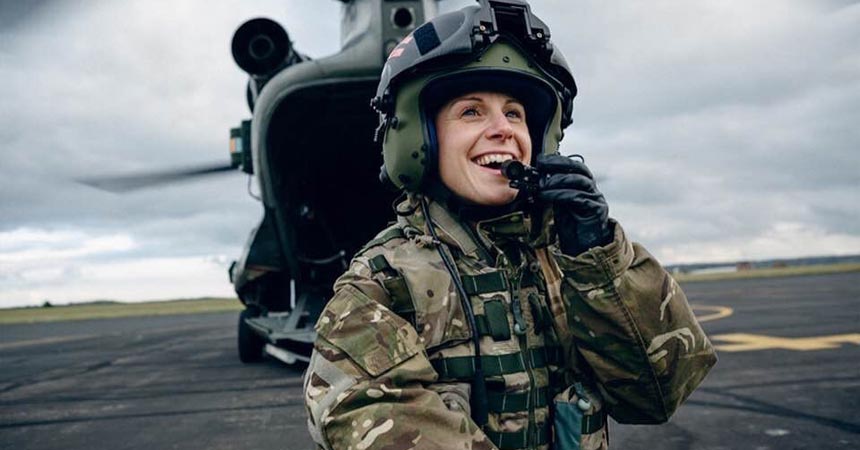
Liz is one of six women who has served as a loadmaster in the RAF, and for four years, was the only female crewman on the Chinook wing. Liz looked back at her experience being a woman in the crew.
“I was the only girl. The first time I went, there was an army commander in the theatre, and he made me go and stay in a girl’s tent because you aren’t allowed mixed accommodation, and I was so miserable. Eventually, my squadron said ‘this isn’t good enough because Liz is on shift with us’ and we’re doing different tasking days and holding different responses. If you’re on a quick response time, you can’t then faff around going to get me from another tent. He made the argument that I had to stay in the tent with the lads and it was game changing!
Liz continued, “I was really pleased they did that and then I was always really lucky because the lads would put me in a corner bed space so I could put a little towel up like a little flag and have a little cubby hole to get changed. It was like having 60 big brothers all the time or 60 uncles. I never got made to feel anything different because I was a girl. I didn’t feel like I needed any extra applause because there was a girl doing the job.”
“My basic training, there were three of us which is good. My Shawbury course (RAF Shawbury, a helicopter training base), I was the only female crewman, then I was the only one on the Chinook force for [several] years, so I’m quite used to being in that environment. I was not the first female crewman by any stretch, there were a couple before me.
But whenever we got to Herrick and even in Iraq, just taking other females out in theatre was really rare. When we lifted an Afghan on a tasking day in 2006/2007, we would hardly ever see any females on crew. Then by 2010/2011 onwards, there was always a female on board at some point.
Liz became the longest serving female Chinook aircrew member after serving for 17 years. Liz reflects on why she stayed for so long, and why she eventually had to leave.
“It felt like 5 minutes. Is there any way to summarise my career went too quickly, because I think for a lot of the chunk of it was Herrick. Operation Herrick was the best sense of purpose; I did 10 deployments there in the end. We first went in 2005 and my last deployment was 2014. I joined the Air forces to do a job and certainly on Chinooks, you don’t arrive on a Chinook and think ‘ohh I don’t want to go to Iraq or Afghanistan’ because that’s exactly what you want to do. That’s what you’re doing today.
And I never not wanted to go and if I hadn’t gone, it meant somebody else had to go in my place. Somebody else [who] had to do an extra one or one of the new guys who wasn’t combat ready had to go instead when he wasn’t quite ready to go. I was always really worried that someone would have to take my bullet, you feel like if you don’t go, what if something happens and I’m meant to be there and I’m not? That kind of kept me in the job, certainly for those ten years. “
“By the time that finished,” Liz explained, “my neck had started to play up, and had been playing up for years because [I was] wearing a helmet and mpg goggles. I’d kind of ignored it because we were on Herrick and there was a war to be fought, and then it started to get so bad I couldn’t fly.
I left in 2019 because I couldn’t fly anymore; the RAF had offered me a desk job, but I did it for about 3 weeks and then went ‘I can’t do this, I can’t look at Chinooks flying everyday outside the window and not be on them’ so I ended up taking Med discharge. If I could have, I would have stayed in that job for life. I really wanted to become the first master aircrewman to stay in and do the job, but sadly my neck had other ideas.”
After leaving the RAF in 2019, Liz started suffering from PTSD during lockdown, and became suicidal. After waking up in Intensive care, Liz got help from mental health charities and received support. Her book, ‘Chinook Crew ‘Chick’’ has recently been released, which details her life in the RAF.
“I wrote the book when I was going through my PTSD counselling, and it took me 3 weeks to write because I just had to brain dump everything and it [was] just stored on my laptop and I never thought about it. Then a friend of mine and I were out walking and I mentioned it and she was like you’ve got to send this off to a publisher, what happens if somebody wants to publish it? Then it got published. It was never written in any way to be read by anyone, never mind the whole world, but seemingly everyone has really enjoyed it.
I went to a book festival and Sheila Hancock; a really famous actress was there. Sheila Hancock [asked], ‘are you an author my dear’ and I said ‘no, no I’m not an author, I’m a Chinook Crewman,’ even though I’ve been [away] for a year and a half at this point. And she said ‘well, why are you here then?’ I said ‘well, I wrote a book and it’s called ‘Chinook crew ‘chick’’. [She said] ‘you’re an author then, my dear’, and I was like ‘ohh yeah, I guess I am.’ So, I’m kind of still getting used to it a little bit, but I think the biggest sense of purpose, writing the book was great.
It's more the mental health aspect, that it’s helping other people. There’s so many people [that] have reached out to me since they’ve read it or heard my story here, either suffering from PTSD, who know of someone who’s got PTSD or might be on the brink of it, who they’re helping now because they’ve read my story, and also a lot of people have been affected by suicide because obviously I got to the point where I took a huge overdose and tried to end my life. I’m lucky I’ve come through that and now I can pass on how I felt in those days running up to that.
Anyone who’s lost someone to suicide can kind of hear my story and realise they couldn’t have done anything to help. I [was] so far down the PTSD route that nobody could stop me. I think it’s an important message for people who have been affected by suicide to know that. That’s the questions [that] are always left after suicide, isn’t it? What could I have done to help them? How could I have stopped them doing that?
My time in the Air Force being one of the only females, I was never made to feel like a burden. But I internalised that pressure; I didn’t wanna be that Liz, crying in the back of the tent or the last one at the fitness test. I just didn’t want to be the burden.
The whole way through lockdown when I knew I was unravelling, I never called to tell anyone because I thought everyone’s got something going on. No one needs little Liz crying down the phone going ‘I think I’ve got PTSD, I think I’m coming apart.’ So, I didn’t. Then I got to the point where I literally fell off the cliff in the space of three or four days.
Liz summarised her experiences with mental health and shared her tips for those who are suffering, and those who know someone else who is suffering.
“Ask twice is my biggest top tip when it comes to mental health. A couple of my mates knew that I was suffering a little bit and they say, ‘how are you Liz,’ and I [was] like ‘ohh yeah living the dream’ and if they asked a second time, it was sometimes enough to crack the egg shell. So, ask twice is what I tell people, and give your mental health a number because it’s much easier to say, ‘I’m a 3 today’ than say ‘I’m struggling.’
If you are quite open and authentic about that then it gives other people a bit of an idea. If you’re struggling and for you, if you’re always saying the number 3 for a few days in a row, [and] you’re like ‘this isn’t good’, maybe speak to someone. When people ask twice, then sometimes that’s just enough to open the tiny tears tap.”
When asked what her advice would be to a young aspiring pilot, perhaps one who thought ‘there’s no way I can do what Liz does,’ she said: “forget stigma, be brave, be bold and really trust in yourself and be really proud of what you do.”
If you or someone you know is suffering, Models for Heroes is a charitable organisation that support the UK Armed Forces and Emergency Services personnel by providing model making as a meaningful activity that promotes wellbeing, skill development and social interaction. You can find more information here: https://www.modelsforheroes.org.uk/