
Welcome to the latest edition of our weekly Workbench blog, and all the news, updates, and modelling exclusives from the fascinating world of Airfix.
With the subject of aircraft and aviation history proving to be so utterly captivating for so many people, it’s no wonder that the scale modelling hobby has thrived as it has over the years, as it’s taken so much subject inspiration from man’s enduring fascination with flight. With last week’s 90th Anniversary of the first flight of the Supermarine Type 300 (Spitfire) still fresh in our minds, many people would probably agree that we can often be guilty of allowing the focus of our attentions to be a little UK mainland centric if we’re being honest, even if that’s understandable bearing in mind the rich subject matter available to us. Because that tends to be the case, we rarely direct our gaze to skies across the Irish Sea, however, in this current edition of Workbench, we’ll be attempting to put that right.
By way of marking next week’s St Patrick’s Day celebrations, our subject for this latest edition is the proud aviation heritage of the Irish Air Corps, using what is actually a fairly limited number of Airfix model kit livery options as our related illustrators, notwithstanding the fact that they happen to be rather eye-catching and extremely appealing ones. From the pioneering aviators making trans-Atlantic crossings, to the first jet aircraft operating out of Baldonnel Aerodrome, we’re looking at aviation through Irish eyes in this latest edition of Workbench.
Captain John Alcock loading up his Vickers Vimy with warming provisions prior to embarking on their epic Trans Atlantic crossing attempt.
When researching the history of aviation in Ireland, it doesn’t take too long before it becomes apparent that the nation had more than its fair share of aviation pioneers, however, the one event which is usually associated with putting Ireland on the aviation map involved two British aviators and a modified Great War bomber.
The end of the First World War brought with it the resumption of a competition to mark the first under seventy-two hour continuous flight crossing the Atlantic Ocean, from any point in the USA, Canada or Newfoundland, to any point in Great Britain or Ireland. This historic undertaking was sponsored by a major British newspaper, with the offer of a substantial cash prize for those successfully taking up the challenge. Fraught with many dangers and pushing the very limits of known aviation technology at the time, aviators John Alcock and Arthur Whitten Brown successfully achieved this historic feat, when their Vickers Vimy landed in County Galway at 8.40 on the morning of 15th June 1919, after an epic flight which tested every ounce of their considerable airmanship.
After completing their epic and extremely arduous flight, it’s incredible to consider that the pair actually made it very close to their intended landing location, however, close wasn’t exact and their aircraft unfortunately came down on the Derrigimlagh Bog, with the rough ground causing the Vickers Vimy to nose over on landing, although thankfully without causing injury to either man. Brown later said that had the weather been better, they could have probably pressed on to London, but that wasn’t of any consequence now, as their heroic entry in the aviation history books had already been written, and the eyes of the aviation world were firmly fixed on Ireland.
A historic success, however, landing in a bog didn’t prove to be the best way in which to reward the aircraft which had just brought Alcock and Brown 1,890 miles across the Atlantic.
The next date on our Irish aviation journey occurs in 1921, and involves the purchase of a former RAF Martinsyde Type A Mark II biplane aircraft, an aircraft which had a rather specific task to perform. It was intended to be stationed at Croydon Airport and placed on 24-hour standby to bring delegates of the Anglo-Irish Treaty talks back home from England, in the event that these historic negotiations should fail. It has even been claimed that when looking to secure a suitable aircraft, it should be one possessing the capability to bomb England, should that be required, although this is clearly open to research scrutiny.
Thankfully, this intended escape flight was not required, and this aircraft would become one of the machines which made up the new National Army Air Service in Ireland in July 1922. It would gradually increase its aviation inventory with aircraft and engines purchased from the Royal Air Force and Aircraft Disposal Company, a business established to facilitate the disposal and sale of Britain’s huge surplus stocks of aircraft, engines and equipment following the end of the Great War.
By the end of that first year, the National Army Air Service could boast an aircraft force which consisted of six Bristol F2B Fighters and four Martinsyde F4 aircraft, plus a collection of engines and equipment, and a force of around 400 personnel.
More Trans-Atlantic achievement for Ireland
The geographical location of Ireland, and the continued pioneering aviation spirit which saw Trans-Atlantic flight glory dominating the world of aviation would propel the nation to further international recognition in 1928. The dream of flying East to West across the Atlantic was far more challenging than the direction in which Alcock and Brown made their famous flight in 1919, and with several fatal attempts having already been made, and with the famous Charles Lindbergh describing the challenge as being beyond the capabilities of current aviation technology, this ‘Everest of aviation’ achievement remained unconquered.
Such a historic picture. With empty fuel drums everywhere, this image shows Junkers W33 ‘Bremen’ being prepared for its transatlantic crossing bid at Baldonnel Airfield.
Ireland’s premier aviator and officer in command of the Irish Air Corps, James Fitzmaurice, was determined this opportunity should be used to put Ireland and the new Irish Free State firmly on the aviation map, and set about trying to arrange an all-Irish attempt bid. Despite his best efforts, he couldn’t convince officials to back his attempt, so in 1927, joined forces with a British airman to mount an attempt using a Fokker F.7A monoplane.
Five hundred miles out into the Atlantic, the aircraft entered a severe storm, and despite the intrepid pair wanting to press on with the attempt, good sense prevailed and they turned back to fly another day, safely landing back on a beach in County Kerry. More determined than ever, but still facing a lack of interest from official sources, Fitzmaurice was invited to join a German pair who had their eye on the same prize, and had themselves mounted a failed attempt in 1927.
Now banned from mounting a challenge from their own home nation, Great War aviator Hermann Koehl and his wealthy associate Baron von Huenefeld brought their single engined Junkers W33 monoplane across to Ireland to team up with Fitzmaurice at Baldonnel, and set about preparing the aircraft for the crossing attempt. These preparations were all about reducing weight and adding long range fuel tanks to the aircraft, with this work eventually allowing the aircraft to carry enough fuel for 44 hours of flight, and with the weight saving measures being so stringent that even the crew’s oranges had to be peeled before being loaded aboard.
The attempt itself would be delayed by 17 days due to bad weather, but at 5.38am on 12th April 1928, the heavily laden ‘Bremen’ took off from Baldonnel heading for New York, but not before narrowly missing a sheep which had wandered onto the grass runway, and only just clearing the airfield boundary fence. Once in the air, the aircraft performed exceptionally well, but with only primitive navigational equipment aboard and no radio, those gathered at Baldonnel were left waiting for news from the other side of the ocean.
The flight was long and arduous, and like all the attempts which preceded them, a violent storm would make the gruelling challenge all the more difficult, blowing the little aircraft way off course to the north. With oil filling the cockpit floor and a position fix having not been taken for some time, the crew began to fear the worst, but with the aircraft performing well, tried everything they could to calculate where they actually were.
Historic success, this magnificent aircraft safely carried its three man crew across the Atlantic to Greenly Island between Newfoundland and Quebec.
Back in Ireland, the lack of a news update was leading people to fear the worst and the mood darkened. Over 3,000 miles away, the crew aboard the ‘Bremen’ could finally see clear sky for the first time in many an hour and set a new course northward, but with the aircraft’s fuel situation now requiring a landing in the near future. Finally, after over 36 hours in the air, the crew sighted a lighthouse and what looked like a suitable landing site, safely bringing the Junkers down on Greenly Island between Newfoundland and Quebec – they had done it!
Finally conquering the Atlantic, the Bremen and its crew were celebrated as heroes, with their achievement being championed as ‘The greatest story of the century’. Once rescued, the crew were taken to New York and given a reception even greater than the one afforded Charles Lindbergh, with two million people lining the ticker tape procession route. Similar scenes would be experienced in Germany and back in Ireland, where Fitzmaurice had done arguably more than anyone else to promote the new Irish Free State.
The curious case of the ‘Wrong Way’ transatlantic flight
Before we leave the subject of transatlantic flight crossings, we can’t do so without including the story of American Clyde Groce (Douglas) Corrigan and his tiny little Curtiss Robin B parasol monoplane. An aircraft mechanic and barnstorming aviator, Corrigan would be employed by the Ryan Aircraft Corporation, and is reputed to have worked on the famous ‘Spirit of St. Louis’ aircraft used by Charles Lindbergh to fly from New York to Paris in May 1927. Corrigan was fascinated by Lindbergh and his flight, announcing on many occasions that he to intended to make a similar flight across the Atlantic one day.
With this aim in mind, Corrigan and his brother duly purchased a Curtiss Model 50 Robin B single engined, high-wing monoplane aircraft, and set about renovating, re-skinning and upgrading the aeroplane. Only a relatively small machine, the pair lavished so much time and attention on the Robin that it was a very different aircraft by the time they’d finished, with strengthening of the airframe itself allowing the installation of a more powerful engine and the additional fuel tanks needed for a transatlantic crossing attempt.
Whilst this work was ongoing, Corrigan filed several requests to make the flight with the American Bureau of Commerce, but was repeatedly turned down as they were of the opinion that his aircraft was unsuitable for such an attempt. With the work completed and the money spent, did Douglas Corrigan decide to go anyway?
In early July 1938, Corrigan and his Robin made the long distance non-stop flight from Long Beach California to Floyd Bennett Field in New York, a west to east coast journey of over 2,800 miles, as if to demonstrate the distance capabilities of his little aircraft. Once in New York, he had his aircraft filled with 320 gallons of fuel, as he duly filed his flight plan for the return flight back to California.
At just after 5am on 17th July 1938, Corrigan and his Robin climbed into the air at Floyd Bennett Field and into a cloud filled sky, but instead of flying west towards California, he set course in the opposite direction, out over the Atlantic Ocean. Twenty-eight hours and thirteen minutes later, he landed at Baldonnel Airfield in Ireland, and either in a calculated attempt to cover his subterfuge, or a genuine state of confusion, is reputed to have asked workers on the airfield, ‘Where have I landed?’
This unexpected aviation arrival sparked immediate official interest, and the American pilot was interrogated at length by both Irish and American officials, however, Corrigan never changed his story, and even though officials were certain this was a calculated attempt to achieve his long held ambition, the pilot himself maintained that it was a simple case of pilot error and confusion with his navigational equipment – he simply went the ‘Wrong Way’.
Clyde Groce (Douglas) Corrigan’s Curtiss Robin B parasol monoplane being loaded aboard a freighter for the journey back to America, following the completion of his ‘Wrong Way’ flight across the Atlantic.
The story of ‘Wrong Way Corrigan’ captivated the world at the time, and despite being scrutinised by the aviation authorities on both sides of the Atlantic, he was celebrated as a hero back in America, with a million people turning out to congratulate him with a ticker tape parade in New York. Passing away in 1995, this incredible man took the truth behind this incident to the next life with him, so we will never know exactly what happened on that day in 1938.
History, however, regarded him as something of a celebrity, an intrepid aviator who flew across the Atlantic in what was essentially a recreational aeroplane, at a time when few people would have dared to take on such a challenge. Did he fly the wrong way, or was it the right way all the time?
What a fascinating aviation story.
Gloster Gladiator fighter of No.1 Fighter Squadron of the Irish Air Corps, based at Baldonnel Aerodrome in 1940.
As the clouds of war started to gather ominously across Europe and with Ireland steadfastly maintaining her position of neutrality, they attempted to procure a number of aircraft from Britain with which to protect their airspace and deter the widespread violation of it. In 1938, they managed to obtain four Gloster Gladiator fighters, with a further eight being placed on order, however, these additional fighters were not delivered due to the outbreak of war and the aircraft being placed under embargo. They would receive around 16 Avro Ansons, 3 Supermarine Walrus amphibians, 6 Westland Lysanders and several training aircraft, as the Irish Air Corps began to build up its strength.
Although there were no recorded incidents of encroaching aircraft coming under fire after being intercepted by IAC aircraft, the force was kept rather busy in dealing with British barrage balloons which has slipped their moorings, with the additional workload eventually persuading the British to send over 13 Hawker Hector biplane bombers to aid their cause. It was hoped that Hawker Hurricanes would provide the force with a much more capable fighter, however, these too were embargoed and they would have to wait until the summer of 1943 before the first Hurricane was added to their inventory.
During the wartime years, several aircraft from various air forces were interned after inadvertently landing on Irish soil, some of which would later help to swell the ranks of the Irish Air Corps. There is also the strange case of a rather high-profile defection attempt involving an Irish crew and one of their Supermarine Walrus aircraft, but we’ll come on to that a little later.
This is the point where we break away from actual aviation history, to look at some of the more recent Airfix model kit releases which featured an Irish Air Corps scheme option amongst those included, scale representations of aircraft charting the history of the force, but also, some of the most appealing schemes we could consider finishing our models in. We begin with one of the pre-war Irish Air Corps acquisitions and an earlier product of the famous Supermarine aviation company.
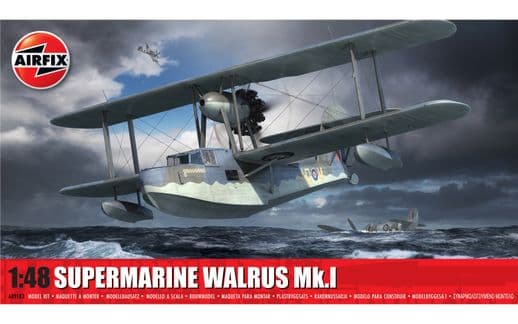
Supermarine Walrus Mk.I ‘N19’, Irish Air Corps (An tAerchór), Erie, 1939/40.
Aircraft operated in the distinctive colours of the Irish Air Corps have always made for interesting subject matter for the modeller, with the Supermarine Walrus amphibian having the additional appeal of also being one of the most interesting aircraft of the 1930s and 40s. In the months leading up to the start of the Second World War, the Irish Government purchased a number of aircraft from Britain, including three Supermarine Walrus amphibians, which were given the codes N18, N19 and N20. This particular aircraft, N19, was delivered to Baldonnel aerodrome in March 1939 and assigned to No.1 Coastal Patrol Squadron. It crash landed at the airfield in September 1940, damaging its hull to such an extent that parts would subsequently be used to keep the remaining two aircraft flying – its wings were later fitted to its sister aircraft N18.
Interestingly, Walrus N18 (its sister aircraft) was the one infamously involved in a defection attempt by four members of the Irish Air Corps who intended to fly to German occupied France in January 1942. Having become increasingly disaffected by arrangements in Ireland and their neutral stance, 20 year old pilot 2nd Lt. A.J Thornton devised a plan to take one of the Reconnaissance and Medium Bombing Squadron Walrus aircraft at Rineanna Aerodrome and fly it to German occupied Cherbourg, where he would offer his allegiance and services to the Luftwaffe.
On the morning of 9th January 1942, Thornton and three of his engineering colleagues covertly fuelled up the Walrus and took off without prior authorisation. As soon as the departure was discovered and the men found to be missing, confusion reigned at the airfield, but a defection attempt was assumed. A Lysander was immediately dispatched to find the Walrus and either force it to land or shoot it down, but with the Walrus having such a good head start, it couldn’t be located.
Full scheme details for this most colourful of Supermarine Walrus amphibians.
Thornton had planned to fly well to the west of Wales and southern England, to hopefully avoid these heavily militarised areas and possible detection, however, his flight was already being tracked all the way by a vigilant British defence network, and as the Walrus was unable to respond to IFF transponder requests because it lacked any such equipment, four Hawker Hurricane fighters were sent to intercept it. Once they had the unidentified aircraft in their sights, the Walrus was duly escorted back to RAF St. Eval and the defection attempt which lasted for less than three hours was over.
The crew were arrested, interviewed and later returned to the custody of Irish forces. Thornton took full responsibility for the episode and was subsequently dismissed from the Irish Air Corps and sentenced to eighteen months in prison, although this was later reduced to just four months. Interestingly, he would later fight for the Royal Air Force in Greece, Italy and Yugoslavia, expressing his sincere regret for his part in his famous defection flight, but always being fiercely proudly of his Irish heritage.
As for the Walrus itself, it was eventually returned to Ireland, survived the rest of the war, and subsequently passed into civilian hands following disposal by the Irish Air Corps. Known to have flown in the UK until the end of 1949, it was discovered lying in a scrapyard in 1963 and purchased for the princely sum of £5.00 by the marvellous people behind the Historic Aircraft Preservation Society. Learning of its incredible history, the aircraft was handed to the Fleet Air Arm Museum in January 1964, where it immediately underwent a program of restoration and preservation, going on public display towards the end of 1966. Walrus L2301 can still be seen on display at the Fleet Air Arm Museum, Yeovilton.
Irish operated aircraft are just so interesting.
Even though more than 20,000 Spitfires would eventually be produced, and it would become one of the most successful fighters of the Second World War, it was interesting to note that RAF officials preferred to rely on their existing pilot training program for conversion to the fighter, rather than produce two-seat training variants of the aircraft to help with this task. Vickers-Armstrong did produce an official two-seat Spitfire conversion for demonstration to Air Ministry officials, however, this was still overlooked, presumably because they didn’t want to rock either the training, or aircraft production boats.
Spitfire MT818 G-AIDN (a converted Mk. VIII) would go on to serve for several years as both a demonstration aircraft for the company, and a UK air race participant, but with one of her more significant appointments being a trip to Baldonnel Airfield in early January 1950, where she was to allow members of the Irish Air Corps to examine and fly her.
Late the previous year, the IAC retired the last of their Miles Master advanced training aircraft, leaving their student and refresher course pilots facing a gap in their training program, and effectively having to jump from the rather basic attributes of a Miles Magister trainer to the much larger twin engined Avro 19 (Anson). Following the visit and a period of further consultation, the Irish Department of Defence placed an order for six Spitfire trainers, to carry the serial numbers 158 to 163, to be delivered starting from the May of 1951.
Spitfires look good in any livery, but during their Irish Air Corps service, were particularly attractive.
The aircraft were to be painted in an overall grey/green scheme which was similar to RAF cockpit green, with the first two aircraft being delivered in a matt finish, but the final four aircraft sporting a gloss sheen. Later, aircraft numbers 158, 161 and 162 would be finished in an extremely smart silver finish, sporting a large black cowling section which extended down past the aircraft’s exhaust manifolds, and from the front of the cockpit right up to behind the aircraft’s spinner.
These aircraft must have been a beautiful sight in the skies above the Dublin area, with the good people of Ireland gaining their appreciation of these two-seat training Spitfires much earlier than the rest of the UK did. Withdrawn from service in April 1960, these magnificent aircraft were transferred to the care of the Technical Training Squadron at Baldonnel, but when finally offered for sale from 1961 onwards, found themselves in the dawning of the UK Warbird movement, and a group of people who were thinking about producing a rather significant aircraft related movie.
Significantly, of the six aircraft purchased and operated by the Irish Air Corps, five remain in existence to this day, with all five either currently in airworthy condition and offering air experience flights, or under restoration to do so soon. Only aircraft number 160 (MK721) doesn’t survive, as she was damaged beyond economical repair following a landing accident on the grass runway at Baldonnel on 15th February 1957.
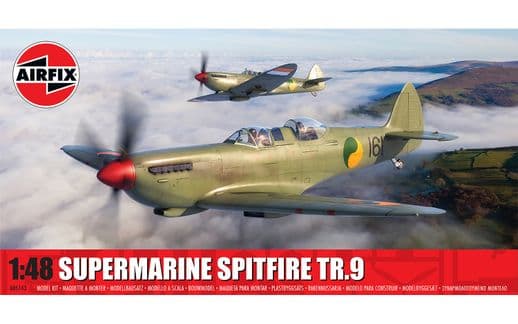
The Spitfire Tr.9 scheme shown above and below has quite a rich history and was originally built as a Mk.IX fighter during the late summer of 1944 and initially allocated to No.33 Squadron operating in Northern France in October the same year. During her time spent with No.33 Squadron in France and Belgium, she helped support the Allied drive towards Germany itself and flew 20 operational missions in the hands of 10 different pilots, men who heralded from Britain, Denmark, Holland and South Africa.
More Irish Air Corps goodness, the release of our 1/48th scale Spitfire TR.9 has brought some welcome modelling exposure to the fascinating aviation heritage on the other side of the Irish Sea.
In early 1945, she was transferred to No.412 Sqn RCAF, in the colours of which she would go on to complete a further 76 operational sorties, and was credited with downing at least three Luftwaffe aircraft, two Focke Wulf Fw190s and a Messerschmitt Bf 109.
The end of the war brought about a slightly more sedate existence for this Spitfire, with a period of storage, before she was selected for conversion to Tr.9 standard and a new career with the Irish Air Corps, providing advanced flying training for pilots destined to fly their existing Seafire fighters. Although still PV202, she would operate under the serial IAC161 whilst in Ireland, would ultimately follow five of her fellow aircraft into the civilian market, following her withdrawal from service.
After passing through various private owners, she came into the hands of Historic Flying Limited (now ARCo), and following a period of restoration, emerged from their hangars resplendent in the Irish Air Corps scheme she had worn during the 1950s, making her first post restoration flight in March 2025. On that occasion, the aircraft was flown by company owner and accomplished Warbird pilot John Romain, with his passenger being none other than Alex Henshaw, a man who probably flew more individual Spitfires in his role as Supermarine test pilot, than anyone else. It was thought that he flew 10 percent of all the Spitfire and Seafire fighters produced.
The aircraft has been repainted several times over the years, but is a stalwart of the UK Airshow scene, in addition to also allowing members of the public to fly in the world’s most famous aircraft, one which also possesses genuine WWII combat credentials. She is currently presented in the colours of Spitfire Mk.IX ML365, the personal aircraft of ace pilot Group Captain Peter Russell ‘Johnnie’ Walker CBE, DFC and DSO, and continues to allow Spitfire experience flights. These markings are similar to those the aircraft wore during her notable wartime service.
By the 1950s, the Chipmunk was very much the basic training aeroplane of the moment, an aircraft which was relatively forgiving in the hands of novice pilots, but was definitely a challenge to fly well. Also boasting excellent service and serviceability records, it’s perhaps therefore no wonder the aircraft was the first choice for the Irish Air Corps when they were looking to modernise their force and prepare for a major expansion in their flying training program. They initially received six newly built T.20 aircraft in January 1952, with these aircraft arriving direct from the de Havilland factory at Chester.
During the Second World War, the Irish Air Corps had operated a collection of different British aircraft types, which included Ansons, Lysanders, Supermarine Walrus amphibians and Gloster Gladiator fighters, but by far their most capable fighting aeroplane they operated was the Hawker Hurricane. Although none of these aircraft were called upon to actually challenge enemy aircraft encroaching into Irish airspace, they did have to shoot down quite a number of barrage balloons which had slipped their moorings and became hazards.
Following the end of the war, Irish Air Corps capabilities were upgraded with the arrival of Seafires and a number of Spitfire T.9s, which also created a need for a more capable training aeroplane. The force would eventually operate 14 Chipmunks between 1952 and 1973, with these aircraft not only providing training support for Irish Air Corps student pilots and air experience flights for hundreds of others, but also for several years, provided flying training for prospective Aer Lingus pilots as well.
Despite the relatively forgiving flying characteristics of the Chipmunk, operations in the striking colours of the Irish Air Corps were not without incident and six of the aircraft would be written off after suffering various accidents. Nevertheless, these aircraft would hold a significant position in the establishment of a modern Irish aviation service, in addition to encouraging a great many more people to consider a career in aviation. The venerable old Chipmunks would eventually give way to newly acquired SIAI Marchetti SF-260 trainers, with the final aircraft being retired by 1980.
The old saying that Aviation class in permanent certainly carries when talking about the de Havilland Chipmunks which served with the Irish Air Corps.
Proud of their aviation heritage and with their aircraft presentation being particularly easy on the eye, aviation enthusiasts and the people of Ireland are fortunate to have an extremely committed group of people who are determined to commemorate the heritage of aviation in Ireland. The Irish Historic Flight Foundation have not only amassed an impressive collection of historic aircraft, but they also have ambitious plans to create a dedicated aviation experience for generations of people to come, providing inspiration for those looking towards a career in aviation, be that as aircrew in engineering, or maintenance.
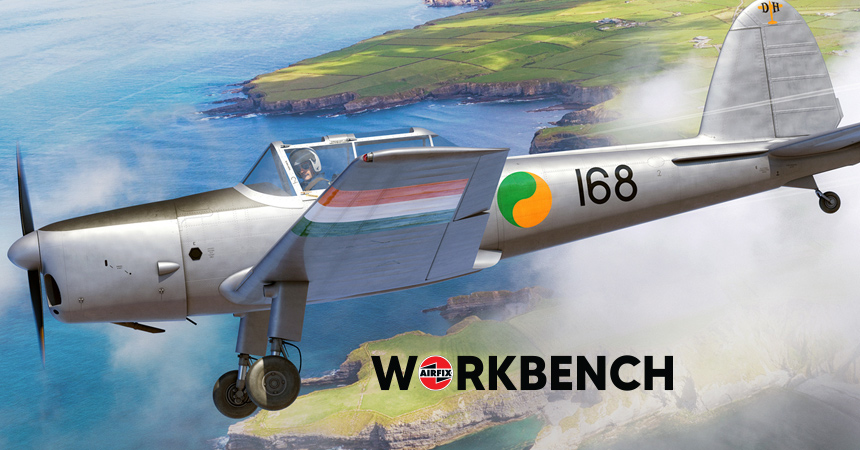
The pride of their fleet is a trio of beautifully restored and currently airworthy de Havilland Chipmunks, each one wearing the handsome scheme of the Irish Air Corps, and each one consecutively numbered in commemoration of their period of service – aircraft numbers 168, 169 and 170. The aircraft commemorated with this particular scheme and the one which inspired the stunning new box artwork for this second release, 168 Construction Number C1-0464 was built as a Chipmunk T.20 at Chester and delivered directly to the Irish Air Corps.
Following an active service career, the aircraft was disposed of and fell into disrepair, but was later to be the subject of a painstaking restoration project, with the intention of returning this beautiful aeroplane back to airworthy condition, the centrepiece aircraft of a new Irish Historic Flight. With the work being carried out by Chipmunk experts Vintage Fabrics at their Audley End facility, what emerged from their hangar was a thing of aviation beauty and was not only testament to their internationally renowned capabilities, but also the determination of the IHF in literally ensuring this impressive project got off the ground.
Unquestionably one of the most attractive airworthy de Havilland Chipmunks in the world today, these beautiful scheme options might give us all the encouragement we need to tackle a few more Irish Air Corps related build subjects, creating a little Irish aviation heritage display tribute of our own. There’s no doubt that whichever aircraft we decide to include, the display will be quite the attention grabber.
This beautiful aircraft is now owned and operated by the Irish Historic Flight, based out of Ballyboy Airfield in County Meath.
Continuing our 2026 theme of slightly unusual Workbench blog subject editions, we hope this little look at aviation heritage across the Irish Sea will prove interesting for many readers and might hopefully stimulate a little Irish Air Corps themed build activity during the rest of the year. With quite a few Airfix kit livery options now out there, both current and slightly more classic in nature, there should be something to inspire many a modeller to tackle an aircraft build project featuring the roundel of the Irish Air Corps.
Happy Saint Patrick’s Day for next Tuesday.
We're afraid that's all we have for you in this latest edition of the Airfix blog, but we will be back next Friday with more project development updates and the very latest Airfix kit exclusives. In the meantime, we're always keen to hear your views on all things Airfix and in particular, any thoughts and opinions you may have regarding our Workbench blog. If you would like to drop us a quick line, could we please ask that you use our workbench@airfix.com email for all correspondence.
To re-visit any of the Airfix blogs we have produced over the past TEN years or so, please head to our main Workbench hub, where you'll find our entire blog back catalogue and all the Airfix design projects we have already covered.
All our dedicated official social media sites can be accessed by clicking the respective link icons at the foot of this page, or by heading to the Airfix homepage. Other useful Airfix links are:
Facebook, YouTube, Twitter and Instagram official sites
Please join us for more Airfix updates next week and thank you for your continued support.