Welcome to the latest edition of our weekly Workbench blog, and all the news, updates, and modelling exclusives from the fascinating world of Airfix.
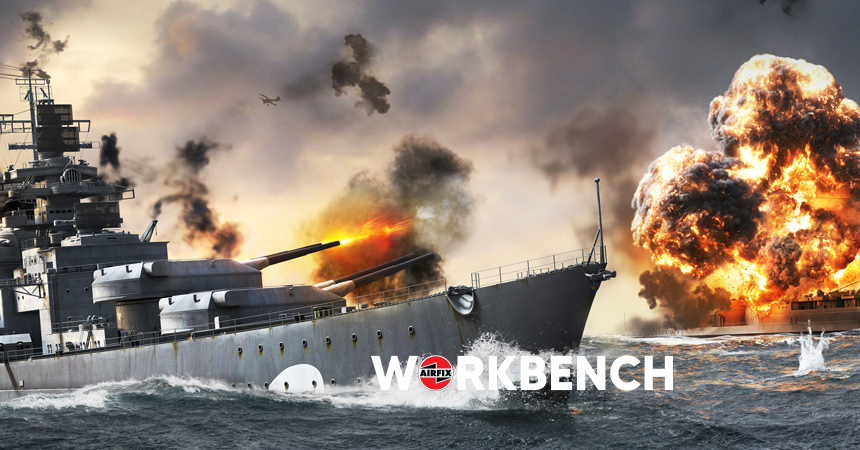
When it comes to modelling the machines which took part in the two world wars of the 20th century, few have the aesthetic gravitas of the mighty warships which fought for control of the oceans, leviathans of the sea which in addition to wielding unimaginable firepower, were also home to hundreds, if not thousands of men. By the time of the Second World War, even the mightiest warships were vulnerable to attacks from the air, so despite their impressive size and firepower, it could be argued that aircraft carriers were now the most important vessels in any military fleet. Nevertheless, cruisers, pocket battleships and battleships remain some of the most awe-inspiring weapons of war ever conceived by man, and therefore make for thoroughly engaging modelling projects.
In this latest edition of Workbench, we will be returning to the nostalgic world of our popular Vintage Classics range to feature a ‘squadron’ of recently released warship kit additions to the range, our scale tributes to some of the most significant naval vessels of the 20th century, with each one making its own contribution to the world of naval history. Warship kits have featured relatively sparingly within Workbench blogs over the years, and we have never featured three different ship kit subjects in the same edition, so in that respect, this week will be something a little bit special. We will certainly be hoping to inspire one of two readers to perhaps consider tackling their first scale warship project, over the course of this edition.
At the very end of this edition, we will be bringing you news about the future of Workbench, and a change to what readers can expect from us as we head through the rest of the year and beyond, so please do stay with us until the end.
Our model kit tributes to vessels which attempted to rule the waves are on our Workbench radar in the latest edition of our blog.
The mighty warships which ruled the waves during the 20th century make for such an impressive sight.
With the world’s oceans supporting exploration and conquest for centuries, the vessels built to support these aspirations and in turn, promote the fortunes of the nations building and operating them, have long been a source of fascination for millions of people. Humanity has always had something of an obsession with making discoveries, and as ocean covers 70% of the world’s surface, ever more capable ships were the impressive vessels which supported these aspirations, ever larger and ever more capable.
As a seafaring nation, a powerful navy has long been an important aspect of Britain’s strength and influence, not only for trade and the protection of trade around its own coastline, but also as a high-profile, extremely mobile illustration of the country’s intent to protect its interests across the globe. As warships became larger and ever more powerful in the lead up to the Great War, these vessels were as much a statement of power and ambition, as they were about technological advancement and remain as some of the most impressive machines ever created by man, floating behemoths possessing the ability to wreak destruction on an unimaginable scale.
Following the end of the Great War, the world’s foremost naval powers agreed to meet in Washington DC to discuss naval disarmament and future limitations, in a similar manner to how the Treaty on the Non-Proliferation of nuclear weapons of the 1968s hoped to prevent the threat of nuclear conflict. At that time, Japanese military expansionism was posing a very real threat to peace in the Pacific region, and something had to be done on an international scale to avert future conflict.
The outcome of this meeting was to impose limitations on the size, capability and numbers of future large warships, with Britain being particularly affected by the terms of the treaty. It could even be argued that as a result of this treaty, all of the world’s major navies were under strength at the start of the Second World War.
At around the same time, famous US aviator Brigadier General William ‘Billy’ Mitchell was doing his level best to convince the world that the day of the Dreadnought was over and how the aeroplane would be both the offensive and defensive weapon of the future. He argued that strategic aerial bombing would overcome any warship and as such, the emphasis for any future military expansion should be placed on air power and not the much more expensive navy.
This former Great war German battleship was used by Billy Mitchell to demonstrate the vulnerability of large warships to attack from the air.
He graphically illustrated his theory in July 1921, when he arranged for the former Great War German battleship Ostfriesland to be attacked by quite primitive bombers, which managed to sink it without too much trouble. Convinced he was right, his work would continue with further dramatic demonstrations of warship vulnerability to air attack over subsequent years, and even though America would go on to build the largest warships the world had ever seen, Mitchell’s theory was proved to be correct and to a large extent, the statement ‘The nation that controls the air also controls the sea’ was proved to be accurate.
Nevertheless, the most powerful nations continued to fund the construction of ever larger and ever more powerful warships, and despite their vulnerability to attack from below the waves, and from the skies, they still had a huge role to play, and were still a significant projection of military power on the world stage. Some of the naval engagements of the Second World War continue to be a source of fascination to this day, and the loss of large warships were some of the darkest days any nation would have to endure.
With a proud reputation in providing a wide variety of kit subjects in support of the modelling hobby over the years, ships and warships have long been a feature of respective Airfix ranges, underlining the historic importance these vessels have always commanded. This stems back to the very earliest days of the brand and the bagged 1:300 scale Golden Hind kit of 1952, which first introduced the nation to the delights of Airfix modelling.
Airfix have a proud reputation for producing ship models, one which can trace its origins back to 1952.
This kit was subsequently joined by a new range of hugely impressive, and significantly larger 1:180 scale classic galleons in 1956 with the release of HMS Victory, a spectacular kit which allowed the nation to have a beautiful scale representation of this famous ship in our homes. As a young man, I remember how several houses on the street where I lived had built examples of this kit displayed on their front room windowsill, something which made me request one of those kits for Christmas, even though I needed my dad to make it at that time.
Moving into the age of steel and armour plated floating leviathans, the late 1950s saw the introduction of 1:600 scale warship kits, with subjects such as Bismarck and HMS Hood cruising into the Airfix range, and immediately becoming staple subjects for the nation’s modellers, and unquestionably some of the most impressive model kits the hobby could boast at that time.
New warship model tooling projects have been a little thin on the ground over recent years, however, our Vintage Classics range has allowed these magnificent models to sail into various Airfix ranges since its announcement in 2018, bringing incredible hobby nostalgia for those of us who remember them being part of our early modelling lives, and potentially allowing the current modelling community to be introduced to them for the first time.
With our Vintage Classics radar highlighting several new model returns on its screen at present, we’re pleased to confirm the arrival of a trio of classic 1:600 scale warship kits, releases which are now firmly in our review crosshairs.
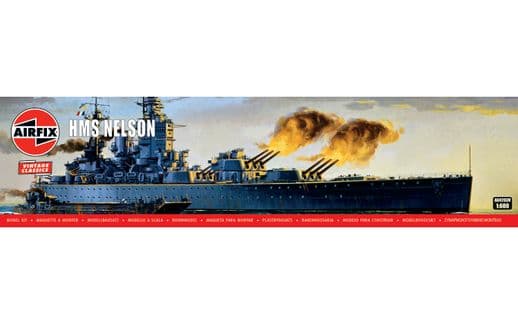
When it comes to the subject of significant warships to have represented Britain’s Royal Navy over the years, few could be described as being as revolutionary and aesthetically impactful as HMS Nelson and her sister ship HMS Rodney. Nelson truly was a warship like no other, one conceived from the embers of the Great War, as Britain attempted to maintain their position as a world leader in terms of naval power. Despite being a hugely impressive design, Nelson was always something of a compromise, with the ship’s specifications being bound by the constraints of the Washington Naval Treaty, legislation which limited the size and firepower of any new warship built during the post Great War era.
Rather than licking their wounds and lamenting the restrictions placed on them, British designers embarked on a project which pushed the known boundaries of naval design and technology, creating a battleship design which was as unique as it was impressive, possessing a silhouette like no other, and clearly demonstrating the Royal Navy’s intention to maintain its firepower position.
The world’s most significant warships have always been amongst the most impressive machines ever conceived by man, and HMS Nelson was the perfect embodiment of that reputation – she was spectacular! Equipped with the nine of the most powerful naval guns allowed by the Washington Naval Treaty, Nelson mounted all three of her main gun turrets at the front of the ship, with the front two being mounted one above the other in a ‘Super-Firing’ arrangement. The third gun was positioned behind the elevated second turret, and was intended to be used during maximum firepower broadside attacks, with this arrangement also allowing for a more concentrated armoured belt.
Another distinctive feature of the warship was its impressively tall control superstructure, with each station having a distinct role to perform, but with its height giving the vessel a truly imposing appearance. This structure housed the very latest gun ranging and sighting optical equipment for the ship’s main guns, however, each turret also had its own back-up systems, allowing for the autonomous operation of each turret in the event of the ship coming under fire and suffering communications damage.
One of the most distinctive warships of her day, HMS Nelson was designed and built around the limitations imposed by the post WWI Washington Naval Treaty.
Nelson was also equipped with smaller 12 inch guns down either side of her hull and she also featured two submerged torpedo tubes to be used when in close quarters operations. One of the most impressive features of the ship was its ability to accept armament upgrade, particularly when considering the anti-aircraft guns added to the aircraft. With the increasing influence of air power on the world of warships, ever more effective anti-aircraft protection was an absolute necessity, and Nelson was successively upgraded with more effective weaponry.
With the ship’s main anti-aircraft batteries fitted on top of the forward turrets, these units also benefitted from the latest targeting and fire control technology, highlighting the adaptability of the warship, but also the changing face of warfare during the 1920s and 30s. Launched from the Armstrong Whitworth High Walker shipyard at Wallsend in September 1925, the warship would be completed and commissioned by August 1927, entering Royal Naval Service in October that same year.
HMS Nelson was a hugely impressive warship, futuristic, distinctive and extremely handsome, however, it does have to be said that she was always something of a compromise from a capability perspective, and arguably wouldn’t have the operational impact her designers hoped she might go on to boast. As Europe headed towards another devastating war, Germany started to re-equip their armed forces with a new breed of capable weapons, including new warships which ignored the terms of the Washington Naval Treaty, essentially re-writing the rules of modern naval battleship design and performance.
Scheme details and built model images showing the spectacular HMS Nelson as she was in May 1941.
HMS Nelson was still the pride of the Royal Navy, a physical embodiment of Britain’s status on the world stage, and the flagship of the Home Fleet at the start of the Second World War, policing home waters and serving as a significant show of strength/deterrent threat. Unfortunately, quite early on in the war, the ship suffered damage after striking a mine which had been laid in home waters by a German submarine. This situation clearly highlighted the perils now faced by these leviathans of the seas, where a single mine, or well placed aerial bomb could cripple a warship which possessed such incredible firepower, and was home to 1,360 sailors.
Immediately having to undergo repairs, HMS Nelson would enter the war in earnest when she joined other naval vessels in attempting to re-supply the beleaguered island of Malta as part of ‘Operation Halberd’ in September 1941. Successfully breaking the Axis blockade, Nelson’s relatively slow speed made her a tempting floating target, and sure enough, a Luftwaffe strike bomber hit the ship with an air-launched torpedo, inflicting significant damage on the ship and requiring an immediate return to Gibraltar for repairs. If nothing else, this showed how a mighty warship could be compromised by a single modern weapon, clearly highlighting their potential vulnerability.
Returning to operations in 1942, HMS Nelson was assigned to bombardment support for the ‘Operation Torch’ landings and whilst she didn’t fire her guns in this role, she served as an effective show of force in the region. She would also play her first diplomatic role of the war, serving as a high-profile location for the signing of Italian surrender terms, a role she would continue in warmer waters later in the war.
Late war configuration for this mighty Royal Navy Battleship.
HMS Nelson would remain in the Mediterranean to provide fire support for the Anzio landings in early 1944, but by June that same year, she had suffered further damage at the hands of Axis mines, and required further repairs at Gibraltar – this was effectively the end of her war.
This elegant, yet relatively underused warship did return to operations during the final days of WWII, sailing to the Far East and once again used as an impressive diplomatic platform from where the Allies accepted the surrender of Japanese forces at the end of the Second World War, a duty which saw her overseeing a conflict she had served through from beginning to end, even though she only saw limited action, and wasn’t involved in any of the most significant naval engagements.
Sailing back to Britain, this mighty warship was decommissioned in 1947, but served on as a training and accommodation ship until 1949, when she was eventually sold for scrap. This most distinctive of British warships was finally broken up and recycled at Inverkeithing in 1950, a sad end for one of the Royal Navy’s most impressive inter-war warships.
In addition to looking very different to most other warships in service, HMS Nelson has to be considered something of a revolution in warship design, a most impressive looking ship which represented the Royal Navy with distinction. She also served longer than most of the warships of her generation, making her the perfect modelling subject for those with an interest in British naval sea power.
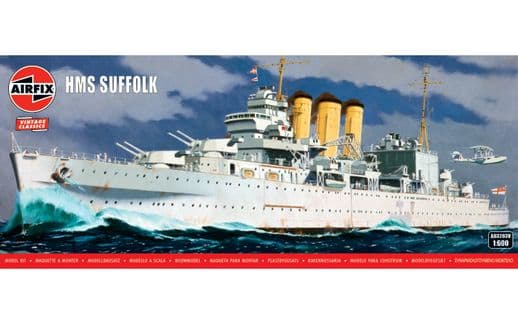
Another example of a post WW1 era British warship which was produced under the restrictions imposed by the Washington Naval Treaty, HMS Suffolk was a County Class Heavy Cruser built as part of the Kent sub-class of vessels, built by Portsmouth Dockyard from the summer of 1942, launched in early 1926 and commissioned in May 1928. She was designed to push the limitation boundaries imposed on Heavy Cruisers, and was of relatively traditional design, featuring eight 8 inch Vickers L50 Mk.VIII guns mounted in two ‘Super-firing’ turret banks, two forward and two aft.
Her secondary armament was relatively light, but in common with many other warships of the day, would regularly enter refit to receive additional, more effective defensive armament and equipment. Also equipped with eight torpedo tubes, the vessel was powered by four propellers and was capable of attaining speeds approaching 32 knots over calm seas.
HMS Suffolk completed her operational work up in home waters, but on completion of this, was dispatched to the Far East to serve on the China Station, something she did effectively, but with her most notable contribution being that of transporting hundreds of rare Chinese artefacts back to the UK for a major exhibition in the UK.
This long serving ship would be remembered for her work in keeping Bismark on her radar screens and eventually helping to avenge the tragic loss of HMS Hood.
During 1936, the warship entered dock for a significant refit, one which would see Suffolk equipped with her own Supermarine Walrus spotter aircraft, and stowage hangar, in addition to receiving an upgrade to both her anti-aircraft defences and anti-submarine depth charge equipment. Contemporary photographs showing these details clearly date the warship as being either before (no Walrus and hangar), or after the completion of this upgrade work.
On return to service, Suffolk was once again sent to work the China Station, where she would remain until the outbreak of the Second World War. Indeed, whilst she was in the area during the Sino-Japanese War, there are no reports of her being either directly involved in combat operations, or having come under fire from enemy units, and would be recalled to Britain during the summer of 1939 to undergo further refit. Significantly, this work included equipping the vessel with air search radar technology, something which would place her at the cutting edge of naval capability at that time.
Following this latest refit, Suffolk was initially allocated to the Mediterranean Fleet, at a time when the Italian Navy may well have still been neutral, but by then, were overtly supporting a German nation they considered a close ally. During the Autumn of that same year, HMS Suffolk was on the move again, returning to home waters to engage in wide ranging patrols looking for signs of German shipping activities in the North Sea, from Iceland to the east coast of Britain, something she would continue doing until early 1940.
China Station livery for this hard-working and well-travelled Heavy Cruiser.
With the war now raging, HMS Suffolk would return home for further refit following a collision in the North Sea which resulted in several members of the crew losing their lives and several more suffering injuries, but returned to duty in April 1940 transporting a complement of Royal Marines assigned the task of occupying the Faeroe Islands as part of ‘Operation Valentine’. She was then sent to support operations off the coast of Norway, initially to bring fire support to bear against the German occupied airfield at Stavanger, where she came under concerted enemy aircraft attack, and was badly damaged after taking a direct hit.
Limping back to Scapa Flow, Suffolk was in quite a state, operating at reduced speeds and only controllable by controlling her engines – the rear of the vessel was also taking in water. After initial repairs were carried out at Scapa, she was subsequently sent to Greenock to undergo further upgrade, particularly to her radar and gunnery control systems, something which would support her during her most famous actions.
Returning to service in March 1941, she was assigned to carry out patrols and convoy protection duties until reassigned to take part in one of the most significant naval engagements of the Second World War – the hunt for Bismarck. In conjunction with her sister ship HMS Norfolk, the pair were ordered to locate and keep track of the German warships Bismarck and Prinz Eugen in the Denmark Strait, using their advanced radar to keep them in sight, whilst still being out of range of their fearsome guns. They shadowed the two German ships until they were challenged by the British warships Hood and Prince of Wales, keeping the enemy ships under observation even after the devastating loss of HMS Hood.
HMS Suffolk in her most famous configuration, the one in which she presented during the Battle of the Denmark Strait in May 1941.
Whilst initially maintaining her station keeping Bismarck in radar contact, Suffolk was forced to break off as she needed to refuel, although it does have to be stressed that she didn’t actually fire on Bismarck. Refuelled and sailing back out to sea, she resumed her patrol and interception duties in the North Atlantic.
HMS Suffolk would prove to be a reliable and hard working vessel for the Royal Navy, and whilst she was dispatched in conjunction with other vessels to search for the German Battleship Tirpitz, and would later renew her radar acquisition acquaintance with Prinz Eugen, she would end her war steaming through Indian and Pacific waters. Undergoing refit in India, she would be used to provide fire support to joint US/British operations against Japanese forces towards the end of 1944, and would remain in the region for the rest of the conflict.
Returning home to Britain following the end of the war, her final task was to bring troops home following deployment overseas, and would eventually be decommissioned in July 1946. Sadly, this hard working warship would meet the scrapman’s torch in May 1948, a sad end to a warship that changed its appearance more than most during her service career.
There’s something strangely fascinating about German military equipment of the second world war, mainly because everything just looks so sinister. Packed full of technological innovation, their tanks, aircraft and ships were all build to excel in times of conflict, but still managed to be as awe-inspiring as they were deadly, with some even going so far as to describe them as beautiful. Unquestionably, the most notable warships which contested the Second World War readily embrace such descriptions, and have to be considered some of the most impressive, but also attractive ships to have ever taken to sea.
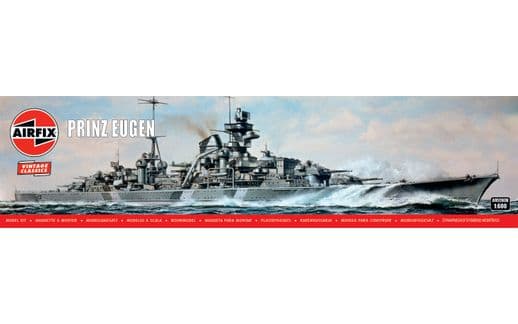
The Heavy Cruser Prinz Eugen was the third and final vessel of the Admiral Hipper class of Cruisers, laid down in the Kiel shipyards in 1936 and launched in August 1938. She was almost immediately damaged by RAF bombers just prior to being commissioned in 1940, which resulted in a further period of time in harbour, and a delay in her maiden cruise. Eventually leaving Kiel bound for Gotenhafen (Gdynia) in April 1941, she would perform her initial sea trials and work in conjunction with the German Battleship Bismarck in the Gulf of Danzig.
In May 1941, and again in conjunction with Bismarck, Prinz Eugen headed out to raid British shipping in the Atlantic as part of ‘Operation Rheinübung’, one of the two actions which would define the history of this warship. As described in the HMS Suffolk text above, the pair were detected by Suffolk’s radar and later came under attack by the British Battlecruiser HMS Hood and the Battleship Prince of Wales, with Prinz Eugen registering hits on both of the British ships, but ultimately making for the safety of Brest harbour as this historic engagement unfolded.
Such a magnificent warship, Prinz Eugen was smaller than either the Bismarck or Scharnhorst class of vessels. She’s seen here in US hands, prior to her being used as a nuclear detonation target.
Once in Brest, the warship was attacked by British bombers in early July 1941, sustaining damage and taking heavy casualties, however, her sailing from Brest in February 1942 would be the other action this ship is most famous for. ‘Operation Cerberus’, better known as the Channel Dash, saw Prinz Eugen and the battleships Scharnhorst and Gneisenau, supported by six destroyers, making a potentially perilous dash for home ports through the heavily contested English Channel. What should have seen the ships suffering heavy damage at the hands or British forces turned into a disaster for Britain, as the Germans managed to successfully complete the operation.
Prinz Eugen would continue to operate in Baltic and Norwegian waters, however early detection by British aircraft would usually see the heavy cruiser returning to port to avoid destruction, and would even be used as a training ship for several months from March 1943.
Some of the last actions where her 8 inch guns were fired in anger were against Soviet troops in the Sworbe peninsula and off the Gulf of Danzig, where she expended all her remaining ammunition. Following this, she sailed for Copenhagen, where she surrendered to Allied forces along with the light cruiser Nürnberg, the only significant German warship to survive the war intact.
Full scheme details of this mighty German warship as she was configured at about the time of her commissioning.
Once in Allied hands, authorities didn’t really know what to do with their two floating German war prizes, but did know that they didn’t really want them. Having said that, they were certain that they didn’t want either of them to fall into Soviet hands, so Britain and the US literally picked the name of a German ship to inherit out of a hat, with the Americans taking Prinz Eugen.
The former Kriegsmarine warship sailed for Boston with a predominantly German crew, but with American captain and troop overseers, arriving in Boston in January 1946, where she was officially handed over and the German crew repatriated back to their homeland. Subsequently, US Navy crews found operating the former enemy ship to be problematic in the extreme, with engine management being particularly challenging. It was almost immediately decided that the vessel was to be retired, but of even greater significance, was to be assigned to target vessel status and used in nuclear detonation trials.
Although the devastating effects of nuclear weapons had already been clearly demonstrated in bringing about the end of the Second World War, military officials were keen to observe the impact these weapons would have on warships. To this end, a collection of obsolete US and captured former enemy warships were gathered at Bikini Atoll in the Marshall Islands, prior to this test taking place.
Prinz Eugen as she was configured at the time of the famous Battle of the Denmark Strait.
The first bomb was dropped on 1st July 1946, and air burst detonation which while spectacular, caused little significant damage to most of the vessels. Prinz Eugen was hardly affected, but had been given a liberal dose of radiation exposure.
The second test detonation on 25th July took place 90 feet under water, creating an enormous explosion which resulted in many more ships being destroyed, however, once again, Prinz Eugen emerged relatively unscathed, with barely a scratch on her, testament to the engineering and design prowess this magnificent vessel benefited from. She was found to have developed a small leak though, and whilst this wasn’t initially seen as anything significant, it would ultimately bring about her eventual demise.
In early September 1946, Prinz Eugen was towed to Kwajalein Atoll, the world’s largest coral atoll, where the ingress of water finally saw the vessel listing heavily to one side, finally capsizing at the end of December that year. Due to the radiation, crews were not allowed onboard to carry out any repairs, so tragically, a small leak eventually did what the Royal Navy and two nuclear bombs failed to achieve, and brought about an end to this magnificent warship.
Reading the content supporting each of the three warship models featured this week, you can find a link between all three which makes their inclusion in the same edition of Workbench all the more fitting. They also make for enjoyable and compelling build projects, particularly if you like your finished models to have real presence when taking their place amongst any collection of built models.
With each one building into a spectacular display piece, we’re delighted to confirm that both HMS Nelson, HMS Suffolk and the incredibly resilient Prinz Eugen are all available now, just waiting for you to spend some of those reward points.
Since posting our first edition back in the summer of 2015, the Airfix team have considered it an absolute privilege to be able to bring our readers all the latest details from the fascinating world of Airfix, but more than this, to have so many of you come on this journey with us. For the majority of that time, we chose to publish Workbench on a bi-weekly basis, however, for the past three years or so, we increased that to bringing you a new edition each and every week, which was quite some undertaking.
Moving forward, we’ve decided to make this the last of our weekly editions of Workbench, meaning that the next edition will now be published on Friday 29th May, as we will be going back to our bi-weekly blog roots, so to speak. We will be looking to keep things fresh and engaging, and one thing you can be absolutely certain of is that Workbench will always be packed full of Airfix related content and new model exclusives.
We look forward to seeing you back here again in two weeks’ time.
We're afraid that's all we have for you in this latest edition of the Airfix blog, but we will be back next Friday with more project development updates and the very latest Airfix kit exclusives. In the meantime, we're always keen to hear your views on all things Airfix and in particular, any thoughts and opinions you may have regarding our Workbench blog. If you would like to drop us a quick line, could we please ask that you use our workbench@airfix.com email for all correspondence.
To re-visit any of the Airfix blogs we have produced over the past TEN years or so, please head to our main Workbench hub, where you'll find our entire blog back catalogue and all the Airfix design projects we have already covered.
All our dedicated official social media sites can be accessed by clicking the respective link icons at the foot of this page, or by heading to the Airfix homepage. Other useful Airfix links are:
Facebook, YouTube, Twitter and Instagram official sites
Please join us for more Airfix updates next week and thank you for your continued support.