

Welcome to the latest edition of our weekly Workbench blog, and all the news, updates, and modelling exclusives from the fascinating world of Airfix.
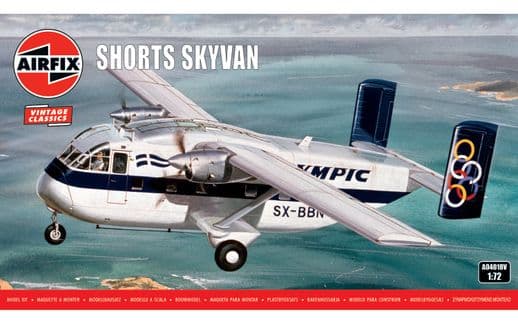
This week’s title and header image serve as confirmation that we will be returning to the nostalgic world of Vintage Classics in this latest edition of Workbench, as we prepare to welcome the scale model kit induction of one of the most unusual looking aircraft of the 20th century into its ranks. When talking about the subject of basic aviation aesthetics, the Short SC.7 Skyvan certainly wasn’t going to be winning a great many plaudits, even though it proved to be extremely capable in several important areas. Importantly, once crews came to appreciate the many qualities of the Skyvan, it definitely earned their respect, and would even reveal itself to be the ideal aeroplane in a number of specialised fields in the years to come.
As we prepare to welcome the Short Skyvan into the 2026 range this summer, we’ll be taking this blog opportunity to look at the development of this unusual aircraft, and see how some of them are still working hard to this day, providing specialist aerial support 63 years after the maiden flight of the prototype, using Airfix artwork to help illustrate the story.
With the Vintage Classics range being our focus of attention this week, we will also be including artwork and built model imagery of a recent release addition to the range, a model kit which has to be considered the most requested Vintage Classics kit return since the range was announced back in 2018, our scale tribute to one of the most impressive machines to have ever hovered above the ocean waves.
We’re riding the crest of an Airfix wave of kit nostalgia in this weekend’s edition of our Workbench blog.
The sight of classic Airfix artwork is always an indication that another addition to the Vintage Classics range is about to be made.
For an aviation company that could boast such elegant aircraft as the Empire and Sunderland flying boats amongst their design portfolio, and have the distinction of introducing the RAF’s first four engined heavy bomber into wartime service, it can be a little confusing to discover that one of their most successful aircraft of the post war era has been described by some as the ugliest aircraft to have ever taken to the skies.
The project which would eventually lead to the introduction of the Short Skyvan began in the late 1950s, when the Shorts company were approached by a rival manufacturer for backing support to produce a small transport utility aircraft called the Hurel-Dubois M.D.M 106 Caravan. A twin engined, high wing, deep fuselage design, the Caravan actually bore more than a passing resemblance to the subject of this feature, however, the joint working proposal was eventually rejected by Shorts, who instead intended to press ahead with their own, similar project.
Using much of the research data presented to them during the initial stages of the collaboration process, the new Shorts design was for an all-metal, high wing monoplane featuring a slab-sided, box-like fuselage, but a design which could boast excellent short-field performance and was as rugged as they come. The company felt that a robust, fixed undercarriage aircraft with a large rear loading ramp and uncompromising operability would gain many suiters looking for a cost effective freight and passenger carrying aircraft to operate from basic or restricted length runway airfields, servicing routes and communities all around the world. If they got this design right, they really did feel that the aviation world was quite literally their oyster.
Due to its design, the cockpit of the Skyvan was impressively roomy, and for crews who may be required to fly several sorties each day, could hardly have been a more pleasant environment from where to ply their trade. An unpressurised workspace, this dictated that the aircraft would not be required to operate at very high altitude, but that wasn’t where the strengths of this aircraft lay. A surprisingly nimble performer, the Skyvan must have been quite an exciting aeroplane to fly, particularly when operating empty and heading back to pick up another load of cargo.
Invicta Aviation G-BEOL as captured by our Airfix colleague Michael Collins. This aircraft now wears an all-over olive drab scheme and Austrian Air Force markings, having originally been delivered to the Japanese Coastguard.
The rear cargo/passenger compartment was equally roomy, being completely unobstructed when configured for cargo or skydiving delivery, even being liked by some as a flying garden shed. Although this may sound a little disrespectful, it was pretty accurate and was meant with affection, not rebuke.
With its fixed undercarriage, straight, high wings and deep, boxy fuselage, the Skyvan might have been an acquired taste at first, but it didn’t take long for this distinctive looking aircraft to start working its way into your affections, and it really was the sort of aircraft that just made you smile, whether you were getting in it, or just watching it in operation. Essentially, the Skyvan was an aviation facilitator, an aeroplane that just wanted to get into the air and one designed to do so with a minimum of maintenance and fuss.
Able to service routes normally only accessible by much smaller aircraft and helicopters, the Skyvan could carry freight and/or passengers into almost any airfield, no matter the size, or restricted length of the available runway. This meant that this capable aeroplane could operate in some of the most remote areas of the world, serving communities that had never previously seen an aeroplane at close quarters, bringing vital supplies, and allowing those people access to modern medical facilities if needed. The aircraft’s main fuselage area was able to take an impressive load of cargo, or even a group of people excitedly looking forward to jumping out of the aeroplane at 15,000 feet – this really was an impressive little aeroplane.
The prototype Skyvan made its first flight from Sydenham Airport, Belfast in January 1963, in the hands of Short’s Chief Test Pilot Dennis Taylor. This and subsequent development aircraft would be powered by a succession of different engine types, as designers struggled to find the most effective powerplant for this rugged little aeroplane. They eventually settled on the Turbomeca Astazou II turboprop, which was a development of a successful unit used to power European helicopter designs, a further development of which was found in the Handley Page Jetstream.
Once in production, the unique attributes of the Skyvan started to attract suiters from the worlds of commercial and military aviation, as its versatility in delivering freight and passengers/troops into airfields and locations rarely serviced by fixed wing types were successfully marketed. A total of 154 Skyvans were produced, which isn’t actually all that many, considering how widely known the aircraft would end up being. Airline operators of the type included British Airways, Emerald Airways, Olympic Airways, Gulf Air and Ansett-Mal, with many seeing service with several operators during their lives.
The Skyvan would also see service with several military operators around the world, including those of Thailand, Singapore, several African nations, Nepal, Austria and Argentina. In fact, two Argentinean Skyvans were committed to operations following the invasion of the Falkland Islands in 1982, when two of the five aircraft operated by the Argentinean Coast Guard arrived on the islands. Whilst little is known of their use during the conflict, both would meet their ends on the Falkland Islands, one as a result of British shelling, and the other being destroyed by British Special Forces during the raid against Pebble Island on the night of 14th/15th May 1982.
Another look at Invicta Aviation’s G-BEOL during a visit to Manston Airport.
In recent years, the Short Skyvan has made a name for itself as an effective and hardworking parachute/skydiving delivery platform, and as photo ships for some of the world’s most accomplished, and extremely fortunate, aviation photographers. In addition to this, some of the remaining airworthy examples of this aircraft happen to be amongst the most distinctively decorated aircraft to have ever taken to the skies. With bright colours and comical grins, some might find these schemes appealing, whilst others think them a little garish, but whatever your opinion, these aircraft are certainly attention grabbers – there was even one painted to look like a flying Nemo clownfish.
Production of the Skyvan ended in April 1986 with the delivery of the 154th and final example to the Air Force of Oman, quite a meagre return for such a well-known and capable aircraft type. Despite the fact that quite a number of Skyvans remain in operation throughout the world, it’s thought that currently, none are registered here in the UK, despite the fact that they do still appear regularly in British skies, both as skydiving support aircraft and aerial photography platforms.
Indeed, until recently, and may still be, Summit Air operated two Canadian registered Skyvans from the Royal Air Force base at Brize Norton, fulfilling a military contract to provide training support for the RAF Falcons parachute display team. In this role, it’s also possible for the public to see these aircraft operating at Airshow and demonstration events across the country, with the Skyvan still proving to be an excellent aircraft in providing such specialist support.
If you’re looking for an aircraft possessing both operational effectiveness and character by the bucketload, look no further than the Short Skyvan, Belfast’s incredible ‘Flying Shoebox’.
Scheme A – Shorts Skyvan SX-BBN, Olympic Airways, Athens, Greece, 1974.
As one of the best loved kits in Airfix heritage, I certainly recall this kit encouraging me to attempt a civilian aviation build when I was very much a military aviation modeller at the time, with the striking Olympic Airways livery being a major factor in encouraging this modelling change of direction. One of the highest profile airline customers for the Skyvan, Olympic took two aircraft from Shorts to serve their domestic and Island services, with the impressive STOL abilities of the aircraft being most welcome in operating from some of their less well equipped airfields.
The Shorts marketing team sent one of their aircraft on a tour of the US to demonstrate their impressive aircraft to this massive potential sales base, in addition to sending a fully passenger prepared example to the massive Paris Air Show, and whilst this did result in some orders, it did seem as if larger operators were only interested in using the Skyvan as a stopgap type until more capable aircraft became available.
Full scheme details of this truly classic Airfix kit livery.
Skyvan kits finished in both of the scheme options available with this Vintage Classics release, with the Olympic Airways marked kit in the foreground.
That certainly wasn’t the case with the Greek airline Olympic, who whilst only taking two Skyvans, would use them extensively for the next 21 years. They would regularly be seen sharing the ramp at Athens International Airport with some of Olympic’s latest jetliners, and those of many international operators. The aircraft were used to operate short haul STOL services between the Aegean Islands of Rhodes, Kos and Karpathos, the Ionian Islands, and between Athens Airport and Porto Heli and Sparta on the Corinth Peninsula.
The two Olympic operated aircraft were this particular aircraft, SX-BBN ‘Isle of Mykonos’ and her sister aircraft SX-BBO ‘Isle of Skiathos’, with both aircraft being purchased new from the Belfast factory in 1970, and only going out of service in Greece from the early 1990s.
After withdrawal from service, SX-BBN ‘Isle of Mykonos’ was later sold to Pink Aviation Services and re-registered OE-FDI in Austria. Hired for a parachute event in Holland in June 1996, the aircraft was forced to make a dead stick landing in a potato field short of the runway at Hoogeveen, and whilst there were thankfully no fatalities, the aircraft was written off due to the resultant airframe damage.
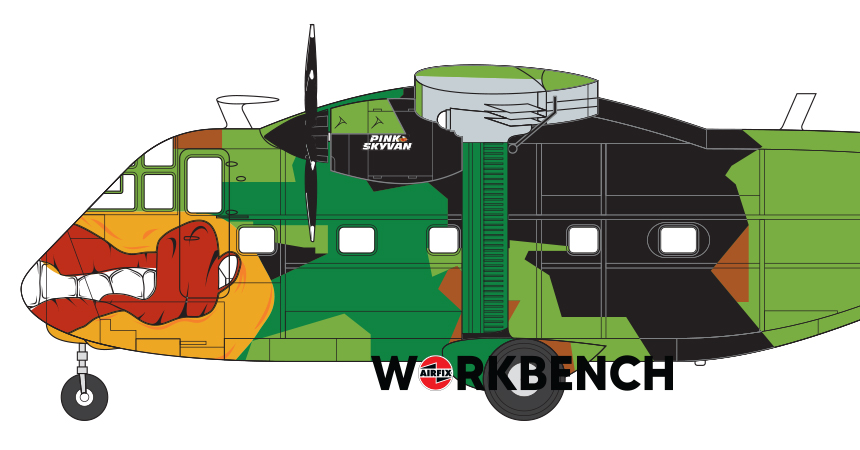
We mentioned earlier that the Skyvan was full of character, with some recent examples sporting some of the most unusual and eye-catching schemes ever worn on an aircraft, and this second finish option serves as a perfect illustration of that. An aircraft which is currently owned and operated by Pink Aviation Services of Austria, this aircraft is extremely active on the skydiving scene around Europe, using its massive, unobstructed fuselage to allow professional and novice skydivers to experience the thrill of jumping out of a perfectly good aeroplane – well, if that’s your thing I suppose!
Interestingly, the demise of the Olympic Airways aircraft featured above came with the aircraft wearing the registration OE-FDI, and even though this aircraft has a different, much later construction number, it carries the same registration – we’re not too sure how that happened, but do know that one of our knowledgeable readers will have the answer and will no doubt enlighten us.
Pink Skyvan, or Pink Aviation Services, have built a reputation for providing unique, customised aviation solutions for a great many customers and since 1986, have been doing so from airfields all over Europe. They operate several aircraft types, but currently have three Short Skyvans in their fleet, aircraft which are the perfect platform for supporting skydiving activities, both civilian and military, as well as providing photographers with an unrivalled platform for securing the air to air images and videos which always manage to capture our attention.
The Pink fleet of three Skyvans all sport big red lips and toothy grins, making them instantly recognisable wherever you’re fortunate enough to see them. OE-FDI is the aircraft featured here, and may even be one that some of our readers have either photographed, or jumped out of. OE-FDN wears a similar grin, but also sports a striking pink and red scheme, whilst OE-FDV is relatively conservatively presented with her all-white fuselage, even though she still sports the same toothy grin.
We told you the little Skyvan had bags of character!
Built model role reversal, this time with the Pink Aviation aircraft in the frame, smiling for the camera.
With their large cargo area and high fuselage, the rear cargo ramp is perfect in supporting skydiving activities, whether they be professional jumpers, or tandem skydivers enjoying the thrill for the first time. All but the tallest people can stand up fully prior to exiting the aircraft, making this one of the most capable aircraft types available to civilian skydivers. These same attributes see these aircraft also used for the drop testing of military and business cargo, all of which keep the Pink aircraft and crews extremely busy with bookings from all over Europe.
Taken from the Pink Aviation Services website, ‘Our aircraft are meticulously maintained by Aircraft Service Klatovy, a certified Part 145 maintenance operation, ensuring they are always up to date with the latest technology. We rent out our modern aircraft, complete with experienced pilots, for operations under SPO regulations. Whether you need a reliable aircraft for skydiving events, air-to-air photography, or other specialized missions, our fleet is ready to meet your needs’.
If the first scheme is 100% classic Airfix, this second option is irresistibly Skyvan – how on earth are we going to be able to choose between them?
Just as an important aside, should you wish to finish your model in this incredible scheme, this Vintage Classics release also includes links to allow 3D printable STL files for both the five and seven bladed propellers to be downloaded by the modeller. For those who do decide to go for a dual build option, you’ll be able to have examples of this incredibly distinctive aircraft from both the beginning and the end of its service life. In fact, we’re doing the Skyvan a disservice by saying that, because the Pink Aviation Services aircraft are still very much active aeroplanes.
You just can’t get any more ‘Classic’ than this magnificent Airfix artwork.
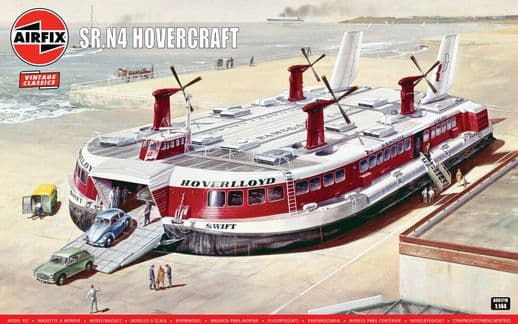
We couldn’t leave the subject of 2026 Vintage Classics kit releases without making mention of arguably the most impressive kit that will ever represent this range, one which has been requested by modellers since the range was first announced back in 2018, and one which is currently still (just about) available. As our scale kit tribute to one of the most impressive machines to have ever offered passenger services, our 1:144th scale SR.N4 Mountbatten Class hovercraft had to be something special, and when it was first released back in 1970, it was unquestionably the kit every modeller wanted to get their hands on.
Produced at a time when British engineering was the envy of the world, the Saunders Roe/British Hovercraft Corporation SR.N4 was impressive in every respect of the word, a mighty craft intended to herald a new era in high speed, high comfort, cross-Channel travel for the masses. Entering service in 1969, these Mountbatten Class Hovercraft were able to cruise at speeds in excess of 60 knots, allowing operators to complete fourteen return trips each day, during the busy summer schedule. Powered four marine variants of the Rolls Royce Proteus turboprop engine, each unit drove a massive 5.8 metre diameter variable Dowty Rotol propeller mounted on pylons, which moved to provide the hovercraft with directional control, along with powered fins and rudders.
This next series of images serve to confirm that one of the most heavily requested Vintage Classic kit releases is now available once more.
At the time the SR.N4 entered service, this floating leviathan was the largest passenger hovercraft ever built, and fittingly equipped with the largest propellers ever produced. Allowing these fully amphibious craft to use terminals away from existing busy seaports, but close enough to still be convenient for passengers, you would definitely know when one of these mighty craft were inbound, because of the incredible noise produced by its Proteus engines. Everything about this hovercraft was spectacular, which also made it one of the most impressive Airfix kits ever produced, one which has made a welcome return this year.
Only six of these mighty craft were ever constructed, and all but one have now been scrapped. The only surviving example GH-2007 ‘Princess Anne’ is now a prised and truly historic exhibit at the Hovercraft Museum at Lee-on-the-Solent, Hampshire, serving as an incredible reminder of when these mighty hovercraft truly ruled the waves.
Just for completeness, we’re also including the British Rail linked Seaspeed livery which is the second scheme option available with this impressive kit.
She holds two records – as the largest commercial hovercraft ever built, and for setting the fastest cross-Channel crossing in September 1995, when she did so in 22 minutes. Originally operated under British Rail’s Seaspeed service, she also wore the liveries of Hoverlloyd and Hoverspeed, with this Vintage Classics kit offering two of these very different livery options.
In the annals of Airfix heritage, 2026 will surely be remembered as a significant release year for the ever popular Vintage Classics range.
We're afraid that's all we have for you in this latest edition of the Airfix blog, but we will be back next Friday with more project development updates and the very latest Airfix kit exclusives. In the meantime, we're always keen to hear your views on all things Airfix and in particular, any thoughts and opinions you may have regarding our Workbench blog. If you would like to drop us a quick line, could we please ask that you use our workbench@airfix.com email for all correspondence.
To re-visit any of the Airfix blogs we have produced over the past TEN years or so, please head to our main Workbench hub, where you'll find our entire blog back catalogue and all the Airfix design projects we have already covered.
All our dedicated official social media sites can be accessed by clicking the respective link icons at the foot of this page, or by heading to the Airfix homepage. Other useful Airfix links are:
Facebook, YouTube, Twitter and Instagram official sites
Please join us for more Airfix updates next week and thank you for your continued support.