
Welcome to the latest edition of our weekly Workbench blog, and all the news, updates, and modelling exclusives from the fascinating world of Airfix.
For those of us who have a few years invested in this wonderful hobby of ours, we know only too well how the model kits we’ve enjoyed building over the years, particularly early on in our modelling journeys, helped to provide us with a different perspective on the facts we learned about in our history books at school, if not by actually bringing those details to life, but certainly by allowing them to take physical form and becoming appealingly tactile. In this latest edition of Workbench, we will be making reference to this by featuring two kits which are both currently available in the 2026 range, both 1/72nd scale representations of fighting aeroplanes, and both writing their names into the annals of aviation history from the very earliest days of aerial combat.
Our main subject is an aircraft which possesses unrivalled aviation credentials, the first ‘hunting’ aeroplane, one developed specifically to prey on other aircraft, dominating the skies and creating a new breed of fighting aeroplane. The second subject ended up being prey for the first one, despite the fact that it was an impressive aircraft in its own right, one which performed exceptionally well in the role for which it was intended. Unfortunately, a new breed of enemy aircraft ensured that history records its service years as being extremely challenging, despite its many commendable qualities.
We’re in the presence of true aviation pioneers and their aircraft in this latest edition of Workbench.
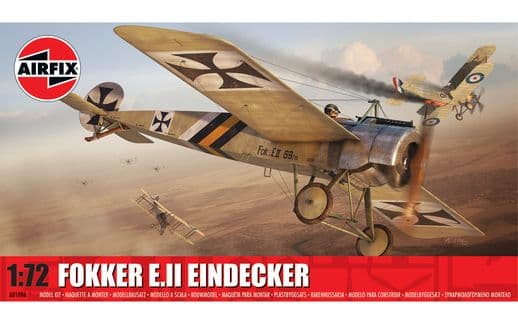
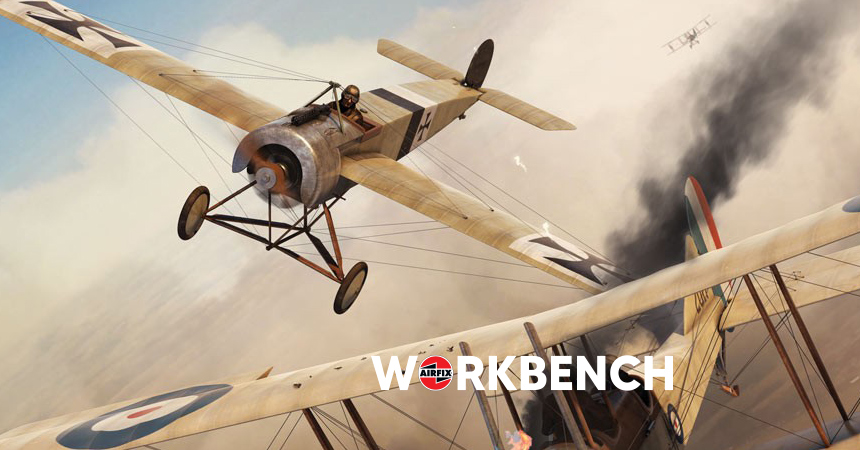
One of the most significant aircraft in the history of aviation, the Fokker Eindecker was the first aircraft developed specifically to hunt other aeroplanes.
As aviation enthusiasts prepare to marvel at the latest Royal Air Force jet aircraft performing at Airshows the length and breadth of the nation this coming summer, the dawning of aerial combat and the men who first contested it appears so far removed from these incredible machines that we rarely give them a thought, despite the fact that some of the doctrines developed by those pioneers are still part of air combat teachings to this day. As fascinating as todays technological aviation marvels undoubtedly are, performing essentially the same role using flimsy wood and fabric aeroplanes just 12 years after the Wright Brothers had made their historic first flight genuinely is as fascinating as it is incredible, something which is surely worthy of greater enthusiast consideration than it generally receives.
In this latest edition of Workbench, we will be heading back to those early days of aerial combat and the introduction of the world’s first ‘hunting’ aeroplane, one which whilst still a relatively primitive design, had a profound impact on the history of aviation, the Fokker Eindecker.
It could be argued that the early involvement of aviation and aircraft during the Great War was gentlemanly, almost chivalrous in nature. Intrepid airmen pitting their wits against flimsy, difficult to control aircraft, pulled along by underpowered, temperamental engines was their dangerous role. Showing incredible bravery to take to the air in such primitive machines was impressive in itself, however, the strategic benefits air power provided military planners saw it rise in importance exponentially, with mastery of the skies quickly becoming of vital importance.
Despite its reputation, the Fokker Eindecker was still a relatively primitive aeroplane.
Many reports exist which document how initially at least, airmen from opposing sides would acknowledge or even salute enemy aircraft when coming across them in a mission situation, however, as the reconnaissance information both were attempting to gather was of critical importance to the future of the war, and held the lives of hundreds, if not thousands of troops within its detail, things soon took a turn for the sinister.
With the air now proving to be just as important a battlefield as the trenches below, crews began to take side arms and rifles into the air with them, determined to ensure they were the only ones bringing the reconnaissance information home, or in many cases, paying with their lives in trying. This development certainly demonstrated how the aeroplane was now a vitally important weapon of war, and how those who flew them now had a new goal, to achieve mastery of the air. Within months, the aeroplane had transformed from a trench system plotter, into the army’s eyes in the sky, and nothing now would ever escape its inquisitive, lofty gaze.
With their clear understanding of the absolute necessity to gain a control of the air and the wider implications this would have on the future of the ‘War to end all Wars’, the German High Command duly instructed their aircraft manufacturing industries to immediately develop a completely new kind of aeroplane, one designed specifically to hunt other aeroplanes and dominate the skies.
The result of their work was the Fokker Eindecker, a monoplane fighter aircraft which represented the very pinnacle of aviation technology at that time, one which made use of all the flight research data designers had available from the front lines, and incorporating all the very latest technological advances the world of aviation had to offer.
Fokker Eindecker pilots were true pioneers of aerial combat.
With the ability to fire its machine gun/guns through the arc of the propeller, utilising a clever engine driven machine gun synchronisation mechanism known as interrupter gear, all the pilot of an Eindecker had to do was to aim the nose of his aircraft in the direction of his target through his his line of sight and fire his gun, something which was a revolutionary concept in aviation at that time, but one which clearly still required much skill to operate effectively.
It has to be remembered that the aeroplane was still in its relative infancy at that time the Eindecker was being developed and even though history regards it as something of a technological marvel, it was still rather primitive an aircraft and relatively underpowered, making the airmen who flew them true pioneers in the art of aerial combat. If they were competent enough to manoeuvre their aircraft into a favourable attack position behind an enemy aircraft, the rudimentary wing warp flight control system still needed a steady hand, and if the situation got the better of them, they could quickly find themselves in a world of trouble.
If they allowed the thrill of combat to overtake their judgement, too tight a turn to stay on the tail of their intended victim could see them entering a dangerous spin, losing valuable combat altitude at best, with their aircraft not stopping until it hit the ground at worst. Early Eindecker pilots were essentially writing the rules of aerial combat engagement with each sortie made, with names like Boelcke, Immelmann and Udet all becoming students of the art, and sharing their expertise with those following in their footsteps.
The Great War saw the aeroplane transform from an information gatherer to an aerial dominator.
With their fearsome new mount beneath them, and plenty of Allied aircraft targets to help hone their skills, Luftstreitkräfte pilots began to rule the skies for the first time in history, with so many Allied aircraft falling to the guns of the Eindecker that the period between July 1915 and early 1916 became known as the ‘Fokker Scourge’. In fact, Allied airmen were so dismissive about the capabilities of their own aircraft that they described any mission in contested airspace as them being nothing more than Fokker Fodder, and whilst this was unquestionably a difficult time to be an Allied airman, it could have been so much worse.
For an aircraft which had such a seismic impact on the history of aviation, it can come as something of a surprise to learn that relatively few aircraft were ever sent to the front lines, and initially at least, they were used sparingly by the Luftstreitkräfte. Desperate to avoid their technological secrets from falling into the hands of the Allies, Eindecker pilots were forbidden from flying over enemy lines, and at first, the aircraft were only used in small numbers to fly as protection for friendly reconnaissance aircraft.
In addition to this, Eindecker pilots were engaging in a completely new type of flying, almost like a man-made Peregrine Falcon attacking a pigeon, however, nobody had ever done this before, so they were very much learning on the job. Each new ‘Hunting Unit’ was only allocated three of four aircraft, and these would have a heavy workload in attempting to protect other German reconnaissance aircraft. When they did encounter the enemy, they usually did so on their own, yet still managed to change the course of aerial warfare.
It’s difficult to imagine that this flimsy looking aeroplane could have such an immense impact on the world of aviation.
Once pilots began to master their aircraft and understand the strategic advantage they now held, the tactics they employed altered dramatically, and larger groups of Eindeckers were allowed to go hunting the enemy, the first aerial interceptors in the history of warfare. Things would never be the same again, and despite the Eindecker’s superiority reign only being a relatively short one, it changed the course of history, initiating an arms race which continues to this day.
Desperate to halt the dominance of the Fokker Eindecker, Allied manufacturing companies started to develop their own hunting aeroplanes, even though they still lacked the synchronisation technology which gave the Eindecker its most significant advantage. Aircraft such as the forward firing ‘pusher’ Airco DH.2 and French Nieuport 11 were significantly more manoeuvrable than the Eindecker and helped to put an end to the ‘Fokker Scourge’. Nevertheless, despite its relatively short period of dominance, the Eindecker had already made its significant contribution to aviation history, and stimulated an aerial arms race which would see supremacy changing hands several times during the remainder of the war, and significantly, continues to this day.
Relegated to non-combat and reserve roles by 1917, the Fokker Eindecker would also be used by the first fighter pilots of the Austro-Hungarian and Turkish air forces during the Great War, despite the fact that only 416 of this historic aircraft were ever produced. Could any other aircraft type claim to have had an impact as great as the Fokker Eindecker?
Few aeroplanes have had such a dramatic impact on the history of aerial warfare as the Fokker Eindecker series of monoplanes, aircraft which have to be regarded as the first true fighter aircraft in the history of aviation. It was not that these single-wing aircraft were such advanced aeronautical designs, as many of the world’s successful early aircraft were monoplanes (such as the Bleriot XI which crossed the English Channel in 1909), but more that they were designed to utilise of a particularly sinister innovation.
The introduction of interrupter gear synchronised the aircraft’s machine-gun to fire through the arc of the propeller, only allowing it to fire a round once the blade was clear and crucially, in the pilot’s direct line of sight. For the first time, an aeroplane had been specifically introduced to hunt and destroy other aircraft, and the use of aeroplanes in wartime would never be the same again. Despite having a dramatic impact on the Western Front, the Eindecker was still a relatively primitive aircraft and required an immense amount of skill in order to be flown well.
This was illustrated by eager young Luftstreitkräfte pilot Baron Kurt von Crailsheim, who on being posted to FFA 53 in the summer of 1915, claimed his, and indeed his new unit’s first aerial victory in September that year. Only days later, he went on to crash his twitchy Eindecker whilst attempting to land back at Monthois airfield, resulting in his fighter being written off, but only suffering superficial injuries.
On receipt of a new replacement aircraft, he once again painted it in his personal colours, however, this would be the machine in which he would lose his life. Crashing the aircraft in a similar, but even more catastrophic landing accident on 30th December 1915, the injuries he suffered would prove so severe that he would lose his battle for life in hospital five days later.
This very much illustrates what we were saying previously, and whilst the Fokker Eindecker may have been regarded as one of the most influential aircraft in the history of flight, it was still an extremely primitive design, and fighter aircraft development still had a very long way to go.
Although often overlooked as a modelling subject, the Fokker Eindecker really should have a place within every collection of built models, the first effective fighter aircraft to enter service, and the one which arguably had the greatest impact on the world of early aviation.
The current Airfix range can not only boast the example featured above as an available build project option, but also the British aircraft type which was preyed upon so mercilessly by Eindecker pilots during the Fokker Scourge, the aircraft we will be moving on to now.
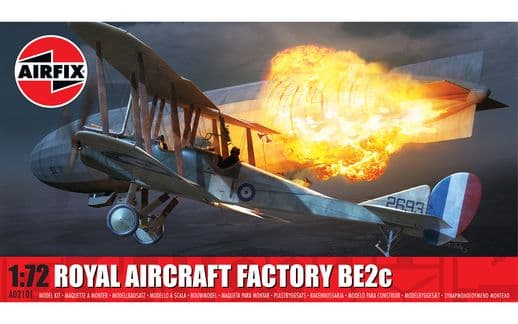
Designed to be an incredibly stable aeroplane to fly, the RAF BE2c was an excellent reconnaissance platform and training aircraft, but wasn’t great when it came to avoiding the attentions of Luftstreitkräfte pilots.
Following the declaration of war in August 1914, any previous War Office resistance in funding new aeroplane development and production was finally removed, with manufacturers now encouraged to introduce new machines at some speed. Unfortunately, that initial lack of foresight would only result in several experimental aeroplane designs, or existing designs which could be rushed into production, aircraft which would quickly have to go to war. One of the most interesting aircraft designs to emerge from this period was the Royal Aircraft Factory BE2c, an aircraft known for its impressively stable handling characteristics.
When looking at the development of the Royal Aircraft Factory BE2c and the reputation it would subsequently inherit, it’s difficult to see how its designers could have done anything differently with the brief they had been given. Back then, and a major factor in the design of the new aircraft, the ability to effectively undertake aerial reconnaissance and surveillance work was the absolute military ‘be all and end all’, not to mention the fact that aviation technology was still very much in its infancy then.
The requirement to also have to deal with fast, deadly enemy pursuit aircraft simply wasn’t in that original design brief, so is it fair that they were subsequently blamed for designing such an excellent aerial reconnaissance platform, one so stable it almost flew itself straight and level?
Designed to be inherently stable, the heavily produced Royal Aircraft Factory BE2c was one of the main aircraft types described as nothing more than Fokker Fodder.
A brilliant aircraft designer and mathematician, Edward Teshmaker Busk had recently joined the Royal Aircraft Factory staff, convinced that he could make a significant contribution to future aircraft designs for the RFC. Early aeroplanes were particularly twitchy and relatively unstable machines to fly, however, Busk was determined to do something about this. Reconnaissance and the ability to take clear aerial photographs of enemy positions, was the most important attribute required of the aeroplane at that time, so stability in the air was the ultimate key to success.
Busk was an extremely talented designer and he immediately embarked on a major re-design of the existing BE2 aircraft’s airframe, with a view to making the new aircraft much more stable in flight and therefore, more pilot and surveillance friendly. He cleverly re-imagined many aspects of the aircraft’s design, after considering how each component would interact with others around it, with the result of this painstaking work being that the BE2c would prove to be an incredibly stable aeroplane.
The weight distribution was such that in most parameters of flight, the aircraft tended to right itself back to level flight, without any major control inputs from the pilot. In essence, this impressive aircraft would almost fly itself, leaving the crew to concentrate on gathering their all-important reconnaissance imagery.
It really is only fair to acknowledge that from an overall project perspective, what Busk achieved with the flight characteristics of the BE2c was hugely impressive, an aircraft which excelled in the role for which it was intended, along with many others. He created a reconnaissance aircraft which was extremely stable and would allow crews to achieve their mission objectives much more successfully than any aircraft currently in service, and was forgiving enough to also serve as an effective pilot trainer.
Produced in large numbers, the BE2c was used in several roles during its service life, including trainer, bomber, reconnaissance platform and nightfighter.
With all this being the case, it’s not surprising to learn that the service introduction of the aircraft was initially rather successful, with it even taking on some light bombing and scouting duties due to this success, however, things were about to take a turn for the worse for BE2c crews over the Western Front, as a fearsome new adversary had them squarely in their sights.
The equally important need for German forces to deny Allied airmen the ability to gather intelligence information brought about the introduction of a devastating new aircraft type, arguably one of the most significant aircraft in the history of aviation, one specifically designed to hunt other aeroplanes.
Unfortunately for BE2c crews, the introduction of the Fokker Eindecker would prove particularly devastating for them and their aircraft, and whilst it had initially been regarded as a huge success, it was soon castigated as being nothing more than ‘Fokker fodder’, an aircraft completely incapable of defending itself in contested airspace.
So began the enduring struggle for aerial supremacy and the most effective fighting aeroplanes, one which began over the trenches of the Western Front during the summer of 1915.
One of the most fearsome aspects of the Great air War was the Zeppelin bombing campaign against Britain – the first Blitz. These mighty airships launched raids against the British Isles from bases on the Northwest coast of Germany, and often in some numbers. Significantly, at the time of those first raids, Britain had very little defence against these incursions, certainly few which could hope to have any chance of successfully bringing the raiders down. Up to that point, the British public had only read about the horrors of war in their daily newspapers, but now, the war had come to their doorsteps and they themselves were under direct attack. The population was petrified.
What made the Zeppelin raids even more sinister for those on the receiving end was the fact that these leviathans of the air came out of the dark night skies, and if the ship’s commander turned his machine’s engines off, they were almost silent, that was until the bombs started to explode. As far as the British public were concerned these enemy raiders could hardly have been more terrifying.
Although initial damage from these raids was only relatively light, casualty numbers soon began to increase, and the population started referring to the Zeppelin raiders as ‘Baby Killers’, after reports of young victims were carried in the national press. The population demanded the government act to protect them against this silent night terror.
The War Office was quick to act, fearing unrest at home may start to affect the morale of the men fighting in Europe, and even though these measures weren’t particularly effective in battling the night raiders, they were effective in providing the reassurance the civilian population needed.
Searchlight batteries and anti-aircraft guns were positioned at strategic locations around the country, and aircraft were recalled from the Western Front specifically to form a new night-fighter defence force, one tasked with meeting the challenge posed by the marauding Zeppelin raiders. It wouldn’t be until early September 1916 that a home defence aircraft managed to shoot down the first Zeppelin, however, this was celebrated widely across Britain, in celebration of the hope that our aeroplanes might finally bring an end to these feared silent killers in the dark.
On the night of 2nd/3rd September 1916, Lieutenant W.L Robinson took off from his home airfield of Suttons Farm, near Hornchurch in a converted BE2c nightfighter, slowly climbing to intercept a reported incoming Zeppelin raid. Little did he know that over the course of the next few hours, his life would change irrevocably, and he would become the most famous man across the Commonwealth, an aviation hero!
On that fateful night, no fewer than sixteen German airships had left their respective bases for a large scale attack against the British mainland, and although some would subsequently turn back with technical issues, this would be the first time that Army and Navy Zeppelin units had combined for a maximum effort attack. To say that the airships had specific strategic targets would be a little fanciful, because this type of raid was subject to many factors, all of which dictated that they were of a rather indiscriminate nature, something which only increased the fear factor on the population below.
It also has to be stressed that to the British public, all German airships were Zeppelins, even though this was just one of a number of airship manufacturers at the time, but as Count Ferdinand von Zeppelin was the pioneer of this type of aircraft, it seemed to be a rather appropriate name for these weapons in common parlance.
As this was going to be a night patrol, Lt. Robinson had put his flying suit and over-jacket on top of his pyjamas, and added a liberal smearing of whale oil over his face, in an attempt to afford him as much protection against the cold night air as possible. His Lewis machine gun was loaded with the new Brock and Pomeroy incendiary ammunition, which was filled with nitro-glycerine, designed specifically to ignite the gas which kept airships in the air. With all preparations for the night sortie made, the BE2c took off from Suttons Farm and headed for its allotted patrol area.
At 1:15am on Sunday 3rd September 1916, flying through intermittent cloud cover, Lt. Robinson spotted the German Airship Luftschiffbau Zeppelin LZ38, which had just released its payload of bombs over the Dungeness area. Lightened by releasing its bombs, the airship started to climb steadily and as Robinson closed in for an attack, it entered heavy cloud and disappeared from view.
Frustrated, Robinson scoured the area for some time, but to no avail, the airship had escaped him.
Frustrated but undaunted, he was determined to find a raider to attack and even though he had already exceeded his intended patrol time, Robinson turned his aircraft in the direction of London, in the hope of finding action. Attracted by search light beams and the flash of explosions, Robinson headed in the direction of the capital, hoping that the city’s searchlight batteries would illuminate another potential airship target for him. Sure enough, his hunch paid off and he spotted airship SL.11 caught in the searchlights, a Schutte-Lanz produced wooden framed machine. Despite the heavy ground barrage being hurled towards the night raider, Robinson flew straight towards it, determined not to let this second airship opportunity escape him.
As SL.11 was caught firmly in the gaze of London’s defensive searchlight beams, it was forced to attempt violent manoeuvres in an attempt to escape, once again attempting to find the protection of any available cloud cover. Robinson was fearful that he was about be thwarted for a second time, but as the anti-aircraft guns fell silent, he continued to search for his lumbering prey.
Full scheme details for this incredibly historic, VC winning aircraft.
Viewed from the ground, thousands of people had been disturbed by the commotion and had come outside to stare skyward at the drama taking place high above them – they all appeared oblivious to the threat of being killed or injured by bombs, debris or shrapnel, presumably all feeling that this show was just too good to miss!
Lt. Robinson’s persistence paid off, and as the airship emerged from the clouds once more, the anti-aircraft guns burst in to action again. To prevent damage to his own aircraft, he fired off a red Very flare to alert the gunners of his intention to attack, causing the guns to fall silent once more. As hundreds of onlookers held their breath, Robinson took his chance.
Arming his Lewis gun, he dived beneath the huge airship and commenced his attack, using a tactic developed following several previous, although ultimately unsuccessful nightfighter attempts to bring down a mighty Zeppelin. The Lewis gun on his BE2c was situated above his head and angled upwards at approximately 45 degrees, which allowed the pilot to attack the airship from below. Using the new incendiary ammunition, Robinson flew below the airship, right along the length of its belly, discharging a full magazine into this aerial leviathan, but to no avail, the airship continued on its course.
Robinson quickly loaded a second ammunition drum onto his gun and positioned his aircraft for a second attack run. Once again flying right underneath the airship along its entire length, he fired another full drum of ammunition, but once again without having any noticeable result. The report Robinson later filed stated that he didn’t think the crew of the airship even knew he was there during his attacks, as they made absolutely no attempt to defend themselves during the entire engagement.
Robinson had just one ammunition drum remaining, but immediately attached it and prepared for one final attack run. This time, he decided to try a different tactic, emptying the entire magazine into the same small area on the airship.
Both scheme options available with this fabulous little kit.
He dived beneath the raider once more and pulled the trigger – every bullet entered the massive bulk of the airship in a much more concentrated area, and he looked back for any signs that he had been successful. Initially, the airship still appeared to have survived his attack, but then he noticed a pale glow, deep inside the belly of the beast.
Within seconds, that glow turned into a bright red fireball, one which grew larger with every passing second – he had done it, he had his victory! In what must have made for a spectacular, if slightly macabre sight in the dark night sky, the burning airship initially continued to fly on in a slow, almost majestic manner, as if totally oblivious to its impending doom.
Then, burning strips of fabric began to fall from the structure, as the fireball grew in both size and intensity, illuminating the fabric-covered wings of the BE2c, so they almost appeared to be translucent. It must have been a truly spectacular sight, but one which masked the unfolding terror for the crew onboard, tragically none of whom would survive the ordeal.
Slowly, the entire structure became engulfed in flame, and it slowly began to sink towards the ground.
Worth another look. This incredible incident has been digitally immortalised as box artwork for this fabulous Great War aircraft kit release.
For those viewing this incident from the ground, it would have made for a spectacular sight. The huge fireball in the sky would have illuminated everything for miles around, and would have been visible to many thousands of onlookers over a wide area. When considering that the German airship raiders had instilled such terror and panic amongst the population for months, it’s probably understandable that the destruction of SL 11 was met with loud cheers of approval, like the crowd at a gladiatorial contest.
A spontaneous cacophony of cheering and clapping broke out, with many shouting “God save the King”, as the flames finally subsided. This was soon joined by the sound of train whistles blowing, factory hooters sounding and riverboat sirens all making their own contributions to this audible sign of approval. A terrified civilian population had their long awaited vengeance over one of the feared Zeppelin night raiders.
The increased duration of this eventful patrol had left Robinson’s BE2c dangerously low on fuel and engine oil, indeed, as he brought the aircraft in for a landing back at Suttons Farm at 02:45 that morning, he only had half a pint of fuel remaining. Frozen with cold and completely exhausted, Lt. Robinson brought his aircraft to a halt, with the only thing now on his mind being to catch up on some well-earned sleep. Unfortunately for him, the extraordinary drama of the nights events was already having an impact, and he would be required to play a fulsome part in the proceedings about to unfold.
Airfield personnel excitedly surrounded his aircraft and there was more shouting, cheering and unbridled joy, as thanks to Robinson, the flight had just scored its first victory against the dreaded Zeppelin raiders. Robinson was pulled from the cockpit and carried shoulder high in triumph by his comrades. By the time they eventually reached the flight office, the squadron telephone was already ringing, with the senior area commander offering Robinson his hearty congratulations.
Another look at the two scheme options available with this Great War RFC aircraft kit.
Unfortunately for the exhausted Lt. Robinson, his commander also demanded a full written report of the incident by morning, knowing that he would be required to supply said report to his own superiors later that same morning. Robinson duly complied with the request, before finally sinking beneath the covers of his bed, and the sanctuary of sleep and silence. Clearly, he was not contemplating the fact that he was already established as a national hero, and how his life would never be quite the same again.
Two days later, the national press carried the news that Lieutenant William Leefe Robinson, the Zeppelin killer, had been awarded the Victoria Cross for his most conspicuous bravery in bringing down the hated enemy craft. On hearing this news, the nation continued with its celebrations!
Lt. Robinson was the first RFC pilot to bring down a German Airship over Britain and the first recipient of the Victoria Cross for actions on British home soil. For many within the civilian population, this would prove to be the most memorable event of the entire war, and Robinson would enjoy something of celebrity status from a grateful nation.
In terms of stories to inspire a modelling project, have we ever featured a more compelling one than this?
The Royal Naval Air Station at East Fortune has a truly fascinating history, not just because it is the current site of Scotland’s fantastic National Museum of Flight, but because it was also an important location for military operations from the very early days of powered flight. With its position on the North Sea coast and covering the Firth of Forth, the airfield was uniquely positioned for mounting naval cooperation flying, with the first fixed wing aircraft arriving on site in October 1915.
These aircraft embarked on a period of intense training, but were soon called upon to join the fight against German Zeppelin raiders, as they had started to target the area. Aircraft were called upon to quickly develop effective interception tactics to bring down these mighty raiders and deter their operations, but were soon also required to take on another new role, that of anti-submarine flying. The number of naval and merchant vessels operating in the area attracted the attentions of German raiders both in the air, and on/under the sea, and this busy station was also tasked with dealing with them.
Although fixed wing aircraft were ideal for taking on the Zeppelin menace, they were much less suitable for mounting long standing patrols on the lookout for enemy U-boat activity, one which was much better suited to an airship force. With that being the case, the airfield station at East Fortune was unusual in supporting both fixed wing operations against enemy airships, and the operation of their own airship force in a coastal defence role.
The aircraft based at East Fortune airfield played an important role in the home defence of the nation during the First World War.
In addition to fighting on the home front, the airfield at East Fortune operated fixed wing aircraft in a training capacity for virtually the entire war, and is regarded as one of the most important bases of its kind anywhere on the UK mainland in the training of student pilots during the Great War.
The Royal Aircraft Factory BE2c which inspired this second scheme option is fitted with ten Le Prieur rockets, which were attached to the outer wing struts of the aircraft and were intended for use against the Zeppelin raider menace. Unfortunately, these unguided, rather basic weapons proved to be ineffective against these silent night raiders, with their use being much more of a visual threat than actually claiming victims.
Having said that, they do help to illustrate how Britain began to use aeroplanes as an effective home defence weapon around that time, and how both airmen and their aeroplanes were quick to adapt to any operational tasking required of them, and to embrace new weapons and technology.
By this time in the war, it was clear that the age of the fighting aeroplane was here to stay.
No collection of built models could ever be considered complete without at least a couple of eagles from the Great War.
Although both of these kits are very different subjects to something like a Spitfire, or Eurofighter Typhoon, there’s no doubting that they occupy a significant place in aviation history and probably have even more fascinating stories to tell. Bearing in mind that both of these aircraft were introduced just over a decade after the Wright Brother’s made their first flight at Kill Devil Hills, they represent the very birth of aerial warfare, aircraft which have influenced all those that followed in their wake.
Both of these kits represent models which were linked in combat, duels amongst the clouds which marked the emergence of the aeroplane as an essential weapon of war, one which has been improved and perfected over the subsequent 111 years, and continues to this day. If for no other reason than this, both models command a place in any model collection, and both kits are currently available.
We're afraid that's all we have for you in this latest edition of the Airfix blog, but we will be back next Friday with more project development updates and the very latest Airfix kit exclusives. In the meantime, we're always keen to hear your views on all things Airfix and in particular, any thoughts and opinions you may have regarding our Workbench blog. If you would like to drop us a quick line, could we please ask that you use our workbench@airfix.com email for all correspondence.
To re-visit any of the Airfix blogs we have produced over the past TEN years or so, please head to our main Workbench hub, where you'll find our entire blog back catalogue and all the Airfix design projects we have already covered.
All our dedicated official social media sites can be accessed by clicking the respective link icons at the foot of this page, or by heading to the Airfix homepage. Other useful Airfix links are:
Facebook, YouTube, Twitter and Instagram official sites
Please join us for more Airfix updates next week and thank you for your continued support.