
Welcome to the latest edition of our weekly Workbench blog, and all the news, updates, and modelling exclusives from the fascinating world of Airfix.
If we have just enjoyed more than two consecutive days of scorching weather here in the UK, we must already be in the latest Airshow season, and can therefore start to get a little excited about seeing skies filled with aeroplanes. Unfortunately, last weekend’s sad cancellation of this year’s Royal International Air Tattoo before the season could really get up a head of steam wasn’t the news we all wanted to hear, however, other shows are already doing their level best to ensure we still have an Airshow year to remember.
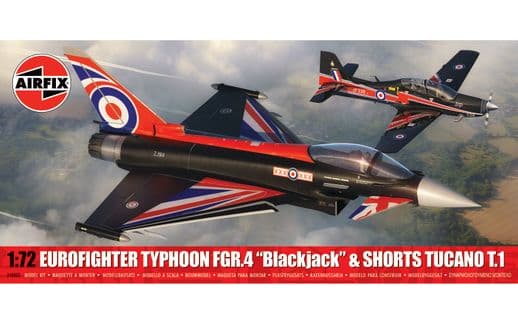
As far as Airfix modelling enthusiasts are concerned, there’s never a time when we leave our people without plenty of options when it comes to selecting their next build project, something which is underlined by the subject of our latest blog update, the second in a series of twin pack releases which already look like being amongst the most popular kits of the year. When it comes to famous Royal Air Force Typhoon Display Team aircraft kit options, we definitely have you covered, and then some, and we’re delighted to confirm that the second in our trio of twin kit pack releases has just arrived in stock. In other words, ‘Blackjack’ has now joined up with Moggy for some Airfix Typhoon Display Team modelling action.
Arguably, ‘Blackjack’ was the most popular individual Royal Air Force aircraft of the post WWII era, one of our most capable front-line airspace defenders presented in a spectacularly unique and patriotic livery. Oh, and did we mention that she was the star of the UK Airshow scene for more than two full seasons.
In this latest edition of Workbench, we will be looking at Blackjack, the kit she’s been paired with, and the reasons why her patriotic livery is certain to make this spectacular kit one of the most popular releases of the year.
We will be paying blog homage to two much missed RAF display aircraft in this latest edition of Workbench, Blackjack the Typhoon and something of an unsung pilot training hero, the Shorts Tucano.
Of all the specially presented RAF Typhoon Display Team aircraft, could Blackjack claim to be the most popular of them all?
An aircraft which has provided the Royal Air Force with one of the world’s most capable multi-role aircraft for over 20 years now, the Eurofighter Typhoon may well have been developed to police the sovereign integrity of the United Kingdom’s airspace, but it has also created a high-profile secondary role as a much-loved Airshow performer, one which has seen a number of aircraft decorated in flamboyant style, aircraft which even went on to create their own individual personas.
As the current defender of Britain’s airspace, and one of the most capable multi-role combat aircraft in world service today, the Eurofighter Typhoon FGR.4 has become a regular sight in European skies over the past twenty years or so, with more than 800 aircraft now in service with nine nations, and Turkey about to become the tenth in the very near future. This magnificent aircraft now forms the backbone of the Royal Air Force, and as the aircraft assigned the task of keeping our sovereign airspace safe, and the aircraft deployed overseas whenever an aviation show of strength is required, the Typhoon is probably the aircraft which is now most recognisable to the vast majority of the nation’s current population.
An aircraft which has now been in operational RAF service for 20 years, the Eurofighter Typhoon was born from an international design collaboration which aimed to produce an agile air defence fighter (European Combat Fighter Project) for service with several European air forces. Such a collaboration held the prospect of keeping costs to more manageable levels for all those involved, as they were being shared across the partner nations, although each would ultimately have their own requirements, something which would put a strain on both costs and working relationships.
At the time this new aircraft entered the development phase, Britain’s sovereign airspace was being protected by such aircraft as the McDonnell Douglas F-4 Phantom and BAe Tornado F.3, the air defence variant of the RAF’s highly capable Tornado strike jet and whilst both were classic aircraft in their own right, neither could really describe themselves as being agile performers. With the USAF able to boast such manoeuvrable aircraft as the General Dynamics F-16 Falcon and world leading McDonnell Douglas F-15 Eagle, the new Eurofighter consortium was looking to develop their own agile fighter, one which was much better suited to the modern and constantly changing air combat arena.
The multinational consortium consisted of the aviation industries of Britain, Germany, Italy and Spain and as the project progressed, it was clear that the new Eurofighter was going to be an extremely advanced aeroplane indeed. Designed to be aerodynamically unstable at all speeds, the aircraft was controlled by a powerful suite of computers, which combined to endow the fighter with exceptional agility.
A popular addition to the Airfix kit range, this beautiful RAF Typhoon FGR.4 is a recent addition to our Starter Set range of kits.
Making extensive use of composite materials, the aircraft was to be powered by a pair of Eurojet EJ200 engines which propelled the fighter to a maximum speed of Mach 2.35 and the ability to supercruise without the use of afterburner. These engines were just as advanced as the aircraft itself and were designed in 15 fully interchangeable modules, with everything monitored in real-time to ensure the early indication of any potential problems with the unit. This was all designed to keep the aircraft serviceable and ready for action.
Equipped with an impressive array of targeting and defensive technologies, the Typhoon can also carry a seemingly endless selection of ever more capable weapons, as it has developed from its original air superiority fighter designation, into an exceptional multi-role platform, one which is truly at the forefront of military aviation technology. Now at the midpoint of its service life, the Typhoon is expected to remain in service until 2040 and beyond.
The Typhoon era began in earnest on 27th March 1994, when the first prototype aircraft made its maiden flight from the EADS facility at Manching in Bavaria, to be followed six days later by the first flight of Britain’s first development Typhoon (ZH588) from the Bae facility at Warton in Lancashire. The name ‘Typhoon’ was officially adopted for the new fighter in September 1998, the same year that the first production contracts were signed, committing nations to purchasing an aircraft they had already been working on for five years at that point.
The first operational RAF Typhoon Squadron was No.3 Squadron, which was established at Coningsby on 31st March 2006 and by the summer of 2007, the unit were sharing national QRA (Quick Reaction Alert) responsibilities with the RAF’s existing Tornado F.3 force, initially on a rolling month on - month off basis, but working up to taking this important duty over entirely.
Have you ever wanted to see what a Eurofighter Typhoon looks like wearing a 1944 era D-Day air support aircraft scheme?
Today’s in service Eurofighter Typhoon is a mature multi-role combat aeroplane, with much of its ongoing development taking place during its first 20 years of service and in the full gaze of the aviation world. With Germany having indicated that their Typhoons will remain in service until at least 2060, we possible have 2/3rds of the aircraft’s service life still to come, and when you consider that the iconic Supermarine Spitfire that everyone knows and loves only spent 16 years in Royal Air Force service, with the Typhoon already surpassing this figure, it remains to be seen if the nation will hold our current airspace dominator in the same affection in years to come?
Although the main role of the RAF’s premier air superiority interceptor is a deadly serious one, it’s always incredibly important for the force to forge strong and positive relationships with the general public, particularly those living close to operational air bases, in view of the important fact that the public purse funds the force. That being the case, although the age of the Eurofighter Typhoon was already upon the Royal Air Force, the aircraft had yet to be introduced to the public.
That first introduction took place at the largest, most prestigious Airshow event in the country during the summer of 2003, the Royal International Air Tattoo at Fairford. Two Typhoons were sent to take part in the show, one on the flying program and one for the static display, however, these were development aircraft and the crowds were going to have to wait to experience the full force of a full fat Typhoon display.
For most Airshow goers here in the UK, that would happen during the summer of 2005, and several show appearances by this spectacular new aircraft at events across the country. Thousands of spectators thrilled at the agility of a T1 Typhoon blasting across Shropshire skies at the annual Cosford Airshow, and just a week later, two Typhoons attended the Kemble Air Day, an event which saw the RAF’s new Typhoon operating from a non-military/development airfield for the very first time.
Combat ready, the vast majority of RAF Typhoons are presented in this sinister, but photographically uninspiring scheme.
The aircraft’s performance at that year’s RIAT show was memorable for all the wrong reasons, as a practice display on the Friday almost ended in disaster, when a Typhoon appeared to lose power when coming out of a loop and only avoided striking the runway by around 30 feet. Recovery from this incident did draw our attention to the incredible power generated by the aircraft’s two Eurojet EJ200 engines, powerplants which have now also gone on to forge the Typhoon’s reputation as the consummate Airshow performer.
By way of highlighting the important roles Royal Air Force Typhoons are tasked with fulfilling, the vast majority of the aircraft allocated to Airshow display duties during those early years were all presented in the standard air superiority grey scheme, which whilst perfect for protecting the skies, were somewhat uninspiring from a display spectacle perspective. Clearly, presenting their new interceptor in striking display schemes wasn’t even on the agenda of Royal Air Force officials at the time, however, a development which took place at RAF Coningsby during May 2015 captured the attention of the nation and proved to be something of a second coming for the RAF Typhoon.
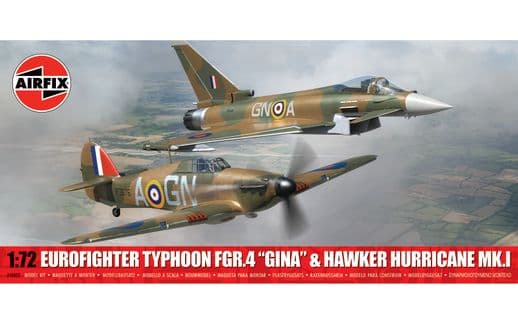
In a high profile tribute to mark the 75th anniversary of the Battle of Britain, Eurofighter Typhoon FGR.4 ZK349 emerged from the paint shop at Coningsby wearing a stunning camouflage scheme based on the VC winning RAF No.249 Squadron Hawker Hurricane fighter flown by James Nicholson on 16th August 1940, including that aircraft’s GN-A fuselage codes. The aircraft looked magnificent and immediately became the most popular aircraft in RAF service at that time – from this point forward, standard grey Typhoons just didn’t cut it in the eyes of the aviation enthusiast – they wanted more!
We’re pleased to announce the arrival of the second release in our trio of RAF Display Typhoon twin pack kits.
As far as the UK aviation enthusiast was concerned, the already exciting RAF Typhoon secured itself credible Airshow gravitas following the unveiling of ZK349 GINA in 2015, instantly becoming one of the most popular individual aircraft of the post WWII era, and reigniting interest in an aircraft which until that point, it could be argued had yet to form a lasting bond with the enthusiast. GINA performed at that year’s largest events, often in conjunction with one of the Battle of Britain Memorial Flight’s Spitfires, as they thrilled crowds with their unique commemoration of the 75th anniversary of the Battle of Britain.
As we all now know, over a period of ten years, three RAF Typhoon aircraft would wear spectacular commemorative/special schemes to thrill Airshow audiences all over the country, and as part of the current Airfix kit range, we were determined to create our own unique series of kit tributes to each respective aircraft. We created three different kits, each one as a dual kit offering, and each one featuring not only the distinctively liveried RAF Typhoon FGR4, but also the aircraft which inspired the stunning schemes for which they are so fondly remembered.
We’re pleased to report that as we stand on the cusp of the main 2026 Airshow season proper, the second of these appealing kits has just been released, and it’s definitely worth us taking a closer look at it now.
The exciting RAF Typhoon decoration tradition which started with ZK349 ‘GINA’ in 2015, saw the display Typhoon baton being handed over to ZJ914 in 2021, an aircraft which was unashamedly patriotic in presentation, and one which would go on to serve for two full display seasons, and even provide work-up support for a third. Because of her good looks and service longevity, in the eyes of many enthusiasts, ‘Blackjack’ was the best of the best when it came to presentation appeal and is still sorely missed by millions of people across the country.
As one of the world’s most capable multi-role combat aircraft, the Eurofighter Typhoon FGR4 is not only the current pride of the Royal Air Force, but also happens to be the consummate Airshow performer and as such, serves as an effective recruitment tool to encourage youngsters to consider a career in the force. As if a Typhoon display wasn’t appealing enough as an Airshow attraction, RAF officials further enhanced that appeal by sanctioning the ‘special presentation’ of their display jet for the 2021 Airshow season, a scheme which immediately ensured that Typhoon ZJ914 would go on to become the highest profile individual aircraft in Royal Air Force service at that time.
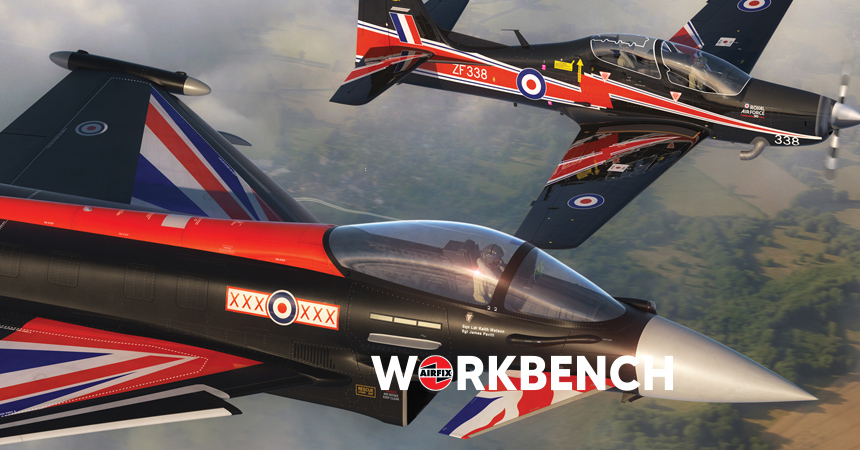
The scheme was a real head-turner, taking its design inspiration from the Union Flag and the Royal Air Force roundel, applied over a smart all-over black ‘aggressor scheme’ and it didn’t take long before the aircraft worked its way into the hearts of the enthusiast and aviation photographer communities the length and breadth of the country. Colloquially referred to as ‘Blackjack’, the RAF’s display Typhoon was always a headline performer at any event it attended, and for the 2022 Airshow season, the aircraft was flown by Flt Lt Adam O’Hare, operating under the thrilling callsign of ‘Anarchy 1’.
Flight Lieutenant O’Hare took the stunning good looks of his unique Typhoon, and combined this with a dynamic display routine full of exciting high energy manoeuvres and high speed passes, making full use of the aircraft's responsive afterburners to leave spectators in awe of the spectacle before them, and desperate for more. Ensuring the RAF Typhoon was always the highlight of any display in which it appeared, Flt Lt ‘Paddy’ O’Hare used every ounce of power his Typhoon’s EJ200 engines could generate to demonstrate the incredible agility of the aircraft, ensuring that everyone went home with an appealing selection of photographs, along with a renewed appreciation of the Typhoon's impressive performance after every show.
The RAF Display Typhoon jet ZJ914 wore this popular scheme spanning three full display seasons, and even throughout the early months of work up for the approaching display season for the coming 2024 Airshow season. Although the RAF elected to mark the 80th Anniversary year of the D-Day landings in 2024 by presenting their display Typhoon in a new commemorative scheme, many enthusiasts still regard ‘Blackjack’ as the best looking of all the specially presented RAF Typhoon Display Team jets.
In the eyes of modellers and aviation enthusiasts everywhere, ‘Blackjack’ was a very special jet, one which is still sorely missed.
With the RAF’s Typhoon being one of the most exciting and dynamic aircraft most people could ever hope to see being displayed at an Airshow or commemorative event within the UK, despite the fact that other branches of the RAF presented their own aircraft in attractive presentation schemes for display purposes, they have historically often find themselves having to play second fiddle in the popularity stakes.
Taking these sentiments just a little further, with some RAF aircraft, even those which enjoyed long and successful service careers, enthusiasts only started to realise how much they were attached to them, and how much they missed them when they were retired and gone. One aircraft which falls squarely into this category, the Shorts Tucano was an absolute stalwart of the RAF’s pilot training program for thirty years from the late 1980s, training thousands of military pilots during that time, but not , it has to be said, without some controversy.
In a move which certainly raised a few eyebrows at the time, the RAF elected to upgrade its ageing Jet Provost fleet, trainers with their side by side student/instructor seating arrangement, with a turboprop powered alternative, one which reverted back to a tandem seating arrangement. At the time, this was viewed by many as something of a backward step, one brought about by cost saving measures, as opposed to a genuine capability upgrade in the RAF’s pilot training program.
As it would ultimately transpire, whilst cost efficiency was undoubtedly a consideration in this development, the Tucano T.1 would prove to be an excellent pilot training platform, and whilst it may not have been introduced in anything like the same numbers as its jet powered predecessor, did prove to be an exceptionally capable successor, enabling Britain’s military pilot training services to keep pace with the changing requirements of the modern Royal Air Force and Royal Navy.
The RAF’s Tucano T.1 was a two seat, tandem turboprop powered basic flight training aircraft, an aircraft which was designed by the Brazilian manufacturer Embraer, but one licence built for the RAF by Short Brothers of Northern Ireland. The design proved successful in a competition between several different aircraft types to become the RAF’s replacement for the Jet Provost, providing future fast jet basic training for student pilots destined to progress on to the Hawk T.1.
Possessing jet like handling, excellent endurance and cost effective operation, the profile of the Tucano is dominated by its large canopy, once which very much resembles the Hawk T.1 trainer successful student pilots would progress on to flying next, as they negotiated the flightpath to becoming a future fast jet pilot in either the Royal Air Force, or Royal Navy. Accepted for trials with the Central Flying School in June 1988, the Tucano officially entered RAF service the following year and 130 of these hard working aircraft would eventually be produced by Shorts.
Throughout its impressive 30 year service career, the important work of the agile Tucano was widely celebrated by the various RAF flying training units and individual squadrons which operated the aircraft, meaning that this attractive little trainer was a regular performer at Airshow and open house events for three decades. Indeed, during that time, a great many Tucanos would go on to wear special display aircraft schemes, not just the different RAF Training Command scheme of the day, but everything from striking silver, to pseudo RAF Fighter Command camouflage from the Battle of Britain.
In celebration of the 90th Anniversary of the establishment of the Royal Air Force in 2008, two No.1 Flying Training School Tucano aircraft benefitted from a visit to the paint shop, and striking new livery presentation for their role as display aircraft during the forthcoming Airshow season. Aircraft ZE338 and ZF210 were given a smart all-over black paint scheme, with red, white and blue lightning flashes down their fuselage sides and on top of both wings, finished off with a large RAF roundel centrally positioned on the underside of the Tucano.
Throughout this significant season for Royal Air Force Display Teams, both Tucanos would be dispatched to events across the country, either to serve as a display aircraft (with the other in reserve in case of unserviceability), or as attractive additions to the static aircraft display. When looking at this appealing scheme, it’s clear to see that there are a great many similarities with the one worn by Blackjack many years later, which is why we elected to pair these two aircraft together in this special twin pack release.
A stunning kit addition to the current Airfix range, we’re delighted to confirm that this second Typhoon twin pack release is now in our warehouse and available, making the prospect of seeing Blackjack, Moggy and their respective scheme inspirations gracing our model display cabinets just a few happy hours modelling away.
When the Airfix team started working to create the next kit range scheduled for announcement at the beginning of the following year, there are some kit offerings which we feel will definitely be finding favour with the modelling community, and seem destined to be amongst the most popular releases of the year to come. That was most definitely the case with our new Eurofighter Typhoon FGR.4 Twin Pack releases, attractive kits with interesting stories to tell, not to mention the fact that the schemes commemorated some of the best loved and most attractively presented aircraft in the history of the modern Royal Air Force.
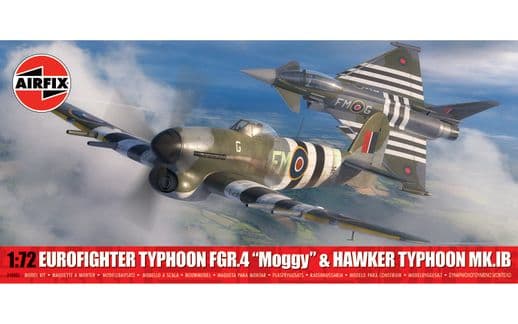
Although we’ve featured Blackjack and the Tucano in this update feature, Moggy and the Hawker Typhoon have already been released, which just leaves GINA and the Nicolson VC Hurricane still to be released, the aircraft which marked the start of this fascinating contemporary RAF display aircraft story.
On a rainy April morning at RAF Coningsby in 2024, the gaze of the aviation enthusiast world was firmly fixed on one of the hardened aircraft shelters at RAF Coningsby, known to many of us as ‘Fighter Town UK’. The Royal Air Force Typhoon Display Team prepared to unveil a new scheme on one of their Typhoon jets, one which was intended to mark this year’s 80th Anniversary of the historic D-Day landings.
As the doors slowly opened in suitably dramatic fashion, they parted to reveal Typhoon FGR4 ZJ913 resplendent in her stunning new livery, one which took inspiration from an RAF No.257 Squadron Hawker Typhoon flown by Squadron Leader Denzil Jenkins in support of the D-Day landings during the summer of 1944. Flying many missions in the weeks leading up to D-Day, Jenkins also led a raid against enemy radar sites across the northern French coast immediately prior to invasion, effectively blinding the Germans and keeping the approaching Allied armada secret for a few vital minutes longer.
The new scheme looked spectacular, as the RAF knew this aircraft was taking over from the relatively long serving, and much loved ‘Blackjack’, which interestingly was the next sequential serial number in RAF Typhoon allocation – ZJ914 after ZJ913.
Even at this early stage, the aircraft had already attracted a nickname for this uniquely presented Typhoon, as she was introduced as ‘Moggy’ by those who will be operating her throughout the 2024 Airshow season, where she was flown by this year’s display pilot Flight Lieutenant David ‘Turbo’ Turnbull. ‘Turbo’ thrilled crowds at events both here in the UK and overseas, as he displayed the incredible power and agility of the RAF Eurofighter Typhoon to millions of people, demanding that every camera in their vicinity was locked onto the RAF’s dynamic duo of ‘Turbo and Moggy’.
Wearing this striking scheme which was similar to the one Allied aircraft engaged in D-Day air operations eighty years earlier wore, Turbo and Moggy worked tirelessly during the 2024 Airshow season, performing at commemorative events in both the UK and France, in addition to completing a successful Canadian tour. They ably demonstrated the legendary agility of the Eurofighter Typhoon, and effectively highlighted the professionalism and capabilities of the modern Royal Air Force in some style.
Unfortunately, after just one glorious summer, Moggy’s RAF Typhoon Display Team reign was over, and we knew she wouldn’t be serving in this high profile role for as long as her predecessor ‘Blackjack’ did. As an airframe expired aircraft, Moggy was flown to RAF Lossiemouth, where whilst retaining her iconic D-Day scheme, she was destined to embark on a new career as a ground instructional airframe, helping to train the next generation of engineers and technicians charged with keeping the RAF’s aircraft fleet in good order.
The final Display Typhoon double kit set takes us back to the beginning of this story, and the unexpected, but hugely popular unveiling of Eurofighter Typhoon ZK349 wearing her pseudo Battle of Britain Hawker Hurricane linked markings. ‘GINA’ was unveiled at a media event at RAF Coningsby during the late spring of 2015, where the RAF made this unique tribute to that year’s 75th anniversary of the Battle of Britain.
The scheme was based on the Hawker Hurricane Mk.I fighter flown by Flt Lt James Brindley Nicholson during actions over Southampton on 16th August 1940, actions which saw him awarded the Victoria Cross, Fighter Command’s only VC award of the Second World War.
All three of these special schemes prove that the Eurofighter Typhoon looks great when allowed to wear the markings of earlier RAF types, and even though not particularly suitable for use in operational circumstances, transform a relatively anonymous example of the RAF’s current aviation inventory into a high profile and much loved focal point for Royal Air Force public relations.
Let’s hope this is a trend we might see continued in the years to come.
This trio of linked RAF Typhoon special scheme double kit packs are unquestionably amongst the highlight releases of the current Airfix range, and are scheduled for staggered releases throughout the coming Airshow season.
With two of the three kits now released and in stock, this might well be the time to secure your examples, as this enigmatic trio surely make for the build project of 2026 – better put your display cabinets on Typhoon Warning!
We're afraid that's all we have for you in this latest edition of the Airfix blog, but we will be back next Friday with more project development updates and the very latest Airfix kit exclusives. In the meantime, we're always keen to hear your views on all things Airfix and in particular, any thoughts and opinions you may have regarding our Workbench blog. If you would like to drop us a quick line, could we please ask that you use our workbench@airfix.com email for all correspondence.
To re-visit any of the Airfix blogs we have produced over the past TEN years or so, please head to our main Workbench hub, where you'll find our entire blog back catalogue and all the Airfix design projects we have already covered.
All our dedicated official social media sites can be accessed by clicking the respective link icons at the foot of this page, or by heading to the Airfix homepage. Other useful Airfix links are:
Facebook, YouTube, Twitter and Instagram official sites
Please join us for more Airfix updates next week and thank you for your continued support.