We’re pleased to be bringing you this latest edition of our regular Workbench blog, with all the news, updates, and modelling exclusives from the fascinating world of Airfix.
When it comes to discussing the subject of the most popular editions of our Workbench blog, those which feature the work of our talented designers always attract the most significant readership numbers, as the modelling world is always keen to discover details from behind the most eagerly anticipated new model release projects we have on the go here at Airfix. For this latest edition, we’re excited to share the news that we have something really special for our readers, an exclusive new tooling update from a model which has been high on the want’s list of many a modeller for quite some time, a larger scale version of one of the most popular 1/72nd scale kits we have released in recent years.
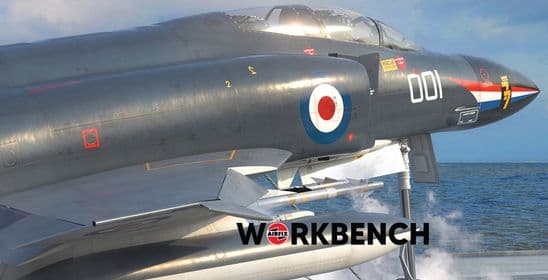
Coming directly from the CAD files of one of our ultra-talented product designers, our subject for this week’s edition of Workbench is our second scale recreation of a Cold War aviation icon in less than a decade, a British interpretation of an American classic and unquestionably one of the most significant jet powered aircraft of the post WWII era, the McDonnell Douglas F4 Phantom II. With an impressive selection of CAD imagery to share with you, we’ll be seeing what a designer faces when recreating such a famous subject in scale construction kit form, and whether the fact that the subject was covered in a smaller scale just a few years earlier was a help or a hindrance to them.
Strap yourselves in for a wild design ride, as we prepare for the arrival of our new 1/48th scale McDonnell Douglas FG.1 kit in this latest edition of Workbench.
Is there a more spectacular sight in aviation?
Since our first Spitfire model kit was released in 1955, Airfix have earned a proud reputation in replicating the world’s most famous aircraft in scale construction kit form, immortalising aircraft types from more than a century of flight as high quality model kits. With an impressive list of heritage tooling within the Airfix inventory, some aircraft types have joined the range and proved so popular that they have benefitted from re-design some years later, whilst others have proved a little more elusive from a range inclusion perspective.
Whilst the classic American McDonnell Douglas F-4 Phantom II has been part of the Airfix story since 1965, it has proved to be something of a surprise that the Anglicized variant of this all-weather jet strike fighter escaped the attentions of the Airfix design team until 2017, despite the fact that these magnificent aircraft enjoy something of an iconic status amongst modellers and aviation enthusiasts. In fact, the first time one of our designers tackled this subject for the Airfix range was in 2016 (for release the following year), with this model finding favour with huge sections of the modelling community. A project which was first announced at Scale ModelWorld 2016, even though the model was roundly welcomed, we did receive some comments regarding the scale of the project, with some modellers wishing the kit had been produced in the slightly larger 1/48th scale.
Even at that stage though, we already knew we would be revisiting the subject at some point in the near future, and to say that the announcement of our larger British Phantom project at range launch last January was well received would be something of an understatement, as this is by far and away the most heavily pre-ordered new kit in the entire range. That being the case, we’re delighted to announce that we had the opportunity to speak to the kit’s designer over the past few days, and he’s supplied us with details of his work on what is surely destined to become a future Airfix classic.
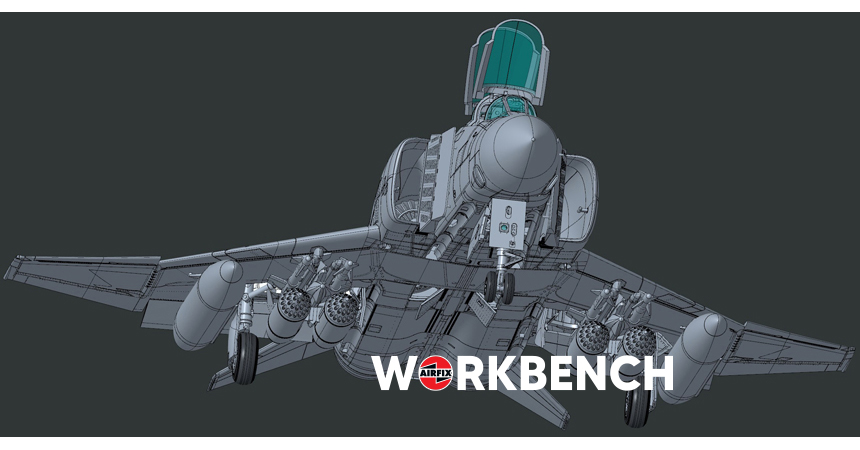
All the images used throughout this feature have been supplied by our designer Paramjit, and are all CAD screenshots from his Phantom design files.
As one of the most successful jet aircraft ever designed, the mighty McDonnell Douglas Phantom earned an enviable reputation within the world of aviation, and even though the first aircraft entered service with the US Navy back in 1960, Phantoms were still in front-line service with the air forces of Greece, Turkey and Japan almost sixty years later. Performing a variety of operational roles during its impressive service career, the Phantom also saw plenty of combat operations over that time, from the savage fighting in the skies over Vietnam, to the Iran-Iraq War of the 1980s, but always proving to be an extremely rugged and highly capable aircraft. Without doubt, as far as the history of jet powered aviation is concerned, the Phantom has to be considered something of a classic aircraft.
As one of the foremost jet aircraft in the history of flight, the Phantom was clearly coveted by many of the world’s air arms, with Britain’s Navy and Air Force being no exceptions, even though it has to be said that the UK’s adoption of the aircraft was not without its controversy. Procured at a time of continued national austerity, project cancellations and political turmoil, the Phantom was not the first choice of either the Royal Navy, or the Royal Air Force, who were both looking for towards the development of indigenous designs, to meet their requirements.
The cancellation of several projects, and a government preference for a cheaper ‘off the shelf’ solution, made America’s Phantom an extremely attractive option, however, British’s later adoption of the aircraft would result in the production of a distinctly different aeroplane from those in US Navy service.
Phantoms destined for UK service would primarily be procured as a fleet defence fighter for the Royal Navy, replacing the distinctive, but outdated De Havilland Sea Vixen in this role, but with the ability to undertake secondary strike operations. It was decided that Britain’s Phantoms would be powered by the Rolls Royce Spey engine for a number of reasons, not least of which was because they would provide a valuable power increase to aircraft which would be operating from the relatively diminutive decks of Britain’s aircraft carrier fleet.
A Cold War icon, Britain were the first overseas customer for the American Phantom.
Even though this sounds like a perfectly logical undertaking, the installation of these engines required significant modification to the fuselage of the British Phantoms, including enlarging the engine bays, re-designing the rear fuselage, and equipping the aircraft with larger air intakes at the front of the aircraft, all modifications which gave British Phantoms a very different appearance.
When taking everything into consideration, the additional drag created by these modifications meant that the extra thrust provided by the Rolls Royce Spey engines had little beneficial impact on the overall performance of the aircraft, even if they did create something of an aviation classic.
The initial British order was for an impressive 140 Phantoms destined for the Royal Navy, aircraft which were intended to be operated from four aircraft carriers, two extensively refitted existing vessels, with a further two to be manufactured specifically for the task. Unfortunately, continuing Government austerity measures would eventually dictate that this mighty force would never actually be realized, and with the cancellation of the contract for the two new carriers and a further decision only to upgrade one existing carrier, the Navy’s Phantom order was subsequently slashed to just 48 aircraft.
The Royal Navy received their first F-4K Phantoms (British designation FG.1) in April 1968 and immediately began flying trials with their new aircraft, in preparation for embarkation aboard HMS Ark Royal, the first vessel to be re-fitted to accept these powerful aeroplanes. That first operational embarkation occurred in 1970, when twelve Phantoms of No.892 NAS landed on Ark Royal as part of her air group, beginning a short, but glorious period of British Phantom operation at sea.
With images such as this, is it any wonder that British variants of the Phantom continue to hold such fascination for aviation enthusiasts and modellers alike.
When it comes to iconic images of significant British aircraft, surely nothing comes close to those incredible pictures of a Royal Navy Phantom in the seconds prior to blasting off the deck of HMS Ark Royal. With the aircraft hooked up to the ships steam catapult and with full flap selected, deck handlers would extend the nose wheel oleo to its maximum 40 inch position to increase the launch angle of attack, further increasing the impact of the aircraft’s engine thrust, but making the Phantom look like some huge metal praying mantis.
With full afterburner selected and with the power from the two Rolls Royce Spey engines almost melting the deck of HMS Ark Royal, the Phantom was released to blast into the air, a truly exhilarating experience for those involved in the process, and a spectacle which served as a source of fascination for aircraft enthusiasts the world over.
That was the launch successfully achieved, not the crews just had the significant task of recovering this hugely powerful aeroplane to the deck of a relatively small British aircraft carrier whilst at sea – no wonder we hold naval aviators in extremely high regard.
Although initially intended as an aircraft to be operated by the Royal Navy, the Phantom would also be later wear the markings of the Royal Air Force, but not without some controversy. With the RAF’s preferred indigenously designed strike/multi-role aircraft options falling foul of continued project cancellations, and with a deal to buy the American F-111 also falling through, the Phantom already destined for service with the Royal Navy was seen as an excellent, cost-effective option for them, a view which wasn’t shared by Air Force officials. They felt as if the Phantom was being forced on them, and they would be asked to operate a second rate aircraft in extremely demanding roles, however, it wouldn’t take long for the RAF to appreciate the many qualities possessed by their new Phantoms.
From these images, it’s already clear to see that Paramjit has managed to incorporate plenty of detail into his new Phantom design.
RAF Phantoms, which were designated FGR.2, first entered service with Royal Air Force Strike Command in 1969, but would also go on to serve as air defence and reconnaissance platforms, providing the RAF with a significant capability upgrade, as the aircraft were fast, extremely capable, heavily armed and able to stay in the air for longer flight times than the Lightning. Indeed, with the decommissioning of HMS Ark Royal in the late 1970s, the RAF would also inherit the Royal Navy’s Phantoms, using these aircraft to provide air defence support for Britain’s airspace.
An American aviation classic which was given a distinctly British identity, these magnificent aircraft would prove as capable as they were aesthetically appealing, admired and appreciated by those who served on them, and viewed with great affection by aviation enthusiasts everywhere. Despite their American origins, the Phantom is still viewed as one of the most significant British aircraft types of the 20th century, one which would serve with distinction for more than two decades.
Creating a legacy which endures amongst enthusiasts and modellers to this day, it will come as no surprise to learn that the British Phantom’s inclusion in the Airfix range has met with incredible levels of support. That being the case, we’re delighted to confirm that our own construction kit tributes to this magnificent aircraft are about to be strengthened further, with the impending release of a newly tooled 1/48th scale version of the aircraft, arguably the model kit the hobby has been waiting for, but from a design perspective, how would you go about tackling such a high-profile project such as this, one you know so many people will be looking forward to getting their hands on?
Thankfully, we’re about to find out a little more about it.
About to blast onto model store display shelves everywhere, may we introduce the new 1:48 scale Airfix Phantom FG.1.
In over a decade of writing the Workbench blog, it has been an absolute privilege to be in the position to bring the incredible talents of our Airfix designers to our blog audience, work which is enjoyed by millions of modellers the world over, but work which might have remained relatively unheralded had it not been for this on-line means of direct communication. During that time, we’ve also been fortunate enough to interview Paramjit Sembhi on many occasions, and indeed have been lucky enough to follow his design progress from his first 1:72nd scale Tiger I project, right through to his current position of Senior Airfix Product Designer.
His career has seen him designing some of the most impressive kits ever to have worn the Airfix logo, including the new 1:48th scale Phantom FG.1 kit, which is surely destined to attain ‘classic’ status following its release later this year. Obviously, we’re delighted to have Paramjit in the Workbench spotlight once again, particularly as we’re discussing such an iconic subject as the Phantom, and as we managed to catch him just before he finished to enjoy some well-earned time off.
During my time interviewing the Airfix design team, I have found myself falling foul of using correct designer terminology a couple of times, or more accurately, my understanding of it, and as a consequence, have run the risk of getting on the wrong side of them. The term which saw me in a bit of hot water was ‘upscaling’, where a previous design project in 1:72nd scale was followed sometime later by the same subject being re-visited in a larger scale.
As someone outside this specialist design field, I simply wasn’t aware of the work involved in upscaling an existing project, and needed to be educated by someone ‘in the know’. Thankfully, the Airfix team are a forgiving bunch, and they didn’t hold it against me, however, I definitely maintain that my lack of understanding of the term would have been shared by a great many of our readers and the ability to explain the situation correctly would not only benefit me, but also large sections of our readership.
All that being the case, and with this new 1:48th scale Phantom project following on from the original 1:72nd scale British Phantom in 2017, I didn’t want to push my luck too far, but thought that the question of ‘upscaling’ would be an appropriate place to start this time around.
As it turned out, Paramjit confirmed straight away that it had absolutely no bearing on this new project whatsoever, so I needn’t have worried in any case. He informed me that even though a project such as this would usually see the designer using elements of the existing scan and skeleton design data at the start of the new project, both he and his research support think this to be an appropriate course of action in this case.
They both knew that the British Phantom was such an important project for the Airfix range and would require so much additional detail to be incorporated, that they were both of the opinion that a completely blank design slate would be the most appropriate way in which to proceed.
Thank goodness we didn’t have any awkward ‘upscaling’ discussions to contend with.
Phantom infatuation. Paramjit was able to visit the former RAF Wattisham to inspect the beautifully preserved RAF Phantom which resides there.
This next selection of images show screenshots from the early stages of the project, scan data images and the gradual overlay of Paramjit’s design files.
For those reasons, the new 1:48 scale Phantom project is completely new in every respect, one which didn’t utilise any of the existing information from the earlier kit project and one which is 100 percent Paramjit. In addition to being handed a robust research file at the outset of the project, he was also presented with new scan data files by our Lead Researcher, and the pair were also given the opportunity to visit a restored example of a former RAF Phantom at the Wattisham Station Heritage Museum, where Paramjit was able to closely inspect every detail of their impressive aircraft and to take hundreds of photographs which would prove vital during the design challenge to come.
This opportunity really did prove invaluable, and Paramjit wanted us to include his grateful thanks to the Museum’s Christopher Russell, who was so accommodating during their visit, and without whose help, this new Phantom model wouldn’t be what it is.
With that potentially tricky subject safely negotiated, we wanted to move on to the design stage proper, and to discover how Paramjit managed to replicate all those complex shapes which are such a distinctive feature of British Phantoms.
He began by telling us that this really was a sizeable challenge for him and how he knew right from the beginning that this was going to be difficult, and how it didn’t disappoint in that respect.
He told me that from a design perspective, working on a modern(ish) jet subject is usually much more challenging than most WWII era aircraft, simply because the shapes are so much more difficult to replicate, and how there are no software shortcuts to help with this challenge. This work is purely and simply an exercise on bringing all a designers prior experience to bear, and even then, you know you’re going to come across plenty of new challenges along the way.
The shape of the Phantom is a real devil to replicate in design, but as it’s such a popular subject with so many people, there can be no shortcuts when working on such a project, it’s just many hours at the computer making his digital Phantom look exactly like the real thing.
More images which illustrate Paramjit’s early Phantom design challenges.
To illustrate this, Paramjit supplied us with a selection of design screenshots which showed the raw scan data and the gradual overlay of his design files, as he worked his way through all those shapes and surface features of the Phantom. On the image which best illustrates what he was talking about, the blue lines on the image represent the natural panel lines on the aircraft, but how the others show how he had to plot additional lines to help guide him through the shape replication process.
Particularly challenging shape features proved to be the relatively diminutive upper wing lumps which were designed to accommodate the main landing gear, and the fuselage recesses for the four Sparrow missiles carried by the Phantom – these proved to be really difficult to replicate in design.
The many photographs taken during his visit to Wattisham, along with the reference drawings in the main file were leant on heavily by Paramjit during this phase, and were absolutely invaluable to him. It was the same when replicating cockpit detail, which you can imaging for an aircraft of this size and capability, was ‘busy’ to say the least.
Again, drawing our attention to the supplied images, Paramjit informed me that the purple areas on the image represent the original scan data files, with everything else being shape detail already replicated in design.
Moving on from this, but something which will be of great interest to Workbench readers, we wanted to ask Paramjit directly about which aspects of the Phantom’s design he found to be the most challenging, and if he would be good enough to provide us with a few images to illustrate the points raised?
His initial response was to refer us back to the previous point and to how in his opinion, the accurate shape replication of his scale Phantom was the most challenging and time consuming aspect of this project, but how there was also loads of other stuff which kept him busy.
He told me that when designing a great many products, including some model kits, much of the detail is symmetrical, so that if you accurately design one half of the project and flip the files over, this can get you close to where you need to be, save for some checking and a few little tweaks. That was certainly not the case with the Phantom, as much of the surface detailing is very much asymmetrical and there were no shortcuts for him. This proved to be a long, if extremely rewarding design path for him to negotiate.
How does he do that? There’s more to making our favourite model kits than meets the eye, you know, but thankfully, we have the right people for this demanding job.
In addition to this, Paramjit directed me to the main lower fuselage part design, which he made impressively large to ensure that not only was all that detail replicated correctly, but also how this part would provide strength and assembly reassurance for the modeller during construction. As can be seen in the image provided, this is a large component and was one which took Paramjit ages to design, not only because of the detail it includes, but also how it interacts with all the parts and shapes around it – who would be an Airfix product designer?
Despite having invested many hundreds of hours in this project, Paramjit is genuinely excited to see how the Phantom is received by modellers, because he’s really happy with how everything has turned out.
Although this is clearly demanding and time-consuming work, we wanted to find out a little more about which aspect of the Phantom’s design Paramjit enjoyed most and again, if he would be kind enough to supply us with some CAD screenshots to show us what he was talking about.
He said that from a designer’s perspective, there really is nothing like taking on a challenge that’s going to push you professionally, as this is the only way you can apply all your existing skills and learn a few new ones, so that being the case, he’s always up for any difficult project. He was only too aware that a Phantom in this larger scale would be welcomed by the modelling community, so he was determined to deliver when it came to replicating that iconic shape accurately, and including as much of that delicious detail as possible into his design files.
Although the overall shape replication of the new Phantom kit is unquestionably the achievement of which he is most proud, some individual design features also proved particularly rewarding to work on, such as the replication of the Matra SNEB rocket pods which were carried by many British strike aircraft during the Cold War era. These weapons were a significant feature of aircraft during this period, but in Paramjit’s view, have rarely been replicated accurately in a scale modelling sense, almost as if manufacturers have viewed such external stores options as something of a design afterthought.
The main lower fuselage part is a particularly impressive piece of design, as Paramjit intended this to be the foundation of the entire build – just look at all that detail!
Phantom armament Airfix style.
Paramjit was determined to do something about that, and found himself spending many an enjoyable hour replicating this armament in design form, even disappearing down something of a SNEB pod research rabbit hole at one point, which he actually found quite rewarding. He discovered that the Royal Navy had some issues operating these weapons onboard Ark Royal, as they were prone to malfunction due to electrical interference. It appears that the powerful radio wave emissions from the ship’s radar equipment could result in unintentional firing of the rockets, something which clearly wasn’t ideal for those stationed on the carrier.
Our final question was from the perspective of the modeller. We asked Paramjit if he would be good enough to tell us which aspects of the new Phantom kit, we’re all going to be impressed with when we eventually get to build the new model.
He told me that he hopes there will be a lot to get excited about with the Phantom, and how once we looked beyond the impressive size and accuracy of the kit, hopefully the good things will just keep on coming. He said, ‘The Phantom is a truly magnificent aeroplane, however, I wanted the process of ending up with a stunning display piece to be just as enjoyable as admiring the finished build’. He went on to excitedly tell us about a little design feature he incorporated that will hopefully be of help during the assembly process, one which will ultimately be hidden during the final stages of the build.
To help with the all-important main fuselage assembly process, he designed the spine of each fuselage section half with two cut-out sections, which when brought together, create two convenient flat surfaces to allow bulldog clips to be used to securely hold the two halves together until fully bonded. Although he didn’t say this himself, Workbench readers will be fully aware that Paramjit is an avid modeller himself, and innovations such as these have appeared many times on his previous design projects.
Design innovation from a modeller for fellow modellers. Paramjit included this feature into his Phantom design to help during fuselage assembly of the new kit.
When he has come across kits which feature difficult or confusing build elements in the past, he has an ability to recall these situations when engaged in his latest design project, because he promised himself that if he was ever lucky enough to be in a position to do so, he would attempt to make the assembly process of any kit he designed as intuitive and enjoyable as possible.
Once the two fuselage halves have bonded securely and the bulldog clips have been removed, Paramjit designed a separate dorsal part which fits on the spine of the Phantom, covering the cutouts entirely, but retaining the panel integrity of the real aircraft – all very clever stuff.
Other aspects of the Phantom’s design he thinks people will hopefully be impressed with include the level of engine detail he’s managed to replicate, something which he’s really pleased with. The impressively long extended nose oleos which were such a feature of the Royal Navy’s Phantoms is another feature Paramjit thinks people will love, and hopefully, the extremely challenging engine intake and splitter plate design will impress many a modeller, not only because it took ages for him to get right, but because he’s also extremely proud of what he managed to achieve.
In summary, Paramjit is really happy with how the new Phantom kit has turned out, not only with the amount of detail he’s managed to include, but also the way all the parts come together during the assembly process, meaning that building the kit should be as enjoyable as admiring the finished model itself.
Having already built several test kits himself, he thinks it looks stunning, and if our infatuation with Britain’s famous Phantoms could ever be in danger of waning, how he hopes this kit will play its part in dragging us straight back into Phantom heaven.
Detail, glorious detail. Paramjit has managed to incorporate all the British Phantom’s personality into his design, and we think this new kit is really going to be something special.
As with every one of his design projects, Paramjit knows that the only opinions that matters are those of the modellers who will be building the kit, and as such, he really hopes that his Phantom is going to be viewed as a valuable addition to the Airfix range once it’s been released, and how people will view it as a fine scale representation of this famous and much-loved aeroplane.
We would like to thank Paramjit for helping us to put this Phantom introduction edition of Workbench together, and for supplying us with this fascinating selection of supporting CAD screenshot images. As you would expect, we will be bringing you further details from this project once we have pictures of built sample models and full scheme details, but until then, we hope this will serve as an interesting introduction to one of the most eagerly anticipated new Airfix kits for many a year.
Just by way of a footnote, Paramjit informed us that from his day spent information gathering at the former RAF Wattisham, to finally signing off the Phantom tooling took just under twelve months, which really does underline just how intense these projects can be for our designers. They put so much effort into their work, that it really is important that we are given the blog opportunity to acknowledge their efforts in this way, and how we should spare them a thought when enjoying building one of their design creations.
Thanks again for your help Paramjit – you really are a design star!
We're afraid that's all we have for you in this latest edition of the Airfix blog, but we will be back in two weeks' time with more project development updates and the very latest Airfix kit exclusives. In the meantime, we're always keen to hear your views on all things Airfix and in particular, any thoughts and opinions you may have regarding our Workbench blog. If you would like to drop us a quick line, could we please ask that you use our workbench@airfix.com email for all correspondence.
To re-visit any of the Airfix blogs we have produced over the past TEN years or so, please head to our main Workbench hub, where you'll find our entire blog back catalogue and all the Airfix design projects we have already covered.
All our dedicated official social media sites can be accessed by clicking the respective link icons at the foot of this page, or by heading to the Airfix homepage. Other useful Airfix links are:
Facebook, YouTube, Twitter and Instagram official sites
Please join us for more Airfix updates next week and thank you for your continued support.