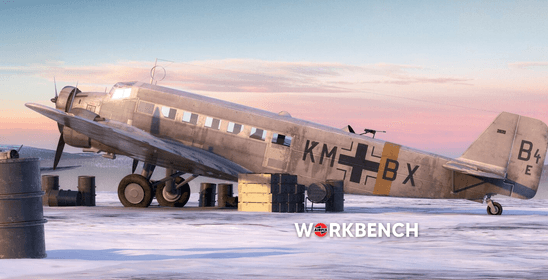


Welcome to the latest edition of our weekly Workbench blog, and all the news, updates, and modelling exclusives from the fascinating world of Airfix.
UK based enthusiasts know only too well how the centenary of their air force’s establishment is a time for national celebration, as they will no doubt have the pictures, books and memorabilia all gathered during a year of RAF 100 commemorations from back in 2018. With that being the case, we will be slightly envious of the Swedish people this year, as they’re already in their centenary year of the Flygvapnet, and have a massive Airshow event to come in August, to be held at Malmen Air Base at Linköping, unquestionably the most exciting place to be in this significant centenary year.
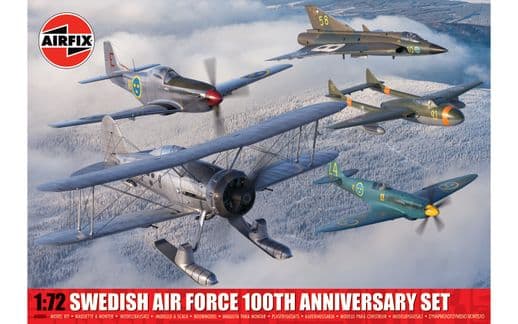
In this latest edition of Workbench, we will be paying our own blog tribute to this year’s Swedish Air Force Centenary celebrations, but from an Airfix perspective, and doing so in 1/72nd scale. Scheduled for release later this summer, our Swedish Air Force 100th Anniversary Set charts the development of the Flygvapnet from the inter-war purchase of British Gloster Gladiator fighters, to the introduction of the spectacular Draken fighter, an indigenously produced sensation of a supersonic aircraft.
A set which is in addition to the current Swedish Air Force related Club kit being enjoyed by active members of the Airfix Club, we’ll be making a sizeable scale Swedish Air Force Centenary entry in our modelling logbooks in this latest edition of Workbench.
Classic Flygvapnet Airfix box artwork, featuring one of the 12 Gloster Gladiator fighters of the Swedish Volunteer Unit Flygflottlij 19, sent to fight against Soviet forces during the Winter War of 1939.
As one of our near European neighbours and a country which has currently been making the aviation headlines by offering their dynamic Saab JAS 39 Grippen multirole fighter to several nations around the world as a viable Lockheed Martin F-35 Lightning II alternative, Sweden may have had something of a slow start when it came to their aviation and Air Force capabilities, but it certainly made up for that during the Cold War era. Now regarded as a major world player in terms of aviation capability, the jet era was a time that witnessed a dramatic emergence of the Saab company as aircraft producers, and the introduction of aircraft which are regarded by many as some of the most exciting aeroplanes to have ever taken to the skies.
Military aviation in Sweden can trace its origins back to 1912, when their Army and Navy independently started experimenting with aeroplanes in mainly reconnaissance and artillery spotting roles, but embracing the incredible potential these craft held. The Swedish Air Force (Svenska Flygvapnet) was established as an independent force on 1st July 1926, the beginning of a significant period of expansion in its capabilities, but mainly by equipping themselves with existing aircraft types procured from their European neighbours, such as Britain, France, Germany and Italy.
The inter war years would see this capability strengthening continuing apace, but would also see the emergence of aviation companies in Sweden itself, using foreign guidance and support to help establish modern facilities, giving them the ability to design and produce their own aircraft types. As Europe erupted into conflict, Sweden was forced to defend its neutrality using an unusual collection of aircraft types secured from many of the waring nations, and by the outbreak of hostilities, could boast a force totalling some 180 aircraft of all types and capabilities. Clearly, this situation left them vulnerable in a capability sense, and if they were unable to make good losses by securing new aircraft from other nations, or couldn’t guarantee a supply of spare parts, defence of their airspace might be compromised.
The only airworthy example of the Saab B-17, pictured during a rare visit to Duxford.
In order to take control of their own destiny, great resource was directed towards the creation of an indigenous Swedish aviation industry, one which resulted in the introduction of their first front-line military aircraft design in 1942. With significant support from the Douglas Aircraft Company of America, SAAB (Svenska Aeroplan AktieBolaget) produced their extremely Douglas-like SAAB 17, the B-17 in its dive main bomber configuration, and the S-17 when configured for reconnaissance and spotting duties.
A large, radial engine powered aircraft, the B-17 may have looked a little ungainly, but actually proved to be an agile and incredibly capable performer, one which held the promise of much more to come from this new aviation manufacturer. The search was now on to introduce Sweden’s first indigenous fighter aircraft, with the FFVS J22 entering service towards the end of 1943, a diminutive fighter which had more than a passing resemblance to a Focke Wulf Fw190.
As the Swedish aircraft manufacturing industry started to find their feet, they soon developed something of a flair for producing unusual and innovative aircraft designs, with the SAAB 21 highlighting this in some style. The J 21 was a twin boom fighter/fast attack aircraft which featured a pusher piston engine and a twin boom design, however, even though this was one of the most interesting looking fighter aircraft to grace European skies, the type wouldn’t enter service until December 1945.
The end of the Second World War brought new challenges for Sweden in protecting its sovereign airspace, as aviation was propelled into the jet age and relations between the West and the Soviet Union cooled considerably. This resulted in them once again having to rely on jet aircraft purchased from Britain, with de Havilland Vampires and Venoms both seeing service with the Svenska Flygvapnet in some numbers, prior to their home-based industries catching up with the technology.
The Swedish Air Force entered the jet age by securing types produced by other nations, such as this British de Havilland Vampire T.II, or SK 28C-3 in Svenska Flygvapnet parlance.
The first indigenously designed jet powered fighter was the Saab Tunnan, a distinctive looking aircraft which was powered by the British de Havilland Ghost engine and with this rotund little fighter being referred to as the ‘Flying Barrel. This was followed by the cultured and highly capable Saab 32 Lansen, an aircraft which served in large numbers as a fighter, ground attack and reconnaissance aircraft, with some specially modified aircraft remaining in service for an impressive 44 years – not bad for an early Cold War jet.
We mentioned earlier that Sweden’s aviation industry gained a reputation for designing and producing unusual, innovative and highly capable aircraft, a tradition which was continued in some style with their next fighter-interceptor, the magnificent Saab 35 Draken. A futuristic design, the ‘Dragon’ was truly groundbreaking at the time of its introduction, and equipped the Swedish Air Force with an interceptor that was the equal of any aircraft of its type anywhere in the world, and more capable than most. This proved to be just the aircraft they needed to protect their airspace against hostile Eastern Bloc airspace incursions.
In actual fact, the above statement is slightly misleading, because Sweden’s neutrality put them in the unique position of being between both the Western allies and the Eastern Bloc nations, slap bang in the middle of two clashing ideologies during the most volatile period in world history. It’s a good job they were able to call upon the services of some of the most capable aircraft ever to see service.
The Saab Tunnan was an unusual looking early jet fighter, but one which started a tradition for aviation excellence with the design and production of jet aircraft in Sweden.
The next indigenous jet type to enter service was a true classic, unquestionably one of the best looking aircraft of the 20th century, and one which could boast performance to match its irresistible aesthetic appeal, the mighty Saab Viggen. The name Viggen translates to ‘Thunderbolt’, or ‘Lightning Bolt’, and if ever a name suited the performance of a jet aircraft, then this was it. A multi-mission capable aircraft, the Viggen was designed to operate from extremely short runways, resulting in the production of the most powerful single engined fighter jet in the world, at the time of its introduction.
The Viggen was required to operate from dispersed, forested locations, using the nation’s roads as its runways, something the Viggen could do with consummate ease, ensuring that Sweden had no problems when it came to hiding their forces from potential enemies during times of conflict. These well concealed locations were fully autonomous bases, with everything these aircraft needed to operate effectively in times of war.
The Viggen was an extremely rugged aircraft, not only capable of operating from dispersed locations with little in the way of facilities, but could also be easily maintained by its pilot, should that be required. The aircraft was truly multi-capable, with variants taking on fighter interceptor, ground attack, marine attack, reconnaissance and training duties during its long service career, and always doing it in style – the Viggen really was something special in jet aviation terms.
The final operational Viggen flight in Flygvapnet service took place on 25th November 2005, as this mighty Thunderbolt finally gave way to a lighter, more modern and much more economical replacement.
Such an imposing aeroplane, the Viggen was a triumph for the Swedish aviation industry and it’s a travesty that it didn’t capture hundreds of export orders.
The current Swedish Air Force may not be one of the largest air forces in the world, but is a highly capable and extremely adaptable force when it comes to operational effectiveness. The most important aircraft in its current inventory is the Saab JAS 39 Gripen, a diminutive, cost effective multi-role aircraft which once again underlines Sweden’s impressive capabilities in the field of aviation design and manufacture. Described as the best non-stealth jet fighter currently in service, Gripen forms the backbone of the current Swedish Air Force, and is unquestionably the most important aircraft in their inventory.
Whilst they are hard at work developing its replacement, currently a sixth generation concept fighter, it remains to be seen if Sweden will continue to go it alone in an aviation sense, or whether the eyewatering costs associated with such projects might force them to look towards the west again for their main interceptor aircraft in future. Going off their track record with Gripen, they might just produce an aircraft which captures export success, thus making their new stealth jet a commercially viable project – never bet against the determination and capabilities of the Swedish people.
One of the most admired operations in the historic aviation world, the Swedish Air Force Historic Flight operate airworthy examples of the classic jet aircraft designed and built by Saab during the 20th century, and as they include both a Draken and a Viggen amongst their thrilling inventory, are headline acts with enthusiasts wherever they perform. With this year marking the Centenary of the Swedish Air Force, a great many British enthusiasts will be hoping to see Saab’s classic jets at Airshows this coming summer, but they will certainly be front and centre at this year’s Centenary Airshow at Malmen Air Base in August. If you’re into classic Swedish jets, this will unquestionably be the Airshow event of the year.
Although some modellers might not have been expecting a new multi-kit Flygvapnet offering to be joining the 2026 range when inspecting all the new and impending kit releases announced in January this year for the first time, many would have undoubtedly been attracted by the eclectic mix of fascinating aircraft types which have worn the three crowns roundel of the force over the period covered. The set also charts the changes in this distinctive identification markings over the years, from the simple, single coloured rendition of the inter-war years, to the one Swedish Air Force aircraft proudly wear to this day.
Although the Flygvapnet remained steadfast during the 1930s in their aim of securing the best contemporary aircraft to equip their air force, they were trying to do so at a time of great international tension. They were trying to establish a viable force which could effectively defend the nation’s neutrality when the rest of Europe was speeding headlong towards conflict, and as all nations were re-arming to defend their own interests, securing good numbers of the latest fighter types proved to be a challenging process.
With America possessing impressive industrial prowess, and a range of aircraft which were available for purchase at that time, it was a logical step for Sweden to procure hundreds of aircraft via this channel during the months leading up to the start of the Second World War, but as war eventually broke out and Germany began her blitzkrieg attacks across Europe, the vast majority of the aircraft ordered by Sweden were either cancelled or confiscated, as the American’s didn’t want the aircraft to fall into German hands, and potentially be used by the Luftwaffe against nations friendly to America.
This situation would shape the Flygvapnet during the wartime years, but also lead directly to the introduction of a new breed of indigenously produced aircraft types, as a neutral nation could only rely on aircraft designed and produced within their borders. Thankfully, they had a particular flair for this kind of work, and if the wartime years were challenging, the Cold War era would be truly supersonic for them. In fact, Sweden showed how an organised small nation could punch well above its weight, even though its neighbours were all nuclear heavyweights, which must be considered extremely impressive.
That being said, let’s now take a look at the aircraft included in this special Swedish Air Force 100th Anniversary set, starting with a British type which was the ultimate biplane fighter, but one which was obsolete almost the moment it entered squadron service.
One of the finest fighting aeroplanes of the inter-war years, the Gloster Gladiator is considered by many to be the pinnacle of biplane fighter design and capability, however, despite its many impressive qualities, the chronicles of aviation technology had already turned a page, and an aircraft which should have been a dominator of the skies, didn’t secure the place in the annals of aviation history it surely deserved.
When the first Gloster Gladiators began to arrive with Royal Air Force Squadrons during the January of 1937, it immediately showed itself to be an exceptional aircraft, possessing many advanced features for the time. Now for the first time, the RAF had a fighter aircraft which featured a fully enclosed cockpit, powerful armament, and had many of the cumbersome struts and wires associated with previous biplane designs replaced by more modern construction techniques. Rugged and reliable, the new Gladiator also proved to be an exemplary aerobatic performer, and as you might expect, RAF pilots loved it.
Essentially, the Gladiator was a perfectly balanced fighting aeroplane, the very pinnacle of biplane fighter design and efficiency. At a time when many preferred to look back, rather than forward, towards the impending conflict to come, the Gladiator represented the last in the line of flamboyant 1930s aeroplane designs, an era when the general public would gaze in awe and wonderment at the skill of the RAF’s dashing fighter pilots and their gleaming silver machines.
Full scheme details showing this fabulous Gladiator in Swedish Air Force service.
Unfortunately, when a Gladiator was in the sights of a Luftwaffe Bf 109 fighter, it wouldn’t prevent the guns from firing just because the Gladiator was a sight to behold, and therefore, dominating the skies was not something the Gloster biplane would be capable of doing.
Designated J8 in Flygvapnet service, the Gloster Gladiator was selected to undertake the air defence of Stockholm area, with the first aircraft arriving with Flottilj F.8 during 1938, part of a total inventory of 55 Gladiators purchased from Britain. Aircraft which were lovingly cared for and vital to the continued neutrality of the nation, twelve of these fighters and four Hawker Hart bombers were also offered to their neighbours Finland, as they attempted to counter Soviet expansion in the Baltic region.
Officially designated as a Swedish Volunteer Unit, Flygflottlij 19 were ordered to fly to Kemi in northern Finland, in order to protect Finnish Lapland against possible Soviet aggression. In a period of hectic operations, the Swedish Gladiators would score several kills against the Soviet Air Force, before a ceasefire was agreed in mid-March 1940, allowing remaining fighters to return home by the end of the month. During their time in Finland, the Gladiators of the Swedish Volunteer Unit flew 464 sorties and claimed ten enemy aircraft destroyed, for the loss of two of their own number.
This particular aircraft was delivered during the middle of October 1937, and after maintenance and service acceptance checks, joined the rest of the F8-3 aircraft at Barkarby early the following year. She was struck off charge in December 1945, thought to have been the Swedish Air Force Gladiators to have the most flying time on her airframe, an impressive 983 hours.
Although Sweden maintained neutrality throughout the duration of the Second World War, the war raging around them ensured that they maintained significant forces to both protect their territory from incursion and prevent possible invasion by hostile forces. Although operating a relatively large air force, many of the fighter aircraft available to them were of inferior quality by 1940s standards, such as the American Seversky P-35 (J-9 Swedish designation) and Italian Reggiane Re.2000 (J-12), with the shortage of fuel further reducing the flying time of the few aircraft they managed to keep serviceable.
Thankfully, new indigenous designs were already in development, however these would take time to enter service, and the Swedish Air Force desperately needed more capable fighters as soon as they could lay their hands on them.
As the intensity of air operations over Europe increased, so did the number of damaged and fuel starved aircraft forced to land on Swedish soil, thus becoming interned for the duration of the conflict. Amongst the aircraft falling into Swedish hands were at least ten examples of the North American Mustang, four of which were subsequently pressed into Swedish Air Force service – two razorback P-51Bs and two of the later P-51D variants, aircraft which were given the Swedish service designation J 26.
Having already made official requests to both Britain and America regarding the purchase of modern fighter types, Sweden later turned their attentions to the Mustang, an aircraft which was widely regarded as one of the most capable aircraft of the war, in addition to possessing an excellent serviceability record. An agreement between US officials and Sweden was signed for the purchase of 70 fighters in February 1945 and deliveries began almost immediately, as the Allies had now almost secured the victory they had fought so hard to achieve.
The US built fighters were delivered by American pilots flying from Liverpool to Bromma airfield, many of which already had flight hours on their airframes and were in storage in Britain. Interestingly, that first batch of 43 Mustangs encounters Luftwaffe Bf 109 fighters over the North Sea, and at least one of the new Swedish Mustangs could boast a Messerschmitt ‘kill’ to its name.
At least one of the Mustangs being delivered to their new owners in Sweden scored a kill when they were bounced by Messerschmitts during the ferry flight.
Once in the hands of their new owners, the aircraft were quickly repainted with new national insignia and squadron markings, before being flown to their respective units around the country. Historically, the advent of the jet age resulted in the Swedish Mustangs quickly being relegated to secondary roles, following the purchase of British de Havilland Vampire fighters, with Sweden becoming a successful early operator of jet aircraft. The Mustangs were later sold to overseas operators, but would go on to provide many years of excellent service with the air forces of Israel, Dominican Republic and Nicaragua. In total, Sweden bought 165 Mustangs, four of which were the airworthy examples confiscated during the war.
As America looked to move on as many of its former WWII piston engined fighters as possible, the final batch supplied to Sweden may well have been secured at an extremely attractive price, but did include some former war service aircraft which were a little more difficult to maintain, however, they would all go on to provide excellent transitional service to a modernising Flygvapnet.
This particular Mustang was delivered to the USAAF 8th Air Force in England, but designated as one of the first batch of aircraft to satisfy an order for the Swedish Air Force. Assigned to the 1409th Army Air Force Base Unit at Station 366 Metfield, Suffolk, she was part of the ‘Project Speedy’ program to supply the Flygvapnet with these capable single engined fighters.
On arrival in Sweden, the aircraft was allocated to F16 Wing at Uppsala, a unit which would historically be the main operator of the Mustang in Sweden. Given the tail code letter ‘E’, the aircraft was known as ‘Elvira’ and sported impressive artwork which featured the cartoon rooster ‘Panchito Pistoles’ on the port side fuselage, under the cockpit.
Following its withdrawal from service and subsequent disposal, the aircraft served with the Air Force of the Dominican Republic, before joining the US Airshow scene as ‘Baby Duck’ in the 1980s. She was destroyed in a tragic fatal accident during the summer of 2017.
Aircraft kit C – Supermarine S 31 Spitfire, s/n 31024, ’11-24’, F 11 Nyköping, Nyköping-Oxelösund Airfield, 1952.
As arguably the most versatile single engined aircraft ever introduced into Royal Air Force service, the Supermarine Spitfire performed many roles during its impressive service career, including that of a snooping photo reconnaissance aircraft. The most capable examples of this variant were the Rolls Royce Griffon powered PR.XIX machines which utilised the now exceptional support network behind the gathering, examining and dissemination of Allied photographic intelligence in Britain.
The operational capabilities of these aircraft was exceptional, and they could definitely be described as 'speedbirds', with their performance being something their pilots came to rely upon, as they were flying unarmed missions deep into enemy occupied territory, with the enemy trying to stop them. RAF Photo Reconnaissance Spitfire crews went by the motto ‘Alone, unarmed and unafraid’, so confident were they in the capabilities of their exceptional aircraft.
Flying at altitudes of around 40,000 ft, PR.XIX Spitfires were almost impervious to ground defences and interception by most piston engined aircraft the Luftwaffe had in operation. Indeed, even the feared Messerschmitt Me 262 would have difficulty bringing down a Spitfire PR.XIX, that is if one could be spared from anti-bomber duties. If a Spitfire was being stalked by an enemy aircraft, the tactic used by most pilots would be to enter a shallow dive, gradually building up speed as they gently descended earthwards. A pilot also had the option of increasing altitude still further and whilst there were reports of Spitfires flying above 40,000 ft, this was actually an exercise fraught with many dangers.
Capable of maintaining a steady 370mph even at extreme altitude, these aircraft also carried the highest internal fuel load of any PR Spitfires, all attributes which made these the most effective clandestine, information gathering variants of this famous aircraft to ever see service. Clearly, when operating at these altitudes, the aircraft were usually only deployed on days when the weather was fine, as cloud cover and stormy conditions would prevent them from obtaining the photographs they were sent to gather.
Although a Spitfire looks good wearing any scheme, it looks particularly appealing in full Flygvapnet markings.
The gathering of aerial reconnaissance imagery was just as important to the Flygvapnet as it was to any other force, even though they initially entrusted this task to a number of modified, but outdated Seversky P-35A (J 9) fighters. The advent of the Cold War resulted in an immediate need for a more capable aircraft, and whilst it was intended that their new Saab J 29 Tunnan jet would perform this role in some style in future years, development delays with this new aircraft required the purchase of a more capable stop-gap aircraft.
To this end, Sweden arranged to purchase 50 surplus Supermarine Spitfire PR XIX aircraft from Britain in 1948, aircraft which were secured for a bargain price and were actually faster and capable of flying higher than any other aircraft in Flygvapnet service at that time. They would be instrumental in allowing the Swedish Air Force to develop effective reconnaissance strategies during this volatile period in world history, something they would later pass on to a new breed of indigenously designed and produced jet powered aircraft.
The Spitfire PR XIX was designated the J 31 in Flygvapnet service and assigned to the specialist F11 Wing at Nyköping south of Stockholm, a unit which comprised of 4 reconnaissance squadrons, and reverberated to the sound of Rolls Royce Griffon engines for several years. The PR XIX was a thoroughbred aeroplane, and it didn’t take long for Swedish Air Force pilots to fall in love with it. Despite their neutrality, Swedish PR pilots provided plenty of detailed reconnaissance information to their friends in the west, even though much of this information was of a highly secretive nature, and only confirmed in recent years.
In a development which was tantamount to aviation vandalism, every one of the former Swedish Airforce Spitfire PR XIX aircraft were destroyed, either summarily scrapped, sent to be used for target practice, or used for fire training support, which is a crying shame considering the important role these capable aircraft performed during a particularly volatile period in Flygvapnet history.
It’s often stated in sporting parlance that nobody ever remembers who came second, something which also has resonance in many other walks of life, including aviation. In the world of aviation and famous aircraft throughout history, the first jet powered fighter to enter service is widely known as being the Messerschmitt Me 262, however, few outside Britain will recall that the second to take to the skies was the Gloster Meteor.
Taking this analogy one step further, even less people will be able to name the de Havilland Vampire as the second jet powered fighter to enter Royal Air Force service, even though this diminutive jet only slipped into second place because the project’s only jet engine in existence at the time was sent to America to help them with their own jet program. Had it not been for that, it’s touch and go as to whether the Vampire would have beaten the Meteor into RAF squadron service.
Despite this significant setback, the Vampire would go on to have several notable firsts to its name. It was Britain’s first single engined jet fighter and was the first RAF fighter to exceed 500mph, with later versions of the aircraft going on to set further records, it was also the first jet aircraft in the world to take-off and land from an aircraft carrier, and in 1948, managed to set a world altitude record of 59,446 feet.
In another significant first, in 1948, the Vampire became the first jet aircraft to fly across the Atlantic, as six Vampires from RAF No.54 Squadron conducted a goodwill tour of Canada and the USA, performing a number of impressive formation aerobatic display routines during their visit.
Clearly an important aircraft to the RAF, as a great many of these aircraft were destined for service, de Havilland went on to develop a two-seat training version of the aircraft, the Vampire T.II. Sharing the same stable flight handling characteristics as the single seat variant, the Vampire T.II was the ideal platform to introduce student pilots to the delights of fast jet flying, and was the first advanced jet trainer to adopt a side-by-side seating arrangement, for the student and instructor. This configuration allowed the student pilot to be more confident during any training flight, in addition to allowing his instructor to have a much clearer view of what the student was doing.
In order to achieve this configuration, the cockpit area of the aircraft had to be widened slightly, giving the fuselage ‘pod’ something of an egg shaped appearance. This increase in frontal area required further modifications to be incorporated into the Vampire’s airframe, but despite these, the T.II was essentially a classic Vampire jet, just one made for two.
The Vampire T.11 surely has to be considered one of the most attractive jet aircraft ever produced.
In many cases, when any manufacturer adapted an existing aircraft design into perform a radically different role, it could end up looking like something of an ungainly hybrid of an aeroplane, one which looks much less appealing than the original design on which it was based. That was certainly not the case with the Vampire T.II trainer, which was extremely easy on the eye, arguably becoming the best known version of the de Havilland Vampire, despite the fact that it was the final variant of this aircraft series.
Operationally, its effectiveness was underlined by the fact that almost 800 Vampire trainers would eventually be built, seeing service with more than twenty of the world’s air forces, and helping thousands of future front line pilots gain their jet powered wings.
Sweden would become a major operator of the de Havilland Vampire, with their modernising force having a requirement for a relatively cheap, reliable and capable jet aircraft to form the mainstay of their updated fighter force. In total, they would operate approximately 400 of these diminutive twin-boom fighters, including 57 of the two seat training variant, aircraft which would carry the Swedish designation J 28C.
Twenty Vampire trainers were initially ordered at the beginning of 1952, which were delivered that same year, but an order for a further ten aircraft would not join their ranks until the following year. As Sweden’s jet flight training program became established, even more Vampires were procured to undertake this work, but were always going to be doing so with the threat of being replaced by the Swedish designed and manufactured Saab SK 60 (Saab 105). This started to happen from April 1966, and as was the case with their PR Spitfires, all but two of the Vampires were scrapped on their withdrawal from service.
In Flygvapnet service, these were extremely handsome little jets, because when it came to the post war Swedish Air Force, they always tended to do things with style.
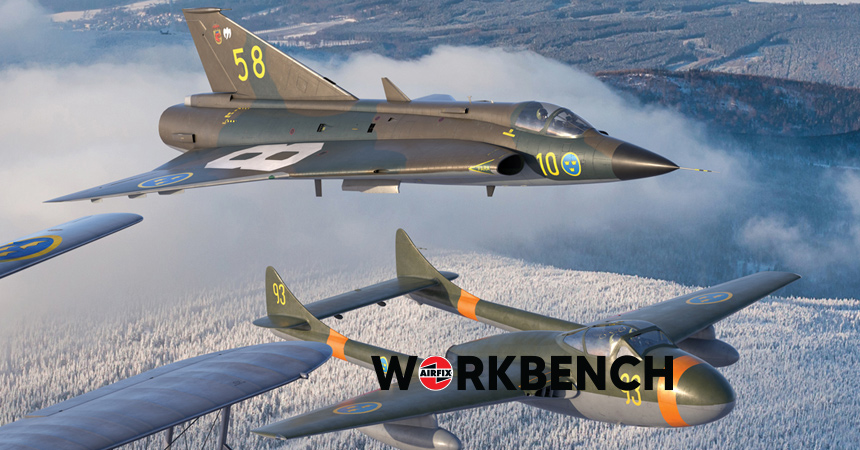
When it comes to the subject of Cold War aircraft that were as exciting as they were capable, the Flygvapnet could boast a couple of beauties. The first of these was the Saab J35 Draken, a futuristic looking interceptor fighter which truly underlined the impressive capabilities of the now maturing Swedish aviation industry, as it equipped their air force with one of the most capable airspace defence fighters of the early Cold War era.
An aircraft which was the result of an incredibly ambitious ‘Project 1200’ to equip the Swedish Air Force with a capable bomber destroyer, the requirements for this project were demanding to say the least, an aircraft which possessed performance never before seen in a European designed aircraft, and one which was intended to be the replacement for both the Saab 29 Tunnan and Saab 32B Lansen, aircraft which themselves were still in development at that time.
The Draken was a point interceptor, possessing blistering performance intended to allow it to be scrambled to face any detected Soviet bomber threat, but to be fast enough to allow it to affect that interception before the bomber entered Swedish airspace. Indeed, despite possessing truly impressive performance, the design team at Saab incorporated something they referred to as ‘Speed Creep’, additional performance over and above that specified, allowing the new fighter to meet and exceed any anticipated threat scenario.
The Draken adopted a clever double delta design which in addition to giving the aircraft its unique shape, also made it impressively manoeuvrable, and even though the aircraft was always positioned as an interceptor, its pilots were always confident in the aircraft’s abilities as a dogfighter. A contemporary of the RAF’s English Electric Lightning, the Draken may have made its first flight after the Lightning prototype, but it would beat the British interceptor into service by several months.
The blistering performance of the aircraft was made all the more spectacular by the fire which shot from the back end of the aircraft’s single Svenska Flygmotor RM6A afterburning engine, which really did make it appear as if this rocket ship came with its own pyrotechnic show, so it’s no wonder the Swedish public loved it. Although the Draken was outperformed by the Lightning in terms of pure speed and acceleration, the Swedish fighter was only equipped with a single engine, and it had another impressive trick up its sleeve.
Part of Sweden’s post WWII doctrine for its air force was the ability to disperse its forces across its vast nation, something which set it apart from many other countries, but did require clever organisation. Their thinking was that if a potential enemy didn’t know where your aircraft were stationed at any one time, they couldn’t destroy them and therefore might be deterred from attacking without a single shot being fired in anger. As far as they were concerned, other nations were short sighted in stationing all their defensive and strike aircraft at known air bases, as they were effectively sitting there waiting to be destroyed.
Sweden’s fire breathing Draken – this was such a spectacular looking aircraft, Cold War jet power at its most appealing.
The Draken was developed to be able to operate from public roads which had been strengthened to take the weight of a fully fuelled and armed interceptor fighter, and were often tree lined to allow aircraft on the ground to remain fully concealed until needed in the air.
Hundreds of these potential dispersed area operating sites were prepared, with the Draken adopting technologies which made it simple for a recruit with only basic training to turn around in just a few minutes. With excellent serviceability, this tried and tested system provided the Draken with even greater operational effectiveness, and whilst this dispersal network was thankfully never tested in anger, it does seem to be a logical solution to a problem facing every air force, but one perfected in Sweden.
This impressive aircraft would see service with the Flygvapnet and several other nations, including Austria, Denmark and Finland, with a handful of aircraft even being used to train test pilots in the US. In Swedish service, the Draken would patrol Scandinavian skies for almost 40 years, unquestionably one of the most exciting aircraft of the Cold War era.
This particular scheme option is a fine representation of the Draken at the height of its service, and looks particularly sinister in these camouflage markings. It also features the ‘Ghost Emblem’ which was synonymous with No.1 Squadron of the F10 Wing, which often operated in a clandestine manner, at high altitude and either early in the morning or late at night. For that reason, people working on the squadron felt that their aircraft possessed something of an ethereal, or ghostly quality to them, often being heard, but only seen in shadow.
This particular aircraft was destroyed in an accident in November 1986, when the aircraft was operating in the extreme southwest of Sweden, just north of its home base at Ängelholm.
Airfix would like to wish the Swedish Air Force a very happy 100th Birthday.
With Sweden looking forward to marking the centenary of their air force at a spectacular Airshow event at Malmen Air Base in August, they will be expecting to see examples of the famous aircraft to have worn the three crowns roundel of the Flygvapnet over the years both on the ground, and in the air. Unfortunately, few British enthusiasts will be in a position to experience this aviation spectacle, however, we can pay our own tribute and be left with a lasting scale memorial by spending time with our Swedish Air Force 100th Anniversary Set kit, and the five aircraft types within.
If we combine this with the current Airfix Club kit, we will have model representations of seven aircraft to have represented the Flygvapnet over the past 100 years, from the classic de Havilland Tiger Moth, to the spectacular Saab Viggen. Now that sounds like a summer modelling project to me.
This incredibly appealing kit is scheduled to be available before the Flygvapnet Centenary Airshow takes place in the middle of August.
We're afraid that's all we have for you in this latest edition of the Airfix blog, but we will be back next Friday with more project development updates and the very latest Airfix kit exclusives. In the meantime, we're always keen to hear your views on all things Airfix and in particular, any thoughts and opinions you may have regarding our Workbench blog. If you would like to drop us a quick line, could we please ask that you use our workbench@airfix.com email for all correspondence.
To re-visit any of the Airfix blogs we have produced over the past TEN years or so, please head to our main Workbench hub, where you'll find our entire blog back catalogue and all the Airfix design projects we have already covered.
All our dedicated official social media sites can be accessed by clicking the respective link icons at the foot of this page, or by heading to the Airfix homepage. Other useful Airfix links are:
Facebook, YouTube, Twitter and Instagram official sites
Please join us for more Airfix updates next week and thank you for your continued support.