

Welcome to this latest edition of our Workbench blog and all the news, updates, and modelling exclusives from the fascinating world of Airfix.
We have something very different to report on in this week’s edition of Workbench, as we bring you interesting news from our enduring association with arguably the world’s most famous military aeroplane, or more specifically, our scale tributes to it. As the first scale model aircraft kit Airfix ever released back in 1955, our association with this magnificent aircraft continues to this day and as any modeller will gladly tell you, shows absolutely no sign of abating. With newly tooled examples of this aircraft appearing in successive range announcements over the years, as we continually strive to create more accurate and appealing scale versions of Supermarine’s aviation classic, both Airfix and the wider modelling hobby are very much Spitfire fans.
For the purposes of this particular feature, our focus of attention will be the largest version of our scale tributes to the Spitfire, and furthermore, our latest tooling homage to it in this largest of scales, our new 1/24th scale Spitfire Mk.IX/Mk.VIII kit. In addition to being a kit design we’re all incredibly proud of here at Airfix, this kit has just achieved something rather significant, something we wanted to celebrate in this latest edition of Workbench.
Although we don’t want to be in danger of steeling our own blog headline thunder at this early stage, we can confirm that we find ourselves in the company of an Airfix model kit record setter in this weekend’s edition of Workbench.
Just as Airfix has earned an enviable association with the Spitfire, so the Imperial War Museum airfield site at Duxford can claim to have a unique association with Britain’s most famous aeroplane, one which continues to evolve to this day. Back during the summer of 1938, Duxford received the RAF’s first Spitfire, when Supermarine’s Chief Test Pilot Jeffrey Quill delivered Spitfire Mk.I K9789 to No.19 Squadron who were based at the airfield. Two weeks later, a second aircraft arrived at Duxford and the pilots of 19 and 66 Squadrons were instructed to fly the aircraft intensively, and report their findings back to Air Ministry officials.
Once Spitfire production started to gather pace, No.19 Squadron would receive further Spitfires at a rate of approximately one new aircraft each week, until they finally claimed the historic accolade of becoming the first operational Squadron in the Royal Air Force to be equipped with this incredible new fighter aircraft. The unit had previously been operating the Gloster Gauntlet biplane fighter and whilst this was an extremely capable fighting aeroplane in its own right, it could hardly have been more different when compared to the Spitfire. A biplane fighter which featured an open cockpit, fixed undercarriage and a radial engine which propelled the fighter to a then impressive 230 mph, the young pilots of No.19 Squadron were exchanging their biplanes for a monoplane fighter which was truly cutting edge, an aviation poem of speed and precision!
Incredibly, Duxford’s unique association with the Spitfire continues to this day, and in some style. In addition to having examples of Britain’s most famous aircraft on display in the museum, there is an impressive and ever increasing number of airworthy Spitfires which call the hallowed aviation surroundings at Duxford their home. On any given day, there is the possibility of visitors experiencing a Spitfire heading out for an air test, or a two seat variant of the aircraft giving some lucky passenger the air experience flight opportunity of a lifetime.
During one of the regular Airshow events held at Duxford each year, it’s not uncommon for visitors to be moved by the incredible sight (and sound) of a massed Spitfire take-off, followed by a formation flypast, something which is both moving and poignant, as it is taking place over an airfield which is so synonymous with Spitfire operations.
The Spitfire: Evolution of an icon exhibition at Duxford in January 2022 saw those in attendance gaining an exclusive preview of our new 1/24th scale Spitfire Mk.IXc kit, a model which the rest of the world wouldn’t know about until range launch the following day.
All this being the case, the Airfix team were honoured to be asked to take part in a special event at Duxford during the second weekend in January 2022, an event which was entitled Spitfire: Evolution of an icon exhibition, which centred around a display of Spitfires of various marks in the front section of the impressive Airspace building. The event on Sunday included a lecture by members of the Airfix team which was entitled Spitfire: An icon in Airfix, where our researcher and design lead gave a presentation on how we take such a well-known subject as the Spitfire and turn it into a high quality scale model kit – we also had a little surprise for those in attendance on the day.
The event was taking place the day prior to the announcement of our latest model range, which unbeknown to everyone outside the company at the time, was scheduled to include our latest large scale model tribute to the Spitfire, our new 1/24th scale Supermarine Spitfire Mk.IXc. By way of a rather spectacular and hugely poignant announcement at this important Spitfire venue, and on this auspicious Spitfire occasion, our presentation included the exclusive unveiling of the new kit to all those in attendance, and to say it went down a storm would be something of an understatement.
As any time-served Airfix modeller will know only too well, our model tooling links to Spitfire kits produced in our largest 1/24th scale (for aircraft subjects) stem back to 1970, and the release of a model which could truly be described as a Super Kit. For the purposes of this update however, we will be sticking steadfastly with our latest tooling incarnation of the Spitfire, and for very good reason.
A significant new tooling project for us here at Airfix, our new 1/24th scale Spitfire tooling was rather special because manufacturing would be taking place here in the UK!
When we made our new 1/24th scale Spitfire tooling announcement at Duxford back in 2022, one of the most interesting details behind this major project for us, was the fact that production of the kit would be taking place here in the UK. As many people will be aware, the vast majority of Airfix kit production takes place in India these days, but for this project, we wanted to have our latest scale homage to Britain’s greatest fighting aeroplane to be manufactured right here in the UK, just like the original aircraft which inspired its creation was. This was a significant undertaking for both us and our manufacturing partner, as this process required quite an amount of planning and no little commitment from the factory at Plastech.
During a specially arranged Press Day visit to the Plastech factory in November 2022, a specially invited guest list of people were invited to celebrate the launch of our new Spitfire by visiting the manufacturing facility to see how the injection moulding process works, have the opportunity to speak to those involved in producing the kit, and to be there for this important development in Airfix history.
Here is a short video taken on the day, which we hope you find of interest.
Obviously for us here at Airfix, we were extremely proud to be able to say that we were having our latest 1/24th scale Spitfire tooling produced here in the UK, home based production for our latest tooling of this quintessentially British aircraft. We knew this interesting production detail definitely wouldn’t harm the popularity of a kit we were rightly proud of, as was just another interesting talking point related to a project we were sure modellers would be keen to get their hands on.
As it turned out, the reception for this kit proved to be nothing short of spectacular, and as the first production run came and went, the demand for this kit showed no sign of abating, and saw us returning to Plastech for further subsequent production runs. Last year’s range launch saw the second release incarnation of this impressive kit joining the Airfix range, as additional part frames allowed the international Spitfire Mk.VIII variant of this famous fighter to be produced, as it seemed the modelling world needed as many of our 1/24th scale Spitfires as Britain and her Commonwealth did during the dark days of the Second World War.
The popularity of this kit has resulted in a proud recent development for both the heritage of the Airfix brand and indeed our manufacturing partners Plastech. Between these first two releases from this new tooling, we have now produced more examples of our latest 1/24th scale Spitfire kit than Vickers Supermarine produced actual Spitfires during the aircraft’s production run. This incredible achievement doesn’t include wartime Seafire production, but the way things are going, it’s not going to be long before this combined figure is also eclipsed.
The following selection of images were all taken during our successful press day at the Spitfire manufacturing facility in November 2022. A manufacturing task of this magnitude requires some heavy machinery.
One of the Spitfire tooling blocks ready to accept molten plastic, and the production of a frame of scale Spitfire components.
The injection moulding process in progress.
A frame of perfectly moulded Spitfire parts, with a tooling block on display in the background.
Placing a newly produced part frame over the same frame painted in neon green will allow any short shots or flashing to be spotted as a quality control measure.
Not only does this achievement underline the enduring affection in which the Spitfire continues to be held, and how the modelling hobby is still important to large numbers across the world, it also allows us to draw some interesting comparisons between real and scale Spitfire production here in the UK, something R.J Mitchell would surely approve of if he were here to pass comment. Although only a scale representation of an aircraft which inspired a nation in its darkest hours, and how our 452 plastic parts can’t really compete with the estimated 80,000 parts of all materials needed to produce a real Spitfire, it can have some of us looking a little deeper into the subject of wartime Spitfire production, and a little supporting research which can only enhance the enjoyment of a 1/24th scale Spitfire build project.
When the Spitfire prototype astounded the nation as arguably the most exciting fighting aeroplane the world had ever seen, the race was on to get this incredible aircraft into Royal Air Force service. As we have already seen, that first aircraft for the RAF was Spitfire Mk.I K9789, however, despite the fact that Britain did now have its new fighter aircraft, producing these aircraft created a significant logistical challenge. The Spitfire was an all metal monoplane fighter, one which made use of all the latest advances in aeronautical engineering and manufacturing, but with war clouds gathering ominously, this created a problem.
Despite its undoubted prowess in the air, would the RAF have enough Spitfires in service by the time they were needed to defend the country? With an estimated 80,000 individual components needed to produce a Spitfire, the general complexity of Spitfire production required 13,000 man hours be spent in the production of a single aircraft. This figure was well over double the time needed to produce a Hawker Hurricane, and compared to its main aerial adversary the Messerschmitt Bf109, these enemy aircraft could be produced with just 4,000 man hours.
Despite its manufacturing complexity, the design of the Spitfire was able to undergo almost constant modification and upgrade, with the aircraft remaining in production throughout the Second World War.
As that first Spitfire arrived at RAF Duxford in 1938, the RAF already had more than 200 Hurricanes in service, and questions were being asked at the very highest levels of government regarding the sense in continuing to produce an aircraft which was just so complex to manufacture. Indeed, discussions actually took place with a view to asking Vickers to undertake Hurricane and Lysander production rather than continuing with their Spitfire. Thankfully, Supermarine officials managed to convince them that the nation needed the Spitfire, and they had some positive ideas regarding the future of Spitfire production.
Understanding that the main Spitfire production plants around Southampton would undoubtedly become targets for enemy bombers, they proposed to disperse Spitfire production around the country. In addition to this, the mass-production experience of Britain’s motor industries were also brought to bear, creating impressive new factories in the midlands and far away from the main potential areas of Luftwaffe bomber activity.
Ultimately, many thousands of people would be engaged in producing parts and sub-assemblies for Spitfire production, as Supermarine sub-contracted much of this work to businesses large and small across the country, from Southampton in the south to Springburn in Scotland. More than 300 different sub-contractors and their workforces were engaged in producing Spitfire parts, from wing tips to plugs and sockets, and in building which ranged from impressive, modern factories, to small existing businesses and even old garage service stations.
An impressive 20,351 Spitfires were built during its production run, a figure which has been eclipsed here in the UK by the production of our new 1/24th scale Spitfire model tooling.
An army of secret Spitfire makers were engaged in producing parts for this important aircraft right under the noses of the Luftwaffe and in some cases, unknown to many people within the communities in which they were situated. Whilst the main sites did attract the attentions of German bombers, hundreds of others continued to churn out components with relative impunity, sending their components to the main assembly plants for Spitfire manufacture – a wartime equivalent of full scale Spitfire kit assembly.
Interestingly, even when the impressive Castle Bromwich factory was in full swing, only 50% of Spitfire components they used were produced in house, with the other half coming in from the shadow factories and sub-contractors dotted across the country.
Unquestionably, the Spitfire galvanised a nation in its most desperate hours of need, not only allowing the ‘Few’ to help maintain the integrity of Britain’s airspace in the face of overwhelming enemy odds, but also inspired the nation to keep fighting when all seemed futile. Spitfire funds were created to encourage this feeling of national pride, where ordinary people were inspired to contribute money they simply didn’t have, in order to send their Spitfire to face the enemy, proudly wearing the name of their town, community, or business. This show of defiance was quite personal and may be one of the main reasons why the Spitfire’s legacy is as strong today as it was during the wartime years.
The current release from this tooling presents the Spitfire in Mk.VIII guise, the intended development upgrade to the Mk.V and an aircraft which was to ply its trade away from Britain’s shores during the Second World War.
It really wouldn’t be appropriate to produce this feature where we’re proudly highlighting the production landmark set by our latest tooling homage to the Spitfire without including details of the current incarnation of the kit, the one which has seen us break the production record which exists for actual Spitfire production. In addition to this, it’s somehow fitting that this particular variant was used extensively by both RAF units fighting overseas and by other Allied and Commonwealth air forces, highlighting the fact that the Spitfire story doesn’t just belong to Britain, and encompasses not only the Commonwealth nations, but also the entire Allied war effort during WWII.
The Spitfire Mk.VIII should have been the next major, fully re-designed development variant of the Spitfire mark V, however necessity (the introduction of the Focke Wulf Fw190) and speed of introduction would actually see a stop-gap option overtake it as the most important Rolls Royce Merlin powered variant of the fighter to see service through to the end of the war. From a performance perspective, both the stop-gap Mk.IX and fully developed Mk.VIII were very closely matched, but with the additional fuel weight of the Mk.VIII providing this variant with greater operational range than the Mk.IX. From a pilot’s perspective, the Mk.VIII was described by British test pilot Jeffrey Quill and the nicest of all the Spitfires to fly and as he probably flew more Spitfires than anyone else, who better to make such a judgement.
The first Spitfire Mk.VIII fighters were delivered to squadrons fighting in the Mediterranean and indeed, this variant of Spitfire would go on to serve with distinction in foreign skies, notably in the Far East and with the Royal Australian Air Force in the Southwest Pacific. Its overseas service and the fact that it was overshadowed by the Mk.IX has resulted in the Mk.VIII being one of the lesser known variants of Spitfire, but as one of the most capable fighting aeroplanes of the Second World War, and one which wore some particularly attractive schemes, a chapter of the Spitfire story which we felt needed to be told.
The Spitfire Mk.VIII would become inextricably linked with Royal Australian Air Force operations during the latter stages of the Second World War, serving with two wings, No.1 Fighter Wing and No.80 Fighter Wing, with the latter comprising three squadrons which were entirely made up of Australian personnel. No.80 Wing would become operational with the Mk.VIII during the summer of 1944 and had been established to support a planned Allied operation into the Dutch East Indies. Unfortunately, after an intense period of training for the Wing’s pilots, the operation was cancelled, leaving them to continue flying long, laborious standing patrols and training sorties over Northern Australia.
Finally, after the successful joint US and Australian operation to re-take the island of Morotai from defending Japanese forces, the Wing was moved forward to the island in order to provide effective air support for a planned advance through New Guinea and onwards to retake the Philippines. Whilst their Spitfires would have a busy mission load in support of these operations, the almost total lack of Japanese aerial opposition meant that most of these sorties would be in a ground attack role, supporting troops on the ground and becoming particularly proficient in dislodging stubborn pockets of Japanese resistance, often in remote areas of jungle.
Australian Spitfire crews were also free to search for targets of opportunity, although they had to be careful when doing this, as concealed anti-aircraft guns were a constant hazard and coming down in jungle areas was something to be avoided at all costs. Attacking Japanese shipping proved to be a particularly highly prized activity amongst RAAF pilots, particularly if the barge being shot up was running ammunition for the beleaguered Japanese garrisons – when these vessels exploded, everybody in the squadron knew about it.
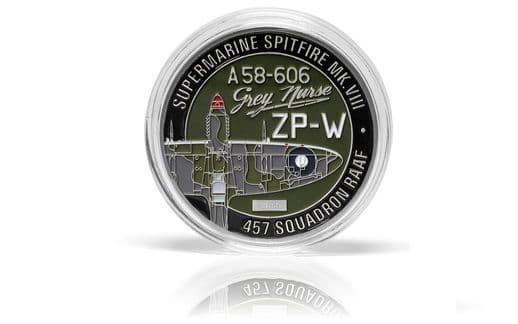
A selection of images featuring this most stunning of Spitfire scheme options, including a built sample model, the full scheme details and one of the exclusive collector’s coin releases which have proved such a popular addition to the Airfix range.
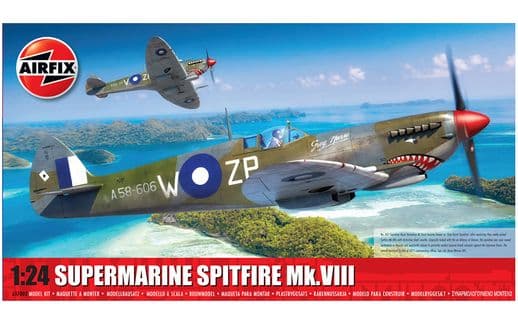
The fighters of No.457 Squadron have to be regarded as some of the most impressively presented Spitfires of the entire war and if a Japanese aircraft did come across one of these aircraft, it must have made for a terrifying sight. Adopting the name ‘Grey Nurse’ Squadron from the end of December 1944, pilots began adorning their aircraft with spectacular sharkmouth artwork at around the same time, with this presentation looking particularly effective on the sleek Spitfire Mk.VIII.
It's thought that the squadron chose this name due to the colours in which their new Spitfire Mk.VIIIs arriving from Britain were painted in, and how the sleek appearance of the fighter really did make it look like a Grey nurse shark, an ocean predator which was native to Australian waters. Taking inspiration from similar artwork applied to the aircraft of the Desert Air Force and the American Flying Tigers, the shark’s teeth looked particularly effective on their Spitfires, as these aircraft did look every inch the airborne predator they were. Even though the unit didn’t claim too many aerial victories during their operational service, they certainly looked like they would have done extremely effectively, had they been given half the chance.
Before the end of WWII, No.457 Squadron would become experts in low level strafing and dive bombing with their Spitfires, in addition to taking part in the Borneo Campaign during the final months of the war.
An extremely sleek variant of the Spitfire, the uniquely presented Spitfires of the RAAF ‘Grey Nurse’ squadron have to be considered some of the most attractive of all the service Spitfires.
The particular Spitfire presented with this scheme option was built at Supermarine’s Chattis Hill factory in Hampshire during the spring of 1944 and was delivered to the Royal Australian Air Force in September the same year. Constructed as MT819, she was allocated the serial A58-606 in RAAF service and on joining No.457 Squadron, she would become the personal aircraft of the unit’s charismatic leader Squadron Leader Bruce Watson. Watson used this aircraft extensively until having to make a forced landing at Morotai on 14th July 1945, having sustained anti-aircraft damage during a strafing attack against the Japanese airfield at Keningau strip. Whilst the pilot managed to walk away from the incident, the aircraft was damaged beyond economical repair and immediately discarded.
As far as Spitfire schemes go, this is an absolute beauty, particularly as the now famous operation down at the Biggin Hill Heritage Hangar have presented one of their T9 Spitfires in this exact scheme and allow people to pay for experience flights in their own Grey Nurse Spitfire.
It would probably be accurate to concede that at the start of the Second World War, Britain’s military significantly underestimated both the strength and capability of Japan’s military in the Far East, which led to some painful early losses and the subsequent loss of vital territory. From an air power perspective, RAF units in the region were equipped with the portly Brewster Buffalo at that time, an aircraft which was no match for the agile Mitsubishi Zero, but was flown valiantly by pilots who had very little in the way of support infrastructure at their home airfields. The situation was turning increasingly desperate.
Although they would be forced to fight a long war of defensive actions, newer aircraft did start to arrive in theatre, in the shape of Hawker Hurricanes transferred from the Middle East and Curtiss Mowhawks, but it would be towards the end of 1943 before significantly better aircraft started to arrive with SEAC units.
RAF No. 162 (Hyderabad) Squadron can trace its origins back to the Great War and the aerial defence of Britain, but was proudly a fighter unit for much of its history. Operating such aircraft as the Sopwith Camel and Gloster Gladiator, the squadron would begin a long association with the Spitfire just after the start of the Second World War and would subsequently see plenty of action operating from UK stations in defence of the country.
As the RAF moved on to the offensive, the squadron would take part in both the invasion of North Africa and Sicily, before moving on to India during 1943 to assist with the defence of Calcutta. Operating the Spitfire Mk.VII from December 1943 until the end of the war, No.152 Squadron would be heavily involved in fighting with the Japanese, occasionally intercepting incoming raids, but more usually providing fighter escort for bomber and transport aircraft, but more commonly, flying fighter bomber/ground attack missions in support of SEAC ground operations.
Built sample and full scheme details for this beautiful ‘Black Panthers of Burma’ Spitfire Mk.VIII.
During their time in the Far East, the unit christened itself the ‘Black Panther’ Squadron and adopted a rather unique and distinctive artwork addition to many of their aircraft, a black panther leaping over, or through the port-side fuselage SEAC roundel. This proved to be another stunning scheme which really suited the good looks of the sleek Supermarine Spitfire Mk.VIII and one this new kit will allow the modeller to replicate.
The squadron is regarded as the first Spitfire unit to be used in a bombing role and after flying many missions in support of the Fourteenth Army, they became the first Squadron to re-enter Burma at Tamu, where they soon became known as the ‘Black Panthers of Burma’. In November 1944, the squadron intercepted a formation of Japanese Zero fighters, shooting down several of them, and with one of the pilots subsequently claiming the distinction of having shoot down aircraft of all three of Britain’s Axis enemies, German, Italian and Japanese – only two pilots claimed this distinction during the Second World War.
No.152 Squadron had the distinction of flying against all Axis air forces during the Second World War, including the Luftwaffe during the Battle of Britain, the Regia Aeronautica in the Mediterranean and the Japanese in the Far East, and were in service until the very final days of the war. Later aircraft flown by the squadron would be the Spitfire Mk.XIV, the Hawker Tempest, Gloster Meteor Mk.12 and Mk.14s, the twin engined Pembroke C.1 and finally the Scottish Aviation Twin Pioneer.
More recently, the Squadron and its operations in Burma received national attention as a large scale search was initiated to find a collection of Spitfires and their engines which were reputed to have been buried at several of the airfields in Burma which played home to RAF Spitfires. It was claimed that up to 60 new and still crated Spitfires were unceremoniously buried in outlying areas of several airfields, as they were deemed surplus to requirements, with the Japanese being close to defeat by the time they were delivered. Despite captivating the nation over several months, the investigations proved fruitless and if these airfields do hold a Spitfire secret, they certainly appear determined to keep hold of it.
The many admirable qualities of the Spitfire were well known to the Americans, as a production example of the fighter was sent to the US for evaluation prior to the start of the Second World War and provided them with valuable data on how a modern, lightweight fighter should perform. What is perhaps not quite so well-known is the fact that over 1000 Spitfires were supplied to American units as part of a ‘reverse lease-lend’ arrangement in place between the two nations.
Prior to America entering the war, many US volunteer pilots travelled to Britain to offer their services in trying to stem the tide of German aggression, often at great personal sacrifice and without the backing of their home nation. Actually restricted from fighting in the name of America, many of these pilots first travelled to Canada and became pilots in the RCAF prior to heading for Britain, with many subsequently serving in the Royal Air Force. Banned from displaying their heritage in a way other Commonwealth pilots in the RAF were allowed to do, these hero pilots became known as ‘Eagle Squadron’ pilots and carried a stylised American eagle on the shoulder of their tunics in recognition of their homeland.
Following America’s entry into the war, the three squadrons which constituted the 31st Fighter Group were sent to operate from bases in Britain, with the initial intention of equipping them with the Bell P-39 Airacobra fighter. Fortunately for their pilots, the RAF had previously evaluated these aircraft and classified them as being unsuitable for combat operations in the European Theatre, so the 31st would actually receive British Spitfire Mk.Vb fighters. The 307th Fighter Squadron would be based at RAF Atcham and would be allocated the fuselage codes MX.
A beautiful Spitfire thoroughbred, this particular aircraft was retained by the USAAF 307th Fighter Squadron when they converted to new North American P-51B fighters in April 1944.
Once acclimatised and released for combat operations, the 31st FG would be involved in heavy action for the rest of the war, initially flying into enemy occupied France from bases in Britain, but moving on to operate from bases in North Africa and Italy, where they would continue to see plenty of action. Following heavy fighting in North Africa where the 31st Fighter Group had been involved in constant combat with the Luftwaffe, the unit would be given a period of rest and replenishment during May 1943, during which time their Spitfire Mk.Vs were replaced by Spitfire Mk.IX and Mk.VIII fighters. Initially, there was some resistance from Group pilots to the Mk.VIII, as the lower mark number led them to assume that these were earlier, inferior variants of the aircraft, however, once they had flown the fighter, they considered the retractable tailwheel, additional fuel capacity and stronger airframe of the Mk.VIII to make this the purer fighting aeroplane.
The next few months would see the 31st Fighter Group supporting Allied operations throughout the Mediterranean Theatre, including the invasion of Sicily and operations at Salerno and Anzio, with their Spitfires seeing heavy action as the Allies slowly pushed Axis forces back towards Germany and allowing strikes to take place from opposite ends of Europe. After months of fighting, April 1944 would see the 31st Fighter Group undergoing another period of change. After months of exceptional service, their Spitfires were finally relinquished in favour of new North American P-51B fighters and they moved to a new base at San Servero, on the eastern side of the Italian mainland to carry on their fight.
A truly fascinating machine, this particular Spitfire Mk.VIII was retained by the 307th Fighter Squadron to be used as a squadron ‘hack’ aircraft, the only Spitfire on an airfield which was now full of Mustangs. Presented in this rather unique scheme, the Spitfire’s tail was finished with the diagonal red stripes which were also applied to the unit’s Mustangs, but helps to tell the interesting story of the 1,000 plus Spitfires operated by USAAF units during the Second World War.
Flying the flag for Airfix. Our latest UK manufactured 1/24th scale Supermarine Spitfire model kit has now been produced in greater quantities than there were actual Spitfires produced.
From a modelling perspective, the release of this new 1/24th scale Spitfire Mk.VIII kit now allows us all to produce a beautifully accurate scale representation of this important, yet largely forgotten variant of Britain’s most famous fighting aeroplane, one which we have seen has strong links with both the Royal Australian Air Force and the USAAF. All three of the scheme options included are both interesting and eye catching in equal measure, and if you find yourself looking for an appealing Spitfire build project to get your teeth into, could there be a better option than this?
A beautifully sleek variant of the Spitfire, the Mk.VIII may have supported the war effort in skies well away from the factories where they were produced, but they were presented very differently from those which operated from British bases and as such, have a fascinating aviation story to tell.
With its fascinating comparison to actual wartime Spitfire production more than 80 years ago, this new Spitfire manufacturing record is not only a proud achievement for us here at Airfix, but is a record the entire modelling community has played their part in creating. Everyone who has one of our latest 1/24th scale Spitfires either proudly on display, or waiting in your stash for future build enjoyment has helped us to achieve the manufacturing benchmark, and we’re all extremely grateful for your support.
When showing your Spitfire build to those interested from this point forward, you can include the fascinating scale Spitfire manufacturing benchmark you helped to create, confident in the knowledge that between us, we’re helping to maintain the enduring affection in which this magnificent aircraft continues to be held.
We are afraid that's all we have for you in this latest edition, but we will be back next Friday with more project development updates and the very latest Airfix kit exclusives. In the meantime, we are always keen to hear your views on all things Airfix and in particular, any thoughts and opinions you may have regarding our Workbench blog. If you would like to drop us a quick line, could we please ask that you use our workbench@airfix.com email for all correspondence.
To re-visit any of the Airfix blogs we have produced over the past seven years or so, please head to our main Workbench hub, where you will find our entire blog back catalogue and all the Airfix design projects we have already covered.
All our dedicated official social media sites can be accessed by clicking the respective link icons at the foot of this page, or by heading to the Airfix homepage. Other useful Airfix links are:
Facebook, YouTube, Twitter and Instagram official sites
Please join us for more Airfix updates next week and thank you for your continued support.