

Welcome to this latest edition of our Workbench blog and all the news, updates and modelling exclusives from the fascinating world of Airfix.
In this latest edition, we will be returning to the subject of Scale ModelWorld 2022 once more, this time to feature the latest winner of the Airfix Trophy and the beautiful model which attracted the attentions of our adjudicating team this year. With so many magnificent Airfix model builds on show, it really was an unenviable task trying to rank one above another, particularly as each one invariably had its own particular merits and would have appealed to different people in different ways. As it was though, there was one build which simply demanded our attention and was a unanimous and worthy recipient of this year's title as far as the Airfix team were concerned. This model, or a build which is more accurately described as a diorama, was a scale recreation of an unusual incident which occurred on a quiet residential street in South Ruislip in December 1946, one which would result in one of the houses on Angus Drive inheriting some rather unusual loft insulation.
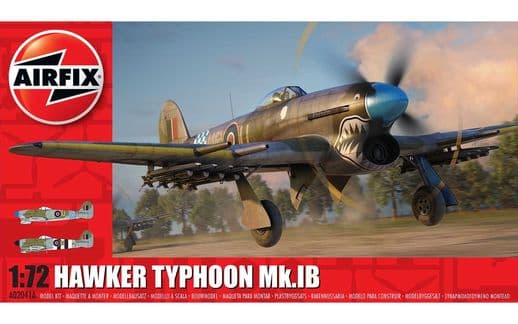
We will be following this with another of the reader supplied modelling features which always prove so popular with our readers, this time one which finally addresses a long standing blog request for information regarding the most unusual (extra) scheme option presentation for our 1/24th scale Hawker Typhoon IB kit. One of the most devastatingly effective strike attack aircraft of the Second World War, with grateful thanks to Mark Camsell, we are now able to show his model tribute to an RAF Typhoon which was brought down whilst conducting a 'Rhubarb' mission in 1943, but was later flown in Luftwaffe markings in a test and evaluation role. A really unusual presentation for this famous British fighter-bomber, Mark's pictures show just how appealing the Typhoon is in German markings, a relatively obscure chapter in the operational history of this famous British aircraft.
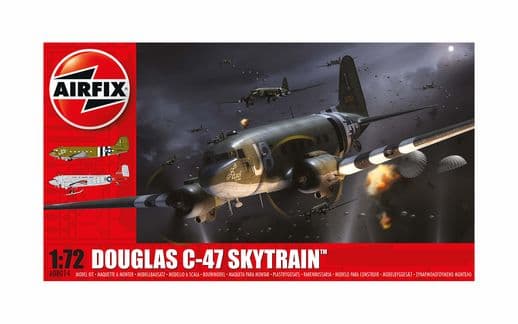
When Geoff Russell takes on a model build, it has to be something with an interesting story behind it, like a Douglas Dakota landing on the roof of your house!
For anyone attending the annual Scale ModelWorld show at Telford, there is one thing we all know we are going to see during our visit and that is a stunning display of modelling excellence. Whether you interest be in modelling aircraft, ships, science fiction subjects or anything else, there will definitely be an abundance of models to inspire and enthral, at the same time as leaving us all marvelling at the creativity of the exhibiting modellers. At this level, modelling must surely be considered to be a form of art and some of its most accomplished participants artists of the highest order.
One aspect of modelling which possesses an irresistible appeal for a great many people, the creation of dioramas are almost like three dimensional scale representations of historical scenes, ones we may have seen on TV or in history books. With so much going on and the central model only being part of the story, the skill here is to accurately represent the scene being recreated and to bring a photograph or an incident we have only previously read about to life. When dioramas are executed well, they always attract plenty of attention and from a Scale ModelWorld perspective, will always command a healthy crowd of admirers around it for the duration of the show.
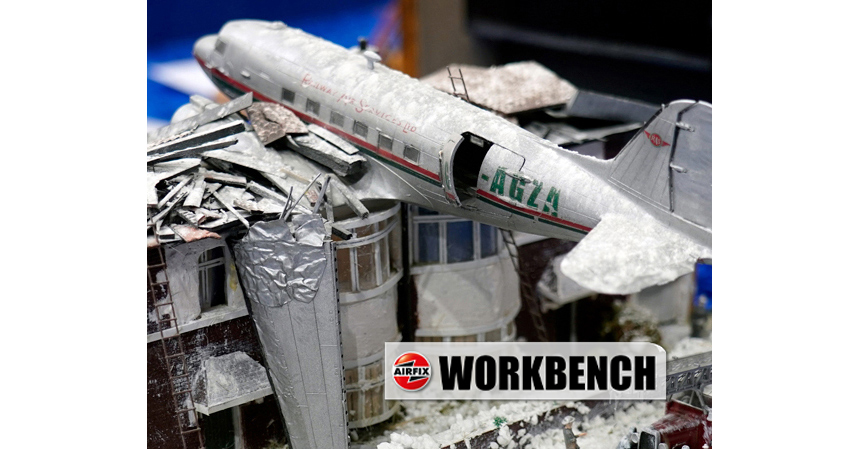
This was the situation facing the Airfix team who were engaged in judging this year's Airfix Trophy competition, trying to differentiate between a never-ending stream of expertly finished model builds, then coming across 'The Rooftop Dakota 1946', an imaginative diorama created by modeller Geoff Russell. As many of the team were aware of the incident on which the diorama was based, it became fascinating to see the level of detail the modeller had noted in the historical photographs he had obviously referred to during the build and how he had tied hard to incorporate as much as this into his build project. If you look at the attached images, you can clearly see that Geoff has not only recreated the damage to the aircraft balancing precariously on the roof of these semi-detached houses, but how he had also recreated the weather conditions on that fateful day, included the arrival of rescue services and even the wall and front gardens of the houses on the opposite side of the road.
Before we look at the model build in more detail and ask Geoff how and why he decided on this particular build, it's probably appropriate to look at the incident itself in a little more detail and how a former RAF Dakota ended up on the roof of Nos 44 and 46 Angus Drive.
Originally built for the UAASF, Douglas C-47A 42-92633 was transferred to the Royal Air Force in 1944 and following the end of the war, on to civilian operators, firstly to BOAC and less than a month later, on to Railway Air Services with the registration G-AGZA. On the evening of 19th December 1946, the aircraft was due to fly a scheduled service for Scottish Airways from London Northolt Airport to Glasgow, however, the weather conditions in London had been poor all day. All incoming flights had been diverted due to snow and plunging temperatures and departures were moving, but subject to long delays.
This next series of images show the finished diorama and how Geoff attacked the build once he had all his references in place, showing how he planned and test built his Rooftop Dakota.
Houses starting to take shape, with their unusual aviation loft insulation in place.
The diorama slowly taking shape, but missing one important element, Geoff's blown polystyrene dust snow!
Having prepared for their flight earlier in the afternoon, Dakota G-AGZA had undergone de-icing, but due to the continuing disruptions, was held for over an hour in the freezing conditions. As the crew finally received their take-off clearance, the wings of the aircraft has iced up once more and with further snow settling on it, the scene was set for a potentially disastrous situation. As the aircraft sped down the runway with four crew and just a single passenger on board, the pilot struggled to get the aircraft airborne, but as he had already passed the abort point, was now committed to the take-off. The aircraft passed the airfield boundary only feet off the ground, steadfastly refusing to gain height and within seconds, appeared to be flying at rooftop height down Angus Drive in South Ruislip, at the end of the airfield.
At this extremely low altitude, a crash was inevitable and the port wing of the Dakota clipped the roof of No 48 Angus Drive, causing the entire aircraft to veer violently to port through 90 degrees, coming to rest on the roof of the adjoining semi-detached houses. Even though the aircraft was now perched precariously on the roof of the houses, the relatively low speed and low altitude of flight averted a potential disaster, with no fire resulting from the impact. Miraculously, there were no fatalities either on the ground or aboard the aircraft and indeed a baby sleeping in his room at No 44 didn't even stir from his slumber during the incident. The occupants of the aircraft did attempt to exit through the aircraft's rear loading door, but as they moved towards the back of the aircraft it started to list, so they immediately used the smaller door at the front instead. It has been reported that everyone exited the aircraft via the loft ladder of the house they had landed on, down the stairs and out through the front door and whilst this makes for a great story, it is not known if this was actually true.
As you can see from Geoff's diorama, the aircraft was a write off and was scrapped once it had been removed from the buildings, and even though building works were started straight away on the damaged properties, owners of the house reported that oil stains would regularly show through successive coats of paint for the next ten years. Following the completion of the building works, the owner of one of the damaged houses decided to rename their home 'Dakota Rest' and for his part in this famous incident, the captain of the aircraft on that fateful day gained the nickname 'Rooftop Johnson'.
Clearly, an incident such as this would attract plenty of local press attention and as the story ended without loss of life and with pictures of the incident being so dramatic, details of the Dakota's unusual resting place were also carried by national and regional newspapers at the time. It was the sight of one of these fascinating photographs which caught the eye of modeller Geoff Russell and started him thinking about a new modelling challenge, how could he replicate this incredible scene as a 1/72nd scale diorama. He had a Dakota kit in his stash, so all he needed now was time and his modelling skill.
Geoff's full diorama in all its glory and a copy of one of the many period images which sparked his interest in the first place.
As we always like to do each year with our SMW Airfix Trophy winner, we contacted Geoff and asked if he would allow us to feature his build in an edition of Workbench, to which he kindly agreed. As we usually find, asking Geoff about his trophy winning build led to the wider discussions about modelling and his usual subjects of choice. Geoff informed us that a health issue around six years ago brought about his return to the hobby, something he enjoyed immensely in his youth, but had to put aside during the years of career, family and other commitments. He described how he never lost his love for modelling and always planned to return at some point - his recuperation offered the ideal opportunity.
Clearly, our next question had to be about the subject itself and if Geoff decided to embark on this project due to some personal connection to this famous incident. He told us that whilst he didn't have any connection, diorama recreations of incidents and photographed scenes are always his subjects of choice, simply because they are more interesting to him, a build which has a story behind it. This build actually came about as he was scouring the internet for suitable images and information, with his actual intended subject being the famous scene where a farmer on his tractor is looking back at a pilot ejecting from a stricken English Electric Lightning F.1 fighter, just outside the boundary of Hatfield airfield. Although he would dearly have loved to recreate this scene in model form, after some time planning the build, he decided it would not look as effective as he would have liked, so he abandoned the idea and continued looking for another suitable subject.
During his web search, Geoff discovered images of several aircraft crashes, including one where a Douglas Dakota had come to rest on the roof of semi-detached properties just over the boundary fence at London Northolt Airport. For an aircraft of this size, you might expect that any crash would involve a scene of total devastation, but in this case, the Dakota appeared to just be sitting serenely, if rather ingloriously on the roof of the houses. With the incident miraculously avoiding the serious injury of anyone involved, Geoff had his subject and with an Airfix Dakota in his stash, the project was on.
Geoff told us that as far as he is concerned, the hard part of producing a diorama model recreation is in the preparation, gathering as much research material together at the outset to enable you to produce a faithful representation of the scene you are attempting to emulate. Having drawn out the houses to scale, he next made a mock up of the building using fibre board, before half building the Dakota to see how everything would line up together. Right from the start, he wanted to keep the entire build to a reasonable size, so he could take the finished diorama to shows, as he is an active member of the Letchworth Scale Model Club and likes to exhibit his latest work. Once happy that everything was in place, it was a simple case of getting stuck in, always having several pictures of the crash scene at hand for reference purposes.
A worthy winner, Geoff's diorama scooped the Airfix Trophy at Scale ModelWorld this year.
Geoff receiving our rather distinctive trophy from Airfix Brand Manager Dale Luckhurst.
We asked Geoff which aspects of the build proved to be the most challenging and were a little surprised by his answer. Although he did include modelling the internal structure of the broken sections of the Dakota's wing as we were expecting, he went on to say that modelling the bay windows of the houses accurately proved particularly problematic for him. Getting this detail right was causing him so much trouble that he simply had to take a break from the build, going for a long walk with his dog to clear his head. Whilst out and only a few hundred metres from his own home, he discovered a house in his immediate neighbourhood had the exact bay window design as the ones in the picture from 1946, so he was able to obtain all the references he needed from this unexpected source.
Another aspect of the build which he was particularly pleased with was the application of snowy finish on the diorama. Geoff didn't just want to sprinkle something white over the build, because this simply would not produce a suitable appearance and more importantly, wouldn't be an accurate representation of the incident itself. The crash happened because it was a cold, snowy and windy night in west London, conditions which caused the wings of the Dakota to ice up and if Geoff had simply sprinkled a white substance all over the build, it would have looked odd in his view. His solution was an ingenious one, but must have tasted awful - he mixed polystyrene dust with talcum powder and a little water and blew it on the diorama through a straw. Where the substance landed, this gave the impression that it had been carried by the wind, allowing it to fall much more naturally.
Looking at these images of the completed build, it is clear to see that Geoff has managed to replicate this historic scene in some style and produce a diorama which has interest and impact in equal measure. For anyone who is familiar with this incident, particularly those who have seen the astonishing pictures taken at the time, this serves as a fascinating three dimensional representation of a piece of aviation history, one which has been brough to life expertly in model form. We think 'The Rooftop Dakota 1946' was a worthy winner of this year's Airfix Trophy and everyone here at Airfix would like to congratulate Geoff one more time.
One final look at Geoff's impressive diorama, a piece of modelling work which brings a historic incident from 1946 to life in scale modelling form.
As for his current build, Geoff informed us that recreating an interesting story is once again the subject of his modelling attentions, this time how America's neutrality act prevented US pilots from flying warplanes across the Canadian border during WWII. The answer they came up with was to land them as close to the border as possible and have a team of horses pull them the few feet into Canada, before flying on to operational squadrons which would invariably be in Britain. This story fascinated Geoff, so his next build features a Lockheed Hudson under horse drawn power and we can't wait to see it.
Just to complete Geoff's story, he also told us that every Thursday, he can be found volunteering at the Imperial War Museum Duxford, where he is the custodian of their magnificently preserved Comet 4, showing people around this elegant aircraft and describing its place in aviation history. Geoff told us that he absolutely loves doing this and has huge affection for this beautiful aeroplane, taking pride in ensuring its story is told accurately and with passion. If you ever get to meet Geoff and his Comet at Duxford, don't forget to mention his Rooftop Dakota build you saw in Workbench.
We would like to thank Geoff for allowing us to feature his diorama in this week's blog and to congratulate him once again on being the latest recipient of the Scale ModelWorld Airfix Trophy - we can't wait to see that horse-drawn Hudson diorama.
Many blog readers may recall an edition of Workbench published early last year, where we asked for help regarding our 1/24th scale Hawker Typhoon kit and in particular, a scheme addition we included with this kit during 2019. Even though this additional scheme presented the Typhoon in a really unusual and fascinatingly obscure scheme, we had yet to see anyone post pictures of a built model using these new decals on any modelling social media sites and were desperate to see how it looked in this scale. In such cases, we know that our readership will always come up trumps, however, to our amazement, we still didn't get a response and our captured Hawker Typhoon was proving as elusive as ever. That is until Mark Camsell came to our rescue, although we do have to thank Mark for his patience. Even though he kindly sent us a selection of his Typhoon build images some time ago, we haven't been able to feature them until now, due to the development schedules of current 2022 projects, however, we are now in a position to address this situation.
As the air war over Northern Europe entered 1943, Allied air forces were at that time predominantly on the offensive and as a consequence, a great number of sorties were being conducted over enemy territory. At around the same time, the powerful and highly capable Hawker Typhoon was given a new role to perform, one which required its pilots to undertake low altitude ground attack operations, as Allied military planners attempted to severely disrupt enemy infrastructure in advance of the planned D-Day landings. These missions were incredibly dangerous for the pilots flying them, as everything from small arms fire, to heavy flak would be hurled towards the attacking aircraft and as they were operating at such low altitudes and at great speed, an aircraft suffering damage from enemy fire or indeed suffering a ground strike would leave them with little chance to react and even fewer options when it came to making it back home.
On the morning of 24th March 1943, Flight Sergeant William K. Mawson of RAF No. 486 (New Zealand) Squadron embarked on a Rhubarb mission over the Normandy region, when his Hawker Typhoon (EJ959) was hit by flak just as it was crossing the French coast. Having to immediately look for a suitable field in which to crash land his fighter, he safely managed to put it down in a field close to the town of Fecamp in Normandy and set about the task of destroying his aircraft before it could fall into enemy hands. Unfortunately, a patrol of German troops were quickly on the scene and stopped him in his tracks, taking him into custody and informing Luftwaffe officials of their unexpected RAF prize. Ordered to protect the Typhoon at all costs, EJ956 was later recovered by the Luftwaffe and would become the first RAF Typhoon to be operated and evaluated in German hands.
Mark explained why he finished this build as something of a hybrid project, but how he was attracted by this stunning scheme and the interesting details behind it. As he told us, it's his model and he can finish it as he sees fit.
Flt Sgt Mawson’s Typhoon was recovered and repaired by 2./Versuchsverband (2nd squadron of the Experimental Unit of the Luftwaffe's High Command - Luftwaffe trials and research unit) at the unit’s Rechlin test centre base, where it was given distinctive new markings and flown in evaluation trials to discover its strengths and more importantly, any potential weaknesses. As an enemy aircraft type not usually operated by the Luftwaffe, the captured Typhoon was extremely vulnerability to attack by friendly Luftwaffe fighter and anti-aircraft units and in an attempt to prevent their prized asset from suffering such a fate, the aircraft of 2./ Versuchsverband adopted special high visibility paint schemes to protect it from friendly fire. Featuring oversized Luftwaffe insignia and sporting bright yellow undersides and tail, these measures were intended to clearly identify the aircraft as being under new ownership. Local flak units in the vicinity of the airfield were specifically ordered to check the identity of aircraft closely before firing on them.
Hawker Typhoon EJ956 was given the new Luftwaffe coding T9+GK and following the completion of its flight evaluation programme at Rechlin, was passed to the care of Captain Theodore Rosarius and his famous enemy aircraft flight, a unit which became unofficially known as ‘Zirkus Rosarius’ or ‘Wanderzirkus Rosarius’. This special test unit not only evaluated the strengths and weaknesses of captured Allied aircraft, but also toured Luftwaffe fighter stations around Europe, allowing pilots the opportunity to not only inspect a collection of the enemy’s latest aircraft in airworthy condition, but also to have the opportunity to discuss tactics with the pilots flying them on how best to defeat them in combat. As this unit toured Luftwaffe airbases with typically between three and six enemy aircraft in their care, the Wanderzirkus name seemed rather fitting and when Captain Rosarius and his captured aircraft were in town, it was a time of great excitement for all.
From details obtained after the war, it appears that 2./Versuchsverband personnel found operating the Typhoon a constant headache, with the massive Napier Sabre sleeve valve engine being their major cause of concern. This hugely powerful unit had a unique starter system, one which involved the use of an explosive cartridge to turn the massive engine when starting it from cold. This cartridge resembled a giant shotgun shell and when one was fired, it would have everyone on the airfield either flinching or actually diving for cover. The engine also had a tendency to catch fire on start-up and during its wartime RAF service, at least 28 Typhoons were known to have been destroyed by fire during the start-up procedure. Obviously, the German unit now attempting to operate the aircraft would not have access to supplies of the dedicated British starter cartridges the engine needed and had to improvise, however, there are stories of frustrated pilots and ground crews trying in vain to start the Typhoon's mighty engine, with dozens of spent cartridges scattered around them and a frustratingly stationary Typhoon propeller!
The eventual fate of Hawker Typhoon IB EJ956 is the subject of some historical conjecture. Some sources report the aircraft as being written off following a ground loop accident after a forced landing at Meckelfeld on 10th August 1944, whilst others say it was destroyed at Meckelfeld on 28th July 1944, claiming the life of its German test pilot Herbert Gold. As this was the first Typhoon to be operated by the Versuchsverband, it seems likely that the latter is most probable, but it is also interesting to note that whilst this unusual unit operated a variety of unfamiliar captured Allied aircraft types, only two Versuchsverband pilots were to lose their lives on operations, something which is a real testament to their flying abilities. To add further confusion to the story of the Luftwaffe's Typhoon, it appears that they managed to operate two examples at different times, but with both using the T9+GK coding, although with much of the information regarding 2./Versuchsverband activities during WWII being sketchy at best, details are difficult to corroborate.
The operation of Theodore Rosarius' Wanderzirkus enemy aircraft flight during the Second World War is a truly fascinating story and even though the Typhoon was their prized asset, it was extremely problematic in operation.
Having decided to tackle our 1/24th scale Hawker Typhoon kit, modeller Mark Camsell made the decision to finish his build in the unusual extra scheme supplied with the 'Car Door' IB variant of the kit and as he knew this was going to be quite a significant project, decided that he was also going to take build pictures of the project at various stages. Thankfully, Mark was also happy to supply us with a selection of these images, something which finally allowed us to lay this particular Workbench modelling quandary to rest at long last.
As you will have no doubt spotted when looking at the attached images, Mark's captured Typhoon is something of a hybrid build, but there turned out to be a very good reason for that. The extra decal set we supplied in this scheme related to the 'Car door' variant of the Typhoon, as this was the variant returned to the air by 2./Versuchsverband following their acquisition of Flt Sgt Mawson’s Typhoon back in March 1943. Mark informed us that whilst he does have the 'Car door' Typhoon in his kit stash, he wanted to finish this kit in one of the supplied RAF schemes, but was at the same time attracted by the unusual story behind the captured aircraft. A later opportunity to purchase the original Typhoon release in this scale at an attractive price gave him his opportunity to use the extra Luftwaffe decals, even though he knew he would be upsetting a few modelling purists in doing so.
Mark told us that the reasoning behind attacking the build in this way was twofold, firstly because his build scale of choice is 1/72nd scale for display purposes, and whilst he had built an original 1/24th scale Mustang kit some years ago, this would be the first time he had attempted a modern Airfix kit of this complexity and detail. Using it as something of a reconnaissance build for his 'Car door' Typhoon kit, he had absolutely no problem finishing the model in this smart Luftwaffe scheme as he thought it was just so interesting and was really looking forward to the challenge.
When discussing the build with Mark, he told us that he was impressed with the detail and complexity of the kit, but also how the instruction booklet was so well put together, guiding him through every stage of the build and when he should be painting some of the detailed areas relatively early on in the build. He also told us that fellow modellers and YouTube were invaluable in introducing him to techniques he had never previously attempted and provided him with the confidence to have a go at such things as pre-shading and leaving panels open to reveal all that fantastic detail. He did go on to tell us that it did take him quite a while to finish the kit, mainly because he was building it around a busy lifestyle, just dropping on for a few hours as and when time allowed. As a consequence, it actually took him over twelve months to complete this build, but how he is extremely pleased with how it turned out.
From the build images Mark supplied, it is clear to see that as a practice build, his Typhoon certainly did its job as intended, as it looks really fantastic. With lots of detail picked out, expertly finished rockets and all that subtle pre-shading on the yellow under-surfaces, this really is an attractive model, even accepting the fact that it is something of a hybrid build. Mark just loved the unusual colour scheme the aircraft is wearing and thinks it really does show off the muscular attributes of this famous British fighter-bomber, something we are in full agreement with. In fact, we are still a little surprised that we haven’t come across more Typhoon kits finished in this fascinating scheme, a chapter in the history of the Hawker Typhoon which is just so appealing by virtue of its relative wartime obscurity.
We are delighted to say that thanks to Mark's hybrid captured Typhoon build, we can now put this long standing blog request to bed, that is unless someone else wants to send us pictures of their own Wanderzirkus Typhoon build in 1/24th scale. Even though 2./Versuchsverband only ever operated two Hawker Typhoons in their touring Luftwaffe dissimilar aircraft role, you really can't have too many Typhoons, even if they are wearing very different markings to those we are more familiar with.
We would like to thank Mark for sending us this fantastic selection of images and for telling us the story behind his hybrid Hawker Typhoon build.
We are afraid that’s it for another edition of Workbench, however, you can be sure we will be back again as usual, same time, same place, with plenty more Airfix project updates for your information and enjoyment next week.
As ever, we are always keen to hear your views on all things Airfix and in particular, our Workbench blog, so if you would like to drop us a line, please use workbench@airfix.com for all correspondence. To re-visit any of the Airfix blogs produced over the past seven years, please head to our main Workbench hub and scroll through the available pages.
All our dedicated official social media sites can be accessed by clicking the respective link icons at the foot of this page, or by heading to the Airfix homepage. Other useful Airfix links are:
Facebook, YouTube, Twitter and Instagram official sites
Please join us for more Airfix updates next week and thank you for your continued support.