

Welcome to this latest edition of our Workbench blog and all the news, updates, and modelling exclusives from the fascinating world of Airfix.
In this latest edition of Workbench, we continue our journey through the new kit additions scheduled to be joining the range in 2025, by paying our first visit of the year to the Vintage Classics range. Our subject is already destined to be an extremely popular addition to the range, as it simply oozes style and visual appeal, an aircraft which may have been ahead of its time, but also introduced technologies which would benefit the aviation world for years to come.
The Boeing 314 Clipper has to be considered as one of the most beautiful aircraft ever to take to the skies, one which captured the imagination of vast numbers of the world’s population, even though only a select few were wealthy enough to enjoy the opulent long-haul service this queen of the skies was introduced to provide. Despite its impressive reputation, the Second World War would play a significant role in determining the legacy of this beautiful aircraft, forcing them to fly less glamorous, but arguably more important services.
With a series of built model images to share, and full artwork details relating to this beautiful kit release, we find ourselves in the company of a true aviation classic in the latest edition of Airfix Workbench.
A truly beautiful aeroplane, the Boeing 314 Clipper was designed to fly passengers on long-haul transatlantic and transcontinental flights in some style, and were extremely advanced for their time. This aircraft was actually one of the three later sold to BOAC in 1941 for operation from Britain. Image in the public domain.
In an age when aviation technology was advancing at an astonishing rate, and the latest aeroplane designs appeared to offer endless possibilities, the Pan American Airways Corporation, who had been operating official mail delivery flights and passenger flying boat services into South America, saw an opportunity to expand their operations across the Atlantic. Their initial passenger services had been made using relatively small flying boats, which they likened to the fast sailing ships which had been used on such routes the previous century, naming their aircraft ‘clippers’.
Perhaps the most interesting aspect of these pioneering services was how the company appeared to enjoy the favour of the US government, making their listed stocks some of the most sought after in the world, as their influence seemed only set to continue. During the second half of the 1930s, Pan American had set their sights on establishing transatlantic and transcontinental passenger services, an undertaking which would require the design and production of an exciting new breed of advanced flying boats.
These aircraft were intended to fly wealthy customers in levels of style and comfort never before seen in air travel, as they quite literally opened up the world to those in a position to take advantage of the service. Crucially, the new aircraft would have to possess the range, flight stability and impressive reliability to make these services pleasurable for passengers, and profitable for their operators.
In early 1936, the Pan Am company released details of a competition to create the world’s first transoceanic airliner, inviting design submissions from Boeing, Douglas, Consolidated, Martin and Sikorsky, companies the majority of which had previous experience in either producing flying boats, or assisting with the design of such machines. The new aircraft had some challenging specification requirements to satisfy, which included the ability to carry a significant payload over a minimum range of 2,400 miles, and at a speed of around 150 mph, but perhaps the most challenging requirements were related to the unprecedented levels of space, comfort and luxury the aircraft’s passengers would have access to. All this had to be achieved whilst adhering to the most stringent safety requirements the aviation industry had ever seen.
Although initially not amongst the companies which decided to enter the competition, Boeing would finally submit their proposal after the original deadline had passed, and only after the intervention of a brilliant young design engineer. Having worked overseas for many years, he had been thinking about his company producing a large flying boat for some time, and had made these musings something of a personal project. On hearing about the new Pan Am contract, he approached Boeing officials with his idea, a design which made extensive use of existing company data, technology which was linked to their cancelled four engined heavy bomber design. Crucially, this technology was already at an advanced stage and had undergone extensive testing.
Interestingly, the engineer’s wife was a talented artist, and she created a series of beautiful artworks which were an impression of the interior features of the new aircraft, a visual representation of the impressive levels of space and luxury it would offer. They must have had quite an impact, as they proved persuasive enough to encourage Boeing officials to seek a proposal submission extension.
An aircraft which captivated Pan Am officials. This image features built examples of our scale tribute to this beautiful aircraft, finished in both the scheme options included with the kit.
Engineer Wellwood E. Beall was subsequently transferred to the engineering department at Boeing, and allocated the resources to advance the project at speed. The new aircraft used design elements from the cancelled XB-15 heavy bomber, the most significant of which was its large and impressive wing, a structure which had shown itself to be particularly impressive during extensive wing tunnel testing conducted previously. This mighty piece of aeronautical engineering allowed the new aircraft to accept four Wright R-2600 Twin Cyclone engines, and to support a hull which allowed for the levels of passenger space and comfort the Pan Am specifications called for.
On presenting their proposal to Pan Am officials at a meeting in New York in May 1936, the new aircraft impressed them sufficiently for them to place a significant order for six of these mighty flying boats worth $4.8 Million, with an option for a further six aircraft further down the line.
Historically, this would be the first order Pan Am had ever placed with Boeing, however, the complexity of the aircraft’s design and it subsequently coming under the scrutiny of the newly created Civil Aeronautics Board, would result in significant project delays, delays which would result in the first Boeing 314 Clipper being delivered around 13 months later than intended. Unfortunately, this would not be the only time that a historic development would have an impact on the legacy of this majestic aeroplane, and the era of the flying clippers could begin.
Without a dedicated prototype aircraft, the first production airframe was the one used for the type’s extensive test and evaluation program, with this magnificent aircraft taking to the skies for the first time on 7th June 1938. During this period, a great many improvements and modifications were made to the aircraft, some relatively small, but with some instability issues requiring more significant modification. Ultimately, on 26th January 1939, the Boeing 314 flying boat was awarded its Certificate of Commercial Airworthiness.
A triumph of aeronautical perfection, the 314 required the production of 6000 highly detailed technical engineering drawings, with its construction consisting of in excess of 50,000 individual components. Each aircraft needed 11 miles of electrical wiring, required 576,000 rivets and used in excess of 15,000 bolts – everything about these aircraft was impressive, not least its stunning good looks.
Due to the distances they would be required to cover, the aircraft were designed to carry 4,246 US gallons of aviation fuel, with an additional 300 US gallons of oil lubricant for the four Twin Cyclone engines. The upgraded 314A variant aircraft which followed the first aircraft into service were able to carry an additional 1,200 gallons of fuel, further extending the range of these aircraft, whilst at the same time supporting the more powerful variants of the engines.
With the highest standards of safety and comfort, the Boeing 314 Clippers represented the pinnacle of aviation technology at the time of their production run.
The mighty hull of the Boeing 314 was 12ft 6 ins wide, and of all metal construction, differing from previous flying boat designs by having the centre section incorporating both the wing shoulders and the inboard engine stations. Remaining sections of the aircraft were constructed separately, with everything coming together during final assembly. Breaking from usual maritime construction tradition, the main hull only featured two full height watertight bulkheads, a collision bulkhead at the front, and a compartmented double bottom.
The design incorporated sponsons located at the waterline and approximately positioned at the aircraft’s centre of gravity, which whilst creating one of the aircraft’s most distinctive features, also provided the dual benefits of stability for the aircraft when in water, and additional lift when it was in the air. They also made for convenient boarding platforms when entering or exiting the aircraft, and were used to carry fuel – quite the ingenious design success.
The tail of the 314 was equally distinctive, incorporating three vertical stabilisers which were improved from the units attached to the first aircraft. Whilst these were vital for providing the directional stability the aircraft needed, despite their combined surface area, the design didn’t detract from the overall aesthetics of the aircraft, and actually contributed to the charm and appeal of these beautiful aeroplanes. These controls also benefited from an ingenious spring resistance system, which gave the pilot a sense of proportional ‘feel’ when making his control inputs, something many future aircraft would follow in design.
Marking its nautical links, each aircraft was equipped with an anchor and substantial mooring lines, and the crew were issued with maritime ratings and appropriate uniforms.
The interior of the hull was split into upper and lower decks, with the higher level housing the flight deck, cargo and baggage holds, crew quarters and access to equipment on the roof of the aircraft and into the wing structure.
The lower deck was where all the magic happened, and was divided into eleven sections, five standard passenger compartments, one Deluxe compartment, a dining lounge, relaxation area and passenger rest rooms. Each standard compartment could seat 10 people, or sleep six, whilst the deluxe section was everything you would expect it to have been, and probably a little more besides – this was absolute luxury. The Clipper offered a blue riband service in every sense of the term, with the only compromise being the weight saving measured imposed on the company’s interior design team.
Another look at our Vintage Classics Boeing Clipper pair.
As you would expect, service levels on board these aircraft was spectacular, with Pan Am’s Clippers offering truly luxurious air travel. In the dining area, passengers were served six course meals by stewards wearing white coats, the sort of service you would find in the world’s finest restaurants.
In addition to the service levels, the appeal of these flights was only enhanced by the fact that only the most proficient and experienced crews were selected for service on the Boeing 314 Clippers, often with reserve crews shadowing them as part of their own ongoing training for the role. Navigational excellence was also a specific requirement, resulting in these services gaining a reputation which has never really been equalled, except perhaps by Concorde.
Safety was clearly also a major consideration, with these aircraft having 15 different ways for passengers to get out in the event on an emergency, which included two emergency doors within each of the passenger compartments. Interior furnishings were all made of fire resistant materials, reducing the possibility of fire being started accidentally in the cabin, and any other fire taking hold in this section of the aircraft.
Should the unthinkable happen and the aircraft be forced to ditch, the same level of attention to detail had been applied to the inclusion of safety and life saving equipment, with food rations for around two weeks, fishing rods and other equipment to catch fresh food, and robust life rafts capable of carrying all those on board, and their additional life preserving items.
Other than the fuel filler ports, all hatches built into the Boeing 314 could be operated without compromising the structural integrity of the aircraft, and whilst an aircraft ditching was not considered a peril most passengers would have to experience, Pan Am ensured that the same high levels of planning and detail had been considered for such an eventuality, and that every precaution had been taken to ensure a positive outcome should any such situation arise.
Such a magnificent image – is there a more attractive sight than this in the world of aviation? BOAC operated three Clippers between 1941 and 1948, with this one being G-AGCA ‘Berwick’, the aircraft Winston Churchill travelled on. Image in the public domain.
The first of these aircraft to be delivered was NC18602, and aircraft her parent company named ‘California Clipper’. She was flown to Oregon at the end of January 1939, in order to avoid making Pan Am liable to pay a significant state tax if landing in Washington State, but was later flown down to the company’s San Francisco base, where she was assigned to the Pacific service routes. The remaining five aircraft were subsequently delivered at a rate of approximately one new aircraft each month, with the final 314 being delivered on 16th June 1939.
The aircraft were intentionally referred to and named ‘Clipper’ in reference to the high speed sailing merchant clippers of the 19th century, ships which were built to take advantage of the trade winds and bring cargoes from around the world to merchants at high speed. Pan Am wanted to make the connection with the high-speed service these ships provided, particularly as they were competing with the traditional services offered by large ocean going liners. Their traditional ‘floating’ competitors may have been able to carry more passengers, but they simply couldn’t compete with the Boeing Clippers in terms of speed.
NC18602 ‘California Clipper’ made the first Boeing 314 transcontinental flight on 23rd February 1939, when she flew from San Francisco to Hong Kong, making the 18,000 mile round trip with stops in Hawaii, Midway Island, Wake Island, Guam, Manila and Macao. She would also undertake the first regular passenger and mail service flying the same route on 29th March 1939, with a one way journey taking around six days to complete.
Her sister aircraft NC18603 ‘Yankee Clipper’ flew the first passenger service across the Atlantic when flying from Southampton to New York on 24th June 1939, making stops at Foynes in Ireland, Newfoundland and New Brunswick.
Another one of the BOAC Clippers, this time their flagship G-AGBZ ‘Bristol’.
Some of the highest profile aircraft in service at that time, the Boeing 314 Clippers were quite simply the aircraft everybody wanted to fly on, not only because they offered unrivalled levels of style and comfort, but also because they were offering a truly pioneering service, one which appealed to people of an adventurous nature, particularly those with the means to take their place on a Clipper’s passenger list.
In the end, just twelve Boeing 314 and modified 314A Clippers were built, nine for Pan Am and three for the British Overseas Airways Corporation, however, the war in Europe seriously curtailed trans-Atlantic operations and with it, possibly the legacy these beautiful aeroplanes undoubtedly deserved. Following the Japanese attack at Pearl Harbor, Boeing Clipper passenger flights were halted, and after writing a glorious chapter in civil aviation history, the age of the Boeing 314 Clipper, and its pioneering service was effectively over, after just three years of operation.
A truly beautiful aircraft to look at, the Boeing 314 Clipper occupies a prominent position in the history of aviation, something which is worthy of recognition in scale model kit form. It introduced the first regular schedules transatlantic passenger flights and was the airliner with the greatest passenger carrying capacity at the time of that first service. The aircraft’s engines were the most powerful in-service powerplants at that time, and it introduced the concept of wide-body air travel, a design feature which was not improved upon until the introduction of the Boeing 747 many years later. It was the first aircraft to incorporate a spiral staircase in its design and was the first aircraft in the world to sell for one million dollars.
All in all, the Boeing 314 Clipper has to be regarded as one spectacular looking aviation pioneer of an aeroplane.
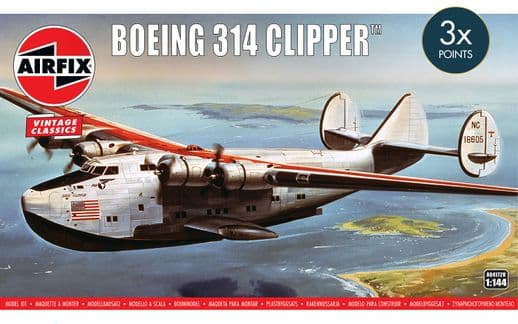
A meeting of classics, our 1/44th scale Boeing 314 Clipper and the artistic talents of a certain Mr Roy Cross – magnificent!
The nostalgia possessed by our Vintage classics range takes many of us back to a time when modelling was just about the most important thing in our lives, with the variety of subject matter available within any Airfix range being the only inspiration we needed. This range of kits allows us all to enjoy those classic models once again, remembering those carefree days of our modelling youth, and allowing us to re-acquaint ourselves with those same highly regarded models from our past.
They also allow younger models to experience the kits we more seasoned modellers always go on about, building the same models that their parents and siblings enjoyed so much in the past, preserving a little scale piece of fascinating aviation (in this case) history in the process.
The mould tools for this beautiful model were manufactured in 1967, with the iconic box artwork illustration being created by the incomparable Roy Cross that same year. Building into a truly beautiful model, the Boeing 314 Clipper has been released several times over the years, however, its introduction into the Vintage Classics kit Hall of Fame has to be considered a high point for this popular range.
This particular aircraft occupies a rather significant position in the annals of aviation history, as she undertook the type’s first passenger flight across the Atlantic Ocean. On 28th June 1939, she left Port Washington on Long Island bound for Lisbon and Marseille, via Horta in the Azores, flying the transatlantic southern route. On board was a relatively modest number of passengers, some of whom had paid their fares to be on this inaugural service many months previously. The flight was only finally cleared to go ahead after these majestic aircraft had successfully completed several airmail only proving flights, but with Pan Am now cleared to fly passengers, the world watched on with fascination.
Pan Am also established transatlantic services flying the northern Atlantic route to Britain, making stops in Newfoundland and Ireland, marking the start of an exciting era for civil aviation, if one clouded by the uncertainties of growing international tensions in Europe. These flights offered the potential of regular and reliable transatlantic air travel for everyone, well at least for those people who could afford a ticket.
Following America’s entry into the Second World War, this aircraft, along with the others in the Pan Am fleet, were requisitioned by the US Government and pressed into military service, assigned to the US Navy, but still operated by experienced Pan Am crews. Initially at least, the aircraft continued to fly passenger flights from the US to Portugal and Britain, but as conflict in Europe made these operations much riskier, they reverted to transport flights, and the shuttling of important and influential people, and/or high value cargo.
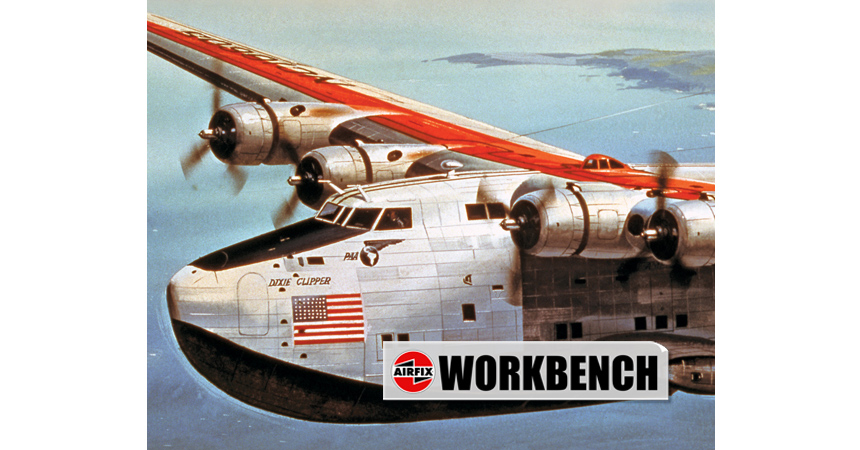
When it comes to high value cargo, it doesn’t come much higher in value than transporting the President of the United States, and when the world’s most powerful man had an appointment to meet British Prime Minister Winston Churchill in Morocco at the Casablanca Conference in January 1943, there really was only one mode of transport to get him there. The ‘Dixie Clipper’ had been fuelled and readied in preparation for a long flight, with the crew being told they would be carrying a special passenger, one referred to as Mr Jones and his party. This must have set their minds racing, but they could hardly have known the role they were about to play in world history.
This high profile operation actually required two Boeing 314 Clippers, with ‘Atlantic Clipper’ NC18604 being the second aircraft involved, with its passenger list including a further collection of important diplomats and secret service agents. On the day of departure, the Dixie Clipper left first approximately 35 minutes before the second Clipper, flying a long route taking in several stops along the way. The President made the final leg of the journey to Casablanca abord a Douglas C-54 Skymaster, and by the time he arrived at the meeting venue at 6.20 pm on 14th January 1943, he had travelled over 7,000 miles during the previous 50 hours.
During the return journey, whilst he didn’t just fly in Boeing 314 Clippers, he did celebrate his 61st birthday abord the ‘Dixie Clipper’.
Following the end of the Second World War, this aircraft was offered to Pan Am by the US War Assets Administration for an attractively competitive price of just $50,000, however, the company was by that time of the opinion that the future of transcontinental air travel would revolve around a new breed of capable land based airliners, so declined the offer. These beautiful aircraft then passed between several different owners and prospective operators, but all quickly succumbed to financial pressures, with the aircraft slowly falling into disrepair.
Boeing 314 Clipper NC18605 ‘Dixie Clipper’ was scrapped sometime during 1951.
The British Overseas Airways Corporation were allowed to purchase three of the modified Boeing 314A model Clippers prior to America’s entry into the Second World War, to assist with their war effort and reputedly at a cost of around $1,000,000 for each one. The aircraft were all part of the original Pan Am option to purchase an additional six aircraft, so each of the British aircraft also had US NC numbers prior to receiving their British registrations. They also happened to be some of the most impressive aircraft operated by Britain during the wartime years.
The ’A’ model Clippers featured several improvements and modifications over their predecessors, which included a slight repositioning of the distinctive fuselage sponsons to counteract a tendency for the original aircraft to ‘porpoise’ when on water. They also introduced more powerful engines and greater fuel carrying capacity, which further increased the aircraft’s operational range from 3,100 to 4,000 miles.
The aircraft were delivered to BOAC wearing the British Temperate Sea Scheme camouflage, however, it’s thought that as they were delivered in these markings, they were most likely a US attempt to closely match the British colour shades, but without the existence of definitive evidence, that it definitely a subject for discussion.
Operating the three Boeing Clippers, BOAC had four entire crews, which were rotated for flights, to ensure everyone was well rested and fresh. They also established a maintenance facility at Baltimore, run by engineers sent from Britain, with each aircraft undergoing an overhaul every time they arrived in the US city. It was claimed that in most cases, BOAC Clipper crews actually spent more time in America than they did in Britain.
From an operational perspective, the British Boeing Clippers were used solely for Air Ministry purposes, meaning that on most occasions, only Government passengers, VIPs and important diplomatic mail was carried, although it is known that quite a number of repatriation passengers were also carried during their wartime service. Both Winston Churchill and Lord Beaverbrook made flights on one of the BOAC Clippers, with Churchill actually becoming the first world leader to make a transatlantic crossing by air, when he did so after meeting the US President at the start of 1942.
This aircraft G-AGBZ ‘Bristol’ was the flagship of the BOAC Boeing Clipper fleet, and after the war had ended, would take the honour of making the final BOAC Clipper flight. All the BOAC aircraft were taken off the transatlantic route in 1946, but continued to fly the Baltimore to Bermuda service until January 1948. G-AGBZ ‘Bristol’ (formerly Pan Am NC18607) made the final flight to Bermuda on 27th January 1948, with the other two aircraft already sat on their beaching gear at the location.
In six and a half years of operation, the BOAC Boeing Clippers had flown 4,250,000 miles and carried 40,042 passengers.
At the end of WWII, all the BOAC Clippers had their camouflage markings removed, making them resemble much more closely their American sisters, although it’s a matter of personal taste whether you prefer the clean, natural metal, or wartime camouflage presentation. After all three aircraft had made their final flights to Bermuda, they were subsequently sold to General Phoenix Corporation, and scrapped during the 1950s.
It is fascinating to learn that at the time of the Japanese attack against Pearl Harbor, two Pan Am Boeing Clippers were actually in the air flying commercial services. Aircraft NC18611 ‘Anzac Clipper’ was just around an hour from landing at Honolulu, but understandably changed course to land at Hilo instead. Once there, the aircraft was beached and hidden amongst trees and foliage for protection, before making the return flight to San Francisco under the cover of darkness.
NC18602 ‘California Clipper’ was also flying a service to New Zealand, but on landing, was ordered to remain in Auckland. Rather than risk the aircraft fly back via the Pacific route, Pan Am officials instructed the crew to take a westerly course, via Singapore, Karachi, Bahrain, Africa and onward to New York, a journey of some 31,500 miles. When she arrived in New York, she had just become the first commercial aircraft to complete a round the world flight, setting several aviation records in the process.
There is an old saying that many of us will remember our parents quoting when we were young, which goes something like, ‘If it looks right, then it is right’, and in the case of the Boeing 314 Clippers, that saying certainly holds true. A production run of just twelve aircraft, they really did seem to have been both pioneers and victims, in the same fascinating aviation story, despite their determination to make their mark before finally handing over long-haul passenger flying responsibilities to a new breed of aircraft which had benefitted from the technological advancement brought about by war.
Elegant and refined, the Boeing 314 Clippers represented a golden age for aviation, a time when the aeroplane offered endless possibilities, opening up the world for those with pockets deep enough to explore it.
The Boeing 314 Clipper is about to become the latest high profile addition to our popular Vintage Classics range.
This beautiful kit is a fine scale tribute to the legacy of these magnificent aircraft, and will make for an extremely cultured addition to the Vintage Classics range. We are expecting these kits to arrive in our warehouse imminently, so you should notice its product page on the Airfix website change from pre-order to available any time now. Wouldn’t a 1/144th scale example of this beautiful aircraft look great amongst our collection of built aircraft model kits?
We are afraid that's all we have for you in this latest edition, but we will be back next Friday with more project development updates and the very latest Airfix kit exclusives. In the meantime, we are always keen to hear your views on all things Airfix and in particular, any thoughts and opinions you may have regarding our Workbench blog. If you would like to drop us a quick line, could we please ask that you use our workbench@airfix.com email for all correspondence.
To re-visit any of the Airfix blogs we have produced over the past seven years or so, please head to our main Workbench hub, where you will find our entire blog back catalogue and all the Airfix design projects we have already covered.
All our dedicated official social media sites can be accessed by clicking the respective link icons at the foot of this page, or by heading to the Airfix homepage. Other useful Airfix links are:
Facebook, YouTube, Twitter and Instagram official sites
Please join us for more Airfix updates next week and thank you for your continued support.