

Welcome to this latest edition of our Workbench blog and all the news, updates, and modelling exclusives from the fascinating world of Airfix.
Although we find ourselves fast approaching the end of yet another year, we do still have new model details to bring you, and as such, have something rather exciting to share with you this weekend. In line with what has now become something of a late year Workbench tradition, we’re going to be taking this opportunity to bring you details of the next exclusive model release awaiting members of the Airfix Club, and though we say so ourselves, this one’s a little cracker! As you would be expecting, we will be bringing you all the details behind the new model offering, including an exclusive first look at a selection of built model images finished in both of the scheme options on offer, just so we can show you the full 2025 Airfix Club picture.
Before we get to that and in view of the fact that we’re still just about in this 80th Anniversary of D-Day year, the current Club kit offering is now approaching its natural end date, and with very few kits remaining in stock, if you have yet to secure your example, that opportunity is fast running out, and therefore the time to act is now. If your renewal date falls within the next six weeks or so, please don’t worry, we have a kit set aside for you, but if you’re still sitting on the Club renewal/new joiner fence, we’d love to have you back with us. To be taken to last year’s new Airfix Club model announcement and to re-discover the details behind the Spitfire PR.XIX and Typhoon Mk.IB kits in all their glory, please use this access link to be transported straight back in time, to that particular edition of Workbench.
Right then, who’s up for a little Airfix Club model exclusive reveal?
Visitors to the RAF Museum Midlands site will be able to gaze upon this magnificent aircraft, the only complete example of the Messerschmitt Me 410 on display in the world, the aircraft which the Airfix team scanned at the start of this project.
For many of us with an interest in the aircraft which took part in the Second World War, the twin engined ‘heavy fighters’ which possessed greater range and firepower than their single engined contemporaries hold particular fascination for us, particularly those aircraft operated by the Luftwaffe, who appeared to have something of a preoccupation with this class of aircraft. The thinking behind the development of these aircraft appeared to be rational enough, and called for the introduction of aircraft which were faster, capable of covering greater distances and possessing greater firepower than their single engined contemporaries, particularly as air combat doctrines of the period felt that bombers with strong defensive armament would easily be able to deal with single engined fighters, particularly if the bombers were in large defensive formations.
In Essence, what the Germans were looking for was a twin engined Messerschmitt Bf 109 fighter, a large and powerful aircraft so devastating that nothing could stand against it in the air battles to come – significantly, as it had the backing of the Commander-in-Chief of the Luftwaffe Hermann Göring, there were few people who were going to argue against such thinking.
Göring was not a lone voice in his championing of the Zerstörer concept, as Great War fighter ace and national hero Ernst Udet was another great proponent of the strategic potential of the heavy fighter concept, and took every opportunity to impress his beliefs on anyone in a position of influence willing to listen to him. He also worked tirelessly to convince the RLM that they must establish a Kampfzerstörer force as a matter of some urgency, in order to support the aspirations of the German leaders, which by that time had become all too apparent. Between them, Göring and Udet ensured the new heavy fighter being developed at that time by Bayerische Flugzeugwerke (soon to become Messerschmitt AG) became a priority aviation project for the nation.
As we all now know, that much vaunted aircraft would be the Messerschmitt Me 110 and despite it having extremely high-profile supporters, the early development and subsequent combat introduction of the Me 110 didn’t pass without some challenges, and it became obvious even from those early combat operations that the ‘Destroyer’ concept may be somewhat flawed for modern aerial combat. Nevertheless, the aircraft would have its successes during operations over Poland and north west Europe, and even though the Battle of Britain effectively exploded the myth of the Luftwaffe’s Zerstörers, they would go on to become extremely effective aircraft in specialist roles and stimulate the development of more capable variants.
Even before the Messerschmitt Bf 110 had been forced to endure its mauling at the hands of Fighter Command during the Battle of Britain, work on developing its successor in the Zerstörer role was already well underway, with officials remaining convinced about the potential of the heavy fighter concept. What they needed was a more capable aircraft which just offered more of everything and in the Messerschmitt Me 210, they thought that was exactly what they would be getting.
Already a popular model in the Airfix kit range, the Messerschmitt Me 410 is such an interesting aeroplane and as such, makes for a compelling modelling project.
The Me 210 was a very different looking aircraft to its predecessor, featuring the very latest technological innovations and utilising the most powerful variant of famous Daimler Benz aero engine. Although the new aircraft was designed to utilise as many of the same components used in Bf 110 production as it could, its appearance could hardly have been more different from its predecessor, with its short, purposeful nose helping to accentuate the size of the aircraft's mighty engines and the fact that this aircraft definitely meant business. Featuring a ventral weapons bay under the nose of the aircraft to minimise the effects of drag, it also incorporated a pair of remotely operated MG 131 machine guns, which were housed in teardrop shaped barbettes on either side of the rear fuselage, operated from the rear cockpit by a gunner using a clever electronically controlled system utilising a hand pistol grip and compensated gunsight. The gunner’s targeting view was further enhanced by a blown rear canopy which extended past the line of the fuselage, meaning no attacking aircraft could escape his gaze.
Ultimately, despite the fact that the Messerschmitt Me 210 was unquestionably a spectacular looking aircraft in every respect, it was a seriously flawed aeroplane and despite protracted delays and a significant initial order for 1000 fighters being placed, this intended replacement for the Bf 110 proved to be a very poor aeroplane indeed and not at all the heavy fighter the Germans were hoping for. In fact, the problems, delays and general unsuitability of the aircraft resulted in effective cancellation of the project and Messerschmitt having to almost go back to the drawing board.
Although they did manage to produce an excellent aeroplane the next time around, time waits for no man, and the air war was a very different place for the Luftwaffe in 1943. The Messerschmitt Me 410 Hornisse may have emerged from the embers of the Me 210 debacle like a phoenix from the Augsburg flames, however, this excellent fighting aeroplane was introduced far too late to have any meaningful impact on the deteriorating situation Germany now found herself in. Had the Messerschmitt Me 410 been introduced when the Me 210 was initially intended to be at the end of 1940/early 1941, the Luftwaffe would have been equipped with a devastatingly effective multi-role aircraft, one which had the potential to claim a great many Allied aircraft in combat operations, and one which could turn its hand to a variety of different roles.
Unfortunately for the Germans and their Messerschmitt Me 410, the aircraft didn’t start arriving with front-line units until the early summer of 1943, by which time, it had little chance of having a major impact on the air war – the Bf 110 replacement was over two years late in joining the fight.
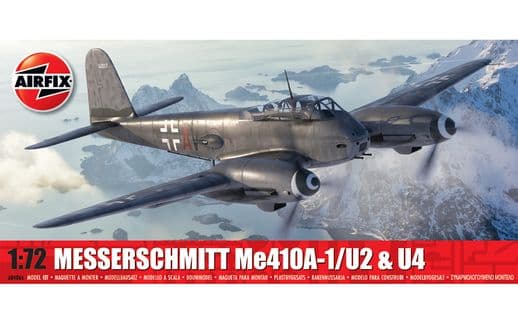
We never turn down the opportunity to show Airfix box artwork, particularly when our subject is so appealing as the Messerschmitt Me 410 Hornisse.
When Hermann Göring initially imagined what his Luftwaffe Zerstörer force might look like as the concept was first muted back in the mid 1930s, it must surely have been close to what a sky full of Messerschmitt Me 410 heavy fighters would have looked like. Although this was a development of the earlier and ultimately disappointing Me 210 and indeed, shared a great many visual similarities to its unimpressive predecessor, the Me 410 was a very different aeroplane indeed. In fact, Hitler would go so far as to proclaim it as his 'Backbone of Germany's Home Defence', after he had seen a cannon armed example flown during a demonstration of his latest Wonder Weapons.
If you know where to look though, despite the similarities shared by the two aircraft, it isn't that difficult to differentiate between a Messerschmitt Me 410 and its predecessor and with it, identifying an effective combat aircraft from an extremely flawed one. Looking at a side profile of the aircraft, the Me 410 has a slightly taller and noticeably longer fuselage, with lengthened, more refined engine nacelles housing the new and more powerful Daimler Benz DB 603 engines.
These modifications alone gave the aircraft a visibly more elegant appearance, whilst at the same time also highlighting its potential as an effective combat aircraft. The instability issues which blighted its predecessor were rectified by redesigning the wing shape and incorporating automatic leading edge slat technology, endowing the aircraft much better low speed handling performance. The wing of the Me 210 featured two different leading edge sweep angles, with a 6 degree sweep inboard of the engines and 12.6 degree sweep outboard, however, the Me 410 wing design did away with this, maintaining a constant 5.5 degree sweep across the length of the leading edge. When combined with the automatic leading-edge slats, these modifications virtually eliminated the instability issues suffered by its predecessor, allowing the Me 410 to concentrate on becoming an effective combat aircraft, rather than simply trying to stay in the air.
The prototype Messerschmitt Me 410 made its first flight during the Spring of 1942, and immediately showed itself to be a much more capable aircraft than its predecessor, essentially the Zerstörer the Luftwaffe had been hoping to have introduced two years previously. Now given the name Hornisse (Hornet), they were hoping the new heavy fighter would stir up a storm in the air, and like its predecessor, was ordered in large numbers shortly after the flight of the prototype, even attracting the same priority production status.
A pair of built model images finished in very different schemes – there’s a tale to tell here!
From the outset, even though the first aircraft were produced as Schellbombers (fast bombers) and intruders, it could easily be argued that the Messerschmitt Me 410 was a true multi-role aircraft, one capable of performing a variety of different tasks effectively, with flexibility intentionally built into its overall design. Could we even go so far as to suggest that this was the closest the Germans ever came to producing their own version of the British de Havilland Mosquito they hated and admired so much?
With its ventral weapons bay in the nose of the aircraft, the Me 410 could be configured to perform a multitude of operational tasks, with fast bomber and heavy fighter being its primary roles, but with others such as night fighter, reconnaissance, bomber killer, torpedo bomber, dive bomber, long range/maritime strike and training roles all eventually being undertaken. In fact, something of a design industry was to grow around the concepting of proposed future variants of the Me 410 throughout its service life, even though it entered service two years later than initially anticipated.
Although developed as a Schnellbomber, many of the first Me 410s entering service were used in nightfighter/intruder or reconnaissance roles, however, it didn't take crews long to discover that this was a much better aeroplane that its predecessor, as it was welcomed into widespread service.
Production of the Messerschmitt Me 410 ended during August 1944, when the manufacturing lines were switched to producing more single engined Messerschmitt Bf 109G fighters for home defence duties, however by that stage in the war, things were already looking futile for the beleaguered Luftwaffe. Remaining Me 410 units continued fighting until the final days of WWII, although very few aircraft would be left intact by the end of hostilities.
Today, just a single complete example of a Messerschmitt Me 410 is to be found on display anywhere in the world, one of the prized aviation possessions maintained by the Royal Air Force Museum at their Midlands RAF Cosford site, the very aircraft Airfix scanned at the outset of this exciting new model tooling project.
Despite its protracted development and relatively limited operational success, the Messerschmitt Me 410 is undoubtedly one of the most impressive looking aircraft types of the Second World War, interesting as the ultimate incarnation of Germany's fascination with the Zerstörer heavy fighter concept.
Are you ready for our exclusive reveal? A captured enemy aircraft of some repute is awaiting Club members in 2025 … read on for more details.
The Airfix team always like to serve up something appealing for our Club members when it comes to kit selection, and this year is certainly no exception. Before we move on to the kit, we’ve also made a couple of subtle changes to the overall kit package for 2025, including a club badge which now includes the year in which it was issued, something members have been asking about for some time, and the remove before flight keyring now has a decidedly Messerschmitt Me 410 feel to it.
On to the kit itself, and this hugely appealing kit comes with additional parts to allow the A-3 reconnaissance variant of the Hornisse to be built, featuring two very different, yet inextricably linked scheme options in which to consider finishing your model. Both schemes actually feature the same aircraft, but under very different ownership and flying in different skies.
Let’s take a closer look at those details now.
Scheme A – Messerschmitt Me 410A-3 WNr.10259 F6+OK, 2.(F)/Aufklärungsgruppe 122, Perugia, Italy, November 1943.
In a development which only served to underline the delays and frustration associated with Germany’s search for a successor aircraft to the Luftwaffe’s Messerschmitt Bf 110 heavy fighter, the Me 410 would actually be an excellent aeroplane, one which was fast, relatively manoeuvrable and possessed impressive range. Perhaps its most impressive attribute, however, was its adaptability and the fact that this was a true multi-role aeroplane, one which was actually rather good at most of the roles it was asked to perform.
One of the specialist roles modified variants of these aircraft were required to perform was that of long range, high speed reconnaissance aircraft, where the weapons bay positioned in the chin of the Me 410 was modified to carry a pair of high quality Riehenbildner RB 50/30, 20/30 or 75/30 medium to high altitude, high resolution camera units, possessing the photographic power to ensure nothing could escape the inquisitive nature of their lenses. As long at the Allied air forces weren’t operating in the area to be reconnoitred, these ‘nosey’ Hornets could keep an eye on Allied activities in southern Italy, as they pressed north, but unfortunately for them, by the time the Messerschmitt Me 410 was available in anything like decent numbers, the Allies already had the upper hand in Europe.
Despite the vital importance of these reconnaissance missions, Hornisse crews would rarely be able to complete a sortie without coming into contact with some form of enemy opposition and by this stage of the war, many of the crack fighter units the Luftwaffe could boast over the previous three years had long since disappeared. As a consequence, the Luftwaffe in Italian skies were consistently losing more aircraft than they were managing to shoot down and for crews involved in performing reconnaissance missions, they were under no illusion that their next mission could very well be their last.
During the late morning of 27th November 1943, Messerschmitt Me 410A-3 W Nr.10259 F6+OK took off from its home airfield at Perugia in central northern Italy, heading out to conduct a photo reconnaissance mission over the Gulf of Naples. The crew of Fw. Hans Beyer and his gunner/observer Uffz. Helmut Hein were flying westward out over the Tyrrhenian Sea at 30,000 ft, when the pilot noticed his instruments malfunctioning and fearing a problem with the aircraft, immediately set course for home.
Unfortunately, with the stress of the situation and with the problem persisting, Beyer made a critical navigational error and rather than crossing the coast over Axis controlled Rome, did so 100 degrees to the south over Salerno. With the aircraft still having problems and with engine temperatures climbing, the pilot elected to make a landing at the closest airfield he could find, one which he hadn’t for one moment thought could be under enemy control.
Scheme and built model details featuring the aircraft as it was captured by the Raf at Monte Corvino airfield at the end of November 1943.
Bringing the aircraft round for a standard approach, both crew members failed to notice the large collection of unfamiliar aircraft types gathered together on the airfield and even when the airfield’s anti-aircraft batteries opened fire on them, they simply thought crews were being a bit trigger happy and let off an identification flare. With the aircraft now clearly committed to landing, the gunners held their fire and looked on in amazement as this enemy Messerschmitt landed at their airfield.
The crew had inadvertently landed at Monte Corvino airfield, a facility which for the past few weeks had been under British control, as the Allies continued to sweep north. Once the aircraft landed, it travelled the length of the runway slowing down, before violently swinging around and lining up to head back down the runway, probably at speed. Onlookers reported that the crew appeared to have noticed their mistake by the time their aircraft came to a halt, and were attempting to take off again. Thankfully, some quick-witted troops had been watching this drama playing out from the cab of a speeding truck, and as the Hornisse attempted to take off again, blocked its path before it could get to full power. It was even reported that the Messerschmitt attempted to manoeuvre around the truck to make good its escape, but was thwarted.
The pilot was reported to have been reluctant to give up his position in the cockpit and only agreed to shut down the engines thanks to the brandishing of a service revolver, suggesting this was definitely a mistake and not an attempt to surrender. Whatever the back-story to this incredible incident, the RAF now had a perfectly intact and almost fully serviceable Messerschmitt Me 410A-3 in their hands, complete with cameras and exposed reconnaissance film. A thorough inspection of the aircraft also yielded a collection of signals documentation, which was to prove useful to the Intelligence Officers in the weeks and months to come. As for the Messerschmitt itself, although official requests were received for it to be handed over to the Americans, this Me 410 had an appointment with the RAFwaffe.
Scheme B - Messerschmitt Me 410A-3 WNr.10259 TF209/P, Fighter Interception Unit, RAF Wittering, England, August 1944.
This aircraft was built by Messerschmitt at their main Augsburg factory, where it was completed in its standard factory applied camouflage scheme, and given the factory Stammkennzeichen code SN+HH (Root Identifier Code), which would usually be removed or overpainted once the aircraft had been delivered to an operational unit. It was also understood that this particular aircraft started life as an Me 210 variant, but used as a donor airframe for the heavily modified Me 410 whilst it was still in the fabrication jigs.
This was the very same aircraft that pilot Fw Hans Beyer inadvertently landed at the RAF controlled Monte Corvino airfield on 27th November 1943. It was subsequently transported to Britain by ship, arriving into the care of the Royal Aircraft Establishment at Farnborough on 14th April 1944, and once there, was given a distinctive new scheme to indicate the aircraft’s change of ownership, a scheme which included yellow undersides and large yellow ‘P’ markings on its fuselage. It would make its first flight from Farnborough on 1st May 1944 in the hands of the RAE’s Chief Test Pilot Squadron Leader Roland ‘Roly’ Falk, a man who would become expert in flying and testing captured Axis aircraft.
The Hornisse was to suffer damage at Boscombe Down on 5th June when one of its main undercarriage legs failed to lock in position during landing and was only able to make its return flight back to Farnborough as a result of some creative engineering and a temporary fix to the problem. All the flights made during the aircraft’s time with the RAE were undertaken by Roly Falk, however, on 14th August 1944, it was prized from his grasp and flown by another pilot to RAF Collyweston, the satellite airfield of RAF Wittering. Once there, the aircraft was to be used in a series of comparative trials with a de Havilland Mosquito, all completed under the control of the Fighter Interception Development Unit.
These flights were essential in not only allowing the British to understand the current state of German aviation and manufacturing technologies, but also in developing tactics to assist Allied pilots in overcoming the latest Luftwaffe aircraft, something which could quite literally prove to be the difference between life and death in the frenzy of aerial combat situation.
Axis eagle in different plumage. Once the captured Messerschmitt Me 410 arrived in the UK, it would be used to perform months of test, evaluation and familiarisation flights, as one of the most capable Luftwaffe aircraft to come into the hands of the Allies.
Having spent much of its time flying in Britain in a test and evaluation role, the aircraft would also serve with one of the most interesting units operated by the Royal Air Force during the Second World War, No.1426 Enemy Aircraft Flight. This unit also spent a time based at RAF Collyweston, but was sometimes colloquially referred to as the ‘Rafwaffe’, by virtue of the number of airworthy captured German aircraft it operated. During this time, the aircraft wore a scheme of RAF dark green/dark earth upper surfaces, with yellow undersides and a large yellow ‘P’ for prototype on its fuselage sides, in addition to the usual roundels and fin flashes. As one of the most capable Luftwaffe aircraft at that time and the one which most closely matched the British Mosquito, the Me 410 would be kept rather busy in revealing all its secrets.
In addition to time spent flying comparative trials against many Allied aircraft types, the aircraft of No.1426 proved to be extremely popular when touring RAF and USAAF airfields across the country, where they were charged with allowing base personnel the opportunity to inspect the appearance and performance of these hostile aircraft types, and even just to allow them to hear what enemy engines sounded like.
This most famous of captured German aircraft was still thought to have been in airworthy condition, or pretty close to it by the end of the Second World War, when it was transferred to the care of No.6 MU at Brize Norton. The aircraft remained at Brize Norton until it was eventually struck off charge and sold for scrap on 14th August 1947.
A most interesting aeroplane indeed.
We always like to do something a little bit special when it comes to Club model subjects, and we sincerely hope you agree that this new offering falls squarely into this category. In addition to allowing active members to build the reconnaissance variant of this distinctive aircraft, you have the choice of two scheme options, one Luftwaffe and one Royal Air Force, but with both worn by the same rather famous aeroplane, before and after its change of ownership. If you’re looking for a build project which possesses both a fascinating story and bags of modelling personality, then this really could be the kit for you, and we can’t wait for you to get your hands on it.
As usual, the new Club kit offering will be available to new and renewing members once the membership date clicks over in mid-January, but whenever your own membership renewal date is scheduled, you can look forward to receiving your own example of this fantastic, captured Messerschmitt Me410A-3 kit.
A Club kit of distinction. We only have to wait until January next year before new and renewing Club Members will be able to get their hands on this really appealing kit.
We are afraid that's all we have for you in this latest edition, but we will be back next Friday with more project development updates and the very latest Airfix kit exclusives. In the meantime, we are always keen to hear your views on all things Airfix and in particular, any thoughts and opinions you may have regarding our Workbench blog. If you would like to drop us a quick line, could we please ask that you use our workbench@airfix.com email for all correspondence.
To re-visit any of the Airfix blogs we have produced over the past seven years or so, please head to our main Workbench hub, where you will find our entire blog back catalogue and all the Airfix design projects we have already covered.
All our dedicated official social media sites can be accessed by clicking the respective link icons at the foot of this page, or by heading to the Airfix homepage. Other useful Airfix links are:
Facebook, YouTube, Twitter and Instagram official sites
Please join us for more Airfix updates next week and thank you for your continued support.