
Welcome to this latest edition of our Workbench blog and all the news, updates, and modelling exclusives from the fascinating world of Airfix.
Our update subject for this latest edition has to be described as one of our most interesting model kit new tooling projects of recent years, and possibly in the entire Airfix range, the pretty unique Fairey Gannet. Not an aircraft type most people would probably suggest as their favourite, and definitely not one you would ever describe as a thing of aeronautical beauty, but from a modelling perspective at least, you don’t have to spend too long in the company of our new Gannet kit to start appreciating its many appealing attributes, and dare I even suggest, become somewhat besotted with it. As far as modelling projects go, if you’re looking for one with real character that’s something just that little bit different, then the Fairey Gannet possesses both by the bucket-load.
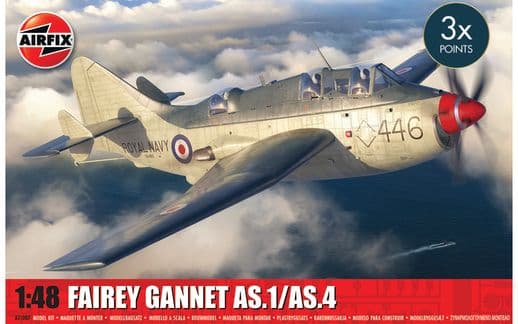
In this latest 2025 project review update, we prepare to welcome what will only be the second kit release from our 1/48th scale Fairey Gannet tooling by featuring our COD.4 variant of this distinctive aircraft, a kit which includes new parts to allow this final variant of the aircraft to be modelled, and three new decal/livery options which will only serve to further endear this magnificent kit to our modelling hearts. With a selection of built model images to bring you, full details of the scheme options, news of our latest collectable coin release, and a brace of videos to embed in this edition, we will be taking this opportunity to bring you a full and robust introduction to what we think is a stunning impending addition to the current Airfix range.
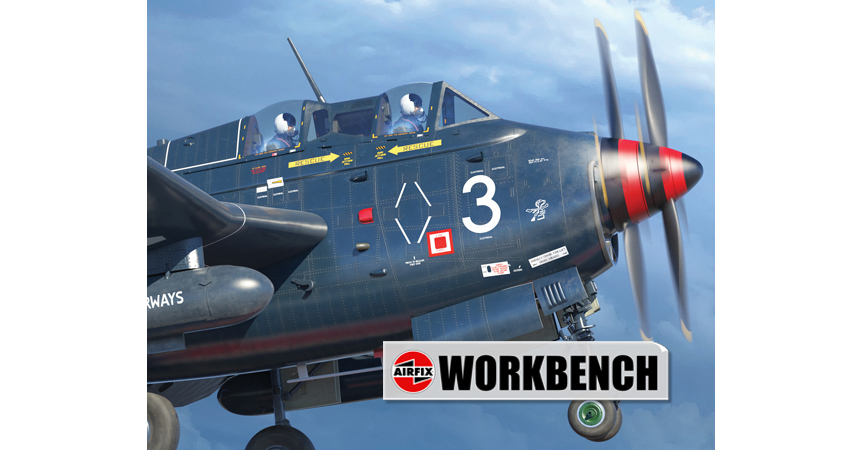
Although our kit can’t convey the incredible sound of a Double Mamba engine arrangement operating at full chat, it certainly provides modellers with a stunning scale representation of this most interesting British naval aeroplane. We’re spending time with the Fleet delivery variant of the Fairey Gannet this Workbench Weekend.
This rendered CAD image produced at the time the Gannet tooling was being developed shows how unusual, and how impressive a design the Fairey Gannet was.
A post WWII British aviation type which from an aesthetic perspective at least, has to be described as something of an acquired taste for many, the Fairey Gannet may not have qualified as one of the most attractive aircraft to have ever operated from the decks of a British aircraft carrier, however, it was extremely effective in the roles to which it was assigned and with it, was unquestionably one of the most distinctive.
The Fairey Gannet claims the distinction of being the first British designed aircraft in Fleet Air Arm history to combine both search and strike roles when it came to protecting the fleet from enemy submarine activities, developed in response to a 1945 Royal Navy requirement for an advanced carrier-based turbo prop powered anti-submarine hunter killer, one which was rugged enough to withstand the substantial rigors of operation at sea. Intended to counter a worrying expansion of Soviet submarine fleet numbers at the start of the Cold War era, the Gannet was equipped with all manner of the latest electronic detection equipment, and should it detect an enemy submarine, that target could be marked, tracked and if necessary, destroyed, using a combination of bombs, depth charges, rockets and air-launched acoustic torpedoes.
Despite possessing an appearance many may describe as portly, the Gannet was actually an impressively manoeuvrable aircraft and when combined with the excellent visibility its pilot was afforded from his lofty perch, and the considerable power available from its unusual and innovative Armstrong Siddeley Double Mamba powerplant arrangement, the aircraft proved to be ideally suited to the harsh aviation environment operating from the deck of an aircraft carrier. Offensively, the Gannet was definitely not to be taken lightly, as its cavernous ordnance bay could carry around 30 different combinations of detection and attack stores, so if you were unlucky enough to attract the attention of a Royal Navy Gannet, you were unlikely to escape the encounter unscathed.
In strike configuration, the Gannet could be equipped with up to 36 rockets mounted on stations below each wing, which could be used against any number of potential targets, from ships to coastal defences. In much the same way as the famous Short Sunderland flying boat was regarded during the Second World War, the Fairey Gannet proved to be a particularly prickly aircraft if provoked.
An Airfix kit classic in the making. This fascinating image shows the Gannet design skeleton overlayed on the scan data supplied at the start of the project.
The term ‘Beauty’s in the eye of the beholder’ extends to the world of aviation, and whether you love, or loath it, there’s no denying that the Fairey Gannet makes for a spectacular modelling build project.
A really impressive naval aircraft type which possessed a number of distinctive features, perhaps the most significant of these was its use of the innovative Armstrong Siddeley Double Mamba powerplant. This arrangement utilised two gas turbine engines mounted side by side in the nose of the Gannet, both sharing a common gearbox, but with both operating independently of each other, with each engine driving its own coaxially mounted, contra-rotating propeller.
Another significant feature was that the engines could run on kerosene and even diesel fuels, which were safer to handle and required less refinement than traditional aviation fuels. This arrangement provided Gannet crews with more than enough power for effective carrier operations, whilst also providing the reassurance of two engines when engaged in undertaking long ocean patrols, whilst engaged in protection of the fleet activities. Once in flight, the pilot could shut down one of the engines to conserve fuel and whilst this would reduce the Gannet's maximum speed, it would also extend its loitering capabilities considerably.
Usually, a pilot would alternate engine use during a long patrol, running each engine for around an hour before swopping over and feathering the prop, minimising the potential for engine damage and keeping engine usage roughly equal. Providing all the benefits of twin engined operation, the fact that both propellors lay on the centreline of the Gannet, there were no control drawbacks from shutting down one engine in flight. The engine mounted on the port side of the Gannet drove the forward mounted propeller, with the starboard mounted engine driving the prop behind.
This series of three pictures feature built models of the new Gannet COD.4 kit, each one finished in the three schemes included with this impending new release.
Another unique feature of the Gannet's design was its impressive bi-folding wing system, an innovation which was designed to allow this relatively large aircraft to operate safely from, and to be stored below deck on one of the Royal Navy's relatively small aircraft carriers. When a pilot engaged the wing unfold, this ingenious system not only prepared the wings for flight configuration, but also automatically engaged all flight control systems, hydraulic connections and fuel ducting to the main system, without any ground crew intervention in the majority of cases.
In operation, the Gannet endeared itself to both air and ground crews by virtue of its rugged effectiveness and how in one incredible incident, an aircraft managed to safely return to base after losing both outer sections of its wings. With its pilot performing some particularly violent manoeuvres during an attack operation, the aircraft lost the outer sections of both wings, however, despite the severity of the situation, the rugged Gannet brought its crew home safely and with it, increased its stock amongst Fleet Air Arm aircrews. As far as they were concerned, if you were going to serve operating aircraft at sea, you had a better chance of surviving the experience if your mount was a Fairey Gannet.
During the summer of 1950, a Fairey Gannet would become the first turboprop powered aircraft in the world to land on the deck of an aircraft carrier, and production deliveries of the most heavily produced AS.1 variant of the aircraft would begin in 1954. No.826 NAS would take the honour of being the first operational Fairey Gannet Squadron in the Royal Navy and around 348 Gannets would eventually be produced, marking this as a significant contributor to Fleet Air Arm post WWII operations.
With its position as one of the most unusual, yet operationally effective aircraft of its kind to see Fleet Air Arm service, the Gannet has long been on the radar of the Airfix development team for new tooling consideration, particularly as it always appeared prominently on any list of new tooling suggestions modellers cared to communicate to us. There has always been something rather enigmatic about aircraft which were operated at sea and as a consequence, model kits featuring Fleet Air Arm subjects have always been popular additions to any Airfix range.
Such an interesting aeroplane, our second release from the new 1/48th scale Fairey Gannet tooling includes new parts to allow the COD.4 air transport variant of the aircraft to be modelled.
Workbench regulars will be aware that our new 1/48th scale Fairey Gannet tooling project was announced with range launch at the beginning of 2023, something of an unexpected, but immediately attention grabbing addition to the range. As such, this project was the first of the new tooling announcements to be covered by Workbench that year, reflecting the interest levels this new kit attracted following its announcement. You can re-visit our researcher/designer project overview edition by using this Gannet Introduction link.
As always, we used the blog to provide readers with comprehensive project updates throughout the year, but were delighted to read on several enthusiast websites that many modellers considered the Gannet to be the model release of the year, underlining the quality of design and subject character this Fleet Air Arm classic possesses.
Although we did have beautifully finished kit builds of the Gannet on the Airfix stand at Scale ModelWorld that year, it wasn’t until Scale ModelWorld 2024 that the Gannet began to show its true modelling hobby credentials. It was humbling to see just how many beautifully finished examples of the kit featured amongst many of the displays across the three exhibition halls, and indeed how many of these had been entered into the various hotly contested competitions this event if famous for supporting. Indeed, many of them appeared to come away with awards of one form or another, with our little kit seemingly doing great things for Fairey Gannet aviation recognition in the months following its release – long may this continue.
Our second release from this exceptional tooling presents the Fairey Gannet in a very different role from the one which inspired its design and introduction, one with a much more humanitarian outlook. The COD.4 variant Gannets were categorised as Carrier Onboard Delivery aircraft, and essentially operated airborne transportation shuttles between their assigned aircraft carrier and shore stations. Six aircraft were converted for this role from existing AS.4 airframes, having their bulky radar equipment removed, and fitted with improved radio equipment in its place. The aircraft’s weapons bay was heavy modified, trading weapons for stores panniers and the ability to carry additional fuel. Baggage pods could also be carried beneath each wing, making these relatively hard-working, and extremely fondly regarded aircraft amongst the ship’s company.
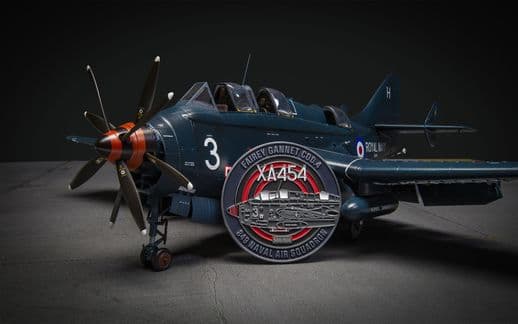
This latest Gannet release is supported by the limited availability of our latest Airfix collector coin, one which features the aircraft immortalised by the lead scheme of three included with the kit.
Although often described as mail delivery aircraft, the COD Gannets were actually much more than that, becoming a vital transport link between the carrier at sea and the nearest shore bases. Although mail and package carrying did make up some of its duties, these aircraft were also required to bring essential spare parts for ships operations, and were VIP air transport for high ranking naval personnel, or anyone who needed to be relocated in short order.
Normally operating with a crew of two, the third seat was reserved for a passenger meeting the COD Gannet’s consideration criteria, but usually after discharging any VIP transportation duty, a COD Gannet would return to her home vessel with a welcome delivery of mail and supplies, enough to keep them in the good graces of the crew.
This second release from the 1/48th scale Fairey Gannet tooling comes complete with three extremely appealing scheme options which will certainly make this seaborne delivery variant of the aircraft of great interest to modellers, particularly those that have a leaning towards naval aviation. Before we move on to take a closer look at each one in turn, let’s take a short break to enjoy the Gannet unboxing video which has only been posted over the past couple of days.
Scheme A – Fairey Gannett COD.4 XA454, No.849 Naval Air Squadron, HMS Hermes, 1969.
For those not convinced about the many impressive attributes of the Fairey Gannet, they could be a little uncomplimentary about the aircraft’s appearance, because it does have to be said that it’s something of an acquired taste. They always say that beauty is in the eye of the beholder and when it comes to unflattering nicknames, those associated with the Gannet were more in relation to noise than looks. With the Double Mamba engine arrangement creating quite a racket when both engines were being run at something close to full power, the Gannet was described as being a Converter of kerosene to noise, even though it has to be said that the aircraft was almost universally held in great affection.
Gannet production was shared between Fairey production facilities at Hayes, Middlesex and Heaton Chapel, Stockport/Manchester Ringway Airport, with aircraft produced at Hayes being transported to White Waltham for flight testing and those produced in Stockport being test flown from Ringway, which was then and obviously still is the current Manchester International Airport site. As a young boy visiting Manchester Airport, you could still clearly see the old Fairey Aviation sheds when standing on the roof of the viewing piers, sheds which would have housed Gannets during their production and testing years.
Fairey Gannet XA454 was originally constructed as an AS.4 variant at Fairey’s Stockport factory, making her first flight from Manchester Ringway on 25th October 1956, and entering Fleet Air Arm service with No.814 NAS onboard HMS Eagle in 1958. Five years later and following the Navy’s intention to phase out Gannet’s in the anti-submarine warfare role, this aircraft was converted to COD.4 configuration at Lee-on-Solent, subsequently joining 849 Naval Air Squadron ‘B Flt’ onboard HMS Centaur. She would also serve on both HMS Victorious and HMS Hermes, where she arrived in 1967.
Full scheme details of this beautiful ‘Hermes Airways’ COD Gannet, the one which served as inspiration for the production of our latest collectable coin.
In the COD role, this aircraft would be heavily employed in supporting everyday carrier operations, from ferrying parts and equipment required for the smooth running of the vessel, to providing a rather dignified mode of transport for senior members of the command staff. She was allocated to 849 ‘A Flt’ and given fuselage number 264 in Feb 1968, but during the following year, she was loaned to RAE Bedford for use in arrestor hook trials, before returning to No.849 NAS HQ at RNAS Brawdy later that same year. In this beautiful all-over Navy Blue scheme, she is presented in the markings she wore whilst serving aboard HMS Hermes, which she did towards the very end of her service career.
Following her retirement in 1970, this aircraft was seen displayed at Royal Naval Air Station Yeovilton for several years, before meeting her end having been transferred to the station fire section. Her smartly presented spinner only enhances the aesthetic appeal of this handsome aircraft and with Hermes Airways printed on both of her underwing baggage pods, this really will prove to be a difficult finish option to overlook for many.
Scheme B – Fairey Gannet COD.4 XG790, No.849 Naval Air Squadron, B Flight, HMS Ark Royal, 1970.
For a Gannet variant which had the least offensive capability of all the Gannets produced, the converted COD carrier on-board delivery aircraft proved to be rather high profile, and quite cherished aeroplanes, both by the crews of the ships they served, and the wider aviation enthusiast community. When HMS Ark Royal was on deployment and her COD Gannet went ashore, they attracted plenty of attention and were the subject of some very appealing photographs, which highlight just how much affection these distinctive aircraft were held in.
As already mentioned, Faireys operated a sub-assembly system for Gannet production, with components manufactures at Hayes, Hamble and Stockport, with two final assembly plants at Manchester Ringway and Northolt. Aircraft manufactured at Ringway would complete all their flight testing there, whilst aircraft produced at Northolt would usually be flown to White Waltham to conduct their test flying programmes.
An unusual looking aircraft which incorporated plenty of technical innovation, the Gannet was ideally suited to flight operations at sea, being incredibly robust and affording its pilot an excellent view of the deck. In fact, the Gannet was so tall that the pilots eye level whilst on deck was almost as good as the deck operations manager in the tower. From an operability perspective, the Double Mamba powerplant gave a Gannet pilot more than enough power to cope with a late landing wave-off and subsequent go-around, also possessing the ability to shut one engine down and alternate between the two gave the aircraft an impressive patrol/loitering capability.
Full scheme details for this handsome HMS Ark Royal based Gannet COD.4
Usually, Ark Royal’s Gannets would be the first fixed wing aircraft to take off on any given flying day, and the last to land back on, something which underlines its importance to carrier operations. Indeed, when the Gannet was first ordered, it was given super-priority production status, something which hadn’t been attributed to a British aviation project for several years previously. Ultimately though, the age of the helicopter had already arrived, and many of the duties previously undertaken by Gannets were taken over by helicopters, which were much easier to operate from ships at sea. The final variants of Gannet to operate from the decks of HMS Ark Royal were her airborne early warning aircraft, and her single, much loved COD.4.
This particular Gannet made her first flight on the 22nd January 1957 and was delivered to the Fleet Air Arm early the following month. Initially constructed as an AS.4, she was later converted to COD.4 standard and was the aircraft detached to HMS Ark Royal as an 849B asset, where she was presented in this magnificent scheme, which included the B Flight logo in the diamond under the pilot’s cockpit. The beautifully applied nose and tail stripe markings illustrate just how fond crews were of their assigned COD Gannet, and how from a modelling perspective, these make for fascinating build projects, despite the fact that they don’t carry any offensive armament.
For something so attractive, its quite distressing to learn that following her service retirement, this beautiful Gannet ended its days as a target on the Tain weapons ranges in northern Scotland, allowing RAF and FAA pilots to perfect their attack techniques by targeting one of their own.
Scheme C – Fairey Gannet AS.4/COD.4 XA430, Flag Officer Aircraft Carriers (FOAC), RAF Changi, 1965.
We mentioned about the COD.4 Gannets also having responsibilities for transporting important Royal Navy personnel from ship to shore previously, well with this scheme, it underlines this role in some style – you don’t get much more important than the Rear Admiral commander of the Carrier Striking Group. From a researcher’s perspective, Royal Navy tradition can be a little challenging to take on board unless you are completely conversant with it, and as I don’t claim to have anything like such knowledge, I’m having a stab at it in the hope that I don’t get things horribly wrong, annoying those in the know in the process. If you do have that knowledge and can shed some light on this fascinating subject, please do drop us a line at workbench@airfix.com.
As this aircraft carries the Rear Admiral’s pennant on its tail, I think I’m right in saying that this was the COD Gannet assigned to the carrier on which he was based, and for the timeframe covered by this particular livery, that would have been Rear Admiral Sir Hugh Richard Benest Janvrin. This scheme was the earlier style adopted by FAA Gannets, however, not long after, they would be repainted in the smart all-over Navy Blue schemes worn by the previously reviewed scheme options above.
Clearly assigned to a carrier operating in the Indian Ocean and Arabian Sea (HMS Eagle), XA430 was photographed wearing this same livery at RAF Khormaksar in around 1963, and again wearing the dark blue scheme at the same airfield a couple of years later. In the livery covered by this option, the aircraft also sports red kangaroos on either side of its forward fuselage, decoration additions which are thought to have been ‘zaps’ applied by RAAF personnel. It’s thought that these were applied during a visit to No.2 Squadron RAAF Butterworth in Malaysia, a friendly military tradition which exists to this day.
Full scheme details for this unusual COD.4 Gannet, followed by the full product box presentation we’re all going to have to keep an eye out for in the very near future.
Fairey Gannet XA430 made its first flight during the late summer of 1956 and was delivered as an AS.4 variant towards the end of September the same year. During an active career, she served on HMS Eagle as both an AS.4 and COD.4, where she was assigned to No.849D Flight in that latter role. She would also operate from Royal Naval Air Stations Culdrose, Brawdy and Lossiemouth during her career, in addition to operating under sunnier skies in the Middle and Far East.
She would be flown to the Naval Air Support Unit airfield at Brawdy during the summer of 1968, an airfield which was used extensively for the training of Fleet Air Arm pilots, and was home to quite a collection of Gannets, mainly those performing the AEW role. Following the airfield being handed back to RAF control, this Gannet was subsequently sent to RNAS Lossiemouth to be used as a spares ship, but again, ended up on the station fire dump and was scrapped in the early 1980s. For aircraft which were previously so lovingly cared for, this really does seem to be a rather unsuitable end for them, particularly as there is currently just a single COD.4 Gannet preserved and on display.
Just the second release from this impressive tooling, we are currently expecting our scale tribute to this strangely alluring Fleet Air Arm aircraft to be in our warehouse by the middle of next month, but as always, you can reserve your example by heading to the COD.4 Gannet webpage anytime. As you will no doubt be aware, those securing their Gannets within the first batch will also receive an example of the latest addition to our popular collector’s coin series, this time featuring the lead scheme option of the three on offer with this kit – Fairey Gannet COD.4 XA454. A limited edition opportunity, at the time of writing, we did still have examples of the Gannet kit and coin bundle available, so for those interested, it might be worthwhile securing yours this weekend.
Anyone looking for an interesting model build project?
Just to clarify the situation regarding ‘eyes-on’ the promised built model images, unfortunately these weren’t available by the time the blog was published, however, we will share these as soon as they do become available, probably by posting a double blog edition that week.
For now though, we’ll leave you to wrangle with the decision as to which of these three appealing schemes you’re going to finish your Gannet in, but also providing one final item of supporting inspiration content, by bringing you a quick look at a recently posted video showing the new Gannet coin in all its Airfix glory – enjoy!
We are afraid that's all we have for you in this latest edition, but we will be back next Friday with more project development updates and the very latest Airfix kit exclusives. In the meantime, we are always keen to hear your views on all things Airfix and in particular, any thoughts and opinions you may have regarding our Workbench blog. If you would like to drop us a quick line, could we please ask that you use our workbench@airfix.com email for all correspondence.
To re-visit any of the Airfix blogs we have produced over the past seven years or so, please head to our main Workbench hub, where you will find our entire blog back catalogue and all the Airfix design projects we have already covered.
All our dedicated official social media sites can be accessed by clicking the respective link icons at the foot of this page, or by heading to the Airfix homepage. Other useful Airfix links are:
Facebook, YouTube, Twitter and Instagram official sites
Please join us for more Airfix updates next week and thank you for your continued support.