Welcome to this latest edition of our Workbench blog and all the news, updates, and modelling exclusives from the fascinating world of Airfix.
For this week’s new kit project update, we’re heading back to the early days of jet-powered aviation in Britain and the Commonwealth, as we feature the first jet type to enter Royal Air Force service, albeit in a slightly more mature incarnation: the Gloster Meteor. Although the Meteor occupies an incredibly important position within the world of aviation, it has never received the recognition an aircraft of its stature deserves, and often lies in the wake of aircraft such as the Spitfire and Mosquito. Undaunted, the Airfix range has addressed this situation, with new tooling projects introducing our latest scale tributes to the aircraft in 2018 and 2022 in 1:48 scale and 1:72 scale respectively, both beautiful representations of later variants of this famous aeroplane.
As we prepare to welcome the latest 1:72 scale release from our new Gloster Meteor tooling into the current Airfix range, which will actually be only the second standalone release from this toolset, we will see how this release allows us to model two different variants of a more mature Meteor, and represents two different air forces. We will look at the history behind both of these variants and bring you an exclusive first look at some magnificent box artwork created in support of this kit’s release.
Prepare your imaginations to hear the awesome whine of a Rolls Royce Derwent engine at full power, as we spend a little quality time with a later variant of the Gloster Meteor this Workbench weekend.
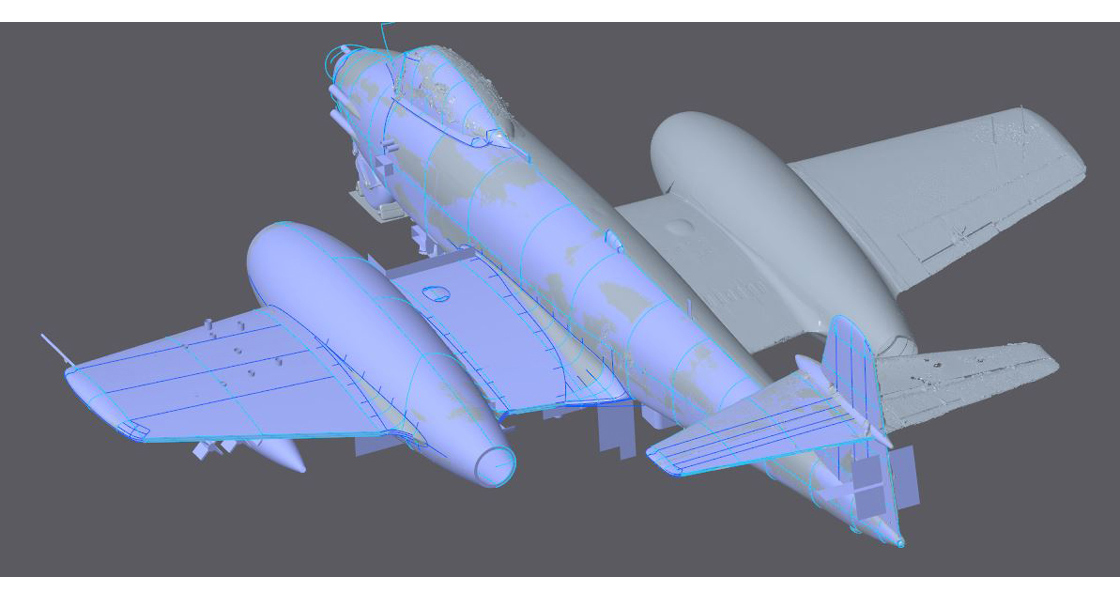
One for the Airfix aficionados, a scan overlay image from the design phase of the new 1:72 scale Gloster Meteor F.8/FR.9 project.
With the world’s first jet fighters only making their combat introductions with the arrival of both the Messerschmitt Me 262 and Gloster Meteor from the summer of 1944 onwards, it’s surprising to consider that work on jet propulsion technology was actually taking place during the mid 1930s. Indeed, the first jet-powered aircraft to take to the skies did so in August 1939. At the time, the advanced nature of the technology driving the Heinkel He 178 meant that the aircraft didn’t worry watching German officials. However, the wheels had been set in motion and the future of aviation had been decided.
The pioneer of jet propulsion in Britain was Frank Whittle, a pilot officer in the Royal Air Force, who was convinced of the technological limitations of piston engines, propellers and their long-term use in future aircraft development. As the world’s military aircraft would be required to fly ever faster and at higher altitudes in future, existing technology was already approaching its zenith and would be inefficient in supporting this development. As you may imagine, with the ominous signs of war clouds gathering, this was a radical, even fanciful theory for those in a position of influence. A brilliant designer and engineer, Whittle presented his ideas to the Air Ministry, but the prospect of having incredibly powerful new engines didn’t appeal to them at that time and they were not particularly impressed. Undaunted, he simply patented the idea himself and continued development work on his project.
Whittle was soon at a stage where he had managed to test a working jet engine, however, he had the significant hurdle of having to get his engine into the air. Working in collaboration with the Gloster Aircraft Company, this progress soon rekindled interest from the Air Ministry, who were now keen to finance the production of a concept aircraft to see if the project had operational merit. This aircraft was the single-engined Gloster E28/39 Pioneer (W4041/G), which made its first flight from RAF Cranwell on 15th May 1941 - the first flight of a British jet powered aircraft. The Whittle/Gloster collaboration had a significant British aviation first to their names.
With the concept effectively proven, the race was on to design, test and introduce Britain’s first jet-powered fighter aircraft during wartime conditions and under the highest levels of security. Of course, nobody involved with this project could ever speak of their work and for an undertaking of such magnitude, a codename was required. This name was ‘Rampage’. Testing of the new aircraft was taking place when British forces were attempting to take Tripoli and the first all-American air raid from bases in the UK was unleashed against a German target.
Under such circumstances, you might think that reports of an extremely fast aircraft flying in British skies would have caught the imagination of the general public, especially if that aircraft was reported as having no propellers, however, the development team were really effective in keeping inquisitive eyes away from the project. Employees were fearful of being implicated with any information leaks, so the nation had no idea that the RAF were close to entering the jet age.
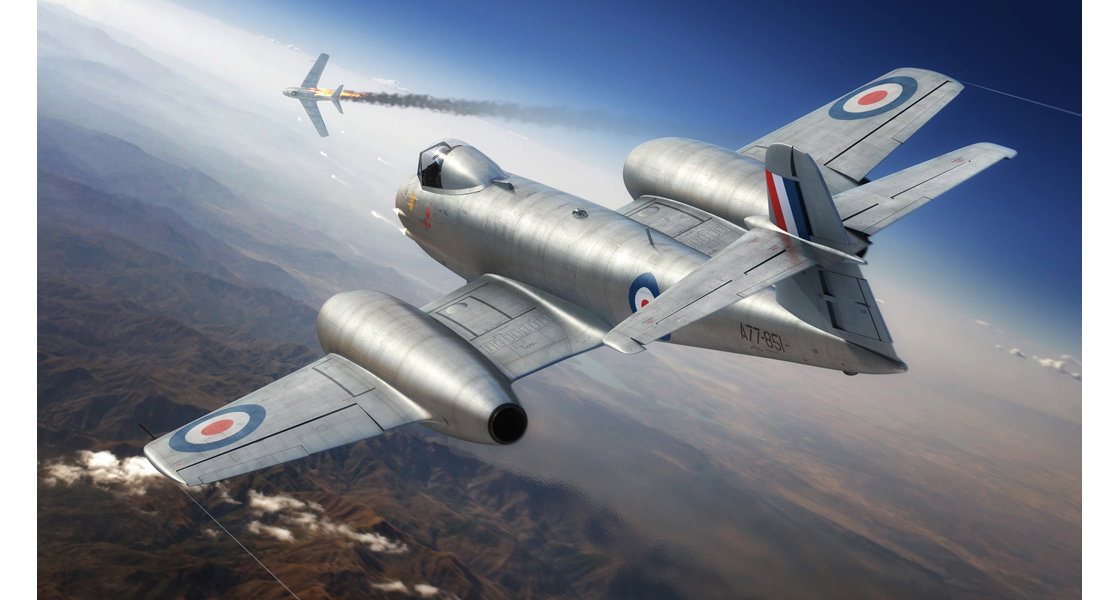
A jet-powered warrior. Beautiful box artwork imagery produced for our 1:48 scale Meteor F.8 tooling, which shows a RAAF Meteor victory over a MiG-15 in 1953 during the Korean War.
Throughout the development of the new British jet, the new aircraft was going to be named ‘Thunderbolt’. However, the introduction of the USAAF Republic P-47 fighter of the same name towards the end of 1942 required a quick change of plan, with the name ‘Meteor’ subsequently selected. With the project now showing great potential, Whittle and the Gloster Aircraft Company were put under immense pressure to deliver their new jet fighter at the earliest possible opportunity, with War Production Minister, Lord Beaverbrook, instructing that the project be given ‘unique importance’ status and to take priority over all other projects.
Unfortunately, the advanced nature of this technology and problems with the mass production of jet engines resulted in significant delays and whilst engine run and aircraft taxiing trials took place in 1942, the first Gloster Meteor did not take to the skies until the following year. Ultimately, persistent engine production problems plagued the development of the new aircraft, with the subcontracting of Power Jets W2 engine production to Rover being the main issue.
Finding it difficult to come to grips with these new technologies, alternative engines had to be procured to allow the test fight programme to get underway and soon after, the entire engine production responsibility passed from Rover to Rolls Royce. Finally, on 5th March 1943, Meteor DG206/G, powered by two de Havilland Halford H.1 turbojets, took to the air at RAF Cranwell. Britain had officially entered the jet age.
The Gloster Meteor F.1 entered Royal Air Force service in July 1944 and the unit taking the honour of being the first to operate Britain’s first jet fighter was No.616 (South Yorkshire) Squadron, based at Culmhead, Somerset. Despite securing its place in aviation history, the Gloster Meteor was still a relatively primitive aeroplane from the perspective of being a combat capable fighter. Thankfully, it proved adaptable enough to undergo almost constant upgrade and improvement, culminating in the subsequent introduction of an exceptionally capable fighting aeroplane.
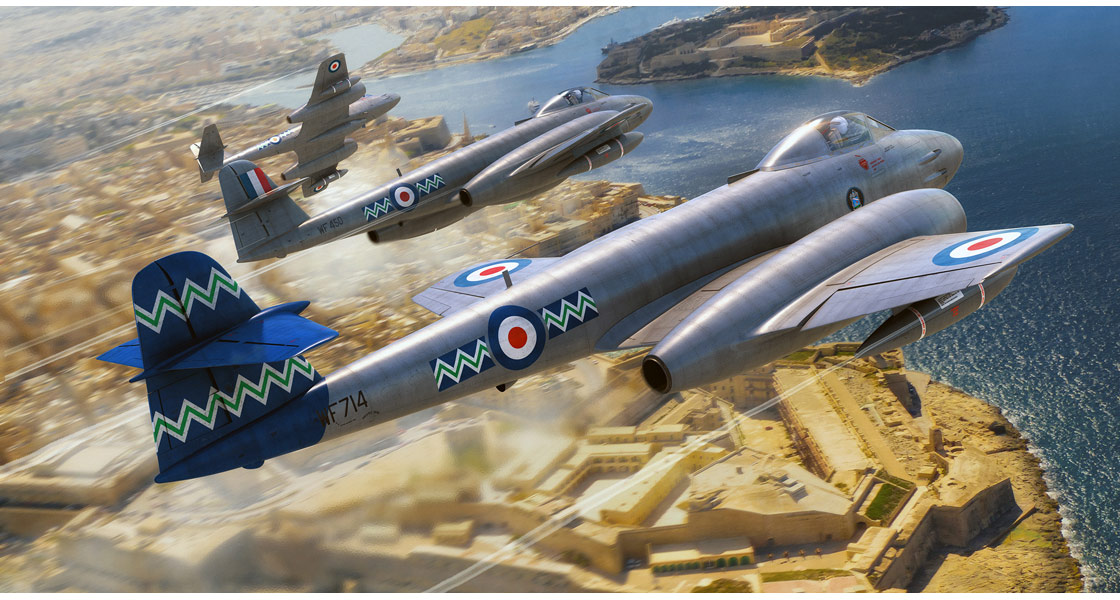
RAF Meteor F.8 fighters over Malta. The definitive F.8 variant looked very different from its predecessors, but was a more mature aeroplane.
The reason for its appearance and why it proceeded as a twin-engined fighter was purely because early jet engines were not particularly powerful at the time and were slow to respond to the power input requests. The use of two engines was seen as essential in securing the service introduction of the new technology and providing the reassurance of redundancy two engines would provide pilots and watching Air Ministry officials.
In contrast to this, once the aircraft was up to speed, it was a delight to fly. With no propeller to obscure the pilots' view and the aircraft being equipped with a tricycle undercarriage, the view from the cockpit was exceptional both in the air and on the ground. When designers overcame the fighter’s gun-jamming problems, it was an exceptionally stable gun platform.
Undergoing almost constant development, the early marks of Meteor were all based around the first aircraft to enter service. However, the service arrival of the F.8 variant in 1950 saw the Meteor maturing into a truly exceptional early jet, which saw service with the RAF and several other air arms across the world. Looking to keep pace with the latest breed of new jet fighters entering service with the major world powers, the Gloster Aircraft Company wanted to equip the Meteor with greater power and operational effectiveness, whilst keeping costs to a minimum by utilising as many of the existing F.4 tooling jigs as they could.
The F.8 featured a lengthened fuselage which gave this variant a sleeker, more cultured appearance over its predecessors. Other identifying features were redesigned horizontal and vertical stabilisers and an impressive new ‘blown’ cockpit canopy. The F.8 featured the new Rolls Royce Derwent 8 engines, each one possessing 3,600Ibf of thrust, presenting the aircraft with more power and greater responsiveness. Increased structural strengthening allowed the F.8 variant to be equipped with ejection seats, something many pilots flying the earlier variants probably wished they had access to, as these early aircraft had a poor safety record and claimed the lives of many unfortunate airmen. Offensively, this latest variant could carry two 1000Ib bombs or 16 unguided rocket projectiles, providing the Meteor with a welcome ground attack capability. It also had greater fuel capacity and a redesigned tail unit, something which helps identify this later mark of Meteor from earlier variants.
Arguably the most effective version of Britain’s first jet fighter, for five years following its squadron introduction, the Meteor F.8 formed the backbone of the RAF’s fighter defence force, a jet-powered equivalent of the Spitfires which patrolled Britain’s skies during the Battle of Britain ten years earlier. With 1,183 aircraft built, the F.8 was the final single-seater fighter variant of the Meteor and the most heavily produced, making this one of the most important British aircraft of the post-war era.
For all the aircraft’s many positives, the Meteor’s introduction was not without its challenges, and it endured a troubled service record. With the adoption of new technologies and pilots sometimes struggling to make the transition from piston to jet-powered flight, the Meteor had a poor safety record, with many pilots paying for misjudgements or inexperience with their lives. During its RAF service, almost 900 Meteors were lost in accidents, with pilots and ground crews giving the aircraft the unflattering nickname of the ‘Meatbox’ as a result.
As one of the world’s most successful early jet fighters, the Meteor was appealing to several overseas air arms who were looking for a rugged, capable jet fighter which didn’t cost the earth. Some received former RAF machines, whilst others placed orders for new built aircraft, although following the introduction of such aircraft as the North American Sabre and MiG-15, the Meteor was undoubtedly beginning to show its age.
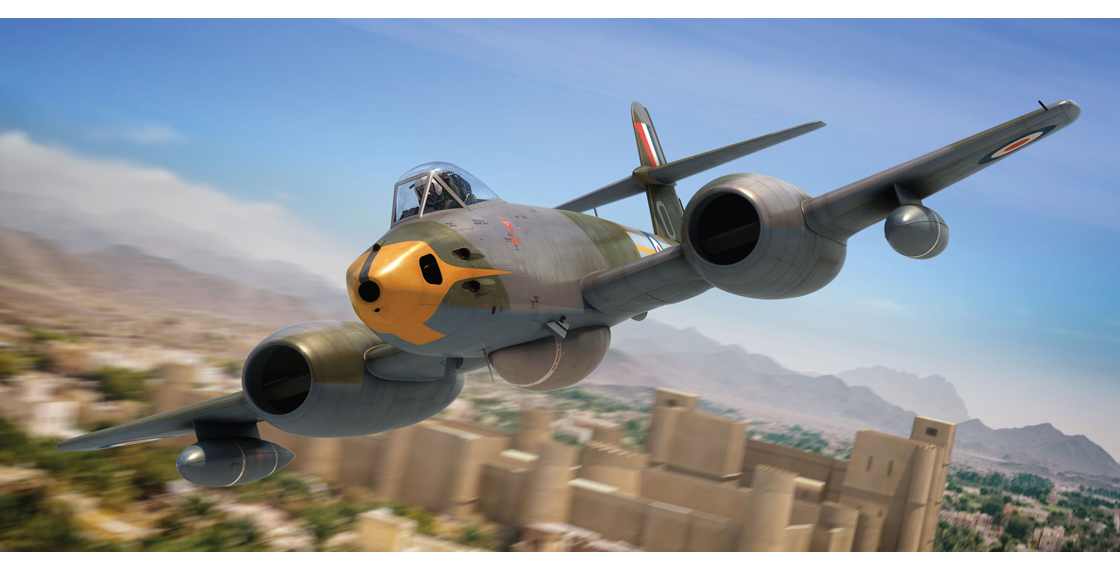
Nosey Parker! The unusual nose of the Meteor FR.9 highlighted its use in a tactical reconnaissance role, whilst the gun ports confirm this airborne snooper can still look after itself.
Even though the Gloster Meteor was a first-generation British jet design, it was an incredibly stable and reliable aircraft in service, particularly impressive considering this was all very new technology. Enjoying a relatively long service career, the Meteor's design possessed plenty of development scope for Glosters, resulting in just under 4000 aircraft being produced between 1943 and 1955, with several variants seeing service with the Royal Air Force and overseas air arms.
The securing of aerial reconnaissance intelligence has been an essential military requirement since the early days of powered flight, with its success being reliant upon a number of significant factors – a stable photographic platform, speed, stealth and reliability. Possessing all these attributes in abundance, the Gloster Meteor was an ideal candidate to improve the reconnaissance capabilities of the Royal Air Force and the Gloster design team had several attempts at producing a suitable variant, before succeeding with the FR.9, a development of the F.8 variant.
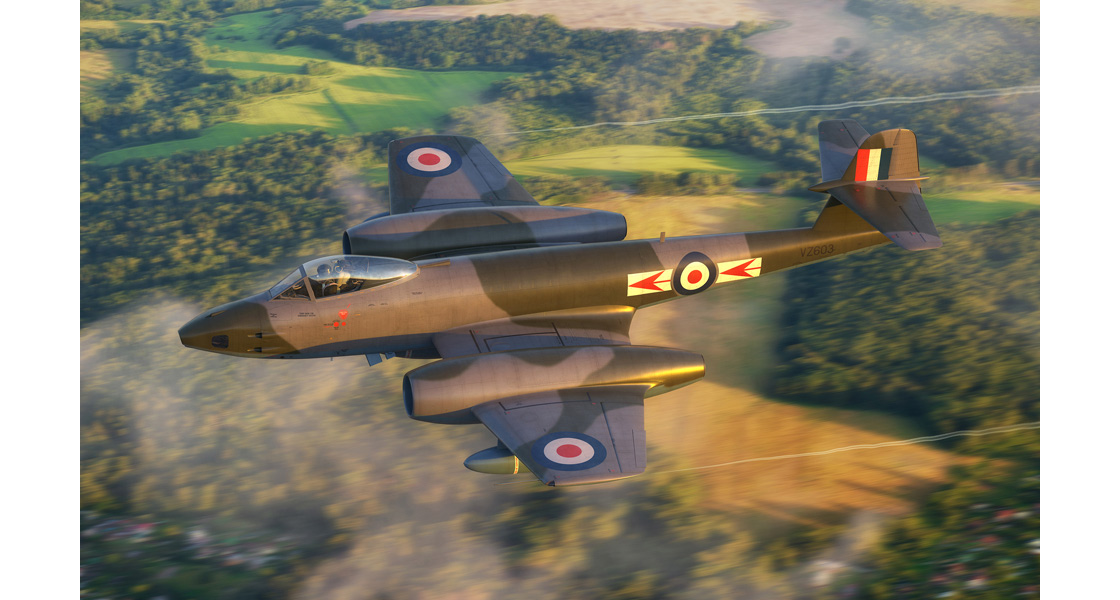
Latest Workbench box artwork exclusive, this time showing an RAF Gloster Meteor FR.9 in the colours of RAF No.79 Squadron flying over an idyllic British countryside scene.
The aircraft was equipped with a modified nose section which housed three remotely controlled Williamson F.24 cameras, each one could capture images through one of three window positions in the nose, allowing the pilot to obtain the best images of his intended target.
Significantly, these aircraft retained the cannon armament of the F.8 variant, so were able to switch from a reconnaissance to an offensive role at any time. They were also being capable of defending themselves from enemy attack. Operated extensively from RAF bases overseas, the FR.9 was equipped with additional fuel capacity in the form of external underwing and ventral fuel tanks, greatly increasing the range and loiter times over which these aircraft could operate.
At the time, the Meteor FR.9 was one of the most effective aircraft of its kind in service anywhere in the world and it’s surprising that only 126 were produced.
The impending release of this excellent new 1:72 scale kit offers modellers the opportunity to build either the ubiquitous F.8 fighter variant or the fighting reconnaissance FR.9 variant from the same kit, with both scheme options being equally appealing, yet very different from a presentation perspective.
Let’s take a closer look at both options in a little more detail.
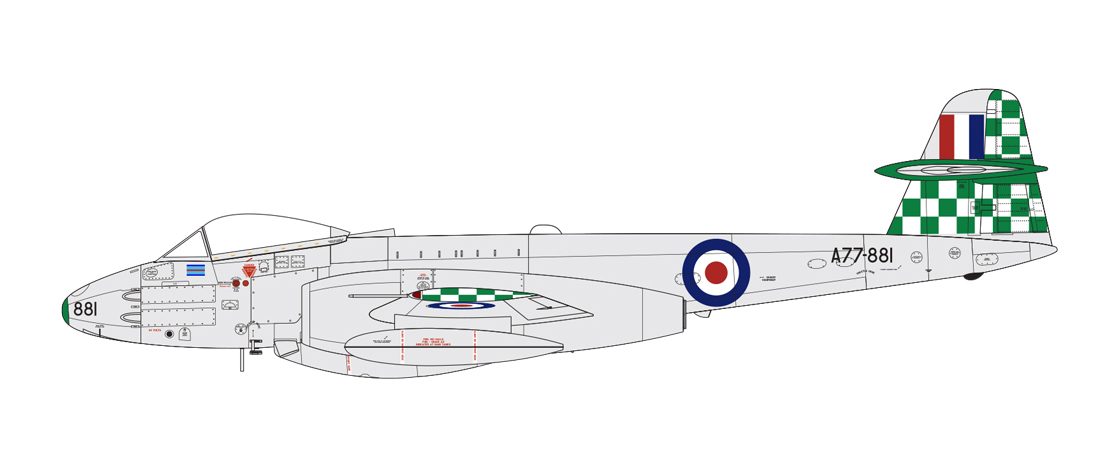
The Royal Australian Air Force have a proud reputation in operating the Gloster Meteor F.8, with No.77 Squadron being the only RAAF squadron committed to combat on the type during the Korean War. With the squadron due to return home from deployment in Japan in June 1950, the outbreak of the Korean War saw them remaining overseas as a significant Australian contribution to the conflict, initially flying their Mustang fighters in bomber escort sorties, but later switching to a ground attack role.
Following China’s entry into the conflict, the Australian Mustangs were coming into contact with MiG-15 jets, and the venerable Second World War fighter was no match for these diminutive jets, leading to an immediate requirement for them to upgrade their own fighting capabilities. Despite requesting the purchase of several US and British jet fighter types, the only aircraft immediately available to them was the Gloster Meteor F.8,. Therefore, in February 1951, 15 Meteor F.8 fighters and two T.7 trainers were loaded aboard the British light fleet carrier HMS Warrior bound for No.77 Squadron RAAF, who had temporarily been withdrawn from the fighting, returning to Japan for re-equipping.
Arriving at Iwakuni the following month, the aircraft were individually unloaded from the carrier and lowered onto a barge, for onward delivery to RAAF base Iwakuni. Accompanying the aircraft were four experienced RAF Meteor pilots/instructors, who were temporarily assigned to the RAAF to introduce No.77 Squadron pilots to their new jets and to assist in their effective and speedy transition from Mustang to Meteors.
Once converted, the squadron resumed operational duties in Korea from July 1951, based at Kimpo air base just outside Seoul, where it joined other Allied units for the remainder of the conflict. Unfortunately, the Meteor was inferior to the MiG-15 in combat situations, so the squadron was assigned to flying secondary air defence duties. Although they claimed three MiG-15 fighters destroyed in aerial combat, Australian pilots were frustrated at the lack of action.
In a brave, yet inspirational decision, the squadron was once again unleashed in a ground attack role, using the Meteor in a way for which it was not intended and indeed, pioneering its use as a ground attack jet. No.77 Squadron RAAF earned a reputation for excellence in this role, with their Meteors regarded as the most successful ground attack aircraft in theatre.
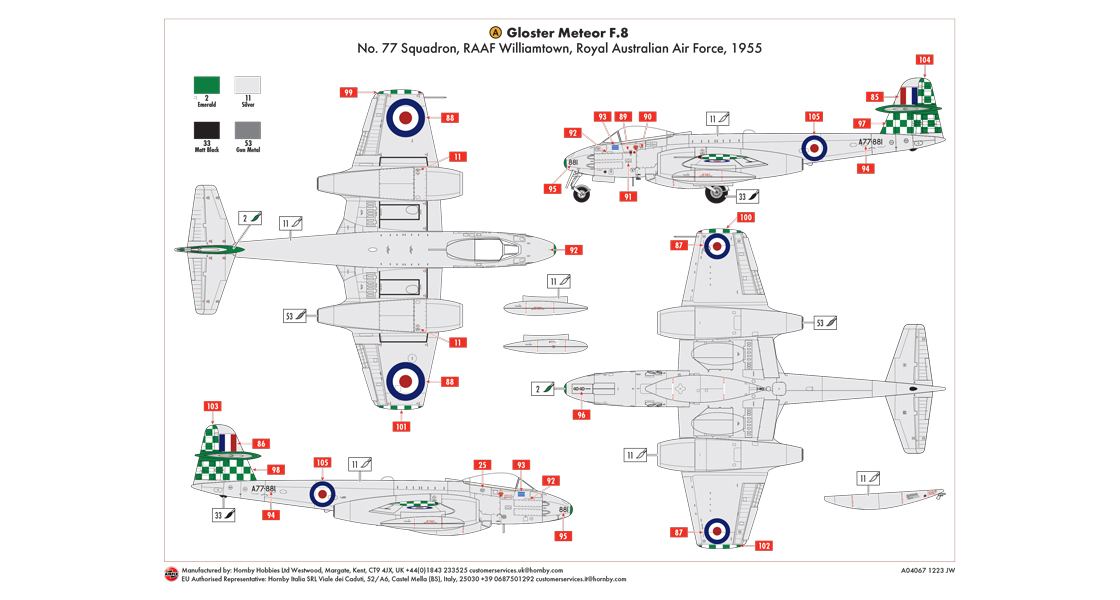
Full scheme details for this well-travelled Royal Australian Air Force Gloster Meteor F.8.
After almost 12 years of continuous overseas service, No.77 Squadron RAAF finally returned home to Australia in December 1954. The 41 Meteors aboard the RAN carrier HMAS Vengeance were distributed between Nos 75 and 77 Squadrons, with No.77 Squadron subsequently reforming and becoming operational at Williamtown on 4th January 1955.
To commemorate their impressive recent period of lengthy overseas deployment, No.77 Squadron embarked on ‘Operation Welcome Home’, a month-long tour of the country which began on 21st January 1955. The tour consisted of the Squadron’s aircraft flying a formation ‘77’ in the skies above every major Australian city, culminating with a display over Sydney on 18th February, with the aim of allowing as many people as possible to see this unique aviation spectacle.
The Meteor’s service in Australia was short lived, and by August 1956, the unit relinquished their British jets, trading them for Commonwealth Aircraft Corporation Sabres, which were operational by November that year.
Gloster Meteor F.8 A77-881 was one of the aircraft which returned to Australia in 1954, allocated to No.77 Squadron at Williamtown. With her distinctive green chequered tail and wingtips, she is a fine modelling tribute to the RAAF’s use of the Meteor, so successful in an operational capacity during the Korean War and in more of a commemorative capacity during their short period flying in home skies.
This particular aircraft attracted the interest of the Airfix team as a scheme option for a kit release on a previous occasion recently, as it was one of the options included in the Limited Edition 2023 Airfix Club kit, although this was in a later RAF No.8 Squadron guise.
With its ability to undertake high-speed armed reconnaissance operations, the Gloster Meteor FR.9 spent much of its service operating with squadrons stationed away from the UK. As well as the Far and Middle East, the 2nd Tactical Air Force in Germany made full use of the capabilities of the aircraft, receiving its first examples in December 1950. Flying in the colours of No.2 Squadron (and later No.79 Squadron), these aircraft were regularly employed patrolling the West German border, photographing areas of particular interest and attempting to deter any Soviet incursion which could lead to conflict.
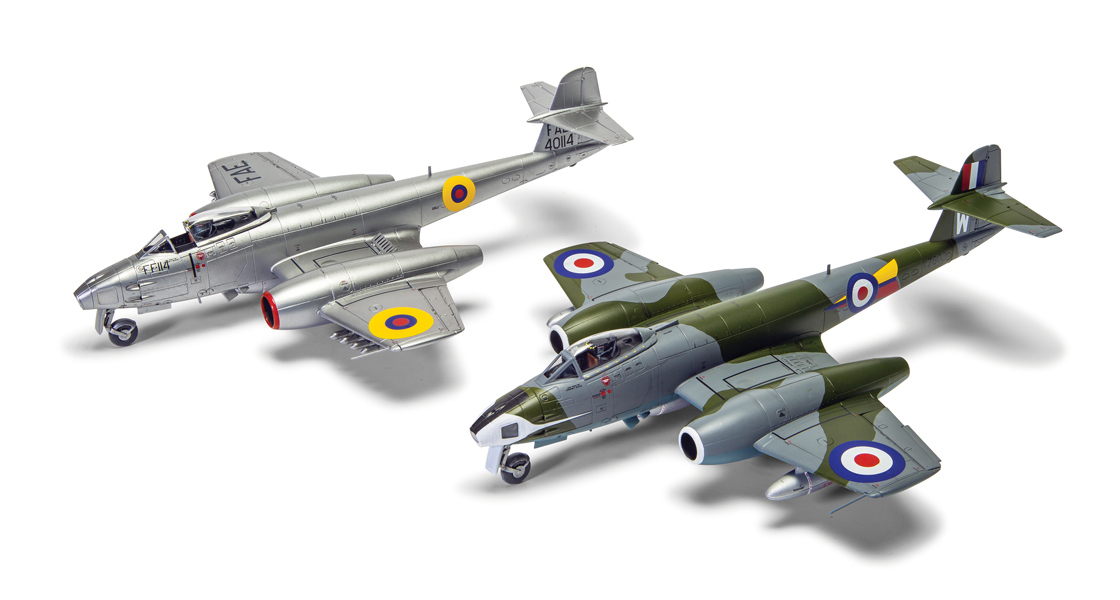
The 2023 Airfix Club kit included scheme options to finish Meteor FR.9 VZ603 in a later RAF guise than this new kit, representing its time with No.8 Squadron.
Gloster Meteor FR.9 VZ603 was delivered to the Royal Air Force in early March 1951 and served with No.79, 208 and No.8 Squadrons, one of only 126 examples of this armed reconnaissance variant of the Meteor produced. She was struck off charge following an accident at Khormaksar in May 1960, with the airframe being beyond economical repair, even though she was stripped of all useable parts to keep other aircraft in the squadron flying. A sad end for this hard-working 'specialist' Meteor.
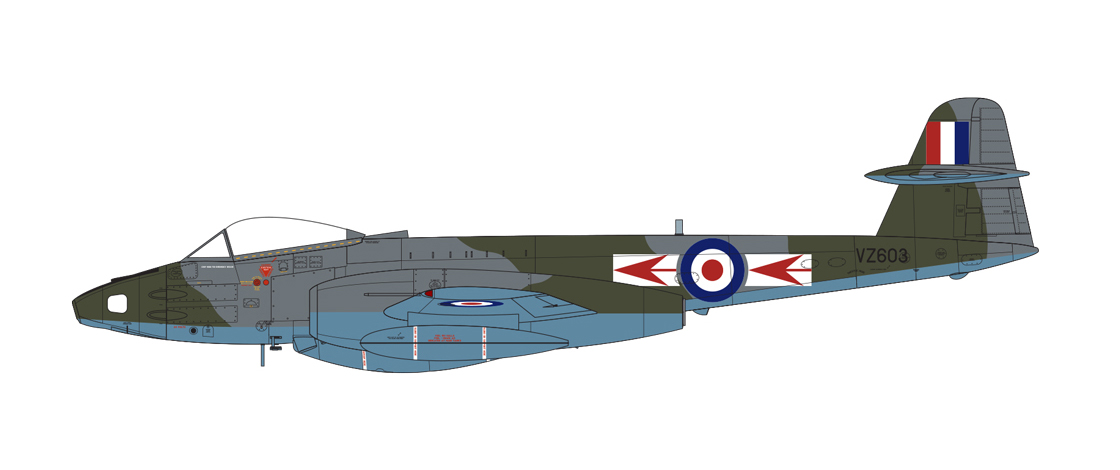
This scheme option shows VZ603 in an earlier presentation incarnation than the one offered with the 2023 Airfix Club kit and allows the aircraft to wear the distinctive double ‘Red Arrow’ markings of No.79 Squadron. This squadron traces its linage back to summer 1917 where it operated the Sopwith Dolphin, but went on to fly such aircraft as the Gloster Gauntlet, Hawker Hurricane and Republic P-47 Thunderbolt.
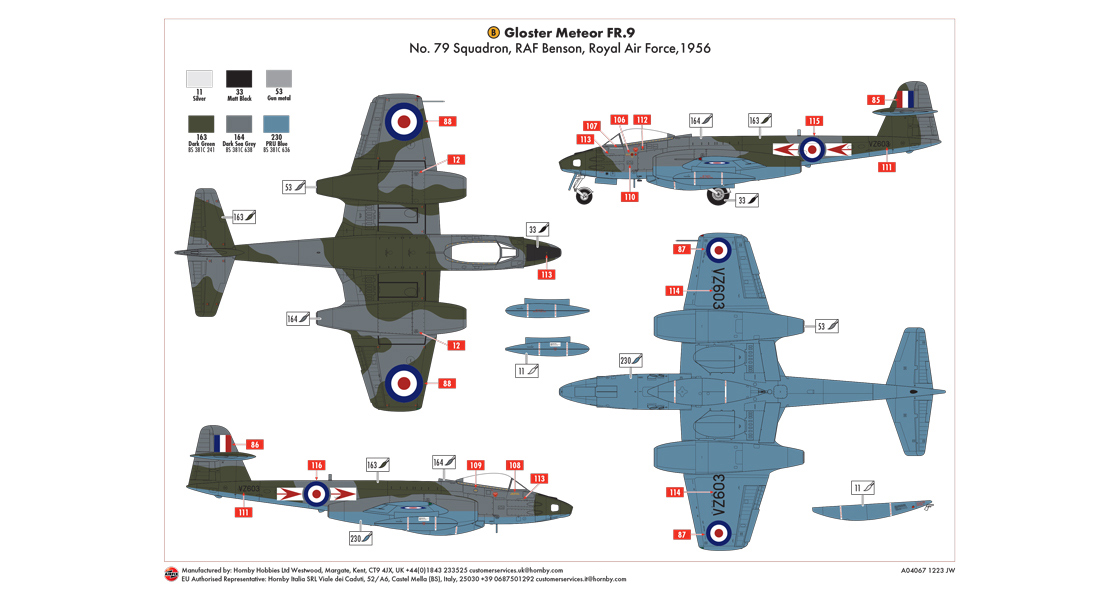
Full scheme details of this attractive snooping RAF Meteor.
Reforming again in November 1951, No.79 Squadron operated as a fighter reconnaissance unit, flying the Gloster Meteor FR.9 based at Wunstorf, Germany, re-equipping in the same role with the Supermarine Swift FR.5 in June 1956. Before taking on the Swift, the unit temporarily moved to RAF Benson in 1956, which must have been fitting, as Benson has a proud history in gathering and deciphering photographic intelligence. Selected as the home of No.1 Photographic Reconnaissance Unit in 1941, this experimental unit was charged with perfecting the art of gathering vital reconnaissance imagery of enemy installations and movements in enemy-controlled airspace, which proved instrumental in the eventual Allied victory of the Second World War.
Wearing its day-fighter upper surface camouflage and smart PRU blue undersides, this lovely scheme will illuminate any display of built models and look particularly impressive amongst any collection of Meteors, or positioned next to a photo reconnaissance Spitfire PR.XIX or Mosquito PR.XVI.
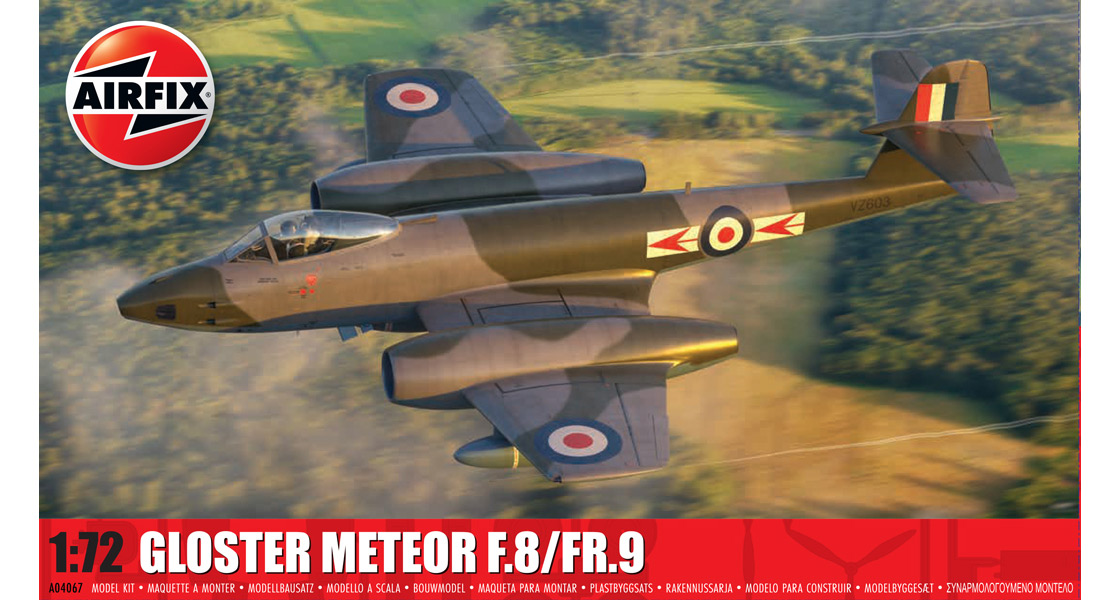
A beauty of a box presentation: if this doesn’t have us all adding a Meteor to our build schedules over the coming months, there’s no justice in this hobby of ours!
Another attractive kit addition to the current Airfix range, this new 1:72 scale Gloster Meteor F.8/FR.9 release should be available by the time this Workbench update is posted.
That's all we have for you in this latest edition, but we will be back next Friday with more project development updates and the latest Airfix kit exclusives. In the meantime, we are keen to hear your views on all things Airfix and any thoughts and opinions you have regarding our Workbench blog. If you would like to drop us a line, please use our workbench@airfix.com email.
To revisit any of the Airfix blogs we have produced over the years, head to our main Workbench hub, where you'll find our entire blog back catalogue and all the Airfix design projects we have already covered.
Facebook, YouTube, Twitter and Instagram official sites
Airfix Workbench Team