

Welcome to this latest edition of our Workbench blog and all the news, updates, and modelling exclusives from the fascinating world of Airfix.
With holidays now just a fading memory, normal Workbench service is resumed this week with our latest trip back into the nostalgia of the Vintage Classics range, and a scale warship model kit which occupies a lofty position not only within the annals of Royal Navy history, but also that of Airfix model kit heritage. As we welcome our 1/600th scale HMS Ajax tooling into the Vintage Classics range, we will be taking this opportunity to look at why this light cruiser which was ordered well before the start of the Second World War, would go on to play such a significant role during it and how successive refits made her fighting fit to represent Britain on the high seas throughout.
With classic box artwork, scheme details and built model images to share with you, we will be heading off for a life on the ocean waves this weekend, well, at least in a scale modelling sense, as we discover the finer details of a kit which might just tempt one or two readers out of their modelling comfort zones, and see them tackling a warship build for the first time in a long time.
Let’s hope everything’s ship shape and Bristol fashion this weekend, as our weekly blog spotlight illuminates a truly classic Airfix scale model ship kit, one which will be celebrating its 60th birthday next year.
Designed and built under international naval restrictions, HMS Ajax was intended to be a long-range and highly capable warship able to represent the Royal Navy in seas far away from Britain. Image in the public domain.
As a seafaring nation, a powerful navy has long been an important aspect of Britain’s strength and influence, not only for trade and the protection of trade around its own coastline, but also as a high-profile, extremely mobile illustration of the country’s intent to protect its interests across the globe. As warships became larger and ever more powerful in the lead up to the Great War, these vessels were as much a statement of power and ambition, as they were about technological advancement and remain as some of the most impressive machines ever created by man, floating behemoths possessing the ability to wreak destruction on an unimaginable scale.
Following the end of the Great War, the world’s foremost naval powers agreed to meet in Washington DC to discuss naval disarmament and future limitations, in a similar manner to how the Treaty on the Non-Proliferation of nuclear weapons of the 1968s hoped to prevent the threat of nuclear conflict. At that time, Japanese military expansionism was posing a very real threat to peace in the Pacific region and something had to be done on an international scale to avert conflict.
The outcome of this meeting was to impose limitations on the size, capability and numbers of future large warships, with Britain being particularly affected by the terms of the treaty. It could even be argued that as a result of this treaty, all of the world’s major navies were under strength at the start of the Second World War.
At around the same time, famous US aviator Brigadier General William ‘Billy’ Mitchell was doing his level best to convince the world that the day of the Dreadnought was over and how the aeroplane would be both the offensive and defensive weapon of the future. He argued that strategic aerial bombing would overcome any warship and as such, the emphasis for any future military expansion should be placed on air power and not the much more expensive navy.
He graphically illustrated his theory in July 1921, when he arranged for the former Great War German battleship Ostfriesland to be attacked by quite primitive bombers, sinking it without too much trouble. Convinced he was right, his work would continue with further dramatic demonstrations of warship vulnerability to air attack over subsequent years, and even though America would go on to build the largest warships the world had ever seen, Mitchell’s theory was proved to be correct and to a large extent, the statement ‘The nation that controls the air also controls the sea’ was proved to be accurate.
Britain’s Leander Class of light cruisers were an incredibly useful and effective series of eight vessels, the design of which was impacted by both the post WWI Washington naval disarmament meeting and the later London Conference of 1930. This later treaty only allowed Britain to build a further 91,000 tons of cruisers up to the end of 1936, but with the first ship being significantly overweight, the difference had to be paired from the weight of its sister ships.
The warships were primarily designed around a need to equip them with both speed and firepower, with their large hulls and impressively long-range making them ideal vessels for posting far away from British shores, protecting friendly convoys and potentially raiding enemy shipping. Armed with eight 6-inch main guns mounted in four turrets two fore and two aft, these cruisers also benefitted from effective anti-aircraft defences, guns which could also be brought to bear against enemy shipping during close quarters confrontations. Significantly, these ships were capable of accepting almost constant re-fit and upgrade and would subsequently prove to be some of the most useful and heavily deployed warships in the navies of Britain, Australia and New Zealand.
Profile artwork showing HMS Ajax in scale, a ship which earned an excellent reputation during its busy wartime service.
HMS Ajax was ordered under the 1931 Programme on 1st October 1932 and laid down by Vickers-Armstrong at their Barrow-in-Furness shipyard on 7th February 1933. Launched the following year, she was subsequently commissioned in 1935 and given the name Ajax, the eighth Royal Navy warship to carry the name. She was produced at a cost of £1.48 million to the Treasury, a figure which roughly equates to £135 million in today’s money, taking the effects of inflation into consideration.
By the start of the Second World War, HMS Ajax had taken up station in the South Atlantic on trade defence duties, quickly making the transition to intercepting German shipping and giving them the unenviable option of either scuttling, or being destroyed by her 6-inch guns. She would famously take part in the first major naval engagement of the war at the Battle of Rio de la Plata on 13th December 1939, actions which would eventually result in the scuttling of the German Deutschland-class pocket battleship Admiral Graf Spee, but we’ll have more on this a little later.
Despite sustaining significant battle damage during this engagement, Ajax would remain on station in the South Atlantic until the end of January 1940, when she was finally ordered to sail back to Britain to undergo refit, works which included the installation of more effective equipment, particularly to her anti-aircraft defences and new radar early warning equipment.
Following the successful completion of re-commissioning sea trials, she was assigned to the Mediterranean Squadron, initially charged with protecting a large shipment of military vehicles destined for North Africa. It was originally intended that the convoy would take a direct route to its destination, however, the increased enemy air activity in the region dictated that an alternative, and much longer route around the Cape of Good Hope was taken instead.
On 12th October 1940, Ajax took part in the Battle of Cape Passero, off the coast of Sicily, where she was in action against a strong force of Italian Navy destroyers and torpedo boats. Despite being heavily outnumbered, aggressive tactics and superior night action training left the Regia Marina with a badly bloodied nose, causing them to question the capabilities of their most celebrated naval commanders. Over the course of several hours, these actions resulted in the loses of an Italian destroyer and two torpedo boats, with a further destroyer badly damaged, with Ajax herself only sustaining light damage.
HMS Ajax in kit form. A warship as famous as this really does deserve to be represented as a scale model it.
The Mediterranean Sea was a hotly contested region throughout the Second World War and Ajax would be committed extensively on various operations over the course of the next few years. In fact, her list of wartime service is long and impressive, highlighting just how effective these light cruisers were in supporting Royal Navy operations. Further periods where Ajax underwent extensive refit occurred in 1941, 1942 and 1943, but she was always sent back into operational deployment immediately after negotiating her refit trials and always with a more effective equipment fit.
HMS Ajax would be on station to support the D-Day landings and on D-Day itself, she bombarded the German shore battery at Longues-sur-Mer, destroying one of the guns with a direct shell strike and helping to disable two others. She would later be tasked with supporting Anglo-Canadian forces in their beach assault attempts before being transferred to ‘Task Force S’ in front of Sword Beach, where she would remain until the end of June 1944.
Following the successful landings in Normandy and securing of the beachheads, Ajax was once again redeployed to the Mediterranean and would eventually be deployed in a similar role to the one she performed off the coast of Normandy, this time in support of Operation Dragoon and the amphibious Allied landings in Southern France.
HMS Ajax was eventually selected for disposal after a proposed sale to the Chilean Navy was blocked by Winston Churchill during 1948, who strongly felt that a warship of this historic significance should be preserved as part of the nation’s naval heritage. Unfortunately, this plan also didn’t come to fruition and the last surviving British warship from the Battle of the River Plate was sent to the breakers yard. In a defiant final gesture from the ship, she ran aground in the River Usk on her way to the breakers in Newport, delaying the inevitable for just a few hours longer, but still just the final story in the history of a most famous warship.
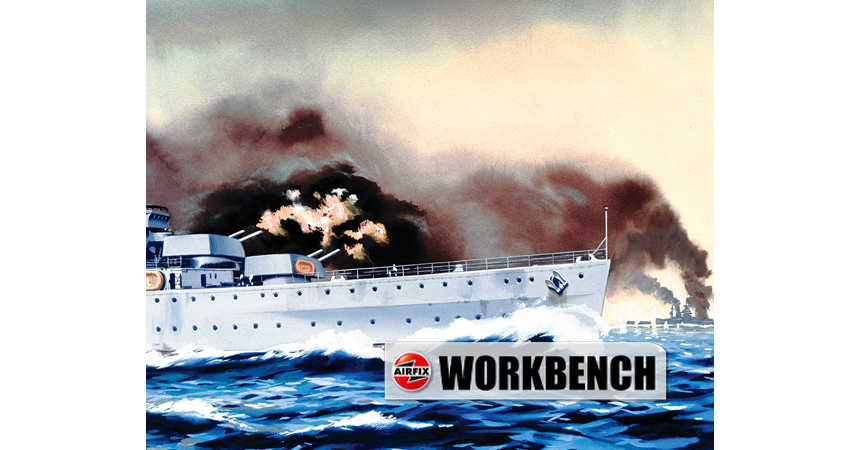
A pair of classics. HMS Ajax and the artwork of Roy Cross …. what more could a modeller want?
Back in 1966, Airfix released the 4th edition of their product catalogue, and whilst its contents were still somewhat basic in design compared to what we’re all accustomed to these days, it was still packed full of fantastic scale model kits for us all to admire. As had already become the norm, aircraft subjects dominated the early pages of the catalogue, however, towards its centre, a growing range of warships and historic ships was growing in popularity and it has to be said, represented some of the most impressive kits produced by Airfix at that time.
With black and white pictures of famous WWII warships still fresh in our minds from books, magazines and the classic World at War TV series, these mighty vessels represented some of the most impressive machines created by man and as such, we simply had to have scale kit representations of them to build. With such classics as HMS Hood and Bismarck already in the range, 1965 saw the release of a new HMS Ajax tooling, an impressive new kit which immortalised one of the light cruisers involved in the early war Battle of the River Plate actions, which resulted in the destruction of the German pocket battleship Admiral Graf Spee.
With these models being described as being ‘Just like the real thing!’, how on earth could we be expected to resist such items, and as these kits built into truly impressive display pieces, warship models became an increasingly popular feature of every Airfix kit range.
To further enhance the appeal of the new HMS Ajax model kit, Airfix engaged the services of a certain Mr Roy Cross, who created a beautifully evocative piece of artwork which showed Ajax under fire during the Battle of the River Plate, with Graf Spee under steam in the distance. As many a modeller likes to say, this artwork was probably responsible for setting thousands of people off in the modelling hobby and was unquestionably the stimulus for many thousands of kit sales following its introduction – Mr Cross has a proud legacy in achieving both.
The artwork and kit present HMS Ajax as she was configured during the Battle of the River Plate in December 1939, one of the most famous naval engagements of the Second World War and as it turned out, a rather significant victory for the Royal Navy.
With Britain and Germany now at war, it seems a little strange to learn that one of the most significant incidents of the early war period actually took place several thousands of miles away from either country, in the harsh waters of the South Atlantic. With war now inevitable, the head of the German Kriegsmarine ordered the powerful Admiral Graf Spee light battle cruiser to leave its home port and head for the open waters of the Atlantic Ocean, to await orders to begin a devastating period of commerce raiding once war had been declared. The Graf Spee was modern and powerful, and posed a significant threat to British interests in the Atlantic. She was designed to be capable of outrunning any warship more powerful than she was and possessed the firepower to deal with any ship faster than her.
More iconic Airfix box artwork, this time featuring the powerful Admiral Graf Spee which was being hunted by HMS Ajax and Force G.
Once she was given the order to begin raiding Allied shipping, Graf Spee immediately showed the terrible threat she posed, sending several merchant ships to the bottom of the ocean, whilst all the time changing her position to keep the Royal Navy guessing as to her exact position. A large number of British warships were now preoccupied in hunting down this ruthless raider and neutralising the threat she posed.
After sailing to the Indian Ocean and sinking another ship off the east coast of Africa, the ship’s captain Hans Langsdorff felt this would serve as an adequate distraction for the Royal Navy and headed back towards the South Atlantic and after refuelling and resupplying from a supporting ship, went on to sink a further two merchantmen on the way. Unfortunately for him, both of these vessels managed to send distress messages prior to sinking and for the first time, the Royal Navy knew exactly where the mighty German ship was – the hunt was on!
The Royal Navy had established several different task force groups spread over a wide area to hunt for the Graf Spee, however due to the recently reported sighting, ‘Force G’ stationed at the Falkland Islands were the closest to the enemy ship and therefore tasked with challenging her. Using the latest intelligence and adopting well versed hunting tactics, three of the cruisers available to commander Commodore Henry Harwood were sent to take up position off the coast of South America, at the mouth of the River Plate, as he had a hunch the German ship might make for neutral Uruguay, as she continued her plan to evade the Royal Navy.
Claiming yet another merchant victim, Langsdorff steered the Graf Spee straight for Montevideo harbour, knowing that the Royal Navy would likely be in the vicinity, but confident of further successes no matter what he would be facing. He was heading for the heavy cruiser HMS Exeter and the two light cruisers HMS Ajax and HMNZS Achilles, with Achilles crewed by sailors from New Zealand. Although unquestionably a powerful force, each ship would be out gunned by the mighty Admiral Graf Spee, so the outcome of the now inevitable engagement was uncertain, however, she had to be challenged, and these were the warships preparing to do just that.
Decoration details for HMS Ajax as she was presented during her involvement in the Battle of the River Plate.
With both sides spotting the other at around the same time, HMS Exeter steamed forward to investigate and fired her main guns first, but was also the first to receive a salvo from the Graf Spee. The other two light cruisers adopted an alternate course, but positioned themselves to take up the most advantageous firing positions on the opposite side of the German warship. Exeter and the Graf Spee both score hits against their opponent, but the more powerful shells of the German ship inflict more damage on her adversary.
With Ajax and Achilles now in the fight, all three British ships continued to hurl shells at the German pocket battleship and despite taking hits, continue repositioning and firing tenaciously. As Ajax and Achilles move in closer, Langsdorff, fearing torpedo attack and with his own ship having suffered multiple hits, made for the neutral port of Montevideo and a respite from the engagement.
The unexpected arrival of this mighty German ship in neutral Uruguay caused something of an international incident, with both British and German officials lobbying the Uruguayans for support. Under international maritime law, Langsdorff only had 24 hours in which to make good his repairs and leave port, however, high level German protestations were requesting at least three weeks for the work to be carried out. All the time, additional Royal Navy warships were at full steam heading for the River Plate, and everything now seemed just a matter of time.
HMNZS Achilles photographed from the deck of HMS Ajax as the pair were steaming towards an engagement with the Admiral Graf Spee. Image in the public domain.
Original Roy Cross artwork restored and prepared for use as the latest addition to the Vintage Classics range.
Initially, the British attempted to have Uruguayan authorities keep the German warship in port, a move which would clearly allow them the time they needed to secure other naval assets in the area, however, as the repair works and diplomatic wrangling continued, the British decided to take a chance. They allowed communications to be circulated suggesting that the aircraft carrier HMS Ark Royal and battle cruiser HMS Renown were already on station and awaiting the Graf Spee, knowing that Langsdorff’s communications officers would surely pick up the transmission. This proved to be a crucial development and probably saved the lives of a great many sailors in the process.
With a compromise reached, Langsdorff was given three days to make good his repairs, so at 18.30 on 17th December 1939, the Admiral Graf Spee slipped away from her mooring and headed out towards the mouth of the River Plate, towards the waiting Royal Navy and the second round of this now famous naval engagement. Under the full gaze of the world’s press and with thousands of local people watching from any vantage point they could claim, Graf Spee cruised to a position around 4 miles from the shore and appeared to stop – nobody was prepared for what happened next.
Unbeknown to either the Royal Navy or the onlooking Uruguayans, Captain Hans Langsdorff, having weighed up all the options available to him, had decided to spare the lives of his men, rather than sacrificing them on an engagement which he thought they had no chance of winning. As the ship slipped away from its mooring, it was only manned by a skeleton crew of essential personnel, with the others all remaining ashore. Once the ship had taken up a safe position, a German supply ship took all remaining crew members on board, leaving the Graf Spee to a fate nobody saw coming.
At 17.54, those watching, along with the world’s press saw a series of explosions rip through the mighty hull of the Graf Spee, with the ship bursting into flames and settling on the shallow approaches to Montevideo harbour in less than three minutes. Langsdorff’s scuttling charges had done their work and the threat posed by this mighty raiding warship was no more.
Another built model image of our HMS Ajax kit, which really should be displayed next to a model of the Admiral Graf Spee, to commemorate one of the most significant naval engagements of the Second World War.
What might have happened had Langsdorff elected to fight his way out of the mouth of the River Plate is the subject of opinion and conjecture, but as the more powerful ship, it’s likely that she would have inflicted heavy damage on both HMS Ajax and HMNZS Achilles and the subsequent cost in casualties that would have created.
What we don’t know is how much damage Graf Spee had sustained during the previous engagement and whether this damage was significant enough to prevent her from giving a good account of herself in a second engagement. There’s no doubt that the crews of Ajax and Achilles would have been relieved at the unexpected outcome of this incident and the part they played in what turned out to be a spectacular victory for the Royal Navy at this early stage of the war.
As for Captain Hans Langsdorff, was he a pragmatic humanitarian, or was this a gross dereliction of duty? We’ll leave you to decide on which side of this thought-provoking fence you reside, but he didn’t live to give his side of the story and his men were interned for the duration of the war. Interestingly, those crew members who elected to return to Germany after the war did so aboard the liner Highland Monarch, which was escorted by HMS Ajax on both the outward and homeward legs of the journey. This was the only time HMS Ajax returned to South Atlantic waters following her involvement in the Battle of the River Plate and she escorted the repatriated German sailors as far as the Isle of Wight on the way back. Was this just ironic, or a symbolic arrangement by the Royal Navy for this famous warship?
An exclusive look at the new box artwork produced to support the introduction of the HMS Ajax kit into the Vintage Classics range.
The preservation of historical events and the scale replication of some of the most significant machines which took part in them has long been a tradition the Airfix brand has held dear, and is a tradition which continues with the recent arrival of HMS Ajax into the popular Vintage Classics range of kits. A kit which not only commemorates one of the British light cruisers which took part in this famous early WWII naval engagement, but also one of the hardest working British warships of the Second World War, one which served with distinction throughout.
Building into a really pleasing scale tribute to a warship which may be no more, but is certainly deserving of our enduring recognition, the kit also serves as a scale mark of respect for the incredible contribution sailors made to the war effort during the Second World War, whether that be in a military capacity, or the brave men who carried food, supplies and the commodities of war across the world’s oceans serving in the Merchant Navy, at great personal risk and often enduring such harsh conditions in the process.
That being the case, we’re delighted to have HMS Ajax available in an Airfix range once again.
We are afraid that's all we have for you in this latest edition, but we will be back next Friday with more project development updates and the very latest Airfix kit exclusives. In the meantime, we are always keen to hear your views on all things Airfix and in particular, any thoughts and opinions you may have regarding our Workbench blog. If you would like to drop us a quick line, could we please ask that you use our workbench@airfix.com email for all correspondence.
To re-visit any of the Airfix blogs we have produced over the past seven years or so, please head to our main Workbench hub, where you will find our entire blog back catalogue and all the Airfix design projects we have already covered.
All our dedicated official social media sites can be accessed by clicking the respective link icons at the foot of this page, or by heading to the Airfix homepage. Other useful Airfix links are:
Facebook, YouTube, Twitter and Instagram official sites
Please join us for more Airfix updates next week and thank you for your continued support.