Welcome to this latest edition of our Workbench blog and all the news, updates, and modelling exclusives from the fascinating world of Airfix.
With Christmas now being only a few days away, and by way of a little festive blog treat, we’re pleased to be bringing you our latest dual blog posting weekend. In response to some extremely positive comments posted about this beautiful little kit on hobby social media sites over the past few weeks, and as we are in receipt of some new built model images, we will be returning to update a blog post from earlier this year, one which features an aircraft which was colloquially referred to as the ‘Constant Speed, variable noise machine’ by those who loved and operated it.
In our second, separately posted blog, which can be accessed by heading to our main Workbench blog hub, we will be taking something of a departure from our usual blog subject matter, where we usually look at kits which are designed and produced for our army of proficient, regular modellers. If you can’t look to provide a kit helping hand to the less experienced, maybe even first-time modeller at Christmastime, when can you offer hobby support such as this? For that reason, we will be taking a look at the subject of Starter Set kit development and the new kits which joined this important hobby range over the past twelve months.
For this update though, our subject is beautiful little aeroplane which is synonymous with post war RAF training operations, the pilot making Jet Provost and our scale model kit tribute to it.
Propulsion transition – RAF pilots could be selected to train on either the Piston Provost, or its new jet powered derivative during the early days of jet powered flight in the UK.
The effective training of new pilots for any air force has to be one of the most important roles they undertake, and the establishment of an effective flying training programme has been of vital importance since the emergence of the aeroplane as a military asset. Although the process of taking a new recruit and tuning them into a competent pilot arriving at their first operational conversion unit posting is undoubtedly a fascinating one, the period post WWII where pilots were also making the transition from piston to jet powered aircraft must have been an incredible time for all those involved.
Following the end of the Second World War, the RAF replaced their ageing Tiger Moths with the rather unusual looking Percival Prentice in the basic pilot training role, a three-seat aircraft which allowed a second student to sit behind the pilot and instructor to observe, thus gaining their own valuable flight experience. The Prentice would be the first all-metal aircraft to be produced by the Percival Aircraft Company, however, due to the changing demands of military pilot training, it would only have a short service life. By the early 1950’s, the RAF were already looking to replace the Prentice with a more suitable basic training aircraft, smaller and more powerful. Building on the experience gained during the Prentice project, Percival developed a new aircraft which they felt was perfect for the Air Ministry specification T.16/48 for a new single engine basic trainer.
The P.56 Provost was an all-metal monoplane aircraft, with a fixed conventional landing gear and fully castoring tail wheel, powered by a 550 hp Alvis Leonides 9 cylinder radial engine, a powerplant which gave the aircraft twice the power of the earlier Prentice. The Provost retained the side-by-side cockpit arrangement for student and instructor as this was regarded as being much more effective in a training environment and actually shortened the time new pilots were in training. The design dispensed with the third ‘observer’ seat found in its predecessor, as this was now deemed unnecessary.
An extremely capable training aeroplane, the Percival Provost T.1 would soon be sharing the ramp with a jet powered aircraft designed by the same people who designed this trainer.
The Piston Provost T.1 possessed excellent performance and flight handling characteristics, and importantly for a training aircraft, was also extremely rugged and easy to maintain. By the time the Provost T.1 entered Royal Air Force service with the Central Flying School at RAF South Cerney in 1953, it was regarded as the perfect aircraft with which to train new pilots, particularly as designers incorporated a busy cockpit layout in the aircraft, as this was felt it would better prepare student pilots for the front-line aircraft they would go on to fly.
This thinking appeared to work extremely well, as the Provost proved so effective in its role that newly qualified student pilots were able to pass straight on to the advanced de Havilland Vampire fighter aircraft following the completion of their courses. The Percival Provost would earn the distinction of being the last piston engined basic training aircraft design to be operated by the Royal Air Force (BBMF Tiger Moths not included).
Despite the effectiveness of the Percival Provost T.1, the aviation world was now very much in the jet age and the RAF were looking to improve their training program still further by introducing a new jet powered basic training aircraft. Frustrated that their highly effective trainer was to be sidelined so soon, Percival (The company would become Hunting Percival Aircraft from 1954 onwards) were determined to develop a suitable aircraft. Essentially, what they did was to take the basic Provost T.1 design and give it a jet engine, something which resulted in an unusual, yet strangely attractive aircraft.
Retaining the successful side-by side cockpit arrangement of the piston powered Provost, the rather modest diameter of the Armstrong Siddeley Viper 101 turbojet engine may have required some internal design modifications, however, the new jet retained more than a passing resemblance to its piston powered predecessor.
Both Provosts, but very different from a powerplant perspective. This image clearly shows the long tricycle undercarriage which was such a distinctive feature of the Jet Provost T.1.
Prototype Jet Provost XD674 completed its maiden flight from the Hunting Percival factory at Luton Airport in June 1954, and even at that early stage, those who saw it thought it was a really attractive looking aeroplane – all they had to do now was to convince the RAF that this was the jet powered trainer they were looking for. An order for ten Jet Provost T.1 trainers was duly placed and in August 1955, No.2 Flying Training School at Hullavington became the first RAF Training School to receive the Jet Provost. Initially, they only had three aircraft, but this allowed them to begin phase ‘A’ of RAF suitability trials, evaluating the Jet Provost as a potential training jet and at the same time, designing a new jet powered flight training programme. Significantly, these aircraft were also the ones used to train the first batch of RAF flight instructors for the proposed future jet powered training programme.
Eighteen student pilots were selected to undertake their basic flight training exclusively on the Jet Provost and from the outset, the aircraft proved to be a resounding success, with the only negative comments being the noise created by the aircraft’s Armstrong Siddeley Viper jet engine, which did make a bit of a racket. Before the end of 1955, the original three Jet Provost T.1 aircraft had been joined at RAF Hullavington by a further six machines, and it’s interesting to note how at that time, the new jet trainers were operated alongside the earlier Piston Provosts. Students selected to train on the older Piston version of the Provost must have been rather envious of their colleagues taking to the sky in their smart new jet trainers from the same airfield!
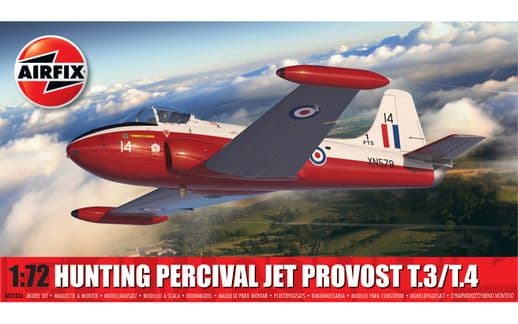
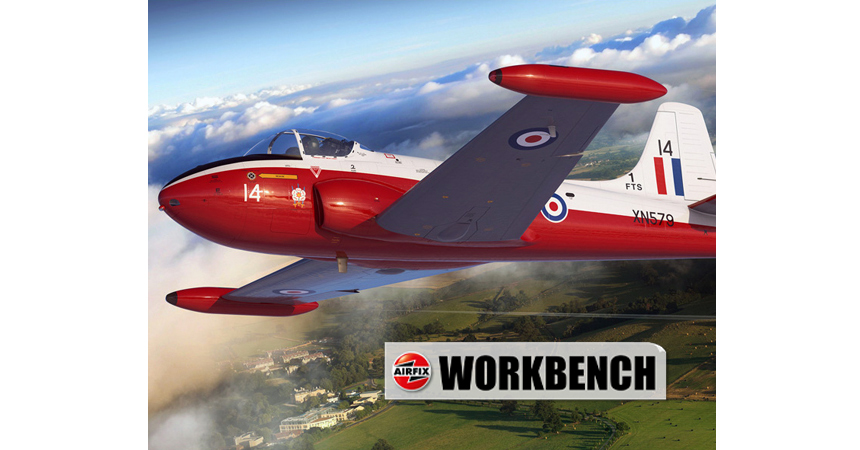
We never need much of an excuse to enjoy Airfix box artwork, especially when it shows how magnificent it must have been to be a student pilot training in a Jet Provost T.3. This artwork was from the first release from this newly tooled kit back in 2016.
These first Jet Provosts may have been the pioneers of the RAF’s ‘All jet flying training program’, however the first major production variant which followed them into service was a very different aeroplane, both internally and externally. Modifying their design after having closely monitored the introduction of the Jet Provost T.1 and after seeking the input of both instructors and student pilots, the T.3 had more power, a redesigned cockpit canopy for greater visibility and the inclusion of the latest lightweight ejection seats.
The aircraft’s wings were strengthened to allowed for the addition of wing-tip mounted fuel tanks, something which improved flight durations despite the inclusion of a more fuel hungry engine, if changing the profile of the trainer. Perhaps the most significant visual difference though came with the modification of the aircraft’s undercarriage – the distinctive ‘stilt-like’ undercarriage legs which were such a feature of the T.1 were replaced with much shorter, more robust units, a design development which saw the aircraft now sitting much closer to the ground. The Jet Provost may have lost a little of its charm, but it was a much more effective training aeroplane for the change.
The first Jet Provost T.3 made its maiden flight on 22nd June 1958 and heralded the beginning of a long and successful association between Britain’s first jet trainer and the Royal Air Force. As is the case with most new aircraft types, the first Jet Provost T.3s were sent directly to the Aircraft Armament and Experimental Establishment (AA&EE) at Boscombe Down, so the resident test pilot school could assess the effectiveness of the aircraft before it could be cleared for RAF service.
For those who lived in the vicinity of an RAF training station during the second half of the 20th century, the Jet Provost would have been a familiar sight and sound.
Production of this latest variant of the trainer continued apace and in June 1959, the first Jet Provost T.3 trainers arrived with No.2 Flying Training School, the same unit which had operated the original T.1 jet trainers. Now stationed at RAF Syerston, No.2 FTS could now offer its students an ‘All jet training programme’, which was the first such course to be established anywhere in the world. The summer of 1960 subsequently marked the completion of the world’s first ‘all jet’ basic flight training course, a major development in the history of the Royal Air Force and a proud achievement for Britain’s aviation industry.
As more Jet Provost T.3 aircraft became available, the retirement of the earlier Piston Provost T.1 still in service could begin in earnest. The first two units to trade their Piston Provosts for the new jet trainer were the Central Flying School at RAF Little Rissington and the Royal Air Force College at Cranwell. The T.3 would also go on to equip No.1 Flying Training School at Linton-on-Ouse, No.6 FTS at Acklington (later based at Finningley), No.7FTS at Church Fenton and No.3 FTS at Leeming. Of the 201 Jet Provost T.3 aircraft ordered by the Royal Air Force, all were delivered between 1958 and 1962.
As the Jet Provost was destined to have a long and successful service career with the RAF, it was to benefit from various upgrades and improvements during that time, all intended to make the aircraft more capable in the vital role it performed. In the early 1970s, a significant programme to equip T.3 jets with the latest radio and navigation equipment commenced, as they had a requirement to bring the aircraft in line with the latest air traffic control requirements. This work was carried out by BAC at Warton following an extensive evaluation study and aircraft undergoing these modifications would be designated Jet Provost T.3a, with 86 aircraft benefiting from the systems upgrade.
The project would take three years to complete, with the final aircraft, Jet Provost T.3a XM510 being handed back to the RAF in June 1973.
The next major development in the Jet Provost line was the introduction of the T.4, an aircraft which was essentially a high-powered version of the T.3, one which saw the introduction of the uprated Viper 202 turbojet. Boasting 2,500 lbs of thrust, the new engine gave the Jet Provost a welcome and rather impressive 40% increase in power, something which definitely brought with it a marked increase in performance. This significant increase in power was most noticeable during take-off and when climbing to height, but generally made this variant of Jet Provost a much livelier performer, one capable of doing everything its predecessors did, only better.
A beautifully finished example of our Jet Provost T.4 kit finished on one of the two scheme options included with the kit.
The additional power the T.4 could call upon made the aircraft a popular choice with aerobatic display teams and several would re-equip with the type during 1962. That increase in available power also dictated that this variant was flown much more enthusiastically than earlier variants, with these aircraft also being used for tactical weapons training and advanced flying training duties, however, there would be a price to pay.
Although the service life of this variant would prove to be relatively short, the more demanding flying undertaken by these aircraft dictated that many were subjected to higher airframe fatigue stresses, with most being withdrawn from training establishments by 1971 as a consequence. Some aircraft did remain in service with the Tactical Weapons Unit at RAF Brawdy and the Central Air Traffic Control School at Shawbury until the summer of 1989.
The final variant of the Jet Provost line was the T.5/T.5a, which was a pressurised version of the aircraft and one which was quite different from the aircraft which preceded it. This is a Jet Provost story for another edition of Workbench and hopefully, even the subject of a new tooling project in the years to come.
A sight to warm the hearts of anyone living or working around one of the RAF training stations around the UK, a Jet Provost T.3A up where it belongs. Wearing the iconic colours of an RAF training aeroplane, this really is a beauty.
Within the long heritage of the Airfix model kit range, the Jet Provost occupies quite a significant position, and as the aircraft marked a historic development for the Royal Air Force, a Jet Provost T.3 tooling was released into the range less than two years after the first flight of the prototype aircraft. Knowing the aircraft represented the future of the RAF and was likely to be in service for many years to come, Airfix designers were quick to forge links with the manufacturer, obtaining enough information to allow the scale representation of the aircraft to join an Airfix range which really could do no wrong at the time.
A version of the T.5/Strikemaster was tooled for release in 1975 and whilst both kits would be released several times in subsequent Airfix ranges over the years, by the turn of the century, it could be argued that both were in need of attention. We would have to wait another 15 years before a new Jet Provost project landed on the desk of one of our product designers, almost coinciding with the launch of our Workbench blog.
By the following year, we were able to inform our readers about the release of a beautifully tooled new Jet Provost T.3/T.3a/T.4 kit, one which immortalised this important British training aircraft in 1/72nd scale and in some style. This latest project update marks the release of what it just the fourth presentation of this beautiful little kit and if the previous releases are anything to go by, this is destined to be a popular addition to the range.
Let’s take a look at the two scheme options available with this latest Jet Provost release.
With the RAF expanding its jet basic flying training programme during the Cold War era, it follows that the aircraft used to train a high volume of new pilots would be the one which would become familiar to the highest number of people throughout that time. Whether building, operating, maintaining or flying the Jet Provost, or simply living in areas which would regularly have these aircraft flying in the skies above them, more people would come into contact with the ‘Constant speed, variable noise machine’ than any other RAF aircraft type. Perhaps this explains why the aircraft can still count on being held in the affections of modellers and enthusiasts alike.
No.1 FTS reformed at RAF Syerston in May 1955 and were initially equipped with Percival Provost T.1 aircraft, charged with providing basic flying training for the Fleet Air Arm and Royal Naval Volunteer Reserve pilots. Moving to Linton-on-Ouse in 1957, the unit received their first Jet Provost T.3 aircraft in August 1960, but at that time, would offer basic training courses flying both their new jets and the original Piston powered derivative of the aircraft.
The unit would enjoy a long and productive association with the Jet Provost and would ultimately be responsible for training several hundred pilots for both the Royal Air Force and the Royal Navy. Of all the students to successfully gain their wings thanks to the instructors at No.1 Flying Training School, without doubt, one of the most significant was Flight Lieutenant Julie Ann Gibson.
Although the ferry pilots of the ATA received plenty of deserved recognition for the vital work they performed during the Second World War, women pilots were not subsequently allowed to become full time pilots in the Royal Air Force. That being the case, when Julie Ann Gibson joined the force, she did so after accepting a position as a trainee engineering officer and whilst she went on to achieve in this role, she wanted much more.
Full scheme details of this Jet Provost which had a significant role to play in the history of the Royal Air Force.
When the rules changed in 1989, Julie was one of the first women to apply for pilot training and once accepted, embarked on that training at RAF Linton-on-Ouse in North Yorkshire. By May 1990, she was ready to make her first solo flight in Jet Provost T.3a XN579, a historic event which took place at RAF Dishforth under the full gaze of the nation’s media.
Flt Lt Julie Ann Gibson would become the first woman to be awarded her RAF wings and would go on to enjoy a successful career flying multi-engined aircraft, initially flying the Hawker Siddeley Andover and later the Lockheed C-130 Hercules. As a trailblazer, Julie became well used to being at the centre of attention and as a qualified pilot, each and every airfield she landed at having gained her wings would be the first time a woman pilot in the RAF had done so in over 70 years.
Obviously having a great affection for the aircraft in which she made that historic first solo flight, Jet Provost T.3A XN579 was built in early 1961 and delivered to the RAF in April the same year. The aircraft would have a long and successful RAF career, serving with several units and at several stations around the UK. Upgraded to T.3A standard in 1975, this aircraft would end its service career as a ground instructional airframe at North Luffenham, but would later be sold to a private buyer.
Despite the significant role she played in Royal Air Force history, this aircraft would end her days lying in a forlorn state, with wings removed, serving as an unusual item of cover at a paintball adventure venue in Suffolk.
The Royal Air Force College was established in 1919 to provide basic flying training for students who were attempting to become the future leaders of the Force. Prior to the introduction of the Jet Provost, all flying training took place at the College, with initial basic training undertaken using the Percival Provost T.1, before advancing students moved on to time in either the de Havilland Vampire, or Gloster Meteor.
The first Provost T.3 arrived at Cranwell in June 1960 and following a period of acclimatisation and conversion, the first training course using the aircraft began in September the same year. In fact, the Jet Provost would go on to enjoy a long association with college, with all the post T.3 variants of the aircraft providing flight training support for students over the years.
As with all aircraft serving in the RAF, Royal Air Force College Jet Provosts were maintained to an extremely high standard, but as the families of students would regularly be invited to this famous venue to celebrate their relative successfully gaining their wings, it was a matter of pride amongst the students that the aircraft they used were presented in a particularly striking manner.
During those occasions where students were celebrating their achievement with family members, the College would often provide some aerobatic display entertainment for those gathered using home-based aircraft. Prior to the arrival of the Jet Provost, these displays had been performed by several display teams operating the de Havilland Vampire T.11 and it wouldn’t be until 1963 that an official Jet Provost display team was established. This team would become rather famous on the UK Airshow circuit and would be known as ‘The Cranwell Poachers’.
Full scheme details for this second option included with this latest Jet Provost kit, one resplendent in the early service colours of the Royal Air Force College Cranwell.
Jet Provost T.4 XP568 was constructed by the British Aircraft Corporation as one of the first examples of this variant to be produced, joining the Royal Air Force College in early 1962. With this variant of the aircraft benefiting from the additional power offered by the latest Armstrong Siddeley (Rolls Royce) Viper engine, the T.4 tended to be flown much more enthusiastically and, in a manner commensurate with that greater performance.
Whilst all that additional power did allow students to enjoy some more exciting flying experiences, and the performing of dynamic aerobatic displays, it also led to some fatigue stressing issues and consequently, a relatively short service career for this variant of the Jet Provost.
Having been disposed of by the Royal Air Force, this particular Jet Provost was secured to become part of the impressive East Midlands Aeropark aircraft collection and after spending some time stored outside and steadily deteriorating, it was to benefit from a concerted period of restoration and renovation from November 2011. With this work completed, she was presented in the beautiful markings she wore during her time serving with the Royal Air Force College and when admiring this scheme, it isn’t difficult to see why the Jet Provost continues to be such a popular subject with the nation’s modellers.
Airfix box presentation of distinction. This one is the full artwork file supplied to our production facility, followed by how the new kit will look when we find it on display in our favourite model shop.
The latest release from a tooling project which was first unveiled in the 2016 Airfix range, we are delighted to confirm that this beautiful new model is available now and presents us with two appealing schemes which will prove difficult to decide on. With the stunning box artwork featuring the Jet Provost in which Flt Lt Julie Ann Gibson made her first solo flight, this will definitely be the scheme I will be finishing my own example in, particularly as it also celebrates the aircraft’s proud association with the fair county of Yorkshire.
We are afraid that's all we have for you in this latest edition, but we will be back next Friday with more project development updates and the very latest Airfix kit exclusives. In the meantime, we are always keen to hear your views on all things Airfix and in particular, any thoughts and opinions you may have regarding our Workbench blog. If you would like to drop us a quick line, could we please ask that you use our workbench@airfix.com email for all correspondence.
To re-visit any of the Airfix blogs we have produced over the past seven years or so, please head to our main Workbench hub, where you will find our entire blog back catalogue and all the Airfix design projects we have already covered.
All our dedicated official social media sites can be accessed by clicking the respective link icons at the foot of this page, or by heading to the Airfix homepage. Other useful Airfix links are:
Facebook, YouTube, Twitter and Instagram official sites
Please join us for more Airfix updates next week and thank you for your continued support.