


Welcome to the latest edition of our weekly Workbench blog, and all the news, updates, and modelling exclusives from the fascinating world of Airfix.
As this weekend will see millions of people around the world celebrating Valentine’s Day, and our undying love for that special someone, or something in our lives, there really could be only one subject for this latest edition of Workbench, even though we’re probably going to be requiring the use of your imagination at points along the way. Will we be able to produce something which encompasses love, Airfix and the hobby we all hold so dear, or will our blog gift end up being a little wide of the Valentine’s mark? As ever, you will be the judges of that, but you can rest assured that we’ll be giving it our best shot, and like the Milk Tray advert of years past, it will all be because we know Workbench readers love Airfix model kits.
So, as we start to create this latest edition of Workbench, the first one since marking our 400th edition last time around, we’re not exactly sure which subject direction we’re going to be taking, but what we do know is that we will be featuring a few Airfix scale model kits along the way. Hold on tight, this might turn out to be something of a wild ride.
Going back to the subject of our recent 400th edition for a moment, as our previous blog was published late on Saturday evening for the first time in almost eleven years, if you haven’t already read that edition, please do so, as we announced a rather spectacular competition last Saturday, with a mega kit bundle worth £400 being up for grabs. Please use the link above to be taken straight to the competition page.
Right then, let’s head into the unknown!
When it comes to our love of modelling, we will all have our own particular stories relating to where and when we first became infatuated with this fantastic hobby of ours, and which model kits in particular hold a special place in our hearts and why. We also all know of the many benefits modelling can bring, from mindfulness and relaxation, to helping increase fine motor skills and dexterity, or simply just having that sense of achievement when finishing a scale model representation of a famous aircraft or ship. Despite this, suggesting that modelling can actually help us find love may be a bit of a stretch, but you never know, stranger things have happened.
Maybe going down the path of suggesting that modelling might help some of us to love ourselves a little more could put us on a stronger footing, as joining a modelling group can provide all the benefits mentioned above, along with the sense of community and camaraderie that only being part of a group of like-minded people can bring, but whether we love them or not, well, that’s a very different question.
When it comes to modelling, going down on one knee has a very different meaning to us than it would for the rest of the world, because when wider society associates this with someone about to make a proposal and is a sign of our most sincere affection, to a modeller, it means that a particularly small and important part has been lost to the dreaded carpet monster, and that’s equally as stressful a situation.
In fact, it would be more usual for a group of gathered modellers to share stories of the elaborate measures they’ve had to take in sneaking the latest kit additions to their stash into the house over the years, without arousing the suspicions of their significant others. Whilst these stories are always humorous and enjoyable to hear, whilst at the same time confirming that bond of brotherhood all modellers share, it isn’t exactly Valentine’s fare and is still leaving us looking for that loving feeling.
Featuring our new Flowers would have been ideal for this edition, but that would have been too easy!
For many modellers, the simple kindness of having our partner care enough to take the time to really know what we’re interested in, and indeed at times such as these, present us with a gift we would really appreciate, would mean the absolute world to us, and would say much more than the actual gift (obviously a model kit) itself did. However, as we know only too well, this works both ways, and if we don’t put in the same amount of awareness preparation work in, we could be in a spot of bother, and we definitely don’t want to be that person.
All this is clearly a little tongue in cheek when it comes to modelling and Valentine’s Day associations, even though the restorative and mindfulness benefits of a little modelling ‘Me Time’ really is a thing, but suggesting we could both spend a romantic evening modelling over a candlelit table might be a little fanciful, to say the least.
When it comes to modelling subject matter for a blog looking to link modelling and Valentine’s Day, clearly our recently announced Airfix Flowers would be the ideal subject for a new tooling design and development edition of Workbench, but that would have been just too convenient, wouldn’t it. Although this represents a fascinating new direction for a brand which has never been afraid to venture into new modelling territories, and to provide interesting subject matter for existing modellers, and those yet to discover its delights, I’m afraid those details are not available just yet, so that door of subject support is still closed.
So, this Valentine’s Day, where are we going to find our current range subject inspiration for a related blog post then? One possible area would definitely be a challenge the Airfix team have been wrestling with for quite some time now, that of appealing to young, novice modellers, and how to encourage them to have a go at modelling, perhaps for the very first time. Having attended a late season Model Show at the Yorkshire Air Museum last year, I was delighted to see their Junior Modeller competition being so keenly contested, with a full table of impressively finished kits up for adjudication consideration.
In my role as the Airfix representative, I also had the opportunity to speak with several parents on the day, discussing how their youngsters had come to enjoy the hobby. Most described how they themselves were modellers, and by letting their kids come to them in their own time, how this had supported those first tentative steps without too much encouragement, if that makes sense – it was their decision, not an experience forced upon them.
Even though they still do have the same distractions we all have in this technological age, they really do enjoy the time they spend modelling, and even if it isn’t as all-encompassing pastime for them as it was for us during our own formative years, it is still part of their lives, and surely that’s the only thing we can ask. If they have a younger sibling, that enthusiastic uptake of a hobby their older brother of sister is already active in is even more natural for them, and starting at an even earlier age, they tend to become even more proficient in modelling terms.
Designed with a specific modelling task in mind, our new Starter Set kits have been produced with first-time and novice modellers in mind.
In support of those first tentative modelling steps, our new Starter Set kit series has been conceived specifically with the younger, novice modeller in mind, expertly designed to create beautiful scale representations of the subjects on which they are based, just with lower part counts and simplified assembly. These impressive little kits go together easily and intuitively, with the reduced part count requirement meaning that pieces which would usually be smaller, separate items in a traditional kit, are designed as larger, amalgamated pieces in these introducer kits. Whilst this clearly make things easier for the novice modeller, it can pose some real challenges for our designers, as these larger parts can cause problems during the tooling/manufacturing stage, leaving much for them to consider.
One of the most impressive features of these new Starter Sets is that even though they’re very much intended for younger, less experienced modellers, they’re never short changed when it comes to subject selection, or the stories behind the scheme options included with the kit. History is still a fascination for large sections of the population, and whilst it may not immediately be of interest to the novice modeller during their first build experience, it’s always there, if and when they do start to ask questions.
With such iconic subjects as the RAF’s current Eurofighter Typhoon, cutting-edge F-35B Lightning II and ever popular Red Arrows Hawk in the range, it’s always surprising to discover that when asking youngsters what their favourite modelling subject is, the majority will usually reply ‘Spitfire’. Thankfully, we made sure that Britain’s most famous aircraft was one of the first new tooling additions to our new breed of Starter Set kits.
Communities which host a Shannon Class RNLI Lifeboat and their crews are fiercely proud of that association, and were keen to make sure our new kit included decal options for their boat.
Staying with the subject of new starter sets, but circling back to the subject of love and affection for a moment, when we released our new RNLI Shannon Class Lifeboat into the range, it became immediately obvious just how attached local communities are to their particular boat, and the brave men and women who crew them. When we initially released this impressive kit, we did so with the model wearing the livery and hull number of a trials vessel, but this simply wasn’t good enough for the communities currently hosting a Shannon Class Lifeboat around Britain’s coastline, they wanted their boat!
Some quick thinking by the Airfix team resulted in the creation and production of a separate sheet of decals for this new kit, one featuring the numbers of 50 different RNLI Shannon Class Lifeboats in service around Britain at the time of printing, including a comprehensive list of boat numbers and station locations for those interested in this incredible service. A situation which clearly illustrated the affection in which these stations and their boats are held, this proved to be one of our most successful kit releases of the past few years, and will hopefully have introduced many new and novice modellers to our beloved hobby.
Significantly, a donation from the sale of every Shannon Lifeboat kit is made to the Royal National Lifeboat Institution, and we’re proud to be associated with this incredible service.
The nose artwork applied to many USAAF aircraft operating from bases here in the UK have been incredibly popular with the modelling hobby over the years.
Although we said at the very beginning of this latest edition that finding direct love connections to our hobby might be a bit of a challenge, it’s actually not all that difficult if you have an interest in USAAF operations during the Second World War, particularly those men and aircraft who were stationed here in the UK. Making a vital contribution to the Allied war effort and ultimate victory, the flower of America’s youth may have left their homes and loved ones behind to fight overseas, but they kept both with them throughout, in their hearts and minds. In a great many cases, if they were aircrew, reminders of home also made it onto the sides of their aeroplanes, the fascinating subject of nose artwork.
Crews and ground support teams obviously had affection for their assigned aircraft, machines which literally held their lives between their aluminium panels and flush rivets, but they also personalised them by painting reminders of home as nose artwork additions, be that the area where they were from, or a reference to the wife or girlfriend of the pilot or crew chief. Aircraft such as ‘Memphis Belle’, ‘Detroit Miss’ and ‘Big Beautiful Doll’ are all familiar to modellers the world over, as these simple terms of wartime affection and endearment made an easy transition to our hobby.
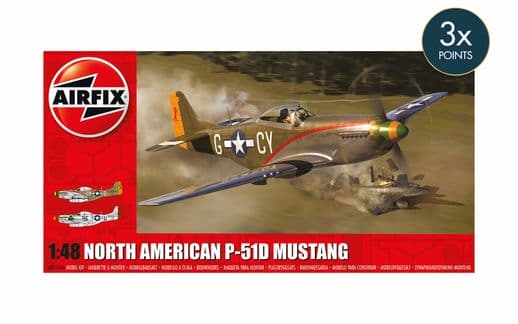
This phenomenon is always a feature of every Airfix range, with kits such as our 1/48th scale North American P-51D Mustang being a perfect example of this, with the lead scheme being an aircraft which was known as ‘The Millie G’, and was named after the pilot’s beloved wife.
Born in Jacksonville Illinois on 8th July 1918, Edward Bonfoy Geller would go on to attend the University of Illinois, where he studied Chemical Engineering, in addition to joining the attached Military School. With his love of aviation, he used his own money to pay for a course of flying lessons and on the successful completion of these, paid even more to become proficient in aerobatics.
Enlisting in the Army Air Corps prior to America’s entry into the Second World War, during the final stages of his training, he would be posted to Portland AFB, an airfield which shared operations with several civilian airline operators. One afternoon, one of his fellow pilots came into the crew room and asked if anyone wanted to go on a blind date with an airline stewardess at the base?
Giller had spent the past few weeks telling his fellow trainees expressly not to get attached to a girl, as they would soon be posted overseas, but despite this, said he would very much like to go on the date.
When he met the attractive Mildred Schmidt, the couple had an instant connection and going against his own advice, married her just three months after this first meeting. Although he would soon have to leave his new wife for a posting to England and the savage aerial fighting over occupied Europe, her name would be carried on all five of the fighter aircraft Giller had assigned to him during his time in Europe - ‘The Millie G’ was sported on a P-38 Lightning and four different P-51 Mustangs.
Lt. Edward Giller and the rest of the 343rd Fighter Squadron left for England during the summer of 1943, destined for the new USAAF Station 131 at Nuthampstead in Hertfordshire. The three assigned squadrons at the base would make up the 55th Fighter Group of the Eighth Air Force and on 15th October 1943, became the first P-38 Lightning equipped group to become operational in the European Theatre. Their initial duties were to fly bomber protection missions deep into enemy territory and when they had the chance to engage the Luftwaffe, to destroy as many enemy aircraft as possible, be that by engaging in aerial combat, or by destroying them on the ground.
Giller is reported to have described the Lightning as an excellent fighting aeroplane, but not one which was ideal for taking on the Luftwaffe over their own territory. German fighter crews knew that if they saw two contrails in the sky, that they were most likely to be American Lightnings, so they had no element of surprise in their operations. Lacking the range to escort the bombers all the way to their targets, if units were attacked by German fighters, they would adopt slash and run tactics, knowing that if the dived towards the ground, the American fighters simply could not catch them.
Once they spotted the vapour trails, they just waited for the fighters to turn back before running in to target the bombers unopposed, but thankfully that all changed when the 343rd exchanged their P-38 Lightnings for a new fighter.
The nose art reminders of home have always been a popular subject with modellers over the years, including those aircraft which carried the names of wives and girlfriends into aerial combat.
In April 1944, all three squadrons which made up the 55th Fighter Group moved to a new base, Station 159 Wormingford in Essex, in advance of their re-equipping with the latest variant of the North American P-51 Mustang. Giller and his squadron mates would prepare for their first flight in this new single engined fighter by fastidiously studying the pilots notes booklets they had all been supplied with and following a quick cockpit familiarisation session, it was a case of immediately taking that first flight plunge. Fully operational in the Mustang by July, Giller thought this new fighter gave them a definite combat edge - not only could they now spring attack surprises on the enemy, but they also had an aircraft which could follow Luftwaffe fighters down to the deck, pressing home their determined attacks.
As the number of enemy aircraft to tangle with became noticeably fewer at that time, they often found themselves having to engage in dangerous, tree-top height missions to known Luftwaffe airfield sites, hoping to find targets of opportunity.
On a bomber escort mission over Munich on 9th April 1945, Giller and his flight were released to go hunting for Luftwaffe targets, when he noticed a Messerschmitt Me 262 jet being chased by, but easily outpacing a gaggle of Mustangs. It was a usual jet tactic to approach protected US bombers at speed, make an attack run and head for the deck, tempting the covering Mustangs to jettison their underwing fuel tanks and give chase. With little chance of catching the jets, the Mustangs would have to turn for home once their limited remaining fuel hit a certain level, leaving the German jets and other fighter units to return to the bombers and exact a heavy toll. On this particular occasion, the Me 262 jet pilot he spotted was not going to retain the combat upper hand for long.
Dropping tanks and rolling into a steep dive, ‘The Millie G’ had a significant height advantage over the Messerschmitt and helped by the effects of gravity, the Mustang’s airspeed indicator hit 500mph as he levelled out, immediately speeding past the other chasing Mustangs. With the German jet now preparing to land at Munich-Riem airfield, he lined it up in his gunsight and let him have all six fifty cal machine guns. The jet made a heavy belly landing, by which time every gun on the airfield was firing in the direction of Giller and his Mustang, but fortunately, his high speed and low altitude made it difficult for them to target him accurately and he managed to head home unscathed.
Later in the war, it was reported that Giller had the opportunity to speak with the famous German ace Adolf Galland, who was being held captive at their forward operating base. Recounting his Me 262 attack to Galland, the German said that he had been on the airfield that day and saw the incident. He told the American that the jet pilot managed to walk away from the incident without injury, but the very next day, took a fighter and made straight for Switzerland, clearly feeling that his close call leaving him with a sense of foreboding.
This fabulous modelling subject was so impressive that it required the production of two different versions of the box artwork, both showing Lt. Edward Giller’s victory over a Luftwaffe Messerschmitt Me 262 jet fighter.
With the new German Jets being so highly prized amongst USAAF fighter pilots and with less Luftwaffe aircraft now engaging in open combat, swarms of Allied fighters would either loiter around areas of known Luftwaffe activity, or fly at tree-top heights hoping to get lucky, stumbling across a lone German fighter, or better still, an airfield full of parked aircraft. These missions were incredibly dangerous and the USAAF would lose far more pilots engaged in strafing missions than they would those as a result of aerial combat, especially as the Germans proved to be particularly skilled in establishing flak-traps for unwary American pilots.
Tempting Allied pilots into pre-determined fire zones, aircraft, often those which were damaged or unserviceable, were positioned around the boundary of the airfield, with concentrated anti-aircraft fire concealed within wooded areas. Any American fighter taking the bait would be met with a withering wall of fire and any thoughts of attack quickly switching to simply getting out of the situation in one piece.
Having discovered Luftwaffe aircraft concealed within trees at the side of the Autobahn on a previous mission just a few days earlier and finding nothing of note on their latest sortie, Maj. Giller flew his Mustang over a different stretch of the motorway and got lucky. At low level and high speed, he called his discovery to other members of his flight, before making multiple passes where he saw strikes on several parked aircraft. Not wanting to miss this opportunity, he wheeled around to make a third pass, this time seeing strikes on a parked Junkers Ju 88, before his aircraft was caught in a hail of ground fire coming from the trees. With multiple strikes hitting his fighter, a 20mm shell exploded through the canopy, causing fragments to bury themselves in his left shoulder.
Overcome by the searing pain and with blood oozing from the wound, all that Giller could think about now was getting out of there and seeing if his aircraft was still responsive and more importantly, if he was fit to fly it. Inspecting the wound and seeing the sheer amount of blood, he initially thought he would have to set the aircraft down in a suitable field and hope the Germans would allow him swift medical assistance, however, with his wingman at his side and a course for home now set, he decided to see how long he could keep flying with his one good arm, before the pain, or blood loss caused him to think otherwise.
A physical, scale preservation of history, models featuring nose artwork and the names of pilot’s loved ones, have always been popular with modelling enthusiasts.
Thankfully, the two Mustangs managed to make it all the way back to their home base, but this would prove to be Major Giller’s final combat mission of the Second World War. Having flown 115 combat missions, including those in support of the D-Day landings and with at least one Me 262 jet to his name, Giller and his various ‘The Millie G’ fighters was officially accredited with three aerial victories and a further six on the ground, during his time combat flying in Europe.
Remaining in the Air Force following the end of the war, he eventually retired having attained the rank of Major General and passed away in October 2017 at the age of 99 years. Although outliving his beloved wife to whom all his wartime aircraft were dedicated, they did enjoy a happy 69 years together, which wasn’t a bad result for a blind date at an Air Force training school in 1943.
See, this is definitely an Airfix model kit linked Valentine’s story – I knew we’d find one!
When it comes to discovering fascinating stories linked to Airfix model kit releases, there are rare and fascinating occasions when you actually get to speak to the people who spent time with the actual aircraft or vehicle which has just been immortalised in kit form in our latest model range, something which is as interesting as it is inspirational. This happened when we released the second kit from our 1/35th scale Ferret Scout Car Mk.1 kit, with one of its three schemes being a vehicle which took part in the Gulf War of 1991, a vehicle which was home to Alister ‘Connie’ Constantine of No.40 Field Regiment for the duration of the conflict.
Having the opportunity to speak with Alister in the week’s following the kit’s announcement, we were given an incredible first-hand account of his time in the Gulf, and of the genuine affection he had for his assigned Ferret. As a modelling project, these details really did elevate this to a must-do project for many modellers, with the details Alister provided giving this kit both the providence and personality to elevate it to something more than just another model build.
When Alister and the rest of his group arrived to inspect their assigned Ferrets prior to deployment, they found them to be in quite a state, so spent much of their initial training period attempting to make them as battleworthy as possible, commandeering as many parts and useful equipment from other vehicles not assigned to the coming task as they could. As they were expecting to be sent into forward ‘contact’ areas when in theatre, their actual preparations involved recognition and familiarity training, so they would be fully conversant in the types of vehicles they may come across when in theatre, both coalition and enemy.
Once initially deployed to Saudi Arabia, this training continued whilst crews awaited the arrival of their vehicles, a period which Alister described as being particularly enjoyable, as they worked closely with elements of the US Marine Corps at that time. Once their Ferret had arrived, it was time for action and initially, surveying potential Allied gun positions, both in defence of further Iraqi Army advances, then on to offensive operations.
Following the release of our second 1/35th scale Ferret Scout Car kit, we made the acquaintance of Alister ‘Connie’ Constantine, a man who called this Ferret home for the duration of the Gulf War.
Initially, the Ferret’s role in the Gulf would be that of reconnoitring territory and positions, but also acting as a general liaison vehicle as and when required. This would move on to seeing them used as general ferry vehicles for both men and equipment, to and from larger supply positions behind the lines. Eventually though, the British Army Ferrets would revert to type and move to forward positions to be used as artillery observation points and working alongside tanks and other armoured fighting vehicles, where their proficiency as stealthy reconnaissance vehicles could be brought to bear.
As the fighting took a turn in favour of coalition forces, Ferrets would be used to check former enemy positions and to scoop up Iraqi troops who were looking to surrender along the way, which was a role not without its dangers for Ferret crews, as these enemy troops were still often armed. Ferret crews would then be charged with escorting these prisoners back to holding points behind the front lines, before speeding back to potential action hotspots, at speeds only a Ferret to hope to achieve.
Whilst the rest of the world watched the conflict in the Gulf unfolding on our TV screens, Alister was actually living through it ‘in theatre’, with trusty Ferret 00 EC 15 (4404) being his temporary home for the duration. Whilst it must have been a worrying time for him back in 1991, having his Ferret immortalised as a scale Airfix model kit certainly rekindled some fond memories for him, in addition to reaffirming the affection he had for an armoured car which kept him safe during his time in a war zone.
There really is much more to our hobby than initially meets the eye.
We end this latest, rather unusual edition of Workbench by considering the actual date we all celebrate Valentine’s Day on each year. When making my initial plans for production of this latest blog, I obviously thought about looking for significant first flights and service introductions which took place on 14th February. Unfortunately, this appears to be an unusually quite day for such things over the years, but I did find one, one which is rather more infamous than famous.
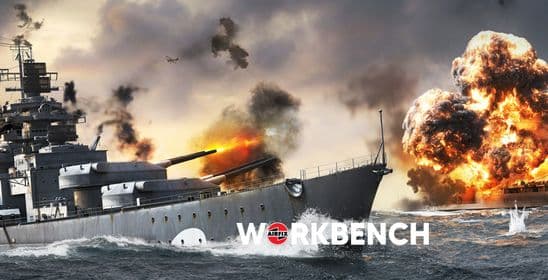
If you asked anyone to name a famous Battleship from the Second World War, many would probably reply ‘Bismarck’, despite the fact that this mighty German battleship only had an eight month career, and conducted just one offensive operation in May 1941, one which lasted just eight days, but included the destruction of the British battlecruiser HMS Hood. This famous Kriegsmarine warship was launched on 14th February 1939.
The mighty German Battleship Bismarck was one of the most advanced warships the world had ever seen, and posed a significant threat to Atlantic convoys and Britain’s vital naval supply lines. She had to be destroyed at all cost, and the loss of the British battlecruiser HMS Hood during the Battle of the Denmark Strait on 24th May 1941 saw a powerful British task force steaming headlong towards Bismarck to that end.
With her rudder damaged by a torpedo strike from one of HMS Ark Royal’s Swordfish biplanes, the crew of Bismarck couldn’t make good their escape and awaited their fate, each man determined to fight to the end. When the British ships arrived, they pounded their huge German target with 2,800 shells fired, and at least 400 of them finding their mark. Destroyers also moved in to unleash their torpedoes and unable to resist any longer, Bismarck slipped beneath the Atlantic Ocean on 27th May 1941.
Although not possessing any reference to love or affection in any way whatsoever, Bismarck was the only machine to be incorporated into the Airfix range in kit form to have any direct link to the actual date of Valentine’s Day, so it’s probably right that it was included. We did say that you might have to bear with us for this edition, as we weren’t quite sure which direction it was going to take – we hope we managed to come up with something of interest.
As far as modelling and Valentine’s Day is concerned, Workbench readers will be only too aware of the many positive benefits our hobby provides, and how it brings us fulfilment and enjoyment, and yes, we could even say that we love it. Whether or not any of us can look forward to a model present or two this coming Valentine’s Day is another story altogether, and there will probably be even less occasions where we actually give an Airfix model gift to our significant others, at least until our new Flowers kit range is released and available.
Even though that may well be the case, we do love our hobby, and as far as we’re concerned, surely that should be reason enough to produce a Valentine’s Day edition of Workbench.
We're afraid that's all we have for you in this latest edition of the Airfix blog, but we will be back next Friday with more project development updates and the very latest Airfix kit exclusives. In the meantime, we're always keen to hear your views on all things Airfix and in particular, any thoughts and opinions you may have regarding our Workbench blog. If you would like to drop us a quick line, could we please ask that you use our workbench@airfix.com email for all correspondence.
To re-visit any of the Airfix blogs we have produced over the past TEN years or so, please head to our main Workbench hub, where you'll find our entire blog back catalogue and all the Airfix design projects we have already covered.
All our dedicated official social media sites can be accessed by clicking the respective link icons at the foot of this page, or by heading to the Airfix homepage. Other useful Airfix links are:
Facebook, YouTube, Twitter and Instagram official sites
Please join us for more Airfix updates next week and thank you for your continued support.