Welcome to this latest edition of our Workbench blog and all the news, updates, and modelling exclusives from the fascinating world of Airfix.
Although we’re clearly excited to be welcoming our new Jaguar GR.1 tooling into the 2025 Airfix model kit range, we had to include this second blog posting this weekend after hearing some extremely sad news earlier this week. In a year which will see the nation marking the 85th anniversary of the Battle of Britain, we lost the last of Churchill’s ‘Few’ last Monday, as John ‘Paddy’ Hemingway DFC climbed into the cockpit of his Hawker Hurricane for one final flight to join his Fighter Command comrades.
At 105 years old, the passing of the nation’s last surviving Battle of Britain veteran makes us all appreciate what they did for us during the summer of 1940 and how back then, Paddy and his colleagues were all young men with their whole lives ahead of them. They faced terrors that no human should have to endure, but because they did, we enjoy the world we do today.
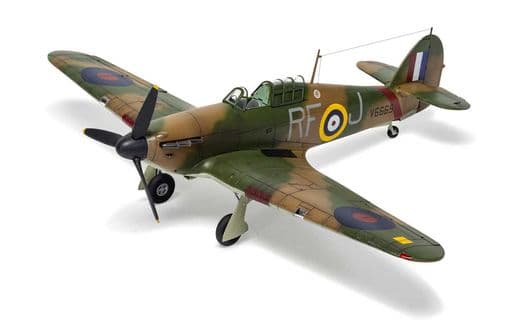
In honour of Paddy Hemingway and those we remember as the ‘Few’, we wanted to re-post a blog feature from several years ago, one kindly submitted by ace modeller and Workbench contributor Michael Scott. A man who also hails from the other side of the Irish Sea, Michael used one of our classic 1/24th scale Hawker Hurricane Mk.I kits to make a scale tribute to Paddy Hemingway, a man who was still very much alive back then, and was still the nation’s last surviving Battle of Britain pilot.
We think this makes for a fitting tribute to John Hemingway, and all the Fighter Command pilots of the Battle of Britain and we thank Michael for allowing us to feature his magnificent model once more.
As a long standing friend of the Workbench blog, the Airfix team have been aware of the prestigious modelling talents of Mr Michael Scott for some time now, as he has helped us with several projects over the years. Michael loves nothing more than immersing himself in a modelling project, combining meticulous research with an undoubted talent for the hobby, with these projects often taking an already highly detailed kit and transforming it to another level of authenticity and accuracy. These builds are often the result of Michael being inspired by a news article, something he came across in a book, or perhaps a historic photograph, all of which came into play with this recent 1/24th scale Hawker Hurricane Mk.I project, something we wanted to know a little more about.
Speaking to Michael about the inspiration behind this very special build project, he told us that like many modellers of a certain age, he was desperate to get his hands on one of the new 1/24th scale Airfix Hurricanes when he was a young man, but could never afford one himself and was never fortunate enough to receive one as a gift. Life and a career would get in the way of modelling before long, however, his desire to build a ‘big’ Hurricane at some point has always stayed with him.
Moving the story forward to an episode of the Antiques Roadshow which aired in 2020, one which was in commemoration of the 80th Anniversary of the Battle of Britain back then, and his interest was rekindled once more. The programme featured a number of Battle of Britain related items, but one in particular which captured Michael’s imagination. The programme included an interview with former Battle of Britain pilot John ‘Paddy’ Hemingway, who described his recollections of the air fighting during the summer of 1940, and who during the programme, was presented with the control column from a Hurricane fighter.
Hawker Hurricane Mk.I P3966 had recently been recovered from a crash site at Fobbing Marshes in Essex by a team of aviation archaeologists, and incredibly, this was the very aircraft Paddy Hemingway had been flying when he had been shot down by Luftwaffe Messerschmitts on 26th August 1940. Mr Hemingway also happened to be the last surviving pilot known to have taken part in both the Battle of France and the Battle of Britain, and was quite the celebrity.
When looking more closely at the wartime flying career of Pilot Officer John ‘Paddy’ Hemingway, it’s both fascinating and sobering to hear his experiences of a time most of us have only read about in books, or when watching a documentary about the subject. The former pilot described how he didn’t believe he would live through the frenetic air battles of the summer of 1940, let alone become known as the last surviving pilot who served during the Battle of Britain. He lost so many friends during that time and described how he was just very lucky to get through it.
He knew friends and fellow airmen who were exceptionally gifted pilots during his service career, men who were absolutely ‘as one’ with their aeroplanes, but didn’t have much luck themselves, and consequently didn’t last that long unfortunately. He did have the confidence of thinking himself to be a good pilot, but fortunate to be a lucky man. This, combined with his Irish heritage, is probably the reason why he survived the Battle and the rest of WWII - he had the benefit of double luck!
This next series of images feature Michael’s stunning Hurricane build and were taken for him by his friend Adam Osborne, to whom we are particularly indebted.
Paddy Hemingway joined the Royal Air Force on 7th March 1938, successfully attaining the rank of Pilot Officer the following year. Assigned to No.85 Squadron to fly the Hawker Hurricane fighter, he was later sent to France as part of the Air Component of the British Expeditionary Force, where he would be credited with victories against a Luftwaffe Heinkel He-111 on 10th May 1940 and a Dornier Do17 the following day. With the squadron suffering heavy losses during its deployment to France, Hemingway would later fly air operations covering the Dunkirk evacuations, before preparing with the rest of Fighter Command to face the might of the Luftwaffe once more, but this time over home territory.
During the Battle of Britain, Hemingway would be shot down twice in August, first whilst engaged in combat with Junkers Ju-88s off the Essex coast, and later when flying Hurricane P3966 against Dornier Do17 bombers over Kent. Incredibly, he would actually be forced to take to his parachute four times during his wartime flying career and having served throughout the frantic early stages of the Second World War, would suffer with severe combat fatigue in the months which followed. He would be forced to spend quite some time performing light duties, before re-joining the fighting later in the war, having fully recovered.
Interestingly, Hemingway’s Hurricane P3966 which crashed at Fobbing Marshes in Essex on 26th August 1940, was located by a recovery team in 1987 and was later the subject of a major excavation project, one which attracted national media coverage. The combat report Hemingway filed after the incident described how he broke off his attack on the Luftwaffe bombers to engage the Messerschmitt Bf 109 fighters which were protecting them, but how his Hurricane was hit by cannon fire from one of the enemy fighters.
With the engine damaged and fast overheating, and the aircraft now unresponsive to control inputs, he decided to bail out, however, as he was aware of reports claiming some British pilots taking to their parachutes had been fired upon by enemy pilots, he delayed pulling the ripcord until he was well below the cloud layer, with his sinuses paying a heavy price. He landed at Pitsea Marshes at around 15.30 and walked to the nearest police station, where he presented himself. He was back with his unit by 22.30 the same evening.
A proud Irishman, Hemingway did spend a number of years in Canada after the war, but couldn’t settle and longed to be back home in his beloved Ireland. John ‘Paddy’ Hemingway is thought to be the last surviving pilot from both the Battle of France and the Battle of Britain, and celebrated his 102nd birthday in 2022.
With his interest now aroused, Michael immediately placed his order for a 1/24th scale Airfix Hurricane kit and started researching the details behind this fascinating story, paying particular attention to the serial number and fuselage codes carried by the RAF No. 85 Squadron Hurricane Paddy Hemingway was forced to bail out of on 26th August 1940. He also told us that he had always had a real affinity with the Hurricane and thinks it gets something of a raw deal historically, as everyone, including Luftwaffe pilots at the time, couldn’t see past the Spitfire when it came to Battle of Britain combat success. Research has since shown that Hurricane pilots actually claimed more victories during the battle than all of Britain’s other defences combined, statistics which include victories scored by the much vaunted Spitfire.
When it comes to the subject of the pilot himself, Michael believes that the time Paddy Hemingway spent in Canada allowed his story to slip under the radar somewhat and the fact that he is now back home in his beloved Ireland and that he is now the last remaining Battle of Britain pilot, is bringing him some long overdue media attention. As far as inspirational aviation related modelling projects are concerned, could there possibly be one more appealing than this?
His research did provide the detail information about the aircraft he was looking for, so the build could now begin in earnest. The code letters were sized and printed on Michael’s computer, with individual masks then printed and cut out using a machine his wife uses for her own hobby. These masks were then used to spray paint the codes on the model, just as they would have been applied on the real aircraft back in 1940, adding that extra bit of scale realism to the project.
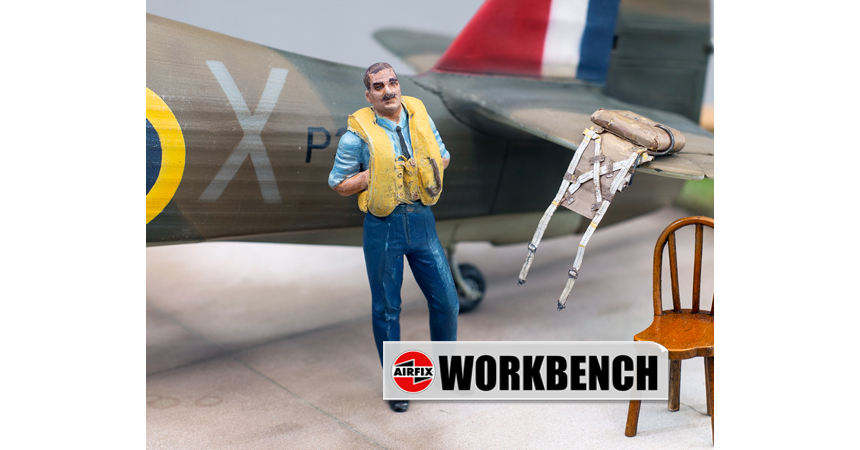
Michael’s research also unearthed a fascinating picture of P/O John Hemingway during his Battle of Britain service, and he wanted to try and replicate this as part of his build. Having scoured the internet for a suitable model figure, he came across a 1/24th scale US trucker figure which turned out to be rather a good match and he set about altering it to replicate the picture pose and facial features of Paddy Hemingway.
He scratch-built an RAF ‘Mae West’ life jacket and made a parachute and harnesses, again following period photographs and simply using Blu Tack as the packed parachute itself. The effect was completed with a chair, something which was often a feature of photographs taken on RAF airfields during the Battle of Britain, with this scale version being a dolls house accessory and one which was finished to look as if it had just been commandeered from the mess hall.
This final selection of images show just how impressively Michael has managed to capture the story of Paddy Hemingway, the ‘Last of the Few’ and tell it in stunning model form. His Hurricane really is a thing of modelling beauty.
The effect Michael was looking to achieve was a build and diorama display which was reminiscent of a Battle of Britain scene, but clearly, the Hurricane fighter itself was always going to be the main attraction. Building the model with the inclusion of many additional touches of fine detail, he included wiring and piping in the engine compartment, extra detail in the gun and undercarriage bays, along with additional detail in the fighter’s cockpit. With the model displayed with many of its panels removed, the overall appearance is quite magnificent and looks for all the world as if this is a stunning scale representation of a combat aircraft, not one which has just been delivered from the manufacturing plant - it really is beautiful to look at. The project is without doubt a fitting tribute to Pilot Officer John ‘Paddy’ Hemingway in his 103rd year ‘The last of the Few’ and a pilot who enjoyed ‘The Luck of the Irish’ during his wartime flying career.
In all, this build project took Michael around a year to complete, but this was mainly down to the fact that he is suffering with quite a severe medical condition at the time, one which affects his eyesight and will only allow him to model for around half an hour at a time, before being forcing him to take a lengthy break. Knowing how this condition has affected him, it is quite astonishing that he managed to produce such an impressive model build, not to mention his resilience in completing the project in such challenging circumstances and in this lengthy ‘little and often’ manner. The completed model is currently on display in Michael’s study, but it will probably end up as one of the impressive displays at the Ulster Aviation Society Museum, where several of his previous model builds can already be admired.
The finished model on its display base and with a label detailing the fascinating subject of the build - great work Michael!
A truly stunning model build and a fitting scale tribute, we would like to thank Michael for allowing us to feature his fascinating Hurricane project, for sending us this impressive selection of photographs and for allowing us to contact him to discuss the details behind the build. As a parting shot, Michael told us that his 1/24th scale Hurricane kit experience was definitely worth the wait and that he has already bought himself another kit to be used on a future project. With a couple of ideas regarding his next project already in mind, we are sure that many Workbench readers would be keen to see the result of his next Hurricane ‘Superkit’ build.
Speaking to Michael again earlier this week, I asked if he would allow us to include this feature once again, in the week in which we sadly lost ‘Paddy’ Hemingway, the ‘Last of the Few’. We think it makes an unusual, but entirely fitting tribute to the life of this incredible man, and Michael told us that he’d be honoured if we did.
Blue Skies Mr Hemingway, hopefully you’re enjoying a beer or two with your Battle of Britain comrades – you certainly deserve it.
We are afraid that's all we have for you in this latest edition, but we will be back next Friday with more project development updates and the very latest Airfix kit exclusives. In the meantime, we are always keen to hear your views on all things Airfix and in particular, any thoughts and opinions you may have regarding our Workbench blog. If you would like to drop us a quick line, could we please ask that you use our workbench@airfix.com email for all correspondence.
To re-visit any of the Airfix blogs we have produced over the past seven years or so, please head to our main Workbench hub, where you will find our entire blog back catalogue and all the Airfix design projects we have already covered.
All our dedicated official social media sites can be accessed by clicking the respective link icons at the foot of this page, or by heading to the Airfix homepage. Other useful Airfix links are:
Facebook, YouTube, Twitter and Instagram official sites
Please join us for more Airfix updates next week and thank you for your continued support.