


Welcome to this latest edition of our Workbench blog and all the news, updates and modelling exclusives from the fascinating world of Airfix.
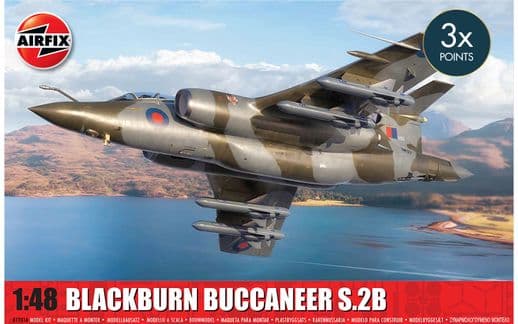
As promised in the previous edition of Workbench, this latest blog will see us returning to the subject of undoubtedly one of the most eagerly anticipated new tooling follow-up releases of recent years, the impending arrival of our 1/48th scale Blackburn Buccaneer S.2B kit in Royal Air Force livery. As you can see by this week's header image, we will be showcasing image exclusives right from the start this week, as we revisit the RAF Buccaneer to share not only an exclusive first look at the new box artwork produced in support of its release, but also a selection of built model images which show off the impressive profile of this modelling heavyweight in fine style.
Although we will be revisiting the interesting details behind all FOUR of the scheme options included with this kit as part of this Buccaneer reprise, there will be new information included and we will have the additional benefit of built model imagery for you to admire, a visually impactful way in which to effectively illustrate the appeal of each option available with this new kit. As we all prepare to settle down for the Christmas holidays, we wanted to spread a little festive good cheer, new Airfix model kit style.
For our final Workbench update of the year to be posted next Friday (22nd), we're intending to look back at some of the successful kit releases of the previous twelve months, but once again by using the medium of built model images to highlight their appeal, but with a slight difference. We are intending to focus on the subjects which may well have featured in various Workbench updates, but kit photography was not available in time to support the update, so effectively exclusive image showcases one and all. We're hoping this will be a nice way for us to end the year, something just that little bit different for Workbench readers to enjoy.
Right then, let's get cracking with this second RAF Buccaneer update feature.
The new 1/48th scale Blackburn Buccaneer S.2B kit will make for an imposing display piece, once you have sorted out the difficult decision of which scheme you’re to finish it in!
Although this second release from our relatively new 1/48th scale Blackburn Buccaneer tooling is a celebration of this rugged aircraft's Royal Air Force career, it has to be acknowledged that no Buccaneer was ever able to fully hide its naval heritage and in truth, why would it want to? This aircraft was designed to be tough and whether it was flying from the deck of a Royal Navy aircraft carrier, or from a land based Royal Air Force station, the Buccaneer had a demanding assignment to fulfil and it had to be ready to answer the call when it came.
When Blackburn Aircraft Limited proposed their design for this capable new British strike aircraft, they may well have had many successful aircraft types already to their name, but they were all piston powered aircraft designs and the new proposal was a very different proposition altogether. As their first jet powered design, they already knew this was going to be a challenging project for them to undertake, but when considering the specifications the new design was adhering to, the Blackburn team braced themselves for a busy period ahead. In addition to producing an aircraft which had to fly low and fast in all weathers, it would have to operate effectively from Britain's relatively small aircraft carriers, with the ability to be stored below deck level - they really did have their work cut out.
All this innovation would have to be incorporated into a design strong enough to support such impressive performance, and required wing and spar components to be produced from solid blocks of steel. As a rule, manufacturing technologies such as these would require the expertise of aircraft companies in America, however, in the case of the new Buccaneer, existing manufacturing commitments in place with those companies would have delayed the project by an unacceptably long three years, effectively ruling out such a collaboration. In order to keep the new project on track, Blackburn took the brave decision to do everything in-house, designing their own machinery for the task and essentially pushing Britain's aviation manufacturing capabilities forward in the process.
More built model image delights finished in the lead scheme of four available, this one being in the full wrap around camouflage finish which gave RAF Buccaneers such visual impact, a real brute of an aeroplane.
For the Blackburn design team, producing an aircraft capable of withstanding the rigours of carrier operation and the stresses associated with high speed, low level strike operations dictated that their new aircraft would have to be incredibly tough, however, all this inbuilt strength would come at a cost. Incorporating all the necessary levels of strength and durability into the design created several aerodynamic inefficiencies, unavoidable factors which ultimately compromised the performance of their new aircraft, however, despite these, what they eventually produced was a truly exceptional and extremely capable aeroplane.
Blackburn's new Buccaneer may not have been capable of posting supersonic performance, but it was highly manoeuvrable at low altitude, was built like a brick outhouse and was without doubt, the most capable aircraft of its kind anywhere in the world, earning the respect of all who flew her over the years. This beast also happened to be the heaviest aircraft that the Fleet Air arm had ever operated. Fulfilling its original design specification requirements to the letter, the Buccaneer was a potential nightmare for the Soviet Navy and through this offensive capability, brought with it the reassurance Britain's Royal Navy needed in the face of such a significant Soviet naval capability upgrade as their Sverdlov Class Cruiser force.
When it comes to the tough and rugged reputation the Buccaneer earned during its service career, perhaps nothing highlights this more effectively than the flight testing procedure each aircraft had to negotiate. Produced and assembled at Blackburn's main manufacturing facility at Brough in East Yorkshire, each completed Buccaneer was subsequently towed around eighteen miles on its own undercarriage via public roads to the company’s Holme-on-Spalding Moor airfield, where they underwent their flight testing program. Don't even think about getting on the wrong side of one of these aviation brutes, because they were bred for action!
Merry Christmas from the Workbench team, as we bring you our latest artwork exclusive and a first look at the beautiful new artwork produced in support of this first 1/48th scale RAF version of the Blackburn Buccaneer.
As we prepare to welcome the eagerly anticipated Royal Air Force variants of our 1/48th scale Blackburn Buccaneer tooling to the Airfix range, we know that many Workbench readers will be particularly looking forward to taking a first glimpse at the new box artwork produced in support of this fabulous new model and as the latest in a long line of Workbench artwork exclusives, here it is in all its Buccaneering glory.
Speaking with our researcher Luke, he informed us that the inspiration behind this new artwork was a series of official photographs taken during the twilight of the operational service career of the Buccaneer during the early 1990s. The sortie was mounted from RAF Lossiemouth and featured several Buccaneers flying off the stunning coast of Scotland, one wearing the iconic full wrap around camouflage which looked so appealing on RAF Buccaneers, and importantly for this release, needed to be carrying the Sea Eagle missiles which are included in the additional part frame to allow RAF Buccaneers to be modelled.
As Royal Air Force Buccaneers were handed the role of anti-shipping strike support in the wake of the retirement of the Royal Navy's aircraft carriers, shore based Buccaneers were now required to mount sorties against enemy surface vessels, as and when required. The Buccaneer was an impressively stable weapons platform when operating in a low altitude environment and when equipped with Sea Eagle missiles, would have been the nemesis of any surface vessel unfortunate enough to be in its sights.
Taking you back to the start of our recent Buccaneer tooling infatuation, both our 1/72nd and 1/48th scale projects started with importing scan data from a preserved example of this massive aeroplane.
Developed by British Aerospace Dynamics, the Sea Eagle was essentially a more capable variant of the Martel Missile, one which was designed to fly low over the surface of the sea as it headed towards its target. It was also flexible enough a system to be released from distances as great as 60 miles from any target, or much closer to it if required, something many existing missile systems struggled to do.
Travelling at speeds of around 650 mph, the Sea Eagle was intended to target and destroy surface shipping of various sizes, from smaller frigates to huge aircraft carriers and once released, could rely on its onboard computer system to provide a completely autonomous attack sequence, leaving its host aircraft free to make good its escape, or initiate another attack on another vessel. The Buccaneers of the Royal Air Force were the first aircraft to carry the Sea Eagle missile in active service.
Now with the benefit of some exclusive built model imagery, let's revisit the four very different, yet equally appealing scheme options included with this new Royal Air Force Blackburn Buccaneer S.2B kit.
For an aircraft the Royal Air Force didn’t really want, the Buccaneer proved to be an exceptionally capable machine and by the time it was eventually scheduled for retirement, they were extremely reluctant to let it go. Although in truth they did end up with the naval aircraft they had originally dismissed, it didn’t take long before the camouflaged Buccaneers of the RAF began to show why this was definitely not a second choice aircraft type in any way.
One of the most impressive attributes the RAF's new Buccaneers possessed was their great inherent strength, with the fact that these aircraft had been designed specifically to withstand the rigours of operation from the deck of a small British aircraft carrier only serving to enhance their land based operability. The Buccaneer was very much at home when operating at low altitude and at high speed, with the aircraft being extremely stable in this environment, providing both pilot and navigator with a great deal of confidence in their mount. As a team, a Buccaneer crew worked as one, ensuring that the workload was shared, but always placing their aircraft in the optimum position from where to launch an attack, if required.
New built Buccaneers for service with the Royal Air Force benefited from an enhanced maritime strike capability, with the ability to carry both anti-radar and anti-shipping missiles, specifically as the retirement of the Royal Navy's large carriers meant that they would now be required to provide surface vessel protection for the Navy from shore bases. These aircraft could deliver both the Martel anti-radiation and Sea Eagle sea-skimming anti-shipping missiles, both of which were stand-off munitions and fired at quite some range from its target, thus greatly increasing the survivability of the attacking aircraft. These new build Buccaneers for the Royal Air Force carried the variant title S.2B, however, former Fleet Air Arm Buccaneers which went on to serve with the RAF would also undergo some limited upgrade rework and were subsequently referred to as Buccaneer S.2As. Around 36 former Fleet Air Arm Buccaneers would be converted to this standard.
Looking resplendent in this stunning scheme, unfortunately researcher Luke has served up three more equally appealing schemes to tempt you with the release of our Buccaneer in Royal Air Force markings.
Buccaneer XW527 was one of the first newly built aircraft produced for the Royal Air Force, delivered at the end of June 1970 and going on to enjoy a long and successful service career. A quick internet search for this aircraft will reveal a large number of images which confirm her status as a particularly hard working RAF Buccaneer, from taking part in the 'Lime Jug 70' exercise in the November of her delivery year, to taking part in the Queen's Silver Jubilee review at RAF Finningley at the end of July 1977.
She is presented here in the attractive wrap around camouflage scheme adopted by so many Buccaneers in RAF service, a scheme she was still wearing when the last RAF Buccaneers were withdrawn from service in March 1994. Although she is presented in the colours of No.12 Squadron in this scheme option, the last pictures of the aircraft at RAF Lossiemouth have it wearing No.16 Squadron markings, another of the RAF units which operated the Buccaneer extensively. She definitely represents one of the longest serving and hardest working of all the RAF's Buccaneers.
It's thought that the nose section of this aircraft remains in good order, the prized possession of an Italian aviation enthusiast.
Scheme B - Blackburn Buccaneer S.2B XW544, No.15 Squadron Royal Air Force, Laarbruch, Germany, 1971.
Now unquestionably one of the most famous Buccaneers in the UK, XW544 is presented here in the first operational scheme Royal Air Force Buccaneers wore during their service career, including smart full colour roundels. This aircraft was delivered to the Royal Air Force in 1972, initially entering service with No.15 Squadron at Laarbruch that same year, before moving on to No.16 squadron in 1979 and returning back to No.15 Squadron in 1982.
It appears that this particular ship proved rather temperamental in RAF service, spending many hours in various maintenance hangars due to her being plagued by persistent fuel leaks and after just ten years of service and with only 2227:10 hours flight time logged, she was withdrawn from service. Flown to RAF Shawbury for storage, the aircraft had her engines removed, in addition to losing various pieces of equipment taken from her cockpit, all items required to keep the remaining RAF Buccaneer fleet flying.
In 1984, the aircraft was transported the short distance to RAF Cosford, where she served under the care of No.2 School of Technical Training, remaining there for the next ten years, until the eventual retirement of the RAF's last remaining Buccaneers. Following this development, she was no longer required by the SoTT and was sold to a local scrap metal dealer, transported to his premises in Shawbury and stored outdoors on her belly, awaiting her fate.
Marking the start of the Buccaneer's Royal Air Force career, this early scheme fascinatingly illustrates the linage of the aircraft, undeniably naval in heritage, but would become 100% RAF.
Thankfully, XW544 was discovered laying in this sorry state by a group of Buccaneer enthusiasts, who managed to raise enough money between them to purchase the airframe. Because of the sorry state they found her in, she actually underwent a programme of rudimentary preservation whilst still on site, in an attempt to ensure she did not deteriorate any further. Eventually, the aircraft was transported to a new home at Bruntingthorpe Airfield, where her future began to look much brighter, especially when she became the subject of a concerted attempt to restore her to ground running condition.
A proud achievement for all those connected with this project, XW544 performed her first engine run in almost 25 years during May 2008 and three years later, performed her first public fast taxi runs at one of Bruntingthorpe's famous Cold Wat Jets events, in conjunction with two other preserved Buccaneers. After spending a happy and successful 16 years at Bruntingthorpe, changes at the airfield saw the Buccaneer hitting the road once more , this time to a new home at the former RAF Kemble, an airfield steeped in post war jet aviation heritage.
Cotswold Airport was seen as an ideal fit for the group’s ambitious future plans, with this exciting development also seeing the groups volunteer force providing active care for aircraft already based at the airfield – two Canberra PR.9s, a Hunter T.7 and a Folland Gnat. All The Buccaneer Aviation Group had to do now is to arrange for XW544 and their second Buccaneer to be transported to Kemble safely, a costly exercise which benefited from significant public support.
Now firmly established as one of the major attractions at Cotswold Airport, when Buccaneer XW544 isn't charming the nation's photographers at one of TBAG's regular nightshoot events, she can be found blasting down the runway at the former RAF Kemble, a living tribute to the Royal Air Force career of the mighty Buccaneer.
By far and away one of the most interesting schemes an RAF Buccaneer ever wore, this option is presented sporting a temporary desert camouflage scheme applied in advance of the aircraft's participation in the Red Flag exercises in the Nevada desert during 1977.
The Red Flag exercises were established in November 1975 to provide USAF crews with a realistic combat training environment to better prepare their personnel for conflict, operating some aircraft specifically in a manner to simulate known enemy tactics and providing the most challenging mission profiles for their most capable pilots.
In 1977, the Royal Air Force were invited to take part in the exercises, the first overseas Air Force to do so, with that honour being bestowed on ten Buccaneers from No.208 Squadron and a pair of Vulcans from RAF Scampton. The Buccaneer crews were well versed in practicing this type of flying, so this was more an exercise in aircraft serviceability and overseas deployment for them, rather than a competition, however, the aircraft would go on to acquit themselves extremely well in both regards.
Sporting their temporary desert camouflage scheme, the aircraft proved difficult for both US ground controllers and interceptor fighters hoping to score a simulated victory against them. Indeed, it was claimed that the Buccaneers flew so low to the desert floor that the only way US fighters stood a chance of seeing one was by looking for the dust cloud blown up by the aircraft's engine efflux as they passed low over the desert floor, and there was absolutely no way that a US fighter pilot was going to fly that low to investigate.
There are even reports that RAF Buccaneer pilots flew so impressively during the exercises that some controllers left their stations to give them a round of applause as they exited their assigned attack flightpaths. One thing which isn't open for debate is how the success of the RAF's Red Flag Buccaneer deployment resulted in the Americans initiating a full analysis of RAF tactics, from 'an enemy perspective', a direct result of how successful their missions had been. Clearly, they were more than a little disappointed by the interception performance of their own fighter aircraft.
Making her first flight in April 1968, Buccaneer S.2B XV352 was constructed for the Royal Air Force, but was initially allocated to the Aeroplane & Armament Experimental Establishment at Boscombe Down for use in extensive weapons trials work. She was later delivered to No.208 Squadron at RAF Honington in March 1977 and would be one of the ten aircraft sent to take part in the Red Flag exercises at Nellis Air Force Base that same year, where the unit displayed the prowess of the RAF's Buccaneer squadrons.
She would go on to serve with both No.12 Squadron and No.237 OCU at Lossiemouth and in keeping with her growing operational stature, would also take part in the Gulf War of 1991, where she flew twelve operational combat missions, sporting the name Tamdhu as one of the famous aviation Sky Pirates.
Following the withdrawal of the Buccaneer from RAF service in March 1944, the aircraft was flown to RAF St Athan for scrapping, however, the nose and forward fuselage section was subsequently saved and purchased by a private collector. This surviving section of the aircraft is currently on display at the excellent RAF Manston History Museum, another former RAF Buccaneer with an illustrious history.
The final scheme option available with the release of this impressive new kit serves to commemorate the time when the RAF's Buccaneers went to war, a full 22 years after the type entered service. The opening exchanges of the first Gulf War were carried out by coalition air forces on 17th January 1991, with a strong force initially attempting to neutralise the potential threat posed by the Iraqi Air Force, shooting down anything which dared to get airborne to challenge them, whilst at the same time using airfield denial munitions to render their operating bases unserviceable. This task proved particularly difficult, not only because the layout of enemy airfields was so vast, but also by the effectiveness of the anti-aircraft defensive fire they encountered.
Once satisfied they had effectively removed the threat of the enemy's air force, RAF bombing operations moved to what they had expected to be safer medium altitudes, using iron bombs to take out their identified targets, however, they continued to be targeted by accurate anti-aircraft fire and bombing inaccuracy was becoming a concern to military officials as a result - the continued loss of aircraft prompted immediate action to be taken.
At that time, the RAF's last remaining Buccaneer jets had been replaced in the main strike role by the Tornado and in the swansong of its operational career, the last 30 or so airframes were all based at RAF Lossiemouth, mainly operating in a maritime strike role, with the exception of No.237 OCU, which maintained a reserve operational role providing laser target designation support for other RAF strike aircraft, using the AN/AVQ-23E Pave Spike electro-optical laser designation targeting pod with which it was equipped. This and the other two remaining Buccaneer units, were all based at RAF Lossiemouth at that time and as the Gulf erupted into conflict, the Station Commander was told by officials that the services of his staff and their ageing aircraft would not be required.
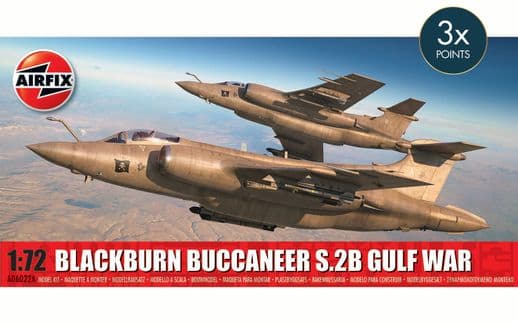
When the RAF's Buccaneer went to war - Another built model image finished in the Gulf war scheme which saw these venerable old warhorses being rushed to a war zone to help much younger aircraft types.
Although this previously published artwork is linked to the recently release 1/72nd scale Gulf War Buccaneer release, it seemed appropriate for us to give it another Workbench airing in this current update.
As the usual squadron training duties continued throughout January, the situation was so normal that the two operational squadrons were allowed out on training detachments, with No.12 Squadron operating from Gibraltar and No.208 Squadron calling RAF St Mawgan their temporary home, however, things were about to change. After just three days of offensive operations in the Gulf, developments dictated that the services of these venerable old jets would now be needed in the combat zone and Lossiemouth had just three days to prepare for a historic operational deployment. The very specific capabilities of these Cold War warriors was now needed in the Gulf as a matter of urgency and RAF Lossiemouth would become a hive of activity as a consequence.
The subject of this scheme, XW547 has to be regarded as one of the most famous of the Royal Air Force Buccaneers, ordered as one of the initial batch of 26 S.2B airframes produced for the RAF and taken on charge in November 1972. She underwent an almost immediate equipment upgrade prior to being delivered to No.15 Squadron at Laarbruch later that same month and during a long career, would also see spells operating in the markings of Nos. 12 and 216 Squadrons, as well as No.237 OCU.
By early 1991, XW547 was with No.12 Squadron at RAF Lossiemouth and being hastily prepared for deployment to Bahrain in support of Operation Granby, British military operations in the first Gulf War. Wearing her distinctive desert Alkali Removable Temporary Finish, she made the transit flight from Scotland to the Gulf region on 27th January 1991, where she would go on to fly eleven combat missions for a total of 100 hours and 15 minutes flight time in theatre.
One of the RAF's famous Gulf War 'Sky Pirates', the starboard side artwork is a little more risqué, but is still available for inspection to this day, as this aircraft is on public display at the RAF Museum's Hendon site.
During her time in the Gulf, XW547 would benefit from several non-standard additions to her presentation, including the painting of mission markings on her starboard forward fuselage, under the cockpit. Ten black bomb markings denoted the missions where the aircraft flew designator sorties for other attack aircraft, whilst the single red bomb stencil marked the single 1000lb laser guided bomb the aircraft dropped in theatre.
The starboard side also carried some typically risqué artwork of this deployment and the names Guinness Girl, Pauline and 'The Macallan' painted on the aircraft, which all went to make her a most interesting aircraft.
On her return from the Gulf, XW547 was retired from No.12 Squadron and later flown to RAF Shawbury for storage and possible future use as an instructional airframe. In early 1993, she would be transported the short distance by road to the RAF Museum site at Cosford earmarked for preservation, the first of the RAF's Gulf War veteran aircraft to be protected in this manner. Several years later, she would be transported to the main RAF Museum site at Hendon, where she can still be found on public display to this day, resplendent in her Gulf War paint finish and complete with her rather unique nose artwork.
All four of these schemes effectively document the impressive Royal Air Force career of the mighty Blackburn Buccaneer in a presentation sense, leaving us with the incredibly difficult task of selecting the one in which to finish our new model. The one thing we can console ourselves with is that the Buccaneer will look great in whichever option we decide to go with and in this scale, will certainly cut an imposing profile as part of our model collection.
As a final arrival update, we are still expecting the RAF Buccaneer to arrive in our warehouse towards the very end of the month, however, with the possibility of delays being very real at this time of year, in addition to the sheer volume of orders currently being processed via the Airfix website, it's unlikely that any models will be sent out before the New Year. If that does prove to be the case, could there possibly be a better way in which to embark on another year of modelling enjoyment than by pushing a new RAF Buccaneer kit to the top of our 2024 build schedules?
Soon to be a popular sight in model stores everywhere, we had better all prepare some workbench space for the arrival of our new 1/48th scale RAF Buccaneer.
We are afraid that's all we have for you in this latest edition, but we will be back next Friday with more project development updates and the very latest Airfix kit exclusives. In the meantime, we are always keen to hear your views on all things Airfix and in particular, any thoughts and opinions you may have regarding our Workbench blog. If you would like to drop us a quick line, could we please ask that you use our workbench@airfix.com email for all correspondence.
To re-visit any of the Airfix blogs we have produced over the past seven years or so, please head to our main Workbench hub, where you will find our entire blog back catalogue and all the Airfix design projects we have already covered.
All our dedicated official social media sites can be accessed by clicking the respective link icons at the foot of this page, or by heading to the Airfix homepage. Other useful Airfix links are:
Facebook, YouTube, Twitter and Instagram official sites
Please join us for more Airfix updates next week and thank you for your continued support.