Welcome to this latest edition of our Workbench blog and all the news, updates and modelling exclusives from the fascinating world of Airfix.
We have something a little special for Workbench readers this week, as we prepare to welcome the first of our newly tooled 1/43rd scale Starter Set model car kits to the current Airfix range. Incorporating our usual selection of exclusive product development imagery, we have been fortunate enough to spend some time with our Design Manager, in order to gain his thoughts and professional insight into a new product range which marks an exciting new direction for the Airfix brand, one which is intended to appeal to a specific modelling audience, but one which can equally be enjoyed by anyone, no matter what their age or modelling experience.
With our new 1/43rd scale Bugatti Chiron kit becoming available this week, we will be bringing readers a preview of what they can expect from this new generation of Airfix model kits and we feel certain that we have a couple of interesting and unusual developments to share with you in the process. Occupying such an important position for the Airfix brand as we move forward, we therefore make no excuse for making this latest edition of our blog something of a new Starter Set spectacular, with a rather attractive super car as our modelling muse.
This stunning box artwork has been produced in support of the first release from our new Starter Set range, kits produced specifically with the first time modeller in mind.
You might well think that the Airfix product designers have a difficult enough job in simply taking some of the world’s most iconic aircraft, vehicles, ships and various other machines, turning them into accurate scale representations of the real thing, using the very latest design and manufacturing processes, however, sometimes they are often required to go one step further - to actually think about the future of the hobby and how they (and Airfix) can play their part in this. We are extremely fortunate to have this talented group of professionals working with us, particularly as their unique design skillset really does make them stand out in their field, with very few people outside of the Airfix office able to boast their particular abilities and design achievements. Working on various Airfix projects is something they will be able to proudly take with them through the rest of their working lives, not that we ever want to lose them.
For this and many other reasons, the Airfix team are particularly qualified to give their opinions on the current state of our hobby and indeed where they think we as a company should be concentrating our development efforts in ensuring the hobby maintains its current healthy status, both in serving its existing consumer base and potentially attracting new/returning modellers to the hobby. The question of how we could interact more effectively with the first time, or inexperienced modeller is something the team have been pondering for some time now and thankfully, we are just about to discover the first modelling fruits of these deliberations.
With our design team able to call upon a wealth of skill and experience between them, not to mention the fact that there is quite an age range within the team now, members were invited to give their suggestions on how we could design a range of new model kits which were to be aimed squarely at first time modellers. For them, the build experience should prove rewarding enough to make them want to look forward to doing it again in the future, with the result of their efforts being the construction of an attractive, faithful scale representation of the car, aircraft or tank on which the kit was based, something they would be proud to display whether they chose to paint it or not.
During these discussions, every member of the team was invited to offer their opinion on the subject and to suggest how they thought this new breed of starter set kits could achieve this desired aim, with younger/newer members of the team actually proving to be really influential during these development discussions. As it was likely that these new kits would be a modeller’s ‘first contact’ with the hobby, the team felt that it was crucial that this initial experience should be an overwhelmingly positive one, as this kit could leave them with their lasting impression of the hobby and we wanted that to be one of enjoyment. No pressure for them there then, but thankfully, this talented group were all more than up for the challenge.
As far as Supercars are concerned, the Bugatti Chiron has to be considered to be in a league of its own, the most super of all the supercars, making this an ideal subject for the Airfix designers.
Many Workbench readers will no doubt recall several previous editions of the blog where we looked at other newly designed kits which fall into this category, such as the relatively new Sherman Firefly and Tiger I in our Military Vehicles range, along with the Spitfire Mk.V and BAe Hawk kits all introduced during 2020. These kits provided a clever combination of adapting the tooling to produce both main range and simplified versions of the same kit tooling for different audiences, however, for this latest breed of new Starter Sets, our designers would be taking this thinking one step further.
Speaking with our Design Manager Matt, he told us that the only brief they really had at the outset of this project over and above their usual accurate representation of the subject matter (which obviously comes as standard), was the need to keep the individual part count as low as practicable, embracing the design philosophy that the kits are intended for first time modellers. In actual fact, Matt described how designing the kits with simplicity of construction in mind actually proved to be much more challenging than anyone had anticipated and how lots of idea sharing and design experience was needed to enable these projects to get over the line. What they actually managed to achieve was something rather impressive and the start of an exciting new range of kits which have a huge role to play in the future of Airfix, and indeed for the wider hobby.
We went on to ask Matt why they decided to go with a trio of new car kits to herald the arrival of this new range and why 1/43rd scale? He told us that historically, model car kits have always been an extremely popular subject within the modelling hobby and how to this day, many of our larger retail partners find it difficult to keep these kits in stock and are constantly asking their reps that we consider producing new car kit subject matter for their displays. Traditionally, our decision to go with 1/32nd scale kits stems back to the popularity of the slot car hobby and our entry into this market back in the early 1960s, as this was the prevalent scale in this market. Subsequent standalone car kit additions simply followed this original scale decision, however, for this new range of starter kits, they wanted to move away from this scale. In deciding to model in the slightly smaller 1/43rd scale, this really did offer a number of appealing benefits, both from the design perspective and that of general modelling/collectability.
Firstly, with the models being just that little bit smaller in size, this would allow the kit’s designer more latitude when it came to planning his individual part splits, conscious of the fact that these had to go together much more easily (and indeed logically) than main range kits do and also had to feature a reduced number of parts in every case. Secondly, when built, these new models would now be in a scale which is seen as being a standard collectors scale, both for the plastic modelling hobby and indeed that of die-cast model collectables, something which could only serve to broaden their appeal and potential customer base.
As for the existing car kits in 1/32nd scale, these still have an incredibly valuable Airfix story to tell, however, it could be argued that this story would better be told as part of our nostalgic Vintage Classics range, leaving these newly designed Starter Set kits to establish their own reputation in an exciting new direction for the Airfix brand. Incorporating impressive levels of detail, whilst at the same time adopting simplified construction methodology, these lovely little kits really are something a bit special.
A first look at the new part trees which have been designed to support our new range of easier to build Starter Sets.
When considering this new range of kits, clearly, the most searching question we could ask Matt was, ‘What design challenges did the team face when developing this new type of starter set kit?’
He told us that from an overall design perspective, many of the factors they always have to consider were still important during the design phase, however, when it came to planning the actual split of parts and eventual tooling design, things turned out to be quite different. Even though they had to stick steadfastly to the iconic shapes of the individual cars, which in itself proved quite a challenge by virtue of their sweeping curves and sumptuous lines, they had to reduce the part count in tooling, which resulted in more than a few head-scratching moments when deciding which parts could be combined together to form larger kit components. They did have the benefit of manufacturer supplied CAD data to aid design, however, this would prove to only be of limited use, as it was produced to support the manufacture of real cars and the design splits are very different for those needed in the production of a scale plastic construction kit. As a consequence, whilst they could obviously check the surfacing shapes of the cars, each design was basically a ‘start from scratch’ project, just with additional research benefits!
To complicate matters further, the designers knew that their own CAD files would be used to produce models which would have to gain licencing approval from the car manufacturers and every aspect of their design would have to faithfully replicate the motoring icon of which they were rightly proud. At no stage would they give allowances for the fact that these new kits were destined for a new, less complicated range of starter model kits, with fewer parts and simplified construction - if it wasn’t a faithful representation, then it wouldn’t be right as far as they were concerned. Who on earth would want to be an Airfix product designer?
In addition to this, all three of these new starter set kits spent much of their development time within lockdown restrictions, something which can’t have made it easy for the designers as they worked through the projects. Under normal circumstances, if a designer hit a creative roadblock or if they just wanted a second opinion on a particular design aspect, they would have several of their colleagues in close proximity, asking for either individual or group input in the issue that were attempting to overcome. During lockdown and whilst working from home, this was clearly not an option available to them and even though it was still possible to stay in touch, the reassurance process was a little more onerous for them during this period. Nevertheless, the team pulled together and made sure that nobody was left without the support they needed.
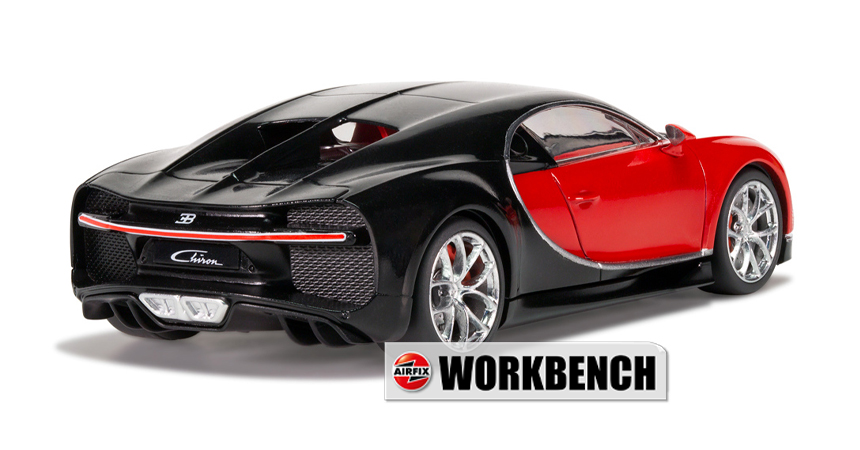
This is what all those parts will build into, a representation of one of the most spectacular sports cars ever produced.
As for the subjects themselves, keeping the part count down to the required levels actually proved to be more challenging on the modern supercars than it did on the classic E-Type Jaguar, purely down to the fact that their more complex shaping made the ability to combine design sections that more difficult, particularly as the resultant built model kit would have to be both robust and a faithful scale representation of the subject. For all the designers working on these new models, Matt told us that it proved to be an extremely enjoyable experience for them, something which served as a pleasant break from more traditional design projects, providing valuable additional knowledge in their continuing career journeys.
‘How will these new kits differ from more ‘traditional’ Airfix kits?’
In addition to the designed reduced part count and simplified construction, Matt proudly described to us how these new kits incorporate a couple of new features which really will make them stand out to anyone who may have made an Airfix kit previously and will help to speed up the build experience for anyone who hasn’t. Firstly, in a fascinating nod back to the way early Airfix model kits were designed and manufactured, the tooling design has been modified to have the parts formed on plastic ‘trees’ as opposed to the frames we have all become accustomed to. This is intended to allow the individual parts to be removed from its carrier with a minimum of effort and if required, without having to use either a knife, or snippers, you know, working them off with your fingers, the way we all used to do back when we were youngsters. This will make the initial inspection of parts quite a different experience from what we are accustomed to when inspecting the contents of the kit box.
Secondly, the work the team put into the new build experience of these new kits didn’t end with their innovative design, but also cleverly encompassed new thinking when it came to the layout of the instruction booklet, where they have effectively attempted to guide a novice modeller more closely through their first build project. Acting like something akin to a modelling dot-to-dot, the parts are numbered in the order you will need them during construction, with the instructions clearly showing a silhouette of the part in question and where you will find it on the sprue tree. Next, the modeller is given clear guidance on how these parts go together and cleverly, how when they are used, they disappear from the part tree image guidance, leaving you in no doubt where you are up to in the build. Reducing the possibility for confusion, the guidance even shows the modeller when and where they should apply the glue.
An interesting feature of these new kits is the layout of the instruction sheet and how they help to walk the modeller through what may very well be their first ever model build.
The intention here is that this should all effectively guide a novice modeller through the entire build process, almost as if one of our designers is looking over their shoulder and telling them how the model should go together at every stage - perhaps even more importantly than this, it hopefully gives them the confidence to simply have a go at modelling. The instructions also highlight where decals should be placed and as you would expect, when to paint and which colours to use.
Finally, providing yet another level of support for the novice modeller, the kits will also include a handy sheet of modelling tips and guidance, which they will hopefully find invaluable, with our ‘Before you start’ sheet showing what tools you might find helpful and how to get the most out of this, their first ever model build.
We just had to include this picture, which features a built sample model of one of the other trio of new Starter Set toolings, the equally iconic E-Type Jaguar. We will be featuring this kit in a forthcoming edition of the blog.
Much thought has clearly gone into the development of this new breed of starter sets and whilst the first three models are all car kits, we can expect to see many new subjects introduced into this range in the years to come. Although clearly aimed at the ‘first time’ modeller, there is absolutely no reason why these kits cannot be enjoyed by modellers of all ages and abilities, and indeed, seasoned modellers of many years standing will no doubt want to have a go at building one, just to experience how effectively our designers have attempted to ensure the ongoing popularity of this fantastic hobby. Little design nuances like how the clear parts have been designed so that no glue is actually required to fix them in place in most circumstances, but if a little is required, just a dab will do the trick and well away from the visible join seam lines - if only we had had such a thing when we started our own modelling journeys. How many of us remember getting glue all over the canopy of the Spitfire kit they had lovingly built?
Ultimately though, these kits have been designed to go together quickly and efficiently, in a relatively short period of time and without to much effort, result in the creation of a beautifully detailed model anyone would be proud to display. As one of these kits will likely be the first experience of an Airfix product many people will have in the future, it is hoped that all these important factors will provide them with a positive, enjoyable experience, one which will have them looking forward to tackling another model kit in the near future. Dare we say, they might even hit the Airfix website.
How did the design phase of these new kits compare with something like a 1/72nd scale aircraft kit project?
Another look at the part trees produced for the new Bugatti Chiron kit, which have been designed to make someone’s first modelling experience an enjoyable one.
Matt told us that the actual design phase was comparable to that of a standard 1/72nd scale kit and whilst they could save some time by not having to design as many individual kit parts, they had to ensure the parts they did design went together like a dream. This was actually one of the main aims of this project and one Matt is particularly pleased with how things turned out. When it came to the subject of working with the test frames produced by the tooling, building the test kits and producing their engineering reports, this is where some real time savings could be made, because by their very nature, the models were intended to be much simpler and quicker to build. This allowed them to focus a little more time on ensuring the instructions sheets were a logical step by step guide through the build itself, with any areas which may need more robust explanation being clearly represented in the instructions. In this respect, the team have very much achieved the requested design brief.
How do you think the new Starter Set kits will be received by modellers?
With the first model scheduled for imminent release, Matt told us that this is quite an exciting time for the team and whilst they are extremely proud of their efforts, they are always keen to gauge the opinions of their intended audience, because after all, they are the only critics who really matter here. He went on to say that although the kits themselves will clearly always be the most important feature of a new tooling release, the new instruction booklet layout and ‘Before you start’ guide will hopefully both prove particularly impactful, helping to support the novice modeller through their first build experience. Passing on snippets of modelling knowledge which we assume people know, or tend to pick up over the years, these tips should better equip the first time modeller to have a successful first modelling experience and more importantly, enjoy the time spent doing it.
We have doubled up on this image of the new ‘Before you start’ information, just so you get a better idea of the information it contains, from a blog imaging resizing perspective. If only we had had access to guidance like this when we took on our first Airfix modelling project all those years ago.
From a product positioning perspective, he doesn’t think that these models will necessarily be enjoyed just by the first time modeller, as the quality of the finished kit will appeal to a great many people, modellers of all ages and abilities and those simply looking for a little enjoyable pastime project. Although the entire Airfix world is awaiting a novice modeller’s discovery, if the starter sets float your boat, just crack on and enjoy building them!
Occupying an important position within the Airfix product range, or new starter sets come in somewhere between our Quickbuild models and the main kit range, but as they benefit from the same high level of design excellence, should go on to play a significant role in introducing many more people to the joys of modelling, building stuff and being creative, something we humans always find rewarding. By their very nature, they will also make for a perfect gifting product and if anyone struggles to think of an appropriate stocking filler at that special time of year, our design team may just have come to your rescue.
So there you have it, an introduction to our newly designed Starter Set kits in a blog nutshell - now its over to you, the modelling community to see what you make of them.
It is somehow fitting that this most super of Supercars should herald this exciting new kit direction for Airfix and what novice modeller wouldn’t want to produce a scale kit representation of one of these motoring beauties?
We are delighted to confirm that the first of our new Starter Set model kits has just been released and takes one of the world’s most striking supercars as its design inspiration. With the eye-watering cost of this magnificent machine, a built scale model representation of the Chiron is probably the only way most of us will ever get to own one, however in this case, it will allow you to assess the qualities of these impressive new kits and whether you think they have hit their very specific design brief.
When it comes to the world of motoring, millions of people lavish money, time and attention on their beloved cars, making sure they look as good as they possibly can, for the next time they need them to performing essential tasks such as getting them and their families to and from their latest appointment, or simply for a trip to the shops. If you love cars, there is no doubt that your mind will regularly wander to the subject of hopefully coming into money some day and which exotic car you would become your first extravagant purchase, even if that expensive beast would actually prove to be much less practical than your current ride. At the head of the current list of world ‘Super Cars’ is a machine which is much better described as a ‘Hypercar’, one which is incomparable in the world of motoring and one which only a select few of the world’s most wealthy people could ever hope to own, the stunning Bugatti Chiron.
When describing the Chiron, the use of superlatives really does come as standard and as far as ‘Super Cars’ go, this is definitely the most ‘Super’ of them all. Incorporating technologies which have come straight from the world of Formula 1, Bugatti’s latest masterpiece may be the epitome of opulent luxury and manufacturing excellence, but at its heart, it has been produced with one specific thing in mind - speed! This is the fastest car in the world, with its 8 litre, 16 cylinder engine capable for propelling this four wheeled bullet to over 260 mph and with acceleration performance which would put most of the world’s current jet fighters to shame. This is a beast of a car, but with a price tag in the region of 2.5 million pounds for each one, it is unlikely that most of us will ever see one in the metal (or should that be carbon fibre), let alone own one, but that is where we at Airfix can help.
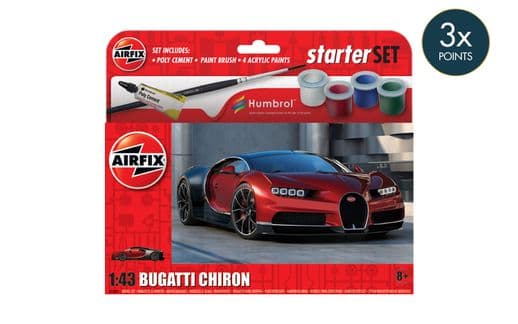
This final pair of images show the stunning new Bugatti Chiron Starter Set kit and the painting guide which will form part of the product packaging for the new kit, one which should be available in model shops during the next week or so.
Our latest new tooling release and the first in our newly designed Starter Set range is a 1/43rd scale kit version of this stunning supercar and builds into a really appealing representation of this motoring masterpiece. As you read this latest edition of our Workbench blog, the new Chiron Starter Set kit will be spending its first weekend available for sale on the Airfix website, so having read about its design story in this latest edition, you could actually be building one for yourself in the next few days, or presenting one to someone you think might enjoy taking the first steps in their own modelling journey. We can’t wait to hear what you all think about these exciting new kits.
That’s all we have for you in this latest edition of Workbench, but we will be back as usual next Friday with more modelling news, updates and exclusive imagery from the fascinating world of Airfix. If you have any comments in connection with the blog, or would like to suggest a subject to be covered in a future edition, please do drop us a quick line using our workbench@airfix.com e-mail address. The Airfix team would be only too pleased to hear from you.
If you would like to continue the Airfix modelling discussions between editions of the blog, the Airfix Workbench Forum is the place to be, however, if you simply wish to keep up to date with all the latest Airfix modelling news, you can access our official social media sites, or simply head for the Airfix website, where you will find all the details you need.
If you have yet to add our sites to your favourites, you can find links to our Facebook, YouTube, Twitter and Instagram sites at the bottom of our website homepage.
As always, thank you for continuing to support our Airfix Workbench blog.