
Welcome to this latest edition of our Workbench blog and all the news, updates, and modelling exclusives from the fascinating world of Airfix.
We find ourselves reporting on rather a significant development for the current Airfix range in this latest edition of Workbench, as we delve into the world of newly tooled additions to the Starter Set range and the impending arrival of our new Eurofighter Typhoon. We originally brought you details of this highly anticipated new kit during the Spring of last year, and whilst we knew this was a project scheduled for release late last year, circumstances dictated that it’s ended up arriving later than anticipated. Thankfully, our wait is almost over and by the time you will be reading this update, this fantastic new model should already be in our warehouse, or well on the way to arriving there.
In this major project update, we will be including all things new Eurofighter Typhoon, from some of the early CAD development images produced in support of this project, to looking at the ongoing history of this increasingly important aircraft, sharing a host of previously unpublished and Workbench debut imagery, as we prepare a fitting welcome for this new kit. Our new 1/72nd scale Eurofighter Typhoon FGR4 has an important role to play in the current Airfix range, however, we’re certain that it’s up for the challenge and is ready to achieve classic kit status.
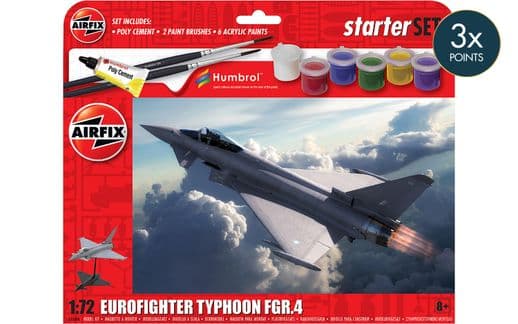
We’re delighted to announce that our new 1/72nd scale Eurofighter Typhoon Starter Set kit is almost here, and you know what that means – it’s time to ‘Bring the Noise’, Airfix style!
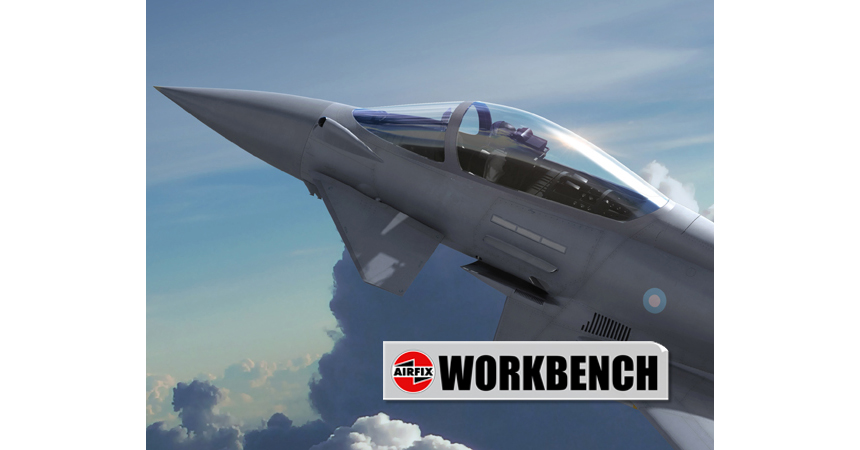
Starting with a bang! A new Airfix Typhoon deserves stunning new artwork and that’s exactly what we have for you here.
As the current Top Guns: Inside the RAF TV programme is currently highlighting, large sections of the British public are still fascinated by anything to do with the Royal Air Force and the men and women who make up its ranks, particularly the latest aircraft type charged with defending our interests both at home and overseas. Currently, should an airliner fail to communicate with ATC, or an aircraft appear to be infringing British airspace, the aircraft which will blast into the air and race to the scene at break-neck speed is the Eurofighter Typhoon FGR4, an aircraft which has been protecting Britain’s skies for 20 years, and seems destined to continue doing so for many more to come.
An agile and adaptable aircraft, the Typhoon has become one of the world’s most important combat aircraft of the modern era, a 4.5 Generation aircraft which effectively balances capability with affordability, and has developed into a truly effective multi-role platform. Under constant development, the capabilities of Typhoon see this aircraft forming the backbone of not only the Royal Air Force, but also the air forces of Germany, Austria, Italy and Spain, not to mention several Middle Eastern nations, highlighting just how widespread the airborne impact of the Typhoon is in the modern world.
Unquestionably, more than any other aircraft type in the history of aviation, the air defence/air superiority fighter has captured the imaginations of generations of people all over the world, inspiring many over the years to become military pilots themselves, and for the rest of us, driving our passion for aviation which has become such an enjoyable and enduring source of fascination. From the Sopwith Camels which intercepted Zeppelin raiders during the Great War, to the Spitfires and Hurricanes flown by the ‘Few’ who fought so valiantly during Battle of Britain, these aircraft came to represent the very pinnacle of aviation design technology, and were just about the fastest machines a man could operate back then.
These incredible aircraft were also the preserve of the most capable airmen in the country at that time, Britain’s most impressive people flying our most capable fighting aeroplanes in the defence of the nation, something only a fortunate and often privileged few could hope to aspire to back then. Under such circumstances, is it any wonder that both the men and their incredible machines have been so venerated over the years.
Eurofighter Typhoon Airfix style – a new model kit starts to take shape.
The Eurofighter Typhoon was born from an international design collaboration which aimed to produce an agile air defence fighter (European Combat Fighter Project) for service with several European air forces. Such a collaboration held the prospect of keeping costs to more manageable levels for all those involved, as they were being shared across the partner nations, although each would ultimately have their own requirements, something which would put a strain on both costs and working relationships.
At the time this new aircraft entered the development phase, Britain’s sovereign airspace was being protected by such aircraft as the McDonnell Douglas F-4 Phantom and BAe Tornado F.3, the air defence variant of the RAF’s highly capable Tornado strike jet and whilst both were classic aircraft in their own right, neither could really describe themselves as being agile performers. With the USAF able to boast such manoeuvrable aircraft as the General Dynamics F-16 Falcon and world leading McDonnell Douglas F-15 Eagle, the new Eurofighter consortium was looking to develop their own agile fighter, one which was much better suited to the modern and constantly changing air combat arena.
The multinational consortium consisted of the aviation industries of Britain, Germany, Italy and Spain and as the project progressed, it was clear that the new Eurofighter was going to be an extremely advanced aeroplane indeed. Designed to be aerodynamically unstable at all speeds, the aircraft was controlled by a powerful suite of computers, which combined to endow the fighter with exceptional agility.
Making extensive use of composite materials, the aircraft was to be powered by a pair of Eurojet EJ200 engines which propelled the fighter to a maximum speed of Mach 2.35 and the ability to supercruise without the use of afterburner. These engines were just as advanced as the aircraft itself and were designed in 15 fully interchangeable modules, with everything monitored in real-time to ensure the early indication of any potential problems with the unit. This was all designed to keep the aircraft serviceable and ready for action.
Business end of a Eurofighter Typhoon. If you see this in your rear-view mirror, it’s time to start saying your prayers.
Equipped with an impressive array of targeting and defensive technologies, the Typhoon can also carry a seemingly endless selection of ever more capable weapons, as it has developed from its original air superiority fighter designation, into an exceptional multi-role platform, one which is truly at the forefront of military aviation technology. Now at the midpoint of its service life, the Typhoon is expected to remain in service until 2040 and beyond.
The Typhoon era began in earnest on 27th March 1994, when the first prototype aircraft made its maiden flight from the EADS facility at Manching in Bavaria, to be followed six days later by the first flight of Britain’s first development Typhoon (ZH588) from the Bae facility at Warton in Lancashire. The name ‘Typhoon’ was officially adopted for the new fighter in September 1998, the same year that the first production contracts were signed, committing nations to purchasing an aircraft they had already been working on for five years at that point.
The first operational RAF Typhoon Squadron was No.3 Squadron, which was established at Coningsby on 31st March 2006 and by the summer of 2007, the unit were sharing national QRA (Quick Reaction Alert) responsibilities with the RAF’s existing Tornado F.3 force, initially on a rolling month on - month off basis, but working up to taking this important duty over entirely.
Today, the Typhoon is a mature combat aeroplane, with much of its development taking place during its first 20 years of service and in the full gaze of the aviation world. With Germany having indicated that their Typhoons will be in service until at least 2060, we possible have 2/3rds of the aircraft’s service life still to come, and when you consider that the iconic Supermarine Spitfire only spent 16 years in Royal Air Force service, as the Typhoon has already surpassed this figure, it remains to be seen how will we come to revere our current airspace dominator in the years to come?
A built sample model of the new Eurofighter Typhoon Starter Set, completed using advanced production parts from the new tooling.
To say that the Typhoon has already eclipsed the Spitfire in terms of its Royal Air Force service, and we know just how important the Spitfire has been to Airfix over the years, it does come as something of a surprise to learn that up until this point, the Eurofighter Typhoon hasn’t featured all that much in respective Airfix kit ranges. The first Typhoon kit to enter the Airfix range did so back in 1990, and this release was configured as a development European Fighter Aircraft configuration of the aircraft. This original kit was later upgraded to F.Mk.2 standard, however, we have definitely been in need of a new Typhoon kit for quite some time now, and we’re delighted to say that there’s one just about to enter the runway!
As unquestionably the most important aircraft type in current Royal Air Force inventory and the fighter aircraft the majority of the UK population are most familiar with, we really did need to do something special with our latest scale homage to this exceptional aeroplane, not simply producing a fine scale representation of it, but a Eurofighter Typhoon for the masses, a kit which could be enjoyed by modellers of all ages and abilities. Clearly, such an important addition to the range would be carrying with it quite an amount of design responsibility, so who would be entrusted with such a task? That would be our very own Ferret man, Mr Ethan Barker.
In addition to designing our Ferret Scout Car which has proved so popular since its introduction to the range, Ethan has built up a wealth of experience when it comes to designing our new breed of Starter Set kits, with everything from a North American P-51D Mustang to a Land Rover Series 1 Pick-up already passing across his design desk. As Ethan has already been kind enough to guide us through the design phase of this new Eurofighter Typhoon kit, we won’t be going over any of that previously published ground again here, but if you would like to take a trip down Typhoon design memory lane, please use this link to be taken straight to that particular edition of Workbench.
Two images taken from the design phase of the new Typhoon, with the first one showing a design overlay skeleton scan, complete with parts and cutting planes – design speak, don’t you know!
For those of us who have many years invested in this hobby, we probably all share similar memories about our very early modelling experiences, and whilst these will no doubt still raise a smile, in truth, they could probably have been better. The nostalgia of having to prepare the dining room table prior to a couple of hours modelling brought its own joys, unless we used that evening’s newspaper, and our dad hadn’t read it yet that is. Laying our kit components across the table and trying to stop the poly cement constantly running once we’d snapped the end off the tube were just part of the enjoyment of modelling, and as everybody of our age was doing it at that time, it was a hobby worth committing to.
For those of us who stuck with it (no pun intended), our modelling skills soon began to improve, to a point where we became the envy of our friends, and were probably asked to take on a build for one of them, because we could do it to a better standard. Not quite a commission build, but it certainly gained us a few brownie points with our peers back then!
If we’re being honest with ourselves, although completely enthralling at the time, presenting us with a world serving as an enjoyable hobby which is still important to many of us to this day, some of the kits we were attempting to build could have been better, although we just seemed to be more resilient back then. With the lack of other viable distractions, if we had a project failure, we simply moved on to the next kit, promising ourselves that when we talked the problem kit again, we would make a much better first of it.
Unfortunately for the modelling hobby, that was then and this is now. The youngsters of today have an absolute myriad of distractions to keep them occupied during their free time, most of which are either phone or computer related, and all of which hold the potential for making them overlook the simple pleasures of building a scale model kit. For many of them, they may not even know about the hobby, let alone had a go at building a model kit for themselves.
With that being the uncomfortable reality, this fact has been one which has been challenging the Airfix design team for some time – how do we get today’s youngsters to simply have a go at modelling, and if they do, ensure they have an enjoyable and rewarding experience in doing so?
Full scheme details for RAF Eurofighter Typhoon FGR.4 ZK377.
Perfection in 1/72nd scale. The new kit in all its glory.
The model complete with its iconic shadow stand. This new kit will surely become one of the most popular models in the Starter Set range.
If our beloved hobby is to have a future, younger, less experienced modellers are going to have to be introduced to modelling and when they take that all important step towards spending time with a scale construction kit, they’re going to need some help, support and encouragement when doing so. Today, that first step needs to be much more considered than the one we took ourselves back in the day, one which is easier to negotiate and one which comes with support, guidance and some design excellence. Thankfully, the Airfix team have been giving this a huge amount of thought over the past few years, and we can now offer an impressive range of new Starter Set kits which provide all the support we identified as being important, whilst at their very heart, still being faithful scale representations of the full-sized subjects on which they were based.
Utilising all the very latest advancements in design and manufacturing technology, whilst at the same time intentionally designing the kits to be easier and more logical to assemble than their famous predecessors, this new breed of kits might be easier for our novice modellers to tackle, but are actually quite challenging for our designers to create. From the second they take on one of these projects, they have to combine all their incredible design experience with putting their efforts in the hands of a complete modelling novice, and how can they best support their first attempt in the hobby with clever design.
Featuring a lower part count and simplified construction as standard, not only do these impressive kits have to go together easily and intuitively, but the reduced part count requirement also means that pieces which would usually be smaller, individual items with a traditional kit, now have to be incorporated into larger, combined pieces with these kits. Clearly, this will make things easier for the modeller, but potentially much more challenging for the designer, when it comes to designing parts which don’t cause problems during the tooling/manufacturing stages, so there is much to be considered.
In addition to creating a new breed of Starter Set kits, the team wanted to go one, or two steps further, by introducing a couple of additional levels of support for the inexperienced modeller taking this important first step in the hobby. Firstly, each of these kits now include a separate handy sheet of modelling tips, guidance and preparations, which will hopefully prove helpful, with our ‘Before you start’ sheet also showing what tools might be required in advance of their first model build.
A further selection of Typhoon built model images, including one sitting on a printed copy of the stunning box artwork.
New thinking has also been applied to the layout of the instruction booklet for these kits, where it literally guides the novice modeller more closely through their first build project. Acting like a modelling dot-to-dot in some respects, the parts are numbered in the order you will need them during construction, with the illustrations clearly showing a silhouette of the part in question and where you will find it on the part frame. The modeller is also given clear guidance on how these parts go together, and how when they’ve been used, they no longer appear on the part frame image guidance, leaving them in no doubt as to what stage they’re at. Less chance for confusion, and reassuring guidance – the instructions even show when and where they should apply the glue.
Whether they have the support of a parent or older sibling with them during the build process or not, the intention with these impressive little kits is that the novice modeller should feel confident throughout the process, almost as if the kit’s designer is looking over their shoulder, guiding them through the assembly process. We want them to have the confidence to simply get on and have a good old crack at it themselves.
In addition to all this kit assembly support, we can’t get away from the fact that we’re now in thoroughly modern times and if kids are going to learn anything new, they will probably only do so by using their mobile phones. That being the case, there is also a host of additional video guidance available via the Community section of the Airfix website, including a series of videos covering various sections of the build process, including walk-through videos which feature several of the new Starter Set kits themselves, so when taking those important first modelling steps, you don’t even need to stray too far from your phone or tablet if you don’t want to!
As these are all Starter Set kits, they continue a proud Airfix tradition where this type of model kit is supplied complete with everything a modeller is going to need when tackling this model build, including poly cement, paints and paint brush. These novice modellers don’t know how lucky they are, because back when we were taking our first modelling steps, we had to buy all these essential items separately for ourselves – we don’t half spoil them these days!
Having extolled the many virtues of our new breed of Starter Sets, we do also have to point out that these are all really fantastic little kits and although they may have been designed with the novice modeller in mind, make no mistake, these kits can be enjoyed by modellers of all ages and all abilities. They are stunning scale representations of cars, tanks, aircraft and boats on which they took their inspiration, and are a real credit to the designers who took on this difficult challenge.
As a new Starter Set, and with its intended target audience being the less experienced modeller, there would be absolutely no point in creating an easy to assemble kit, then to spoil everything by asking the modeller to paint it in a challenging and elaborate scheme. Thankfully, that’s rarely a problem when modelling the RAF operated Eurofighter Typhoon, as most aircraft are presented in Barley or Air Superiority Grey, a colour which is designed to make the aircraft difficult to see at any angle, until its too late for you to do anything about it. When thinking display Typhoon, that’s most definitely not the case, but we’ll get on to that a little later.
If you would describe yourself as something of a Typhoon fanatic, you will no doubt be familiar with the area surrounding RAF Coningsby in Lincolnshire, a regular haunt for Typhoon fans from all over the country. You can also see Typhoons at BAE Systems Warton airfield and of course at RAF Lossiemouth, but as Coningsby is the most accessible airfield for the largest percentage of the nations Typhoon loving population, Lincolnshire usually gets the call when you need a day filling your senses with these magnificent aircraft. Reasonably accessible to vast swathes of the population, Coningsby offers the aviation enthusiasts something unique, not only the front-line airfield which boasts the RAF’s current air defence fighter, one of two Quick Reaction Alert bases in the country, but also the possibility of seeing some of the oldest aircraft still in RAF service, the classic aeroplanes of the Battle of Britain Memorial Flight.
On any given day, a visit to RAF Coningsby could see a No.3 Squadron Typhoon scrambled on a QRA shout, followed by a Spitfire taking off to undertake a practice display flight, a fighter which had been doing the same job as the Typhoon, eighty years earlier.
RAF Coningsby is home to two front line combat ready Squadrons, with both Nos 3 and XI Squadrons flying the extremely capable Eurofighter Typhoon FGR4 in an air defence role, also sharing southern QRA responsibilities for the nation between them. These aircraft occupy the hardened aircraft shelter complex at the southern side of the airfield and when you see aircraft taxiing out from this side of the runway, you know these boys and girls mean business.
Taking up station on the other side of the airfield, the Typhoons of three other units also call Coningsby home, each one responsible for the vital training and conversion of new Typhoon pilots, or engaged in the test and evaluation of new weapons and tactics potentially destined to be used on Typhoon. RAF No.29(R) Squadron is charged with training pilots to fly the multi-role capable Eurofighter Typhoon FGR4, but of greater significance to the enthusiast, are also responsible for providing the aircraft, pilot and support for the RAF Typhoon Display Team, probably the highest profile public facing unit in the entire Royal Air Force.
The RAF’s current display aircraft shares the ramp at Coningsby with No.41(R) Test and Evaluation Squadron, a unit which operates the Typhoon in a truly fascinating role. Part of the RAF’s Air & Space Warfare Centre (which is based at Waddington), this unit works closely with front line squadrons, defence manufacturers and research institutions to develop and evaluate the next generation of aircraft technology, weapons and avionics, flying their aircraft regularly in support of this role.
Since the summer of 2018, this busy airfield has also been home to No.12(B) Squadron and a unique aviation collaboration between the United Kingdom and the Qatar Emiri Air Force. Providing air and ground training for Qatari personnel in the operation of the Typhoon FGR4 multi role aircraft, this initiative is in support of Qatar’s decision to purchase 24 of these awesomely capable jets, helping to establish them as an effective fighting force, in advance of their deployment back to home airspace.
With many of the unit’s aircraft featuring a uniquely modified version of the Squadron’s famous crest, featuring a fox’s head and the flags of both Britain and Qatar, these training aircraft are just one of the many reasons why a visit to RAF Coningsby is at least an annual pilgrimage for many enthusiasts, offering plenty of opportunities for those looking to enjoy some Typhoon action.
The aircraft selected as our subject for this latest Starter Set project was one of the Typhoons based at Coningsby during 2022, and significantly for the novice modeller, one that is finished in the standard RAF Barley Grey scheme. This particular Typhoon, ZK377 carries the construction number BS138 and was constructed in 2016, making its first flight on 19th October that same year. She was delivered to RAF Coningsby on 22nd May 2017 and has enjoyed a rather active service career since that date. She has spent time with both No.3 and No.12 Squadrons at Coningsby and is thought to currently be with No.IX Squadron at Lossiemouth, but has been photographed at such diverse locations as Poznań-Krzesiny AB in Poland, and attending Exercise Red Flag at Nellis AFB in Nevada.
Clearly, the scheme selection for this latest addition to the Starter Set range almost chose itself, from a simplicity perspective, but if a more experienced modeller wanted to present their Typhoon in a different scheme, then that would require either some incredibly proficient painting skills, or the use of suitable aftermarket decals.
Over the years, the Eurofighter Typhoon has shown itself to be not only an incredibly effective air superiority, strike and reconnaissance aircraft, but also the consummate Airshow performer. A perennial display favourite at any display event the aircraft is scheduled to perform, members of the Royal Air Force Typhoon Display Team have become something akin to aviation celebrities over the years, and in the process having surely done more than their bit for RAF recruitment.
For those modellers who might be up for a Typhoon challenge, the new kit could be used as the basis for a ‘Display Jet’ project, but which scheme would get your vote, GINA, Blackjack or Moggy?
In addition to thrilling Airshow crowds with its dynamic display of agility, speed and awesome power, the RAF have elected to present several of their display Typhoons in special schemes, striking liveries which have seen these aircraft become the most famous in current RAF inventory during their time in service, and much loved by modellers and enthusiasts alike. This new Typhoon Starter Set therefore has a significant role to play in both the current Airfix kit range, but also for the very future of the modelling hobby. Not only could this scale representation of the RAF’s most numerous multi-role aircraft appeal to those people taking their first tentative steps in our hobby, but it could also be used as the basis for more elaborate scale Typhoon tributes, for those with a little more time invested in the hobby.
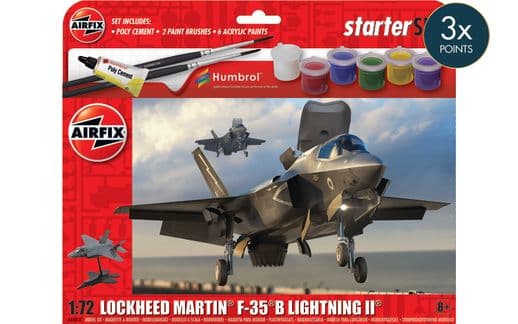
Significantly for our new range of Starter Sets, the impending arrival of the Eurofighter Typhoon allows modellers of all abilities to have scale examples of the RAF’s two most capable airspace dominators to place in their display cabinets, with the Typhoon standing guard over the Lockheed Martin F-35B Lightning II whilst it settles into British service.
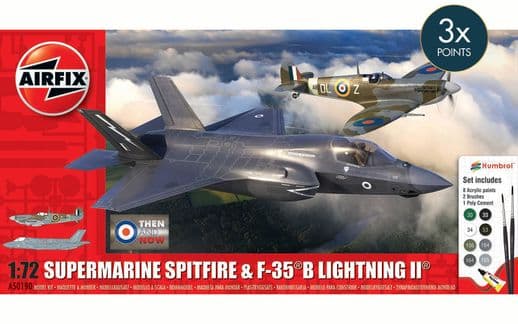
More than this, if you wanted to represent a very passable Airshow line-up in Scale form using only Starter Set kits, you have everything you need now, with the Typhoon and F-35B Lightning being joined by the Spitfire and P-51D Mustang performing the classic section, with everything topped off by the appearance of the world-famous Red Arrows Hawk. As far as the less experienced modeller is concerned, we really do have an impressive selection of kits available for you to take that first step in our hobby now, and we sincerely hope that you enjoy the experience. If you do, there’s no excuse, its time to build your own scale model Airshow and we have just the kits to help you do it.
The latest addition to our Starter Set model range is a little cracker, and one surely destined to become a firm favourite with modellers of all abilities.
Our new 1/72nd scale Eurofighter Typhoon Starter Set should be in our warehouse by the time you read this latest update, and our processing teams will be sending them onto model shops and website customers from next week onwards. We hope this becomes a popular addition to the 2025 range.
We are afraid that's all we have for you in this latest edition, but we will be back next Friday with more project development updates and the very latest Airfix kit exclusives. In the meantime, we are always keen to hear your views on all things Airfix and in particular, any thoughts and opinions you may have regarding our Workbench blog. If you would like to drop us a quick line, could we please ask that you use our workbench@airfix.com email for all correspondence.
To re-visit any of the Airfix blogs we have produced over the past seven years or so, please head to our main Workbench hub, where you will find our entire blog back catalogue and all the Airfix design projects we have already covered.
All our dedicated official social media sites can be accessed by clicking the respective link icons at the foot of this page, or by heading to the Airfix homepage. Other useful Airfix links are:
Facebook, YouTube, Twitter and Instagram official sites
Please join us for more Airfix updates next week and thank you for your continued support.