
Welcome to this latest edition of our Workbench blog and all the news, updates and modelling exclusives from the fascinating world of Airfix.
As one of the most famous military aircraft in the history of flight and arguably America's equivalent to the Supermarine Spitfire, the North American Mustang has long been one of the most popular subjects in the modelling world, despite the fact that its WWII combat flying career was actually relatively short. Nevertheless, the difference it made to the European air war in particular, dictated that the Mustang earned a fighting reputation which was unmatched by any other aircraft type.
In this latest edition of Workbench, we welcome the arrival of the latest Mustang kit addition to the Airfix range by looking a little more closely at this famous aircraft's post war service career and how the Marvellous Mustang would influence the design of the early jet fighters which followed it into USAF service. With particular emphasis placed on our new 1/72nd scale Mustang kit, we will be featuring the new box artwork produced to support this release, in addition to bringing you details of the two scheme/decal options which are includes with this new kit. In essence, what we have here is a Mustang, but not quite as we usually know it, as far as this edition of our Workbench blog is concerned.
What the British received was an aircraft better than the proposed Curtiss P-40 and one which possessed significant development potential.
Anyone with even the slightest interest in aviation with be aware of the North American P-51 Mustang and how it is regarded as one of the greatest fighting aeroplanes of all time, the one which finally strangled the Luftwaffe into submission during WWII. It was also said that Luftwaffe Commander in Chief, Hermann Göring, admitted to his closest advisors that he knew the war was lost when he saw Mustangs flying low over Berlin, looking for Luftwaffe fighters to destroy, another story which underlines the impact of the fighter. What some people might not be aware of is the fact that the Mustang owes its very existence to Britain and how a further decision to re-engine the fighter with a British powerplant unlocked the full potential of this magnificent aircraft.
As Britain stood alone against the might of the all-conquering German war machine, they were in desperate need of as many fighter aircraft as they could get their hands on, as existing manufacturing output was barely keeping pace with the combat attrition rates they were experiencing. Desperate to find a swift solution to the problem, the British Purchasing Commission approached US aircraft manufacturer North American Aviation, with a proposal for them to produce licence-built Curtiss P-40 fighters for the Royal Air Force, as the Curtiss factory was already running at maximum capacity producing aircraft for both existing US and British contracts. Happy to take on this lucrative work, but slightly indignant at the prospect of producing a rival manufacturer's design, company president James H Kindelberger tabled an incredibly bold counter-offer, claiming that he could develop and produce a new fighter aircraft which would be superior to the Curtiss P-40. He added that this could be achieved in around the same time that it would take for the company to tool up to mass produce the Curtiss fighters under licence.
What made this development all the more incredulous was the fact that North American had at that time never produced a fighter aircraft of their own design and what Kindelberger was proposing was to produce a fighter which was better than an excellent aircraft which was already in production. What he did have in his favour was experience in the very latest methods of aircraft mass production, following a visit he made to the German Heinkel and Messerschmitt manufacturing plants during 1938. Impressed with the high levels of organisation and automation he saw, these observations shaped the way North American established their own production lines, a crucial factor in the development of their first fighter design.
In a move which showed surprising faith in the North American company and their confident president (but also highlighting the desperate state of their predicament), the British delegation agreed to the proposal, but with the clock already ticking, work on the new fighter had to start straight away. In what proved to be one of the most impressive design and engineering feats of the 20th century, what the team at North American managed to achieve over the following few months was nothing short of astonishing. With their new aircraft designed to incorporate many highly advanced new features and utilising the very latest manufacturing techniques during production, their prototype aircraft (NA-73X) was rolled out of its hangar on 9th September 1940, just 120 days after the production contract had been signed.
The first flight of the new fighter took place 47 days later and other than the usual issues associated with the first flight of a new type, the aircraft showed great promise and was clear vindication of the confidence North American Aviation had in their design capabilities. Rather than this being a stop-gap first attempt at producing a fighter aircraft in record time, what they had produced was a fighting thoroughbred, although they didn't know it at the time.
The first Mustang fighters were powered by the reliable and readily available Allison V-1710 V-12, liquid cooled engine, the same basic powerplant used on the P-39 Airacobra, P-40 Warhawk and new P-38 Lightning fighters. Although a perfectly good engine, the lack of a supercharger restricted performance at higher altitudes to little better than average, reducing the operational effectiveness of the engine. The North American (P-51A) Mustang I entered service with the Royal Air Force in 1941, however, the aircraft's lack of high altitude performance quickly became apparent, relegating the Mustang to flying tactical reconnaissance and ground attack missions, albeit with some success. In these roles, the Mustang was required to operate at high speed and at low level, often at treetop height, where there was no margin for error. Proving itself to be rugged and reliable, the Mustang continued to bring its pilots home in these demanding circumstances and quickly earned the respect of pilots and ground crew alike. Operationally, the Mustang had a strong, wide track undercarriage, which gave it much better ground handling characteristics than those of a Spitfire.
Already an excellent aeroplane, once the Mustang was paired with the Rolls Royce Merlin engine, it turned the aircraft into a world beater.
Just as the Mustang owed its very existence to a British requirement, so the nation was also responsible for unlocking the immense potential of the fighter. With the aircraft already possessing excellent low altitude performance and generally being a delight to fly, pilots began to express the opinion that if it only had a better engine, the Mustang would be some aeroplane. In early 1942, a Rolls Royce test pilot was invited to fly a Mustang and the experience would make quite an impression on him. Finding the handling of the aircraft to be exceptional and with low and medium altitude performance being just as impressive, he reported to his superiors that if the aircraft could be fitted with the latest supercharged versions of the Rolls Royce Merlin engine, performance at higher altitudes would be equally impressive.
Convinced of his findings and after much cajoling of his superiors, he eventually managed to convince them to support the project and in August 1942, the Mustang X program saw several Mustang airframes experimentally fitted with Rolls Royce Merlin 61 two speed, two stage supercharged engine and the rest, as they say, is history. The results were nothing short of spectacular, with this combination propelling the Mustang to an impressive 441mph at 29,800ft, which was approximately 100mph faster than the Allison powered P-51A at the same altitude. The Mustang had just come of age!
Clearly, the performance boost the Merlin engine gave the Mustang was of huge interest both to North American and the US military, who were keen to unlock the full potential of the fighter, but there was a problem. The RAF could not proceed with the widespread implementation of the Mustang X project because all existing Rolls Royce Merlin engine production was required for existing designs and those currently in production. Aircraft types such as Spitfire, Hurricane and Mosquito all needed the latest versions of the Merlin and the decision to ‘up-engine’ the disappointing Avro Manchester bomber to the four Merlin engined Lancaster, was going to put even more strain on production.
There is always a solution to every problem and in this case, it proved to be the American Packard Motor Car Company. They had a licence to produce the Merlin Engine in America and work on the US manufactured Merlin engines began immediately, in tandem with the mass production of the superb North American Mustang. As far as newly produced Merlin powered Mustangs are concerned, they were designated North American P-51B (aircraft built at Inglewood, California) and P-51C (those built at Dallas, Texas), with both aircraft being more or less identical and both devastatingly effective. The combination of the Mustang airframe and the Packard Merlin engine transformed this promising aircraft into a world-beating fighter, one which was to have a dramatic impact on the course of the Second World War.
Able to fly faster and longer than any fighter which had gone before it, the USAAF now had the ability to escort their Flying Fortress and Liberator heavy bombers all the way to their targets and back, and as a consequence, greatly improved the strategic effectiveness of these devastating raids. Mustang ace Brigadier General Thomas L Hayes famously quoted “the Merlin powered Mustang possessed three qualities you need most, if you are going to escort bombers all the way to Berlin – range, range and range”.
One of the most iconic sights in aviation, a North American P-51D Mustang still thrilling audiences on the Airshow circuit.
The actual combat introduction of USAAF Mustang fighters in European skies did not take place until late 1943, however, the fighter would have an immediate impact on the conflict which had already been raging for four years. Bombers could now rely on fighter cover for the entire duration of their missions, including those to targets deep inside Germany, something which led to an immediate reduction in combat losses and the start of a steady decline in the effectiveness of Luftwaffe fighter opposition.
Continued development of the Mustang led to the introduction of what many consider to be the definitive variant of the Mustang, the P-51D. Maintaining the performance of this superb fighter, the D variant dispensed with the high ‘Razorback’ fuselage of its predecessor, in favour of a design which allowed for the addition of a bubble canopy, greatly increasing the pilots visibility. It also featured greater firepower and a much improved gunsight, which made the aircraft even more effective during combat encounters with the Luftwaffe. By this time, the Mustang was the main fighter of the USAAF and production of this latest variant was again split between the North American manufacturing plants at Inglewood and Dallas, although this time all aircraft manufactured would retain the same ‘D’ nomenclature. The only sub-variant of this Mustang were aircraft equipped with a different propeller, due to the preferred Hamilton Standard units being in short supply – Mustangs finished with the slightly smaller Aeroproducts propeller (and were produced at Dallas) were known as P-51Ks.
Working closely with combat units and listening to pilot experiences using existing variants of the fighter, the already impressive credentials of the Mustang were further refined in an attempt to unleash all the potential possessed by the aircraft and it hammer home its superiority in European skies. One of the things pilots were not keen on was the relatively poor field of view from the framed canopy and as any fighter pilot will tell you, in combat, vision is everything.
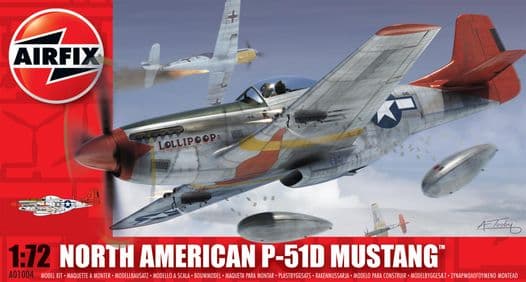
This stunning artwork was produced in support of an earlier release from our 1/72nd scale North American P-51D Mustang, an aircraft which is regarded by many as the finest fighter aircraft of the Second World War.
Advancements in moulding technologies allowed the development of a single piece 'blown' teardrop canopy to be manufactured, one which greatly enhanced the field of view from the Mustang. The existing design was modified behind the cockpit to allow the new canopy to sit atop of the fuselage, with this modification incorporated into all the new D and K model Mustangs manufactured from 1944 onwards. Introducing a host of additional improvements, this ultimate Mustang also featured a modified wing, increased armament and the continued development of lightweight external fuel tanks, something which would further extend the operational range of this magnificent aircraft, placing the struggling Luftwaffe under even more pressure.
The 'D' model Mustang started to arrive in Europe from the early spring of 1944 and would make their combat introduction from July, going on to become the primary US fighter in the European Theatre of Operation and be produced in greater numbers than any other Mustang variant. Having said that though, by the end of the war in Europe, roughly half of the Mustangs still in service were the earlier B and C 'Razorback' versions of the fighter, which was interestingly ever so slightly faster than the model which replaced it.
Incredibly, the P-51D Mustang would be in combat service for less than twelve months before the end of the Second World War, meaning that its post war service career would prove to be longer than its wartime career, ruling the skies until it handed this responsibility to the first jet powered types to enter service.
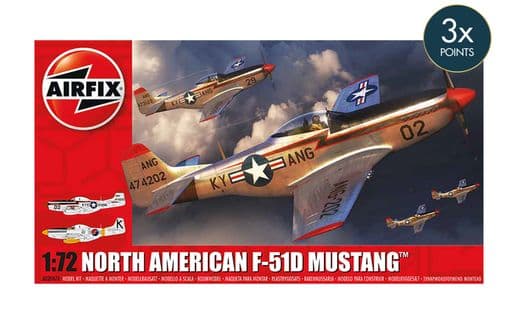
Our latest 1/72nd scale Mustang kit release presents this famous fighter in its post war guise, both as it went on to serve in the US and how surplus aircraft allowed overseas air arms to secure an aircraft which had unrivalled wartime credentials. The two very different scheme options offered are:
The unrivalled success of the Mustang during the final months of the Second World War dictated that these aircraft were available in large numbers following the end of hostilities, but more than would be required should the world settle into a period of relative peace. Having said that, its combat credentials were so impressive that the Mustang was at that time considered the USAAF's primary fighter type, something which would see the majority of the type survive, whilst other designs were immediately destined for an appointment with the scrapman.
Following the end of WWII, many Mustang units remained in service with the forces of occupation in both Germany and Japan, with others being sent back home, but retaining their active status, just in case their services were required again, at a particularly volatile period in world history. Earlier P-51A, B and C models were withdrawn, however, other combat veteran P-51D and K models were collected at the San Antonio Air Material sub-facility of Kelly Air Force Base in Texas, before being allocated to reserve and Air National Guard squadrons.
In the immediate post war years, continued inter-service wrangling resulted in the implementation of the National Security Act of 1947 and the establishment of the United States Air Force as a separate branch of the military. This development would also result in a rather significant change to the way aircraft were designated, with the familiar wartime designation of the P-51 Mustang changing to F-51, where the P stood for Pursuit (fighter aircraft) and the F now just denoting a fighter. Thus, the F-51 is the same as a P-51 in everything other than the fact it was in service after the establishment of the US Air Force in 1947.
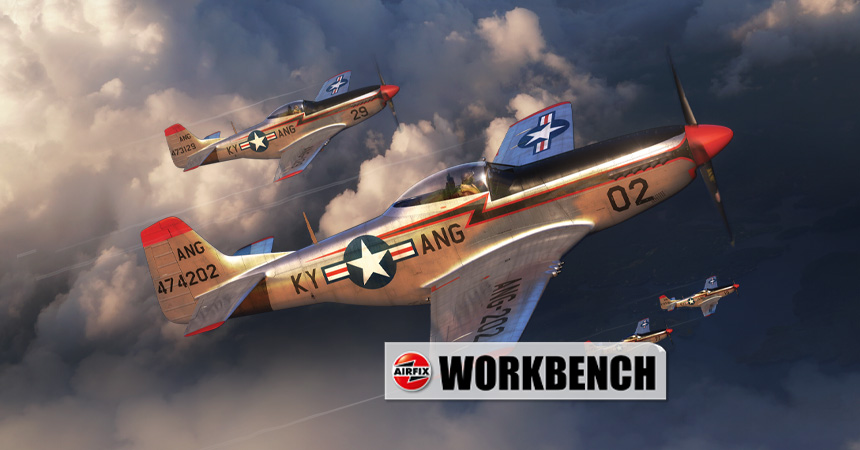
New Mustang artwork to keep an eye out for, this beautiful image shows F-51D Mustang 44-74202 during her days representing the Kentucky Air National Guard, a new lease of life for these famous fighters.
The outbreak of the Korean War in 1950 again saw Mustang squadrons returning to combat once more, but this time in a strike/fighter-bomber capacity, calling on the legendary fighting qualities of this incredible aircraft again. By that time, the arrival of the jet age had dictated that the North American Mustang was deemed to be almost obsolete at a fighter, however its proven combat attributes of range, firepower and manoeuvrability dictated that it was much more suitable than most of the early US jets to undertake strike missions from American bases in Japan. The urgency of the situation resulted in American gathering as many suitable Mustang airframes together from home based units and immediately loading them aboard USS Boxer for transportation to the Korean war zone.
Once in theatre, the Mustangs were pressed into action straight away, attacking North Korean armoured columns and troop concentrations with a combination of machine guns, rockets, bombs and Napalm. The aircraft helped to stem the tide of enemy advances and would play an important role in these early stages, but at a price – the Mustang pilots were vulnerable to the accurate enemy anti-aircraft fire at these low altitudes and hundreds of aircraft would be lost whilst engaged in these dangerous missions.
Planning for the post war establishment of home based Air Force reserve squadrons had been taking place long before the end of WWII, with those involved looking to provide America with the world's largest and most effective standing air force, both in the roles of domestic security and for rapid mobilisation in the event of conflict. With its own command and control structure, in addition to an autonomously controlled budget, these units would be in addition to full time and reserve forces and would see at least one squadron allocated to each of the US states. Initially, the service was organised into 12 Air National Guard Wings, covering specific geographical areas of the nation.
In August 1946, inactivated USAAF squadrons were transferred to the National Guard Bureau, with the fighter element totalling 62 squadrons, with a further 4 light bomber units and several others forming composite groups.
A truly historic photograph which shows F-51D Mustang 44-74202 with her fellow Mustangs in Kentucky Air National Guard service. Image usage authorisation - The appearance of U.S. Department of Defense (DoD) visual information does not imply or constitute DoD endorsement.
The Kentucky Air National Guard can trace its origins back to 9th June 1947, with the activation of the 123rd Fighter Group, the oldest unit of the KANG. Activated at Standiford Field, the current Louisville International Airport, its 165th Fighter Squadron was equipped with P-51D (F-51D) Mustangs and were charged with the air defence of the state - pilots assigned to the unit flew a hectic period of flight operations, despite their ANG status.
The invasion of South Korea in June 1950 would bring about a general realisation that the regular Air Force were not equipped for war at that time and brought about the mobilisation of many ANG units to active status. For the 165th, this meant a move to Godman AFB for training, where they would be joined by the North Carolina ANG's 156th Fighter Squadron and West Virginia ANG's 167th Fighter Squadron, all of which were equipped with Mustangs.
Full scheme details for this fascinating Mustang in its post war Air National Guard livery.
After undergoing around a year of intensive training, the 123rd Fighter Group were re-designated as a fighter bomber group and sent to England as replacement for a unit rotating back Stateside. Operating from RAF Manston in Kent, they were assigned to fly fighter escort missions for Strategic Air Command B-50D Superfortresses and B-36 Peacemaker bombers, but not using their usual Mustangs. These aircraft were left behind at Godman and on arrival in the UK, pilots were required to convert to Republic F-84E Thunderjet fighters. Following the end of the Korean War, the Mustangs of the 165th Fighter Squadron returned to flying defence of the State duties, before eventually trading their famous piston engined fighters for North American Sabre jets.
This particular Mustang (44-74202) was delivered to the USAAF on 7th May 1945 and initially assigned to the 445th Fighter Squadron at Bakersfield, California. With the end of the war in Europe, she would not see overseas service, but would instead serve with several reserve and Air National Guard units, including from July 1953, time with the 165th Fighter Squadron and the Kentucky Air National Guard at Standiford Field (now Louisville International Airport). Later deemed surplus equipment, she was sold into civilian ownership, where she would change hands and storage locations several times over the next forty years.
In 2007, the aircraft became the subject of a concerted attempt to restore her back to flying condition, work which would take a further five years to complete. In May 2012, Mustang 44-74202 made its first post restoration flight, the first time she had been in the air for many a year. She was later finished in the markings of 'Swamp Fox', a Mustang which was the personal mount of pilot Will Foard who flew with the 357th Fighter Group during WWII.
In April 2019, 'Swamp Fox' returned to Kentucky to take part in the 'Thunder over Louisville' Airshow, operating from the same airfield where she had operated as part of the Kentucky ANG 63 years previously.
An interesting aspect of the Mustang's incredible fighting legacy occurred during the Korean War, when the aircraft helped to establish the Republic of Korea Air Force. The need to emphasize the importance of air power to the South Korean people was an absolute priority in the aftermath of the Second World War and despite their lack of suitable modern aircraft, would result in the formation of their first official air unit in May 1948. This situation would change dramatically during the Korean War, as the North Korean Air Force was much better equipped than their opponents and posed a significant threat to stability in the region. During the course of the conflict, the ROKAF would acquire 110 aircraft from the Americans, with their first combat aircraft being former USAF F-51D fighters, as part of the 'Bout One' project.
This ambitious project had the aim of not only equipping the RoKAF with Mustang fighters, but also providing US flight instructors and ground handlers to train their South Korean hosts in every aspect of operating high performance aircraft efficiently. Initially, there were significant problems caused by the language barriers and the inability to deliver important instructions effectively, problems which resulted in the completely avoidable loss of several aircraft. Despite this, a determination to succeed saw a relatively small team of American specialists overcome these challenges and provide the South Koreans with their fledgling air force.
Full scheme details for the Republic of Korea Air Force Mustang option for this latest kit release.
Another historic picture, this time showing a flight of RoKAF F-51D Mustangs over home territory.
At the start of this project, it was clear that the South Korean pilots had the resolve to take the fight to their neighbours, but lacked the aircraft with which to carry this out. The 'Bout One' project overcame this problem, despite the initial misgivings of their hosts in needing American support in leading such operations. The early accidents and a lack of cohesive responses to requests for air support soon changed this situation and RoKAF pilots soon came to value the input of their highly professional overseas supporters.
The majority of the first operational sorties were flown in defence of their nation, but these would soon change to offensive strikes across the border, as the strength of their Allies helped to give the force some real momentum. For many of these operations, American advisor Major Dean Hess would fly at the head of a formation consisting of several Mustangs piloted by South Korean pilots, using the aircraft effectively in a fighter-bomber role. By the end of his relatively short time in theatre, Dean Hess had flown no fewer than 250 combat missions in conjunction with his RoKAF students.
In RoKAF operational service, their Mustangs would sport a large black 'K' on their tails to denote their use by Korean forces, in addition to their rather distinctive national insignia. In late 1953, the Republic of Korea Air Force were confident enough to form their first flight demonstration teams, which they named the 'Black Eagles' - the team initially operated four F-51D Mustang fighters, which they used to perform at displays throughout the nation until 1958. The RoKAF would eventually relinquish their Mustangs for North American F-86 Sabres, as they entered the jet age.
The full box presentation for this latest release from our 1/72nd scale North American F-51D Mustang kit.
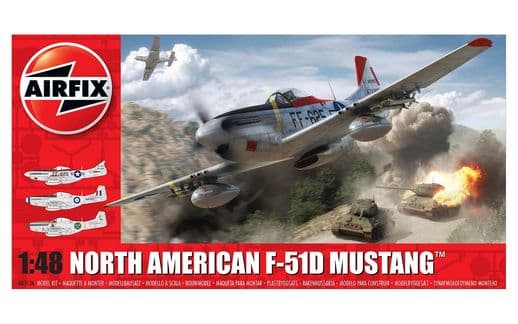
This latest release from our 1/72nd scale P/F-51D Mustang tooling presents this famous aircraft in her post WWII guise and in two schemes which are not usually associated with the career of the North American fighter. With regard to the lead scheme, this aircraft is now a much loved performer on the US Airshow circuit, helping to preserve the legacy of this magnificent aeroplane to a current generation of aviation admirers. North American F-51D Mustang kit A02047A is available now.
That’s all we have for you in this latest edition, but we will be back with more project updates for you next week. As always, we are interested to hear your views on all things Airfix and particularly in relation to our Workbench blog, so if you ever feel like dropping us a quick line, please use our workbench@airfix.com contact e-mail address.
All our social media sites can be accessed by clicking the respective link icons at the foot of this page, or by heading to the Airfix homepage. Other useful Airfix links are:
Facebook, YouTube, Twitter and Instagram official sites
Please join us for more Airfix updates next week and thank you for your continued support.