
Welcome to this latest edition of our Workbench blog and all the news, updates and modelling exclusives from the fascinating world of Airfix.
Even though we posted our re-introduction update for the soon to be released 1/72nd scale McDonnell Douglas FG.1/FGR.2 kit in our previous blog, this was actually a holiday edition, and as we all know, a lot can happen in the world of Airfix when you're away for a week or two. As we once again find ourselves in catch-up mode, this week's update is entirely devoted to a third unexpected kit addition to the current Airfix range, a mighty beast of a model which many will have been patiently waiting for since the announcement of this newly tooled kit back in 2020. Proving that good things can sometimes come in multiples, last week saw yet another previously unannounced model kit release joining the 2023 Airfix kit range and whilst this wasn't a new tooling announcement like the Westland Sea King which preceded it, this is just the second release from a kit tooling which has to be regarded as one of the most impressive in our entire range, our scale tribute to the mighty Avro Vulcan B.2.
Although the Vulcan is regarded as something of a Cold War sentinel, a high profile aviation deterrent against potential Eastern Bloc aggression, its use during the Falklands War of 1982 was the first time the aircraft was used in anger and not in the nuclear role for which it was intended, but more like the conventional bombing role performed so successfully during WWII by it's famous Avro predecessor, the Lancaster. Used to perform the longest range bombing raid in history, a small force of Vulcan bombers operating from Ascension Island would make a vital contribution in allowing Britain to re-take the Falkland Islands from invading Argentinean forces, illustrating both Britain's determination and military capabilities in returning the Islands to British control.
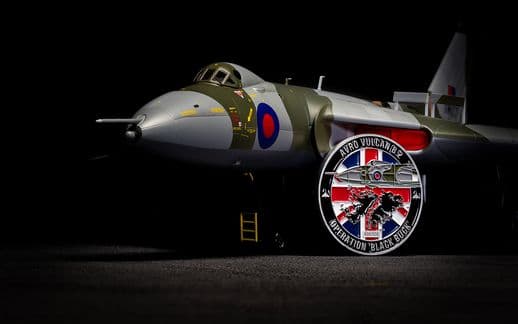
This second release from our new 1/72nd scale Avro Vulcan tooling features scheme options for two of the Ascension Island based aircraft which took part in the 'Black Buck' raids of 1982, with the kit featuring an additional frame of parts to allow both of these historic aircraft to be modelled. This impressive kit can also currently be secured complete with the latest edition to our exclusive commemorative coin collection, although with almost a week of sales behind it, these may well have sold through by the time this update is posted.
Nevertheless, we will be including this, a series of exclusive images and a release update as we bring you a full project overview of our new 1/72nd scale Avro Vulcan B.2 Black Buck release in this latest edition of Workbench.
For a subject as popular as the Vulcan, we knew the modelling world would appreciate a new version of our 1/72nd scale kit, one which incorporated all the very latest advances in design and manufacturing technologies.
As one of the most famous and distinctive examples of Britain's aviation prowess, the Avro Vulcan is regarded by many people as one the most famous British aircraft of all time and with a single example dominating the UK Airshow scene for eight years following its first post restoration flight back in 2007, is still a huge favourite with modellers and enthusiasts. For this reason, it can be rather sobering to consider that development work on this futuristic looking aircraft actually began back in 1947, only a few short years after its famous predecessor, the Avro Lancaster, had proved so decisive for Bomber Command during WWII.
At their Chadderton factory facility near Manchester, the A.V Roe design team began work on this ambitious project in response to Ministry of Defence requirement B35/46, one which called for an aircraft which must possess an operating range in excess of 3,350 nautical miles, be capable of speeds approaching 500 knots and have an operating ceiling of 50,000 feet. Importantly, the aircraft was also required to carry a ‘special’ payload of 10,000 Imperial pounds in weight - this special payload was a nuclear bomb. The new aircraft was intended to serve as a flying deterrent to any future threat against the UK.
An incredibly challenging design brief to adhere to, these specifications represented a 100% increase in the capabilities of any previous bomber aircraft in RAF service, meaning the new aircraft would have to be something very special indeed.
What the Avro team rolled out onto their airfield at Woodford in Cheshire on 30th August 1952 must have filled them with immense pride, particularly as it was undoubtedly one of the most distinctive aircraft ever produced by the British aviation industry. As the all-over white ‘Anti-Flash’ prototype aircraft VX770 blasted into the air for the first time, Avro officials must have been delighted with their stunning achievement, whilst members of the public lucky enough to be in the vicinity of the airfield were simply left open-mouthed – the age of the Vulcan had dawned.
It was reported at the time that the local police were inundated with calls from concerned members of the public, all reporting the sight and sound of a huge triangular flying object over Cheshire, with some actually thinking the county was under attack from an alien craft. What they soon came to understand was that they were witnessing the dawning of a new era for Britain's aviation industry and the first flight of an aircraft which would go on to become a Cold War icon.
Even though the Vulcan originated from the same design offices as the wartime Lancaster, this was a very different breed of aircraft.
As the Avro Vulcan entered squadron service with No.83 Squadron at RAF Waddington in July 1957, the Royal Air Force had one of the most advanced bomber aircraft in the world at their disposal, one which was at that time not only the first delta bomber in service, but also the fastest nuclear capable bomber in the world.
Clearly, the Avro Vulcan is an aircraft of significant repute and as such, has long been a favourite with modellers all over the world. First joining an Airfix range in 1/72nd scale back in 1983, this kit was a triumph for our design engineers at the time, as it really did represent the pinnacle of plastic injection moulding technology at that time, producing a stunning scale example of this majestic aircraft.
Despite beginning to show its age in the face of ever improving technological advancements in the hobby, this kit sold in incredible numbers every time it was released, a clear illustration of the incredible affection in which the Avro Vulcan has always been held in. The final release of this original kit back in 2010 saw the world's last flying Vulcan commemorated and as XH558 continued to grace the UK Airshow scene, this model found favour with a great many people, but little did we know at the time that this would be the final release from this tooling.
This project started with the LIDAR scanning of the Newark Air Museum's preserved Vulcan.
Knowing that we simply had to produce a new Vulcan tooling which incorporated all the very latest design and production advances the industry had to offer, the Airfix team set to work, initially scanning Newark Air Museum's Avro Vulcan B.2 XM594 in 2018 and announcing our newly tooled Avro Vulcan kit project at the Scale ModelWorld Show the following year. The news was greeted with great excitement and as many Workbench readers will already have an example of this kit either built and on display, or safely tucked away in their stash, they will be able to attest to the quality of this kit, as it really is a beauty.
We are proud to announce that the second release from this spectacular tooling is available now, despite the fact that our 'Black Buck' Vulcan was only announced as a surprise addition to the current range last week. Marking arguably the most historic chapter in the history of this iconic British aircraft, let's take a closer look at the two scheme options which are included with this new Vulcan release.
The amphibious invasion and occupation of the Falkland Islands by Argentinean forces on 2nd April 1982 resulted in military planning which had already been taking place for some time in Britain, increasing in pace dramatically. In addition to assembling a powerful naval Task Force, military planners also began exploring ways in which they could prevent the main airport at Port Stanley from being used as a base from where Argentinean strike jets could operate against a British task force, with the RAF's fleet of ageing Avro Vulcan B.2 bombers seen as being the only option for such a mission.
As the remaining Vulcan fleet was scheduled for service withdrawal later that same year, the use of these Cold War sentinels for this logistically challenging undertaking posed several significant problems. One of many illustrations of these issues was the fact that the aircraft didn’t even have all the bomb rack components they were going to need for a conventional bombing attack, with officials actually having to buy this equipment back from the scrap metal dealer they had previously been sold to.
The aircraft would also have to be fully in-flight refuelling capabile if this plan was to even get off the ground, so as you might well imagine, this was a time of feverish activity amongst the remaining Vulcan force. On 29th April, just two weeks after training had begun, the first two Avro Vulcan bombers left RAF Waddington and set out for Ascension Island, arriving nine hours later, having flown non-stop to Wideawake Airfield. Both aircraft had taken on fuel from supporting Handley Page Victor tankers twice each during the flight, testament to the professionalism and adaptability of the Royal Air Force.
Full scheme details which present the Vulcan as the aircraft which after having attacked Argentinean radar installations at Port Stanley Airport, created something of an international incident at Rio Airport.
A Vulcan kit finished in this historic 'Black Buck' scheme.
On the night of 30th April/1st May, ‘Operation Black Buck 1’ resulted in Avro Vulcan XM607 bombing the runway at Port Stanley, an audacious strike which was at that time was the longest range bombing mission ever attempted. These operations over vast expanses of ocean required a complex plan for in-flight refuelling to be established and no fewer than thirteen Victor tankers (outbound and return, including reserves) to get a single Vulcan to the Falkland Islands and back. We will look more closely at this incredible feat a little later.
The sixth of seven planned Black Buck raids during the Falklands War (two were subsequently aborted due to weather and a problematic Victor tanker respectively), Black Buck Six was an operation to target Argentinean anti-aircraft radar installations around Stanley Airfield on the night of 3rd/4th June 1982, and would see Avro Vulcan B.2 XM597 equipped with four pylon mounted AGM-45 Shrike missiles for this specialist task.
With Argentinean forces now only too aware of the capabilities of visiting RAF Vulcans and their intentions in preventing them from using the airfield against the British Task Force, anti-aircraft operators were reluctant to turn on their detection equipment, as this would give the British airmen a target. Vulcan XM597 was therefore forced to loiter in the dangerous airspace over Stanley Airfield for 40 minutes, trying to tempt the defenders to target their bomber, which they eventually did. With anti-aircraft radar units now visible, two Shrike missiles were fired, causing the destruction of a Skyguard fire control radar unit on the ground.
Having spent more time over the target area than intended, fuel levels were now a major concern for the crew and the Vulcan headed for its refuelling rendezvous with a waiting Victor over the South Atlantic Ocean. They were still facing a flight time of over seven hours if they were to make it safely back to Wideawake Airfield on Ascension, however, if they thought their troubles were over, they were in for quite a shock.
Having met the waiting Victor and started the much-needed fuel transfer process, the Vulcan’s refuelling probe broke without enough fuel having been taken on, leaving the captain with just two options, both as unpalatable as each other. The first option was to attempt a divert to Rio de Janeiro Airport with fuel running low and the distinct possibility of creating an international incident at this sensitive time. The other option wasn't really and option and would see XM597 ditching in the Atlantic, with little hope of rescue for the Vulcan's crew.
Setting course for Brazil with the decision made, an immediate mayday call was transmitted, along with a landing request for Rio Airport with a fuel critical status. As this was taking place, all mission sensitive documentation was being jettisoned into the ocean, along with the two Shrike missiles which the crew clearly did not want Brazilian authorities to see. Despite the crew's very best efforts, only one of the missiles released as commanded, with one steadfastly refusing to leave its pylon station.
Two more images featuring a Vulcan kit finished in this truly historic scheme.
All the time this was happening, the Vulcan was getting closer to the Brazilian coast and conversations with air traffic controllers were becoming increasingly fractious. They were refusing to grant permission for the Vulcan to land, demanding that the aircraft inform them of its identity and its airport of departure, even scrambling a pair of fighter aircraft to challenge the as yet unidentified aircraft. With fuel levels now almost depleted and after discussions with the rest of his crew, the pilot eventually informed the Brazilian ground controller that they were 'A British aircraft low on fuel, with a loss of cabin pressure and we are from Huddersfield!’
This appeared to do the trick and with the Vulcan now finally cleared to land, it touched down at Rio de Janeiro Airport with so little fuel remaining in its tanks that it wouldn't have had enough to even make a circuit of the airfield. Clearly attracting plenty of attention at the airport, the sight of a Shrike missile on its pylon would have not helped matters and with the aircraft impounded, both the crew and the British Government now faced an uncomfortable few days of diplomatic wrangling, particularly as the missile had been supplied by a powerful ally, with this secret needing to be preserved.
Eventually, a high level diplomatic deal was struck to release the Vulcan and its crew, with a fully fuelled up aircraft allowed to head back to Ascension Island on 10th June 1982, and in return, the Brazilian military received much needed spare parts for their Lynx helicopter fleet. The covertly supplied Shrike missile remained in Brazil.
Avro Vulcan B.2 XM597 had a replacement refuelling probe fitted at Wideawake Airfield and subsequently flew back to RAF Waddington on 13th June. This famous aircraft is now one of the much loved exhibits on display at Scotland’s National Museum of Flight at East Fortune, East Lothian.
Scheme B - Avro Vulcan B.Mk.2 XM607, 'Black Buck One', Royal Air Force No.44 Squadron, Waddington Wing, Wideawake Airfield, Ascension Islands, May 1982.
The new box artwork features a representation of the immediate aftermath of the famous 'Black Buck One' raid on the night of 30th April/1st May 1982.
Following the Argentinean invasion of the Falkland Islands at the beginning of April 1982, Britain's response was swift and decisive. As a powerful Task Force was assembled under the full gaze of the world's media, aircrews assigned to the last three remaining RAF Avro Vulcan squadrons watched on with interest at their home base at RAF Waddington. With their aircraft scheduled to be retired later that year and the fact that the type had already been in service for thirty years at that point surely made their involvement in any military response highly unlikely. In any case, the Vulcan hadn’t been used in a conventional bombing role for some years, so they really weren't prepared for such an operation.
With that being the case, you can imagine their surprise when a selection of Waddington based crews were soon informed that they would be taking part in actions to retake the Islands and how they and their aircraft would immediately have to undergo an intense period of preparation and training. Not only were they going to have to practice conventional bombing techniques, they were also going to have to brush up on their airborne refuelling skills, both of which crews had not been required to practice for several years at that point.
If a bombing attack against the airfield at Port Stanley was going to be successful, it would have to be flown over great distances and with the target runway being just 120 feet wide, would also require absolute navigational accuracy and probably whilst under enemy fire. During an intense period of practice flying, aircraft conducted live bombing practice sorties against the Scottish Island of Garvie, high on the northern coast of the country, the only place in Europe where live 1000lb bombs could be used.
With this increase in activity, it would surely have been an exciting time for the crews taking part, particularly as they could be confident of the secretive nature of their involvement in the coming British military response. That was until just days before their anticipated deployment, when news of the RAF Vulcan forces' involvement also found its way onto a news bulletin being watched by crews, as they relaxed between practice sorties. Not only would they be undertaking one of the most challenging missions the Royal Air Force had ever mounted, now they would be doing so against an enemy who knew they were coming.
From a communication influencing standpoint, as the Task Force set sail for the South Atlantic, live pictures of aircraft carriers and Vulcan bombers had an important role to play in the coming conflict, as the strength of Britain's impending military response could have paid significant dividends during ongoing diplomatic negotiations. Hopefully helping to bring a peaceful solution to the situation was clearly going to be infinitely more desirable than war, however as we all now know, that didn't prove to be the case.
Another built Vulcan model kit, this time finished as arguably one of the most famous aircraft in the history of the Royal Air Force.
On 29th April 1982, the first two Vulcans left RAF Waddington bound for Wideawake Airfield on Ascension Island, supported by Victor tankers, with their destination soon to become the most active military airfield in the world at that time. As they headed out, military planners continued to assess the logistics and success potential of any proposed Vulcan attack against Port Stanley Airfield and even if every aspect of this incredibly challenging raid came together, it's thought that they were working on an assumption of only around a 40% success potential.
The full magnitude of the difficult task facing raid crews only became fully apparent when the complex refuelling plan was shared with Vulcan and Victor crews on Ascension. For the round trip of over 12,000 km which would take the lead Vulcan crew 16 hours to complete, no fewer than eleven Victors and two Vulcans would be in the initial strike air armada taking off from Wideawake airfield, with reserve aircraft ensuring built in redundancy in the event of problems. With the reserve Vulcan returning to the airfield after accompanying the formation for the first four hours and assuming everything was okay with the lead aircraft, two further Victors would subsequently be needed to support the return flight of the sole attacking Vulcan.
With such a vast distance to be covered over open ocean, navigational excellence was going to be essential if all aircraft were to be at each refuelling station at the correct time and indeed, if the attacking aircraft was going to successfully hit its target. To complicate matters further, strict radio silence would be observed to minimise the chance of detection and all refuelling points had been carefully selected to allow diversion options for any aircraft, should anything go wrong. The plan called for Victors to refuel other Victors as well as the strike Vulcan, to ensuring all aircraft had enough fuel to get back to Ascension Island safely.
For 'Black Buck One', the plan was for a single Vulcan to attack the runway at Port Stanley Airfield, rendering it unusable to Argentinean fast jets and as a result, not allowing Island based aircraft to attack the approaching British Task Force. The two aircraft selected for the attack were Vulcan XM598 as the lead aircraft, with XM607 as the reserve.
Just before midnight on 30th April 1982, the first of eleven Victor tankers blasted off the runway at Wideawake Airfield, with others following at one minute intervals, and with Vulcan XM598 in their wake and XM607 bringing up the rear - the raid against Port Stanley was on. Even before crews had had the chance to make their initial post take-off checks, there was a problem. The crew of the lead Vulcan discovered that their aircraft has a seal leak around one of the cockpit windows, an issue which would prevent pressurisation of the aircraft. Only four minutes into the operation, the lead Vulcan was forced to abort and return to Ascension.
Profile and scheme details for the Vulcan which performed the longest bombing raid in the history of warfare. The story of 'Black Buck One' is both incredible and inspiring.
Although they would have trained for such an eventuality, the crew of XM607 now found themselves as the lead attack aircraft only minutes after taking off and prepared for a long and eventful night. It was quickly discovered that all aircraft were using more fuel than had been calculated, however, the formation continued with the complex refuelling plan, eventually leaving just two Victors and Vulcan XM607 to make the final transfer. As the two Victors exchanged fuel for the final time, the probe on the lead aircraft sustained damage and couldn't take on any more fuel. Immediately, the two aircraft exchanged places, with the damaged Victor passing as much fuel as it could spare to the last remaining tanker, before also heading back to Wideawake Airfield.
The last Victor then refuelled Vulcan XM607 for the seventh and final time on the way to the target, but couldn't deliver the full scheduled load due to its own dire fuel reserve position. Indicating he had transferred as much fuel as he could to the Vulcan pilot by flashing red lights on the underside of his aircraft, Vulcan captain Martin Withers was now left with a decision to make. Having less fuel on board than had been planned, should he abort, or press on with the attack? As the last remaining Victor peeled away and returned to Ascension, the crew of Vulcan XM607 decided to press on with the attack and headed for Stanley Airfield.
Fully aware that Argentinean radar would be looking for them, XM607 approached the Island at a height of just 300 feet above the ocean, but as the navigator was struggling to get a radar fix himself to give his pilot an attack heading, the pilot had to increase height sightly to help him. This did have the desired effect, but also made their own aircraft visible to defensive radar units and with attack coordinates now computed, the Vulcan ascended to its attack height of 10,000 feet.
Two more images featuring a Vulcan kit finished as Avro Vulcan B.2 XM607, the 'Black Buck One' raider.
Activating the attached AN/ALQ-101 jamming pod to confuse enemy radar, the Vulcan's bomb doors were opened in preparation for the attack run. Releasing the bombs at half-second intervals, the bombs straddled the target and as the last one left the aircraft, pilot Martin Withers immediately initiated a steep bank to head back towards the ocean, with the sky now illuminated by enemy anti-aircraft fire.
Of the 21 1000lb bombs released during the attack run, 16 exploded, with the very first one released hitting the main airfield runway, a successful outcome for the raid. Now all the Vulcan had to do was to find its support tanker in the vast South Atlantic night sky, with fuel fast approaching critical status.
Just as the flight crew were beginning to consider taking drastic actions in view of their fuel status, the welcome sight of a Victor tanker appeared alongside them and immediately manoeuvred into fuel transfer position. The Vulcan's co-pilot is reputed to have stated that he had never known of a Vulcan being airborne with as little fuel on board as XM607 did on that fateful night and how he had never been so pleased to see a Handley Page Victor.
With enough fuel now onboard for the return flight to Ascension Island, the crew could now reflect on what they had all just achieved. As one of the crew played the music from the film Chariots of Fire over the aircraft's internal intercom, the crew of Avro Vulcan XM607 had just completed the longest bombing raid in history and with it, announced to the world that Britain would not rest until the Falkland islanders had been liberated.
The raid may only have been partially successful in terms of the actual damage caused, however, the psychological impact was profound and far reaching. If the Vulcans of the Royal Air Force could strike over such distances, then the Argentinean mainland was also within their range, at least that's what Argentinean military leaders thought. For that reason, significant numbers of aircraft were retained for home defence duties and therefore not committed against the British Task Force.
Also, with Stanley Airfield unavailable to Argentinean fast jets, this also reduced their striking potential against the Task Force, both significant factors in the eventual outcome of the conflict. These ageing Cold War aviation warriors may have waited until the final few months of their Royal Air Force careers to show what they could do, but when the call came, they served with distinction.
Avro Vulcan B.2 XM607 was eventually retired at her home airfield RAF Waddington in December 1982 and positioned as a high profile gate guardian the following month. Still preserved at Waddington, this historic aircraft has just undergone a period of preservation and restoration, prior to retaking her place on the airfield as one of Britain's most historic aircraft.
You will really find it hard to ignore this latest release when next visiting your favourite hobby store - it just looks so spectacular!
An on-line exclusive offer, the first several hundred models sold also included the latest in our popular series of collector coins, however, sales have been so healthy that they may have all sold through now. If any are still available, snap one up now!
If building models of historic aircraft is one of your passions, this latest Avro Vulcan B.2 kit release will definitely prove hard to resist. As modelling also serves as a really effective recreation and preservation of the machines which took part in some of the world's most historic events, this Vulcan scheme pairing has to be amongst the most appealing we have ever offered and as we have only just marked the 40th Anniversary of the Falklands War, could this be considered the perfect modelling project for the impending Autumnal nights?
This fantastic new release is already available, with an Airfix website exclusive initially offering the kit complete with the latest in our popular kit/coin combinations, however, with limited numbers available and the kit now being available for the past week, it's highly likely that they will have all sold out by the time this latest update is posted. That being the case, the standard Black Buck Vulcan B.2 kit will definitely still be available and as always, ordering via the Airfix website will allow you to use your accumulated hobby reward points to reduce the price of the kit.
So, that's now three fantastic ex-catalogue kit additions to the current Airfix range - I wonder if that will be us done for the year!
We are afraid that's all we have for you in this latest edition, but we will be back next Friday with more project development updates and the very latest Airfix kit exclusives. In the meantime, we are always keen to hear your views on all things Airfix and in particular, any thoughts and opinions you may have regarding our Workbench blog. If you would like to drop us a quick line, could we please ask that you use our workbench@airfix.com email for all correspondence.
To re-visit any of the Airfix blogs we have produced over the past seven years or so, please head to our main Workbench hub, where you will find our entire blog back catalogue and all the Airfix design projects we have already covered.
All our dedicated official social media sites can be accessed by clicking the respective link icons at the foot of this page, or by heading to the Airfix homepage. Other useful Airfix links are:
Facebook, YouTube, Twitter and Instagram official sites
Please join us for more Airfix updates next week and thank you for your continued support.