
Welcome to this latest edition of our Workbench blog and all the news, updates and modelling exclusives from the fascinating world of Airfix.
In this second blog post of the weekend, our subject matter is the second of the two new impending kit releases scheduled to join our 1/35th scale Military Vehicle range and arguably one of the most famous tank designs in the history of warfare. During the Second World War, the design of armoured fighting vehicles took on many guises, as they were required to take on a multitude of battlefield tasks and were therefore manufactured accordingly. In some cases, AFVs are referred to as tanks, when they are actually self-propelled artillery or anti-tank vehicles and a distinction really does have to be made, however, in the case of this particular machine, it is very much a tank, perhaps even arguably the most famous tank in the history of warfare. A magnificent addition to any tank and armoured fighting vehicle model collection, this latest update welcomes the classic Panzer III (Ausf.J) to our 1/35th scale range and as with our StuG IV review also posted this weekend, we will be looking at the scheme detail options available with this kit, in addition to exclusively showcasing the beautiful artwork created to grace the packaging of this new release.
As this has been posted as a separate Workbench blog, please don't forget to visit the main Workbench blog hub to access all previous editions, including the Sturmgeschütz StuG IV (Early variant) update also produced this week, a vehicle which can actually trace its interesting heritage back to the Panzer III.
If you are an avid military modeller and have a collection of 1/35th scale built models on display, could we please ask if you would be good enough to send us a picture or two for inclusion in a future blog, as we, and our readers would love to see them and they also help to illustrate the subjects we are writing about. Right then, it really is tank time now!
A picture from the history books, anyone who has ever seen images from the Second World War will recognise the Panzer III as one of the most heavily used tanks of the conflict.
As we covered in the other Sturmgeschütz StuG IV related blog posted this week, it isn't really possible to discuss the famous German military vehicles of the Second World War without first looking at the birth of tank warfare and the battlefields of the Great War. When the Germans were faced with the first terrifying British tank assault during the Battle of Flers-Courcelette in September 1916, rather than rushing headlong into immediately initiating a tank building program of their own, their response was much more measured. They knew that the best way to combat this new threat was to use their existing field artillery in a slightly different way and to train crews specifically in tactics to effectively disable a British tank. What they were essentially doing was forming anti-tank gun squads and by the end of the war, they were extremely proficient in this role. They did eventually introduce their own tank in 1918, but the majority of tanks fielded in combat by the Germans during the Great War were actually captured and repurposed British machines.
During the inter-war years, German tank thinking was as much about how to protect against tank attack as it was about offensive tank capability, particularly as the Treaty of Versailles preventing them from producing or even developing such weapons. Cleverly, whilst they could not actively start the production of tanks, they made sure their industries obtained vital knowledge on how to develop and manufacture modern tanks once the time was right, sending technicians covertly to both Sweden and Russia in order to gain this valuable knowledge. At the same time in Germany, programmes under the spurious titles of 'light, medium and heavy tractor' projects may have had the appearance of being agricultural machinery developments, but were actually concerted efforts in establishing an industrial base from where modern tanks could be produced in short order.
Once Hitler came to power in 1933, he instructed military officials to put all this knowledge gathering to good use and to initiate the production of tanks for a new, mechanised German Army. Knowing that mobility would be critical in any modern conflict, but how there was also a pressing training need for this type of future combat, this instruction would result in the production of the Panzer I light tank, a highly mobile two man vehicle capable of withstanding small arms fire and equipped with machine guns to suppress the enemy. Significantly, this was the vehicle which was used to train German tank crews for war and the one which would see heavy use during the first months of WWII.
Even at this early stage, the German Military had mapped out their intended tank design programme, with vehicles we now know as the Panzer III and Panzer IV out for design tender with some of Germany's biggest manufacturing companies. At that stage, both these vehicles were intended to be breakthrough tanks, with the Panzer III actually being the strike tank capable of taking on enemy armour and the larger Panzer IV produced in two versions, one to protect the Panzer III and one to support infantry units. As we now know, that was not exactly what happened in practice and could even be described as something of an operational role reversal, but what was absolutely clear was that it would take some time for sufficient numbers of these tanks to be produced, with military planners initially reporting to Hitler that they would not be ready for war before 1943.
Clearly this was not good news for the Führer and whilst he ordered the immediate development of these larger tanks, he also ordered the production of a slightly larger, more heavily armed version of the Panzer I, the Panzer II.
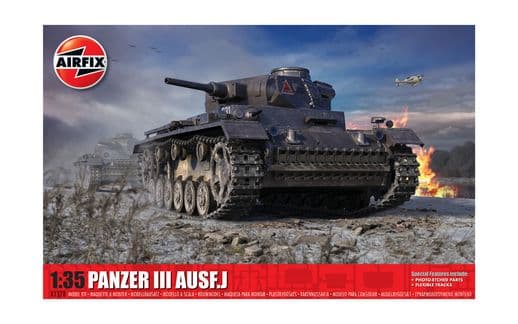
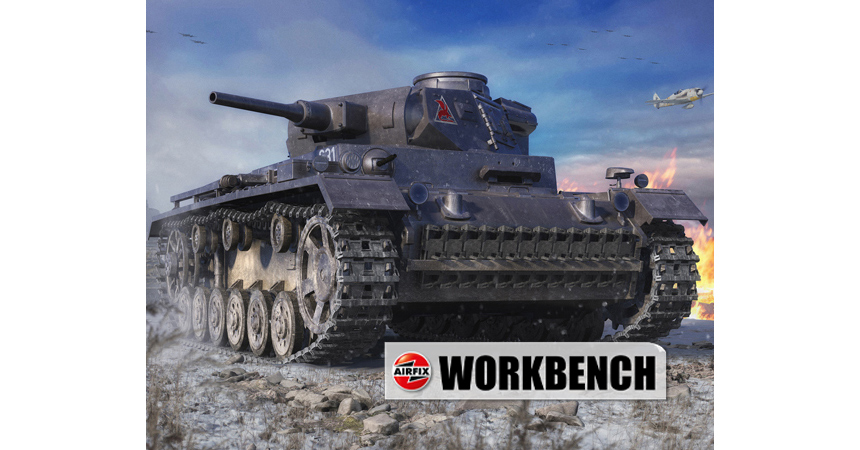
This magnificent artwork has been produced to support the impending release of this latest addition to our 1/35th scale Military Vehicle range, one of the most instantly recognisable tanks of the Second World war.
Although the Panzer III would go on to be considered one of the world's most important tanks, its development was somewhat problematic and even at this early stage, it could be described as being a little over-engineered for the task at hand. The complicated suspension arrangement proved to be particularly challenging and indeed several different arrangements were actually used during the production life of the vehicle. It also has to be accepted that whilst the tank would be seen as a major component of Blitzkrieg, the actual percentage of government funding towards tank development and production at that time was only a tiny fraction of what was being spent on aircraft and warship procurement.
By the time of the Polish campaign, only around 180 Panzer III tanks had been delivered and not all of these could be committed to combat at that time. The vast majority of Germany's tank force both then and during the Blitzkrieg months which followed, were made up of the much more numerous Panzer I and II light tanks and vehicles captured during Germany's occupation of Czechoslovakia, vehicles which nonetheless highlighted the effectiveness of the training German tank crews had received. Once units started receiving larger numbers of the more powerful Panzer III and IV machines, they showed just how far German tank development had come and would be seen on the battlefields of Europe, Russia and North Africa until the very last days of the conflict.
The Panzer III Ausf (model) J was a later production development of this famous tank and one which represented quite an advancement over earlier models. A slightly redesigned hull allowed for the addition of increased armour protection and a new gun mantlet facilitated the installation of the more powerful 50mm KwK 38 L42 gun, even though these modifications were in development for far too long and consequently suffered a delayed combat introduction. By the time this variant of Panzer III entered service with Panzer Divisions on the Eastern Front, they were struggling to cope with the armoured protection of the heavily armed Soviet KV-1 and T-34 tanks they were facing, and in addition to this, the larger ammunition rounds the new gun used also reduced the internal stowage capacity from 90 down to 84 rounds.
Although the Ausf. J would become the most heavily produced variant of this famous tank, by 1943, the Panzer III was outclassed by the latest enemy tanks on the battlefield and a decision was taken not to continue producing it as a gun tank from that point, even though the main chassis would still be used in the production of the highly capable Sturmgeschütz III assault gun/tank destroyer. Operationally, Panzer IIIs would be found on battlefields all over Europe and the Eastern Front right through until the end of the war, even though many were used in secondary or support roles by that time.
One of the truly iconic profiles of the Second World War, the Panzer III may not possess the physical stature and almost mythical status of the mighty Tiger I, but it was one of the most capable tanks in the world when it was introduced and is an illustration of the impressive tank development work which took place in Germany during the mid 1930s. Manned by well trained crews, these tanks remained effective throughout their operational service, even though the way they were deployed had to change following the introduction of more capable Allied types.
Following its combat introduction, the Panzer III would undergo almost constant development, with the addition of more armour and better main gun armament, all serving to increase its operational capabilities. The successes of campaigns in Poland, France and the Low Countries showed just how capable these tanks were, but when they settled into the attrition of combat on the Eastern Front and came across the massed formations of Soviet T-34 and KV-1 tanks, it was found that the main armament of the German tank was ineffective at anything above short to medium ranges. It is generally accepted that the T-34 was a better tank than its German adversary, but that did not tell the whole story, as German manufacturing prowess and better crew training made this a much more even match. When the Panzer III had the option of using the specialised Panzergranate 40 armour piercing ammunition, they could destroy opposition tanks at much greater distances, however, these were in extremely short supply and could only be used sparingly.
Operations in Russia highlighted the fact that the Panzer III was in serious need of main gun upgrade to cope with the thicker armour of the T-34 and had it not been for a number of factors, German tank crews would have been at a serious disadvantage. As it was, the better sighting optics, better general manufacturing quality, much better training, greater gun accuracy and a better rate of fire of the German machine all made this contest an even match and allowed German tank crews to post an overall combat success rate in theatre of 6 to 1 in their favour.
The 2nd Panzer Division was one of the three original German tank divisions created in 1935 and under the command of Heinz Guderian, would later take part in the annexation of Austria. They would also see action at the start of WWII, serving during the invasion of Poland and on to the Battle of France, enhancing its reputation for field craft and fighting prowess during both campaigns. They would later be sent to fight in Greece, but it would be their redeployment to the Eastern Front that would bring their first serious test.
Such a classic tank image, this lead scheme has also made its way onto the stunning box artwork produced to support the release of this new kit.
Sent to Russia in October 1941, the division was needed to replenish losses in Army Group Centre in advance of their drive towards Moscow and whilst initial engagements went well for the Germans, the stubborn resistance put up by the city's defenders soon put paid to Hitler's hopes of a swift victory in the East. Worse than this and in the teeth of a Russian winter, the heavily reinforced Red Army soon launched a series of ferocious counter offensives, driving the Germans back to their original start positions and taking a heavy toll of men and equipment in the process.
With the division now fully committed to operations on the Eastern Front, they would suffer grievous losses over the next eighteen months, to a point where they were withdrawn and sent to France for refit in late 1943. At that stage of the war, the decision had already been taken that the classic Panzer III would no longer be produced as a gun tank, as it had been outclassed by Allied machines.
It has to be said that the dark grey finish of this Panzer III Ausf J is as sinister as it is iconic and certainly goes some way to highlighting why the German tanks of Blitzkrieg earned such a fearsome reputation. Initially, new Panzers were delivered factory painted in dark grey (dunkelgrau) with a camouflage overspray of dark brown (dunkelbraun), however, this practice was discontinued from the end of July 1940, when just an overall coating of dunkelgrau was used, unless the tank was destined for operations in North Africa, when these machines would be given a dark yellow covering.
The Panzer III replicated here would have presumably benefitted from the liberal application of a field applied whitewash, had it survived into the Russian winter of 1942.
Following the completion of a retrospective review of Panzer combat experiences during the Battle of France, it was discovered that the main gun of the Panzer III had proved relatively ineffective against heavily armoured tanks such as the British Matilda and French Char B, a development which didn't escape the attentions of Hitler who had been impressed with his Panzer division's performance in the war so far. He instructed officials to immediately up-gun the Panzer III with the high velocity 50mm KwK 39 gun, a move which would provide the tank with the penetrative power it needed.
This was actually quite a considered decision, but for some reason, those high up in the Ordnance Department chose to ignore the Führer and instead decided that the less powerful KwK 38 should be used, a gun which they felt was more than adequate to deal with all current Allied tanks. Hitler remained oblivious to this decision until the summer of 1941, when he attended a tank demonstration in advance of the strike against the Soviet Union. He noticed that none of the tanks he was inspecting were equipped with the gun he had stipulated and when he was told why, he was understandably apoplectic with rage. He demanded that the tanks be fitted with the more powerful gun he had initially requested immediately, however, the damage had already been done and of the 2000 plus Panzer IIIs destined for deployment during Operation Barbarossa, there was only enough time to up-gun around 44 machines.
It has since been assessed that this decision and the overall delay of around 18 months in fitting a more powerful gun to the Panzer III was a significant contributing factor in the Wehrmacht losing the military initiative in the European campaign.
Not the usual kind of built sample model images we feature in Workbench, the recent arrival of these two models in the Airfix office had our Brand Manager quickly taking some pictures for inclusion in the blog, just because we thought you might like to see them. The final image also includes the new StuG IV which is the subject of our other blog for this week.
The best years for Panzer III production came in 1941 and 1942, when around 3,500 G, J and M models were delivered to tank units across Europe, the Eastern Front and North Africa. The Ausf J model was outwardly similar to the G variant which preceded it and was fitted with a 50mm KwK 38 L/42 gun - it also had similar armoured protection and was powered by the same Maybach 285hp engine. Tanks were regularly up-armoured to increase their combat survivability, which also included the fitting of Schürtzen side armour, which was attached to a rail welded to the side of the vehicle's hull and used as defence against Soviet anti-tank rifles.
The pressing need to constantly upgrade and up-gun Germany's Panzers would eventually see the Panzer III lose its position as a main gun tank, as the larger Panzer IV was thought to possess the greater development potential by virtue of its larger turret, a decision which resulted in no further Panzer IIIs being produced as gun tanks from August 1943. They would, however, continue to be produced as the highly successful Sturmgeschütz III, a vehicle which proved to be arguably the most successful tank destroyer of WWII.
The vehicle scheme offered here is typical of a Panzer operating on the Eastern Front in winter conditions, with the standard camouflage markings covered by a liberal application of winter whitewash, something which was absolutely necessary at this stage of the war, as Red Army gunners had become proficient at picking off German armour at ever increasing distances.
For such an iconic military vehicle subject as the Panzer III, this kit provides two scheme options which are equally appealing, even though both could hardly be more different from each other. A tank which has to be considered one of the most familiar machines of the entire Second World War, surely no 1/35th scale Military Vehicle collection can be considered complete without an example of this famous machine being part of it. Our new Panzer III Ausf.J kit will be rumbling on to those who pre-ordered it by the end of the month.
Another look at the new Panzer III artwork, this time complete with full Airfix product branding.
That’s all we have for this week, but please do check out our other Sturmgeschütz IV (SdKfz 167) (early version) related blog, which can be accessed via our main Workbench hub. We will be back as usual next Friday with more Airfix project updates for your enjoyment, but in the meantime, if you would like to drop us a line regarding anything Workbench or Airfix related, we would be delighted to hear from you. As always, could we please ask that you use our workbench@airfix.com contact e-mail address for all correspondence.
All our dedicated official social media sites can be accessed by clicking the respective link icons at the foot of this page, or by heading to the Airfix homepage. Other useful Airfix links are:
Facebook, YouTube, Twitter and Instagram official sites
Please join us for more Airfix updates next week and thank you for your continued support.