

Welcome to this latest edition of our Workbench blog and all the news, updates and modelling exclusives from the fascinating world of Airfix.
In last week's blog, we began our development update focus on all the new Airfix kits for 2023 by featuring the very early stages of the new 1/48th scale Fairey Gannet project, focusing on the efforts of two members of the team who were instrumental in the decision to undertake this project, Researcher Luke and Product Designer Paramjit. In truth, this did turn into a monster of an edition, but was the first time we had fully discussed this early stage of a new tooling project from the perspective of both research gathering and how this information helps a designer open his new project file. This latest update, whilst still touching on some of the points raised in last week's edition, will be looking at another new model for 2023, but one which includes new parts to allow a different version of a previously released, but still very new kit, to be modelled. Once again, we are indebted to designer Paramjit for his input and insights, but as we seem to be speaking to him all the time this year so far, we fully expect him to stop taking our calls in the very near future, but thankfully not this week.
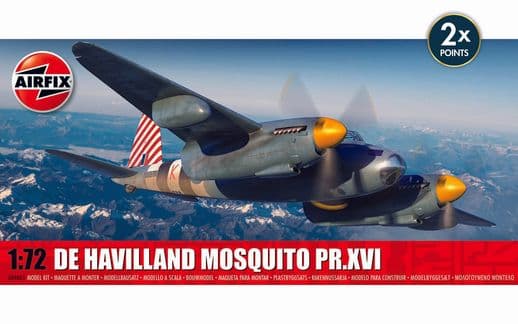
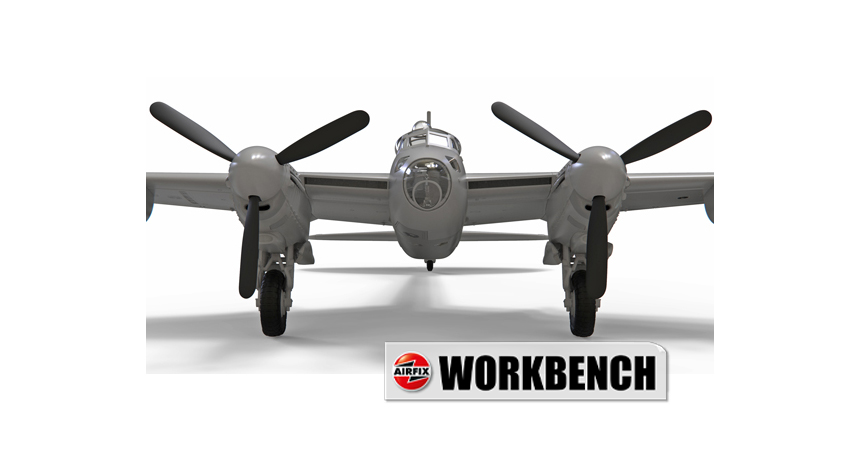
Our subject matter for this week is the 1/72nd scale de Havilland Mosquito kit and more specifically, the inclusion of two new component frames which will allow enthusiasts to build the photo-reconnaissance Mk.XVI variant of this famous aircraft. A perennial modelling favourite, we will be asking Paramjit about his design efforts when working on this Mosquito project and with grateful thanks to him, are also in a position to share a selection of exclusive CAD and tooling imagery with our readers. Hold on to your hats, its boost pressure to maximum, as the speedy de Havilland Mosquito takes centre stage in the latest edition of Workbench.
One of the fastest aircraft of the Second World War, the de Havilland Mosquito had the range and speed to roam deep into enemy occupied Europe and to secure vital intelligence photography.
Since the very early days of military aviation, the aeroplane has afforded military planners the ability to secure two vital pieces of intelligence information, a bird's eye view of the current battlefield situation and details of enemy positions. Clearly, this information is essential in both defensive and offensive situations and as such, all sides involved in any conflict were desperate to obtain this information and perhaps of even greater importance, prevent their enemy from doing the same. With the introduction of such aircraft as the Fokker Eindecker having a profound impact on the future of aerial warfare, the Great War would ensure that specialist aircraft and their crews would continue to evolve in order to provide this essential information, even as the pace and scope of war would go on to increase dramatically.
For a photo reconnaissance sortie to be successful, there are four critical aspects which must all be satisfied. In the air, your aircraft must be fitted with the finest photographic equipment available, be flown by a pilot with excellent navigational skills and with the aircraft itself possessing on vital attribute - speed. Carrying all this heavy photographic equipment and lots of fuel required a trade off and that was the removal of armament, so often stealth and speed would be a PR pilot's only method of evading interception. In fact, it's important to acknowledge the bravery of Photo Reconnaissance pilots as a group, as they were always flying in enemy airspace without defensive armament and with their adversaries knowing they was coming and determined to stop them completing their mission.
The forth aspect of a successful PR sortie is very much on Terra firma, an effective infrastructure system to quickly process, interpret and disseminate the information gathered amongst all the necessary departments. Whatever your enemy was constructing, preparing or trying to conceal, the prying lenses of Photo Reconnaissance aircraft made it their business to discover all their secrets.
At the start of the Second World War, Britain was still in a period of feverish military expansion and was ill-prepared for conflict in many respects. One significant area of concern was the RAF's lack of suitable reconnaissance aircraft, despite the fact that one or two visionaries had been covertly gathering such information during flights into Europe for some months and had highlighted the need to secure such vital airborne intelligence. Initially, existing aircraft types such as the Bristol Blenheim were converted to perform this task, however, the aircraft lacked the necessary speed and was quickly found to be unsuitable for the task. A handful of modified Spitfires would soon provide the speed, but were still not ideal due to their lack of range, but thankfully, an exceptional new aeroplane was just about to enter service and would revolutionise the art of aerial photo reconnaissance.
With all armament removed and equipped with just a bank of high quality photographic equipment, the Mosquito PR XVI relied on speed and the skill of its pilot to evade interception and to bring back its vital imagery.
When considering significant British aircraft of the Second World War, many people would probably think about types such as the Spitfire, Hurricane and Lancaster due to their enduring popularity and the fact that examples of each can still be found on the UK Airshow circuit. In addition to this enigmatic trio, there was another aircraft type which would prove to be equally impactful and quite possibly the most effective fighting aeroplane ever built, the magnificent de Havilland Mosquito. Without question, the Mosquito was one of the most effective aircraft of the Second World War and one which could even be described as being the envy of every air force in the world at that time, particularly the Luftwaffe, who tried hard, but never quite managed to develop an aircraft with Mosquito capabilities.
A true multi-role aircraft, the Mosquito was colloquially referred to as the ‘Wooden Wonder’, due to the fact that this hugely successful British aircraft was constructed using mainly ‘non-strategic’ materials, using a clever system of balsa and birch plywood lamination in its construction, a process which made the Mosquito incredibly strong. Although Mosquito crews would come to rely on the impressive performance and survivability of their aircraft during operational sorties, they would themselves often playfully refer to their mounts as little more than ‘Flying Furniture’, a term which an affectionate play on its more widely known nickname. Whatever they called it, they held their aircraft in high regard and knew their Mosquito was more than likely going to bring them home from their latest sortie.
The Mosquito was originally developed and tested largely as a private venture, free from interference by either the Luftwaffe, or indeed by the bureaucracy of Britain's Air Ministry. During the early stages of the Second World War, the de Havilland Company were fully engaged in either repairing damaged aircraft, fitting the latest propellers or constructing new Tiger Moth trainers and it seemed as if they had little spare capacity with which to develop a ground-breaking new aircraft. In fact, the situation was so serious and war materials so precious, that the minister of aircraft production suggested that their D.H 98 project (which would go on to be the Mosquito) should be cancelled, allowing the company to concentrate on their vital existing work commitments.
Thankfully for the British war effort, this directive was not taken as an official order by the de Havilland team, who simply moved part of their development operation to a secluded location just 4 miles from the main Hatfield site. At their rural Salisbury Hall site, work on the new twin engined aircraft could carry on in relative secrecy, something which eventually allowed the Mosquito to enter service much earlier than would have been the case had it been the subject of official scrutiny.
Although designed as a high speed, high altitude bomber, the incredible Mosquito possessed all the attributes to make it arguably the most effective reconnaissance aircraft in the history of warfare.
Once their new aircraft was ready to be tested and subsequently displayed for air ministry officials, the decision to proceed with its development was fully justified, as de Havilland clearly had a winner on their hands. Possessing blistering performance and impressive handling characteristics, the air ministry immediately placed an order for 150 aircraft, but perhaps of even greater significance to the project, placed a ‘priority status’ production requirement on the new Mosquito. The fastest aircraft in the world at that time, the Mosquito would go on to prove something of an aviation phenomenon.
Most enthusiasts are aware that the de Havilland Mosquito was developed as a high speed, high altitude bomber, however, many will be surprised to learn that the first Mosquitos to enter Royal Air Force service actually did so in a photo reconnaissance role. The Mosquito's greatest attribute was without doubt its speed and even though it was developed as a high-speed, unarmed bomber, the sheer fact it could outpace Luftwaffe fighter aircraft of the day made it an attractive proposition to those in the military charged with obtaining photographic intelligence of potential enemy targets. It is interesting to note that the second Mosquito prototype aircraft to begin construction was actually a dedicated photo reconnaissance variant and indeed, the first Mosquito to be taken on charge by the RAF was a PR Mosquito, so vital was this work to the British war effort.
For the first time, the RAF now had an aircraft with the performance, range and versatility to excel in the field of photo reconnaissance, with its ample internal storage allowing it to be equipped with a wide variety of the most sophisticated photographic equipment available. With Mosquito PR Mk.I aircraft joining RAF No.541 Squadron (No.1 PRU), enemy activities right across occupied Europe were now under the scrutiny of RAF Mosquitos and frustratingly for the Germans, the speed of the Mosquito meant there was little they could do about it. From providing naval intelligence, to photographing the results of the latest Bomber Command raids, photo reconnaissance Mosquitos would be kept incredibly busy for the remainder of the war and as each successive variant of the aircraft was introduced, so the capabilities of PR Mosquitos increased still further.
Beautiful to look at, the multi-role Mosquito proved to be one of the most effective aircraft of WWII and in the photo reconnaissance role, would show itself to be the ideal aviation platform for this crucial work. This PR version of our new 1/72nd scale Mosquito tooling will allow modellers to mark this important aspect of the aircraft's operational service.
The months prior to the D-Day landings saw the introduction of the upgraded Mosquito PR Mk.XVI variant, an aircraft which was the most effective photo reconnaissance aircraft in the skies at that time. Able to fly higher, faster and over longer distances, these latest reconnaissance Mosquitoes could go anywhere in Europe and see everything the Germans didn't want them to see and how they hated them. Specialist Luftwaffe 'Mosquito hunting' units were established to directly challenge the reconnaissance incursions of their British and American adversaries, however, it wasn't until the introduction of their rocket and jet powered fighters that they had any hope of success in this regard. Even then, Mosquito crews were well versed in interception evasion techniques and they continued to bring home their vital intelligence imagery.
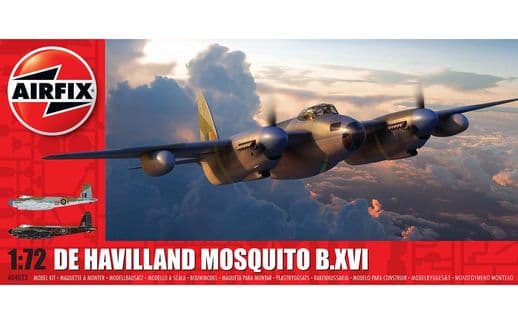
With the Mosquito going on to successfully perform so many roles during the Second World War, this true multi role type has to be considered one of the most important aircraft of the conflict and one which continues to enthral and inspire aviation enthusiasts to this day. The Mosquito also remains an incredibly popular subject in the scale modelling world and for one Airfix Product Designer, will always have a special place in his career affections. Back at the beginning of 2021, an early year edition of Workbench included development details of the recently announced 1/72nd scale de Havilland Mosquito B.XVI new tooling project and how for one designer, this would be a very special project indeed.
Although the name Paramjit Sembhi is now familiar to thousands of Airfix fans the world over, we have to start our Product Designers somewhere and for Paramjit, that somewhere was our new 1/72nd scale de Havilland Mosquito project. Although this was actually going to be the fourth Airfix design project Paramjit had worked on, the Mosquito project was the first one he had led from the start. Although he must have been ever so slightly daunted, he certainly didn't show it around his Airfix teammates and seemed genuinely excited at the prospect, embracing all that additional responsibility in a way that only youth can.
Rather than supplying us with pictures of a grey frame of additional Mosquito PR.XVI parts, Paramjit kindly sent us this fascinating images of the same parts within his tooling plan layout, the first time we have featured such an image in a Workbench blog.
In a link back to some of the points raised in our previous blog, at that time, researcher Luke had not yet joined the company, so the research brief Paramjit received at the outset of this project was delivered by our previous researcher Simon, even though it would have included the same detailed content. To help him get underway, the research files contained LIDAR scan data of a preserved Mosquito on display at the RAF Museum Midlands and during the course of the design phase, Paramjit was also able to take the opportunity to closely inspect the aircraft for himself, taking a large number of detailed photographs and speaking with museum staff and exhibit volunteers on specific matters of Mosquito design.
You may recall that in last week's blog, we described how the design brief files always include details of all future variant options of the subject the new tooling design must incorporate and how if these will form the basis of future additional releases, how any additional parts needed will have to be designed on separate frames, but incorporated into the main design project. Going back to add newly designed features to the tooling at a later date is both impractical and prohibitively expensive and rarely happens these days, so all the parts for current and future release options have to be designed and planned as part of the wider Mosquito project. Just another of the many challenges facing an Airfix designer in the execution of his duties.
This image shows the tooling design layout for the clear part frame which will allow the PR.XVI variant of the de Havilland Mosquito to be modelled from this kit.
Although we have only recently questioned Paramjit on his design work in relation to the new Fairey Gannet project, we did want to ask him if he recalls anything which challenged him particularly when designing additional parts for his 1/72nd scale Mosquito project. He told us that it proved quite difficult to arrange all the parts needed for future variants of the kit as separate part frames, but how actually laying them out within his tooling plan proved to be the most challenging task for him. He said that for the Mosquito PR Mk.XVI variant of the kit, he had to design new weapons bay bulkheads and closed main doors, new camera bays and a new aerial, in addition to new parts for the cockpit and camera windows. In fact, this new version of the Mosquito kit will feature two new frames of components, one in standard grey plastic and the other a frame of clear parts.
On closer inspection of the image selection Paramjit kindly sent us, you will notice that rather than include images of the early test frame components of these new parts as we have done previously when discussing modified tooling projects, he instead chose to send us two images of the actual tool plan layout he created towards the end of the design project, showing all the additional parts he had to design in order to allow this photo reconnaissance variant of the Mosquito to be modelled. Another interesting image first for our Workbench blog.
As we always like to do, we went on to ask PJ if there was any aspect of his design work on the Mosquito project which he is particularly pleased with, maybe something modellers building the kit might find useful or appealing. He told us that as he always likes to do, incorporating a little bit of innovation into his designs is the most rewarding aspect of the entire process, using his modelling experience to try and foresee potential build problems with the kit and to make them better through design. If he can make something that he might have struggled with himself during his own time modelling a little easier for modellers building his latest kit project through his experience and some clever design, then this makes him a very happy man.
Three design images which really do have to be grouped together for effect. This first one shows how Paramjit attempted to incorporate guidance for the placement of the three identification lights carried by PR.XVI Mosquitos, a design he would later change for a more suitable alternative.
That's better, the innovation Paramjit finally decided to go with. This drill hole location jig will allow the modeller to perfectly align this feature of the Mosquito PR.XVI, with the jig part itself supplied on one of the two new component frames supplied with the kit.
The correct positioning of the Mosquitos identification light bank, with lenses fitted, but pictured as a CAD screenshot.
The Mosquito project allowed him to innovate in design once more, as he noticed a distinctive feature of this particular variant that he would have to design into the shared fuselage parts for all variants, but prepare it for use specifically with the second, photo reconnaissance version of the Mosquito kit. The research brief included details of three identification light openings in the lower starboard section of the rear fuselage, offset from the centreline, but a distinctive feature of a PR Mosquito.
Paramjit told us that he actually tried several different ways of highlighting the area of the Mosquitos fuselage where this detail is located, but as the fuselage sections are a common part to be used across all release variants of the kit, what he was actually attempting to design was drilling guidance for the modeller intending to build this variant of the aircraft, showing where they would have to open up holes for the ID lights.
To Paramjit, it appeared that each design option he attempted held the potential to cause him problems when it came to the manufacturing process and he knew he could find a better way. His 'Eureka' moment came when he thought about attacking the problem from a different direction, quite literally. Rather than trying to incorporate drilling guidance for modellers looking to open up this feature from the inside of the Mosquito's fuselage, why didn't he include a separate drilling jig to place over the fuselage part to mark the three drill holes required. You will notice that the drilling jig design he came up with forms part of the additional plastic part frame to be included with the new kit, with the clear lenses needed to complete the feature found on the separate clear part frame - modellers who are aware of the trouble this caused will no doubt think of Paramjit and his design foresight when building this section of the new PR Mosquito kit. As is the case with each member of our design team, if they can help to ensure an enjoyable build experience for our modellers through their designs, then that really is their greatest achievement.
The de Havilland Mosquito has always been a popular modelling subject and we think this Photo Reconnaissance variant of our recently tooled new 1/72nd scale Mosquito kit will be a welcome addition to the 2023 range.
For those of us who are not Airfix Product Designers and simply marvel at the things they do, we are always impressed by their unique skillset, but probably also think they are far too modest when describing their work for our Workbench blog features. Letting us into their fascinating world for a while will always be of interest us, but will never have us thinking for one mad moment that we could ever be capable of stepping into their specialist shoes - we'll just keep on enjoying the kits they design and let them get on with the real work!
In describing what they do, all our designers do is draw our attention to just how difficult this type of work actually is and how they almost have to have a second sight when it comes to understanding where potential problems may arise. Not only having to design numerous individual components to allow a beautifully accurate scale representation of an aircraft, military vehicle or car to be built and within the confines of the injection moulding industry, they also have to make certain that each and every part moulds to the required standard and of equal importance, ejects from the tooling mould once manufactured.
Blog readers discovered a new designer peril last week when Paramjit described the term 'draft' when telling us about his design work on the new Gannet. As each and every part of a new Airfix model kit will be produced by injecting pressurised, molten plastic into a stainless steel tooling block, the process also includes the need to mechanically eject that new frame of parts from that same tooling jig after just a few seconds. In order to allow this to happen effectively, the designer has to incorporate something referred to as 'draft' into the design of each part, basically adding a slight taper to the surface of every component, allowing it to eject from the mould efficiently during the manufacturing process and to reduce the chance of it being subjected to possible moulding stresses.
This week, Paramjit told us of yet another design peril, 'undercut'. This term is linked to draft in many ways and could cause a similar problem during production and is basically when the draft angle applied to a particular component is inverted, with the wider section area of the part being on the inside of the tooling design. If this was committed to tooling, the moulded part will be wider at its base than it is at its mouth and should that happen, it will get stuck in the tool and will not eject as intended from the mould during production. The result of this may cause a failure of the part frame of which it is part and even cause damage to the tool itself. Clearly, this is potentially a huge problem for our designers and is something which has the potential to affect every part of a kit and is just waiting to ensnare the unwary designer.
Thankfully, Paramjit informed us that Airfix designers have three levels of support when it comes to avoiding the potential problem of undercut, namely the incredible levels of experience within the Airfix design team, an analysis extension of the design software they use which can highlight potential areas of the design where undercut may become an issue and support from the toolmaker, who are themselves expert in spotting areas of a design which may be prone to the problem.
Clearly, now we are all aware these issues, we want to know more about them and to see visual evidence of how they manifest themselves during the design process and thankfully, Paramjit has promised to help us do just that in a future edition of the blog. For now though, that's where we are going to leave this first 1/72nd scale Mosquito PR.XVI project overview, to return in a few weeks’ time with further details of box artwork and scheme details for this aviation eye in the sky.
Once again, we would like to thank Paramjit for this fascinating insight into his design work and for supplying us with this interesting selection of images. The burning question is will we be ringing him for more new model insights again next week, only our Development Manager knows the answer to that question at this point. Whatever proves to be the case, please check back with us next week to find out if we did.
We are afraid that's all we have for you in this latest edition of Workbench, but we will be back next Friday with more project development updates and the very latest Airfix kit exclusives. In the meantime, we are always keen to hear your views on all things Airfix and in particular, any thoughts and opinions you may have regarding our Workbench blog. If you would like to drop us a quick line, could we please ask that you use our workbench@airfix.com email for all correspondence.
To re-visit any of the Airfix blogs we have produced over the past seven years or so, please head to our main Workbench hub, where you will find our entire blog back catalogue.
All our dedicated official social media sites can be accessed by clicking the respective link icons at the foot of this page, or by heading to the Airfix homepage. Other useful Airfix links are:
Facebook, YouTube, Twitter and Instagram official sites
Please join us for more Airfix updates next week and thank you for your continued support.