Welcome to this first edition of our Workbench blog for 2026, and all the news, updates, and modelling exclusives from the fascinating world of Airfix.
As most of us will still be clinging steadfastly to the festive spirit on this first Friday in the new year, we thought we’d embark on a new year of Workbench blogs by updating one of our popular editions from last year, particularly as we now find ourselves in possession of built model samples of the kit in question. As our subject aircraft just happens to be arguably the most famous piston engined aircraft to have ever graced world skies, we didn’t think there would be too many dissenting voices amongst our, particularly as this variant marks a powerful new direction for this potent performer.
Unquestionably the highest profile design to come from the British aviation industry, the Supermarine Spitfire served throughout the Second World War and beyond, with ever more examples undergoing restoration to airworthy condition, such is the enduring fascination with this aircraft. Our new kit subject for this latest edition really is something special, only the second stand-alone kit release from this particular tooling, and a release which charts the post war career of a true stalwart of the historic aviation scene here in the UK. Significantly, this kit release presents the same aircraft in three different scheme guises, spanning almost 70 years of flying.
As many readers will no doubt have this stunning kit on their build schedule for the coming year, let’s see why our 1/48th scale Snooping Spitfire makes for an ideal way in which to start our modelling journey for 2026.
Now we have built models in hand, we thought it would be appropriate to update our Spitfire PR.XIX kit in this first blog for 2026.
It can sometimes be surprising to learn that despite the aircraft which served during the Second World War being some of the most famous machines in the history of aviation and still the subject of fascination for millions of people, these iconic machines were not exactly built to last at the time. Taking such factors as combat attrition rates, changing operational requirements, and the need to constantly improve performance into consideration, the service life expectancy of most aircraft types during the war was assumed to be more a matter of weeks, possibly months, as opposed to being measured in years.
For that reason, the service longevity of their impressive new fighter would not have been the highest of their priorities when the Vickers Supermarine project team watched with some trepidation when Chief Test Pilot Joseph ‘Mutt’ Summers lifted Spitfire prototype K5054 off from the grass airstrip at Eastleigh Aerodrome and into the air on 5th March 1936 for the first time. Although everyone would have been delighted with the performance of the aircraft, let alone how easy it was on the eye, it’s unlikely that any of them would have been considering how long this new fighter would be destined to remain in RAF service. With the clouds of war now looming ominously, it was now all about making this promising prototype into a fighting, service aeroplane and providing the nation with an aerial means with which to defend itself.
If we could go back in time and tell those engineers and technicians that what they had created would still be in Royal Air Force service eighteen years later, they would have probably thought we’d have lost or minds, however, that’s exactly what the Spitfire was destined to do. Indeed, if we include the aircraft currently under the care of the Battle of Britain Memorial Flight, along with the many private operators still flying Spitfires to this day, we would be telling them that Spitfires would still be flying almost 90 years later, something which would surely have had them calling for the men in white coats.
The Spitfire’s service longevity and adaptability went hand in glove with constant developments taking place at Rolls Royce Aero Engineering, and how their engineers and technicians were obsessed with trying to wrestle every last ounce of performance from their engine designs. The arrival of the throaty and impressively powerful Griffon engine provided the Spitfire with a performance increase of over 100mph above that of the prototype aircraft, something which would be appreciated by the photo reconnaissance pilots who were plying their trade deep into enemy territory, without the benefit of any armament for self-protection. For them, speed, height and piloting skill was their only protection against enemy action.
Existing 1/72nd scale Airfix Spitfire PR.XIX artwork. Spitfire PS852 set an altitude record of 51,550 ft on 5th February 1952, when Flt Lt Edward Powles took his aircraft higher than any other non-purpose built piston engined aircraft, a record which stands to this day.
As the Second World War progressed, the need for regular and reliable aerial reconnaissance imagery turned this kind of flying into something of an art form, with an impressive network of support operations behind it. Prior to the use of Spitfires in this role, larger aircraft types had been carrying out these dangerous missions from the very first days of the war with mixed results, with it quickly becoming apparent that the two most crucial factors in establishing an effective photo reconnaissance service were speed and altitude. Specialist training and dedicated support would also be required if the imagery obtained was to be used to its fullest potential, but the RAF simply didn't have the aircraft or infrastructure in place during those early stages of the Second World War.
To make matters worse, the Germans knew exactly what these aircraft and their brave crews were attempting to achieve, and were equally determined to prevent them from returning home with the valuable imagery they had been sent to obtain, modifying their own aircraft to make them even more effective as photo reconnaissance aircraft hunters.
As Britain’s search for an effective photo-reconnaissance aircraft continued, two standard Spitfire Mk.I fighters were modified specifically to perform such duties, and whilst these certainly proved to be an improvement over the Blenheims and Lysanders which had previously been performing such missions, the RAF still had much work to do if their photo reconnaissance Spitfires were to prove successful in this highly specialised, clandestine role.
Work continued in something of a bespoke manner until the introduction of more powerful variants of the Spitfire transformed the art of aerial reconnaissance, allowing missions to be flown at higher altitudes, at greater speeds and over greater distances. Now, all the lessons learned over previous years and months could be brought to bear in perfecting this service, and even though Photo Reconnaissance Spitfires would operate wherever British forces were deployed and their services were in great demand, it's always surprising to discover that relatively few aircraft were produced in this specialised configuration.
The pinnacle of Spitfire photo reconnaissance capability arrived with the introduction of the Rolls Royce Griffon powered variants of the aircraft, an aircraft which made full use of the now exceptional support network behind the gathering, examining and dissemination of Allied photographic intelligence in Britain. Operability of the new aircraft was generally excellent, and they were definitely 'speedbirds', something their pilots came to rely upon, as they were flying unarmed missions deep into enemy occupied territory, with the enemy trying to stop them. RAF Photo Reconnaissance Spitfire crews went by the motto ‘Alone, unarmed and unafraid’, so confident were they in the capabilities of their exceptional aircraft.
Spitfire PR.XIX PS853 in her current guise, commemorating the contribution of RAF photo reconnaissance pilots during the Second World War as part of the Rolls Royce Heritage Flight.
Flying at altitudes of around 40,000 ft, PR.XIX Spitfires were almost impervious to ground defences and interception by most piston engined aircraft the Luftwaffe had in operation. Indeed, even the feared Messerschmitt Me 262 would have difficulty bringing down a Spitfire PR.XIX, that is if one could be spared from anti-bomber duties. If a Spitfire was being stalked by an enemy aircraft, the tactic used by most pilots would be to enter a shallow dive, gradually building up speed as they gently descended earthwards. A pilot also had the option of increasing altitude still further and whilst there were reports of Spitfires flying above 40,000 ft, this was actually an exercise fraught with many dangers.
Capable of maintaining a steady 370mph even at extreme altitude, these aircraft also carried the highest internal fuel load of any PR Spitfires, all attributes which made these the most effective clandestine, information gathering variants of this famous aircraft to ever see service. Clearly, when operating at these altitudes, the aircraft were usually only deployed on days when the weather was fine, as cloud cover and stormy conditions would prevent them from obtaining the photographs they were sent to gather.
If cloud cover was obscuring any assigned target, Spitfire PR.XIX pilots had the option of descending to a lower altitude in order to secure the imagery they needed, however, this significantly increased the risk or interception, or sustaining damage inflicted by enemy anti-aircraft defences. Photo reconnaissance Spitfires would regularly be sent to provide raid effectiveness imagery following a bombing mission, arriving over the target area minutes after the last bomb had been dropped, with their pictures determining whether the bombers would have to return to the target again in the days which followed.
So effective were these aircraft in carrying out this specialist role, that they would continue to perform these duties in the years which followed the end of the Second World War, not only being regarded as some of the fastest Spitfires in RAF service, but also some of the last. Operating in the heat and humidity of the Far East, these Spitfires truly were in their element, soaring at speeds and altitudes that the first prototype aircraft could never have imagined attaining, the final custodians of an aviation legacy which remains undiminished by the passage of almost a century of aviation.
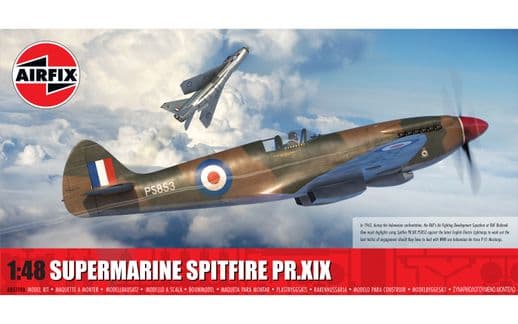
New Airfix box artwork revealed. To mark the long overdue return of this magnificent kit, the latest box artwork takes its inspiration from the mock combat trials Spitfire PS853 took part in against English Electric Lightning jets during the early part of 1964. This scheme is our lead option of three which all feature this same aircraft at different points during its 80 year flying career.
The pilots posted to operate Supermarine’s snooping Spitfires of the Second World War may not have been flying aircraft which would allow them to build up personal victory tallies, but they were unquestionably some of the most potent piston powered fighting aeroplanes ever conceived and as such, really did require some taming. With their only targets being photographic ones and with all armament removed for speed, these aircraft were the scourge of the Wehrmacht, always watching what they were doing and ensuring all their secrets didn’t remain secrets for long.
Incredibly dangerous to fly, with the quality of photographs obtained being the only mark by which a mission could be judged a success or not, these pilots were highly specialised in their skillsets, and clearly extremely courageous. Operating alone deep into enemy occupied territory, with just their aircraft and their wits to keep them safe, the more proficient they became, the more sorties they would be sent on, truly becoming unsung heroes of the European air war.
With several PR.XIX Spitfires having served on the UK Airshow circuit throughout the post war years, these potent machines have become a firm favourite with enthusiasts and by association, also with modellers around the world. From an Airfix perspective, the powerful PR.XIX has been available in both 1/72nd and 1/48th scale since 2009 and 2013 respectively, with both appearing relatively infrequently in various ranges since those dates, it has to be said.
Although every modeller will certainly have their own opinion on this subject, but when it comes to the modelling and display of single engined piston powered fighters from the Second World War, my personal preference is definitely for kits in 1/48th scale. If you ever have the opportunity to get up close to aircraft from this era, they’re all about brute power, huge engines driving massive propellors, and they look quite magnificent. Although 1/72nd scale will always be the traditional modellers scale, the larger 1/48th scale kits certainly lends itself to the power, muscle and majesty of a piston powered fighter, creating a much more appropriate representation of the power of your subject aircraft, in the opinion of many.
If you’re looking for a subject with which to underline such a bold statement, the 1/48th scale Spitfire PR.XIX fits that bill perfectly, beautiful to look at in any scale from 1 to 1 downwards, but spectacularly represented in our display cabinets in this slightly larger scale. Anyone who has ever seen a Griffon powered Spitfire displaying at an Airshow will attest to the fact that these aircraft look and sound very different to Merlin engine powered variants. Where Merlin Spitfires are refined, almost cultured, their Griffon counterparts seem hell bent on warning you not to mess with them, like some aviation horse of the apocalypse. When a Griffon powered Spitfire is in your vicinity, it positively demands that you keep your gaze firmly in its direction.
The only dedicated Photo Reconnaissance variant of the Spitfire to be powered by the Rolls Royce Griffon engine, the PR.XIX may well have been something of a hybrid aeroplane, constructed using components from several other variants of Spitfire, but it was still an extremely potent performer nonetheless.
With over 20,000 Spitfires built across numerous different marks, a collection of built models in 1/48th scale not only allows for their power and presence to be represented in a more visually appealing manner, but also allows the modeller to chart the aircraft’s incredible development through the medium of modelling in a really impactful way.
With that being said, and my modelling colours now pinned firmly to the 1/48th scale mast, this brings us on to the subject of this week’s new release update, an aircraft type which was almost made to be replicated in 1/48th scale. The Spitfire PR.XIX is a brute of an aeroplane, one which underlines just how impressive the Spitfire’s airframe was when it comes to its development potential. Aircraft which were asked to perform a particularly demanding role during the latter stages of the Second World War, and proved capable enough to remain in service during the immediate post war years, these photo reconnaissance Spitfires also played a prominent role in helping to establish the Airshow scene here in the UK, something we’re about to discover.
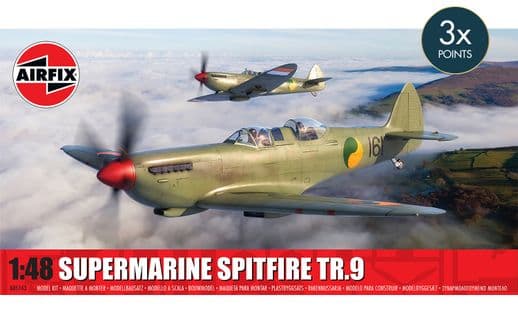
Workbench readers will be only too aware that we love a good story relating to one of our releases within these updates, but have we got something special for you this time around. For this first release from our 1/48th scale Spitfire PR.XIX in many a year, we have THREE fascinating scheme options included in the kit, each one a different presentation of the SAME aircraft from within its post war flying career. Significantly, this magnificent aircraft is still thrilling Airshow fans with powerful displays to this day, a fine airworthy example of a photo reconnaissance Spitfire from the latter stages of WWII. Which one of the three scheme to choose, well that’s going to need some serious thinking about, and a little time setting aside for contemplation.
With the retirement of the last former RAF Spitfire PR.XIX aircraft operated by the Temperature and Humidity Flight at RAF Woodvale in July 1957, their aircraft were allocated to the recently formed Historic Aircraft Flight and flown to RAF Biggin Hill. Spitfire PS853 was one of the three, essentially forming the nucleus of what we now know as the Battle of Britain Memorial Flight, but not without creating something of a story first.
Despite arriving at Biggin Hill with the other two former THUM PR.XIX Spitfires, PS853 was actually deemed surplus to requirements the following year and subsequently flown to the Central Fighter Establishment at West Raynham, where she was allocated for possible use as a base gate guardian. Despite being struck off charge on 1st May 1958, the aircraft never took up that ceremonial post, and instead managed to keep on flying, later still being sent for overhaul at RAF St Athan. When she returned to the Central Fighter Establishment, they had moved to RAF Binbrook, however once there, she was brought back on charge.
This is important to the next part of this aircraft’s incredible history, but was linked to events taking place on the other side of the world. Unrest in South-east Asia saw the RAF allocating jet aircraft for use against Indonesian guerrilla forces in Malaysia, and the very real prospect of powerful jet aircraft coming into contact with enemy piston engined fighters from an earlier era, such as the North American Mustang. Aircraft such as the mighty Gloster Javelin were in position to deal with the threat, but how would they fare against these older, much slower opponents.
Back in the UK, the current boss of the RAF’s Air Fighting Development Squadron (part of the Central Fighter Establishment) had plenty of experience in flying powerful piston engined fighters in the Far East and as Fighter Command’s liaison officer assigned to the English Electric Lightning programme, was just the man to oversee a unique series of flight trials. The trials pitted one of the world’s most advanced Mach 2 jet interceptors with a powerful piston engined fighter, to see how the modern aircraft would cope with such an incompatible foe and specifically, how tactics could be developed to deal with such adversaries.
Spitfire PR.XIX PS853 was flown in mock combat trials with two new Lightning F.3 aircraft delivered to the Central Fighter Establishment for evaluation and trials purposes, something very few people in the Royal Air Force could have contemplated at that time. With the Gloster Javelins already in theatre destined to come into contact with the Indonesian Mustangs, it’s open to debate as to how seriously the prospect of Lightnings being used in any Far East conflict was being contemplated at that time, but what isn’t up for debate is the fact that Spitfire PS853 was flown in combat trials against English Electric Lightnings.
A fascinating period in the history of this historic Spitfire.
It will come as no surprise whatsoever to discover that the Spitfire did rather well against the Lightnings, with the fact that it was around 1,000mph slower than the F.3 being exploited as a definite combat advantage. The Spitfire offered little in the way of a ‘lock-on’ signature when it came to using the Lightning’s missiles, and the high closing speed of the Lightning left absolutely no room for error for the attacking jet’s pilot. If they slowed down to better target the Spitfire, they were playing right into its hands, and had the PR.XIX been equipped with guns (it was an unarmed reconnaissance variant), this is the scenario when it would bring them to bear.
Essentially, whilst there was a huge gulf in aviation technology and capability between the two aircraft, this mismatch actually worked in favour of the older, slower piston powered aircraft, unless the cutting edge Lightning could unleash a well-aimed cannon strike, but that would have to be one of the earlier variants still in RAF service, as the F.3 variant omitted the inclusion of guns.
A fascinating footnote in the service history of the Spitfire, it appears that these trials were undertaken after the other Lightning development work for the day had been completed, and very much on an unofficial basis.
The accurate dating of these Spitfire versus Lightning trials has also been the subject of some conjecture over the years, however, those in the know report the Lightnings as arriving at Binbrook on the 1st and 15th January 1964, and Spitfire PS853 as being sent back to the Historic Flight, which was now at RAF Coltishall, by April that same year. That means that the window of opportunity for these mock combat trials to have taken place was between those dates, just a few short weeks in early 1964.
Thankfully, the latest RAF jets were not required to engage in combat with Indonesian Air Force Mustangs, as a settlement to the disagreement was negotiated and conflict avoided. That being said though, how attractive does this stunning camouflaged PR Spitfire look?
Prior to its use in the unusual mock Lightning combat trials at Binbrook and being assigned to the Historic Aircraft Flight / Historic Flight, Spitfire PR.XIX PS853 was one of the aircraft used by the Meteorological Temperature and Humidity Flight, a tasking which was usually assigned to older aircraft types in Royal Air Force inventory. The RAF had been conducting these research flights since the mid 1920s, with aircraft gathering information to enable detailed forecasts to be produced and shared across the force, with this requirement increasing dramatically in number during the wartime years.
Following the end of WWII, these THUM flights returned to just a single daily sortie, usually flown by a Mosquito from one of the West Malling Mosquito squadrons.
From April 1951, the responsibility for undertaking these meteorological flights was contracted out to Short Bros & Harland, even though they were supplied with a collection of former RAF aircraft. This decision was taken to enable the gathering of this useful information to continue, whilst removing the responsibility from operational RAF squadrons, something which appeared to work rather well, whilst at the same time creating a fascinating new unit for enthusiasts to discover.
Although formed at RAF Hooton Park near Liverpool, it would soon move to a more permanent home at the nearby airfield at RAF Woodvale on the Sefton Coast near Southport, with the Supermarine Spitfire PR XIX being seen as the ideal aircraft to undertake this specialist work. This was due the aircraft’s excellent range, impressive climb performance, pressurised cockpit and extremely stable handling characteristics once at operating altitude, almost flying itself, allowing the pilot to concentrate on more pressing tasks. Over 2,000 of these Meteorological Spitfire flights would be made during the Woodvale THUM years.
The Spitfire PR.XIX proved to be the ideal aircraft with which to conduct these demanding THUM flights, fast, stable and possessing impressive range.
These flights were undertaken six days every week, but not on Sunday, and in all weather conditions. These aircraft were equipped with specialist meteorological equipment, and the pilots conducting them had quite a lot of work to do, in addition to flying these powerful aircraft. Taking a huge array of pressure readings at different hights, but over the same route, they were also required to collate any number of visual reports, becoming incredibly adapt at gathering everything the Met Men required.
On their return to Woodvale, the information would be sent to Speke, where details were checked and sent on to the Central Forecasting Office at Dunstable. From 1953 onwards, THUM pilots would make a daily stop over at Speke to deliver the information first hand, thus reducing the time taken to get the information to the CFO.
For the pilots involved in these sorties, they were not only flying high performance aircraft, but they also had to embrace an incredibly heavy workload, one which required great skill and expert airmanship. Unfortunately, there was little room for error when engaged in these sorties, and several pilots would be lost whilst engaged in these THUM flights.
The role previously performed by Woodvale’s Spitfires would subsequently be taken over by de Havilland Mosquitos during the summer of 1957, as the parts required to keep the Spitfires in the air being increasingly difficult to source, with the Flight regularly having to obtain components from sources across the far East. The last Spitfire PR.XIX sortie was flown by PS853, the aircraft scheme presented here, on 10th June 1957, the last operational flight by an RAF Spitfire to take place anywhere in the world, more than 21 years after the first flight of the prototype aircraft.
With their much loved Spitfires now scheduled to be retired, officials at Woodvale arranged for an air display to take place at the airfield in June 1957, both to bid their Spitfires farewell, but also to introduce the public to their new Mosquitos. Unfortunately, all three Spitfires proved temperamental on the day of the event itself and didn’t really give a good account of themselves, almost appearing to have something of a THUM tantrum. One refused to start, one landed with radio trouble after a single circuit, which just left PS853.
She did manage to blast into the air, but immediately appeared to be experiencing engine trouble, so again, made a swift return to the airfield. Making something of a heavy landing, one of the aircraft’s main undercarriage legs found a rabbit hole or divot in the grass at the end of its landing run, causing the propeller to hit the ground. The incident looked much worse to onlookers than the damage actually caused, and all three Spitfires were able to leave Woodvale the following day, all bound for the Historic Aircraft Flight at Biggin Hill.
This third scheme option brings the story of Spitfire PS853 right up to date, an aircraft which is a cherished component of Rolls Royce’ rich aviation heritage, and a much loved performer on the UK Airshow circuit. Maintained to exceptionally high standards, not only does she represent Rolls Royce at corporate events across the country, but she also serves as a flying tribute to the crews who performed the dangerous role of airborne photographic reconnaissance during the Second World War, a vital component in securing victory for the Allies, but one which often goes unheralded.
Supermarine Spitfire PR.XIX PS853 was built by Vickers Supermarine at their Southampton factory works towards the end of 1944 and subsequently delivered to the Central Photographic Reconnaissance Unit at RAF Benson on 13th January 1945. She would see active service with No.16 Squadron before the end of the Second World War, flying sorties over Belgium and Holland, missions which included attempting to locate possible German V1 and V2 launch sites in northern Europe. Spending time with No.268 before returning once again to No.16 Squadron, she would be damaged following her involvement in a flying incident in early 1949, with the damage requiring her to be sent back to Vickers Supermarine for repair.
Spitfire PR.XIX PS853 would later be allocated to the civilian operated Meteorological Research Flight at RAF Woodvale, where she would be involved in another accident in June 1957. On an Airshow ‘At Home Day’ to mark the end of THUM Spitfire operations, the aircraft took off to perform a demonstration flight, but developed engine problems as soon as it got into the air. The pilot made an immediate return to the airfield, only to have the Spitfire nose over at the end of its landing run due to a divot, damaging the aircraft’s propeller in the process.
With the disbandment of the flight occurring the very next day, PS853 was allocated to the RAF's new Historic Flight, transiting to RAF Biggin Hill with the damaged propeller now fixed, along with two other Spitfire PR.XIX aircraft - this unit would later become the Battle of Britain Memorial Flight cherished by so many people to this day. She would later be earmarked to serve as the station gate guardian, although this never actually came to pass, with her remaining airworthy throughout. Later still, she embarked on a painstaking restoration programme, with the intention of returning her to airworthy condition.
The real deal – celebrating her 80th birthday this year, Supermarine Spitfire PR.XIX PS853 is the prized possession of the Rolls Royce Heritage Flight and a popular performer on the UK Airshow circuit.
Dressed for aviation success – happy 80th birthday PS853.
All grace and power, the PR.XIX was a late war development of the incomparable Spitfire.
This magnificent aircraft was purchased by Rolls Royce in 1996 and since that date, has become a much loved component of their heritage preservation initiative, used extensively for promotional and ceremonial purposes, in addition to now being a regular display act on the UK Airshow circuit. She can be seen thrilling audiences throughout the summer months, with her displays of grace and power allowing those in attendance to experience this ultimate incarnation of the famous Spitfire. Using history and their proud heritage to inspire the skills and technologies of today, Rolls Royce are rightly proud of their beautiful Spitfire, lavishing much time and attention on her care and maintenance.
Spitfire PS853 wears a scheme which is as close to the one she wore during her operational flying days with No.16 Squadron at RAF Benson back in 1945, and were it not for the Rolls Royce wording carried on her nose, looks for all the world like she could set off on a V2 launch site hunting mission from her East Midlands Airport home base at a moment's notice.
Cared for by a dedicated team in a beautifully prepared hangar at East Midland Airport, this magnificent aircraft marks more than a century of Rolls Royce excellence in the field of aviation propulsion, sharing her base with some of the most advanced aero engines in world service today. The star of many a flying display during the summer months, this powerful aircraft not only represents her owners with distinction, but she is also becoming much more active on the UK Airshow circuit, a fine example of this powerful variant of Spitfire.
Oh, and did we mention that 2025 marks the 80th birthday of Supermarine Spitfire PR.XIX – happy birthday PS853.
Looking absolutely magnificent in this larger 1/48th scale, this beautiful tooling has been missing from the Airfix range for far too long, but is definitely now back with a bang. Helping to tell the interesting service story of this much loved and hard working aircraft over the 80 years of its flying career, this unusual scheme collection really does give this model incredible character, but does present us with a selection dilemma of Griffon engine sized proportions – how on earth are we going to choose just one scheme to complete?
Box artwork to inspire a thousand build projects, but how on earth will we choose between the three different scheme options for the same incredible aircraft?
All three stories are so engaging that this will probably be our most challenging scheme decision of the year, but will certainly see many of us spending some quality time with the magnificent Spitfire PR.XIX. The lead scheme is just so interesting and how good does a Spitfire PR.XIX look wearing camouflage markings! The THUM operation at RAF Woodvale has always been of interest to aviation enthusiasts and marks a particularly demanding type of flying for those pilots engaged in this specialist work. This option also marks the birth of the Battle of Britain Memorial Flight, and one of the first aircraft allocated to this historic aviation phenomenon.
And then there is PS853’s current guise, one of the most potent historic aircraft performers on the UK Airshow circuit, and a cherished component of Rolls-Royce’ heritage division. We are fortunate enough to know members of the team who look after her, and they truly dote on their aviation charge, lovingly maintaining her in the best condition possible – she’s absolutely pristine.
Such a fantastic idea from the Airfix development team, and a kit addition to the current range which will be welcomed by modellers all over the world. A05119A Supermarine Spitfire PR.XIX is available now and awaiting an incredibly difficult scheme selection to be made.
We're afraid that's all we have for you in this latest edition of the Airfix blog, but we will be back next Friday with more project development updates and the very latest Airfix kit exclusives. In the meantime, we're always keen to hear your views on all things Airfix and in particular, any thoughts and opinions you may have regarding our Workbench blog. If you would like to drop us a quick line, could we please ask that you use our workbench@airfix.com email for all correspondence.
To re-visit any of the Airfix blogs we have produced over the past TEN years or so, please head to our main Workbench hub, where you'll find our entire blog back catalogue and all the Airfix design projects we have already covered.
All our dedicated official social media sites can be accessed by clicking the respective link icons at the foot of this page, or by heading to the Airfix homepage. Other useful Airfix links are:
Facebook, YouTube, Twitter and Instagram official sites
Please join us for more Airfix updates next week and thank you for your continued support.