
Welcome to this latest edition of our Workbench blog and all the news, updates and modelling exclusives from the fascinating world of Airfix.
For an aircraft which was designed to put the Soviet Navy on the back foot, by mounting high speed sea-skimming strike operations against their new breed of surface ships, it's interesting to note that the mighty Blackburn Buccaneer would actually write its most glorious chapter operating at heights of over 29,000 feet, illuminating targets for much younger aircraft to deliver their precision guided munitions during the Gulf War. As we prepare to welcome the addition of the latest release from our 1/72nd scale Blackburn Buccaneer tooling to the 2023 range, this latest edition of our Workbench blog will be focusing not only on this long serving and extremely rugged post war British jet, but will also be looking at its role during the Gulf War of the early 1990s and how these aircraft, which were in their supposed dotage, were required to be quickly readied for operational deployment, and would make a telling contribution following their arrival.
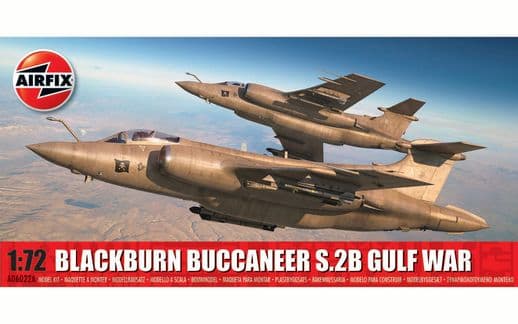
In addition to looking at the impressive credentials of the Buccaneer and its lengthy British service career, we will see how the Gulf War deployment of the aircraft showed how you can always teach an old aircraft new tricks and how in the world of aviation, the experienced head can still show the young upstarts a thing or two when required. Featuring stunning new box artwork and looking at the two fascinating scheme options which will be included with this new kit, we are about to spend some time in the company of the 'Sky Pirates' and two of the aircraft which were prepared and flown out to the Gulf region in extremely short order at the beginning of 1991.
A true naval aviation heavyweight, the Blackburn Buccaneer was designed to terrorise the Soviet Navy, but would also become an invaluable strike asset for the Royal Air Force.
When it comes to the subject of capable post war British strike jets of stature, there is certainly one aircraft which stands at the head of such an aviation group, particularly if the criteria includes the ability to operate from one of the nation's diminutive aircraft carriers - the Blackburn Buccaneer. A proud achievement for Britain's aviation industry, the Buccaneer was a superb aeroplane and one which incorporated many design ‘firsts’ for a British built aircraft, an aircraft which was initially developed to equip the Royal Navy with an effective airborne Soviet Navy Sverdlov Class Cruiser destroyer. With the country in yet another period of austerity at the time and funding for a massive naval expansion to match the Soviets being out of the question, the British response to the significant threat of the Soviet Navy’s new vessels was to develop an aircraft which was designed specifically to destroy them, basically removing that threat in the most cost effective, yet devastatingly effective manner possible.
The proposed new naval strike jet would be the first of its kind developed from the outset as an ‘under radar’ design and would need to provide excellent performance at low altitudes, as well as the capability to deliver nuclear munitions on their target, should it ever come to that. Clearly, these parameters would place extreme demands on any aircraft, however, the new jet would also need to achieve all this whilst operating from the deck of one of Britain’s diminutive aircraft carriers and it was clear right from the start that this would have to be a very special aeroplane indeed - as tough as they come and a fast, stable, subsonic weapons platform.
Due to the sensitive nature of its intended operational profile, the new jet was developed under a cloak of extreme secrecy, with the favoured design being one submitted by famous British naval aircraft manufacturer Blackburn Aircraft Limited, with their aircraft initially being referred to as the Blackburn Advanced Naval Aircraft (BANA), an acronym which would stay with the aircraft throughout its future service life. Extending the acronym slightly, the aircraft which later went on to be christened the Buccaneer, would be colloquially referred to as the ‘Banana bomber’, a name which is solely linked to its development acronym and not to its fuselage shape, as is often incorrectly quoted, even though it did bear more than just a passing resemblance.
Although possessing plenty of experience in the production of naval aeroplanes, this latest design would be Blackburn's first jet aircraft type and the performance criteria it needed to satisfy would pose plenty of manufacturing challenges for their design team. As it would need to be an incredibly strong and durable design, many components for the new aircraft would have to be worked from solid blocks of metal, but as this manufacturing expertise was not available in the UK at that time, they initially looked for help from manufacturers across the Atlantic Ocean. Unfortunately, everyone they asked for help were fully committed on their own existing projects and in order to prevent the new aircraft from getting off to a much delayed start, bravely deciding to produce their own bespoke manufacturing machinery for the task.
Two images taken from the design phase of this magnificent model kit, firstly showing the start of the project and the 3D modelling phase. 2D curves are carefully drawn, following the complex surface contours of the scan data. Where possible, these are positioned to line up with the frames and ribs of the full size structure, referencing the original drawings.
Frontal profile of the completed model files.
Clearly, producing an aircraft capable of withstanding the rigors of carrier operation and the stresses associated with fast, low level operations over wide expanses of water dictated that their new aircraft would have to be extremely tough, however, all that strength would come at a cost. Building in the necessary levels of strength and durability into the design resulted in an aerodynamic penalty, with the performance of the aircraft compromised as a consequence, nevertheless, what they eventually produced was a truly exceptional aeroplane. Their Buccaneer may not have been supersonic or particularly pleasing on the eye, but it was manoeuvrable, built like a brick outhouse and the most capable aircraft of its kind to be found anywhere the world at that time. It also happened to be the heaviest aircraft ever operated by the Royal Navy.
Although the Navy were delighted with their capable new jet, when the RAF were offered the chance to take it, they were initially disinterested at best and positively dismissive at worst. The aircraft's development as a naval jet was certainly one of the reasons why the Royal Air Force were initially uninterested in taking the Buccaneer as a potential option and initially dismissed its procurement out of hand. Offered the aircraft as a potential replacement for their ageing Canberra’s in the low level strike and reconnaissance roles, at that time, the RAF could see no further than the incredibly exciting prospect of the British Aircraft Corporation TSR.2, which appeared to be the aircraft which presented them with everything they were looking for and therefore, forcing them to see the situation very much through TSR2 tinted flying goggles.
A built example of this magnificent kit in RAF No.208 Squadron livery.
The subsequent high profile cancellation of the TSR.2 programme forced the RAF to initially look in the direction of the American General Dynamics F-111, but as this aircraft's development programme continued to have problems of its own, the British Government would also decide to end their interest in this option as well. With no other viable option available to them and with this proven British designed and built type available 'off the shelf', in a manner of speaking, the government decided that the RAF would take the Buccaneer as their Canberra replacement, even if RAF officials initially felt as if the was forced upon them.
Entering Royal Air Force squadron service some seven years after it did so with the Royal Navy, an initial order for 26 new aircraft was placed with Blackburn, with the RAF machines having a number of differences from their seaborne counterparts and given the designation S.Mk.2B. It was also decided that with the retirement of the Navy’s last big carriers, the RAF would also inherit the former Royal Navy Buccaneers, aircraft which would constantly remind their new owners of their proud naval heritage. It's interesting to note that the new aircraft ordered for the RAF would retain the folding wings and arrester hook of the original naval Buccaneers, as it was felt that these features did not detract from the performance of the aircraft, allied to the not insignificant fact that they were desperate to avoid the expense of unnecessary re-development costs.
For an aircraft the Royal Air Force were initially not all that keen on, the Buccaneer would prove itself to be an exceptionally capable strike platform and by the time it was eventually scheduled for retirement, they were actually reluctant to let it go. Although they did end up operating the very same naval aircraft they had initially dismissed, it didn’t take long before the camouflaged Buccaneers of the Royal Air Force began to show what they could do, and why this particular jet was definitely no second choice aircraft type.
Stunning new artwork produced in support of this latest Gulf War release from our relatively new 1/72nd scale Blackburn Buccaneer tooling. The Sky Pirates are coming!
The opening exchanges of the Gulf War were carried out by coalition air forces on 17th January 1991, with a strong force initially attempting to neutralise the potential threat posed by the Iraqi Air Force, shooting down anything which dared to get airborne and challenge them, whilst at the same time using airfield denial munitions to render their operating bases unserviceable. This task proved particularly difficult, not only because the layout of enemy airfields was so vast, but also by the effectiveness of the anti-aircraft defensive fire they encountered.
Once satisfied that they had effectively removed the threat of the enemy's air force, RAF bombing operations moved to what they had expected to be safer medium altitudes, using iron bombs to take out their identified targets, however, they continued to be targeted by accurate anti-aircraft fire and bombing inaccuracy was becoming a concern - the continued loss of aircraft prompted immediate action to be taken.
At that time, the RAF's last remaining Buccaneer jets had been replaced in the main strike role by the Tornado and in the swansong of its operational career, the last 30 or so airframes were all based at RAF Lossiemouth, mainly operating in a maritime strike role, with the exception of No.237 OCU, which maintained a reserve operational role providing laser target designation support for other RAF strike aircraft, using the AN/AVQ-23E Pave Spike electro-optical laser designation targeting pod with which it was equipped. This and the other two remaining Buccaneer units were all based at RAF Lossiemouth at that time and as the Gulf erupted into conflict, the Station Commander was told that the services of his personnel and their ageing aircraft would not be required.
As the usual squadron training duties continued throughout January, the situation was so normal that the two operational squadrons were actually sent out on training detachments, with No.12 Squadron operating from Gibraltar and No.208 Squadron calling RAF St Mawgan their temporary home, however, things were about to change. After just three days of offensive operations in the Gulf, developments dictated that the services of these venerable old jets would now be needed in the combat zone and Lossiemouth had just three days to prepare for a historic operational deployment. The very specific capabilities of these Cold War warriors was now needed in the Gulf as a matter of urgency and RAF Lossiemouth would become a hive of activity as a consequence.
Having again been told that his Buccaneers would not be required in the Gulf only hours earlier, the Station Commander at RAF Lossiemouth would find himself in an aviation race against time, after receiving a phone call at around 10.30 in the evening from Strike Command HQ. The conversation apparently went something like, "Hello, How quickly can you get your aircraft to the Gulf? - You have 72 hours".
As you can imagine, a period of feverish activity ensued at Lossiemouth, with deployed aircraft and personnel immediately being recalled and work started on preparing the first six Buccaneers for deployment to the Gulf warzone. This work would include the installation of modified IFF equipment, new secure radio sets, new chaff and flare dispensers and a highly visual alteration, the addition of a 'Desert Pink/Sand' ARTF (Alkali Removable Temporary Finish) scheme, to give the aircraft some form of camouflage protection whilst in theatre. From a human perspective, all personnel destined for Gulf deployment were also required to undergo a series of inoculations, just to add to the pressure and their discomfort.
The first pair of 'Pave Spike' equipped Buccaneers left Lossiemouth for the Gulf at around 04.00 on the morning of 26th January 1991, arriving in Bahrain nine hours later, following a direct flight and multiple in-flight refuelling couplings. It was said by base personnel at the time that when the aircraft took off from Scotland, the Desert Pink/Sand paint was still wet! These first two Buccaneers would soon be joined by ten others, with the RAF now having their all-important AN/AVQ-23E Pave Spike laser designation targeting system in theatre.
This technology allowed RAF strike aircraft to accurately target Iraqi hardened aircraft shelters, strategic targets of importance and individual enemy aircraft and even though the venerable old Buccaneers were the last RAF aircraft type to deploy during the Gulf War, these Cold War era strike jets would make a telling contribution to the success of coalition forces in the twilight of their service careers. Operating in pairs, and with four Tornado GR.1s flying with them, one Buccaneer would provide the target marking capability for the formation, with the second aircraft acting as a reserve, in case of any technical difficulties with the lead aircraft. This combination allowed the RAF to accurately deliver their munitions on strategically selected targets and virtually eliminate the potential of any coordinated Iraqi military counter attack, by removing their ability to resupply.
Full scheme and decal placement details for 'Fiona/Miss Jolly Roger', one of two Gulf War Buccaneers covered with this release.
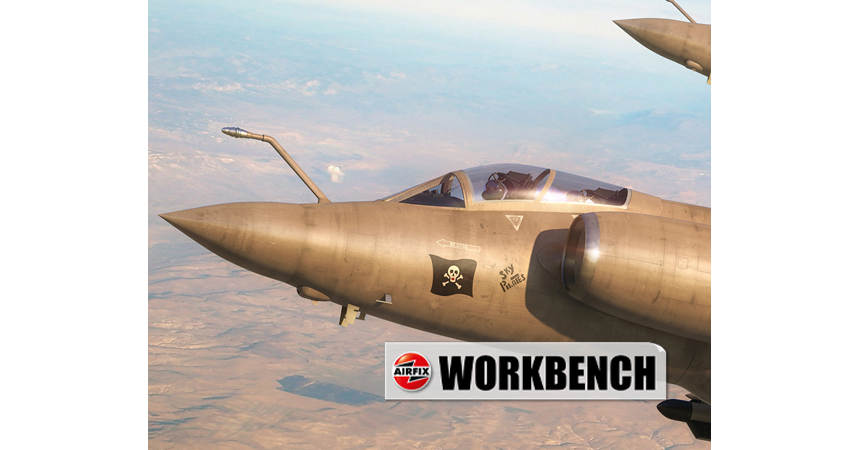
The RAF's Buccaneer force in the Gulf during 1991 proclaimed themselves to be ‘The Sky Pirates’ in reference to the proud naval heritage of their distinctive aircraft and decorated their classic jets in a suitably swashbuckling manner. Also proudly proclaiming their association with Scotland, the aircraft carried the names of some famous malt whiskeys on the side of the fuselage, along with a variety of ladies names across the fleet. Some of the aircraft also carried striking, if a little risqué, nose artwork, which certainly made these Gulf War Buccaneers highly individual and confirmation that the latest RAF aircraft still needed the help of this wily old warhorse.
Blackburn Buccaneer XW533 was constructed as an S.2B variant for the Royal Air Force by Hawker Siddeley Aviation at Brough and delivered to the RAF on 26th February 1971. She was taken on strength as XW533 and transferred to No.237 OCU at Honington. During her 20 year service career, she is known to have spent much of her time with the Operational Conversion Unit, but also in the colours of Nos. 15 and 208 Squadrons and most significantly, was one of the aircraft sent to support coalition air operations during the Gulf War of 1991.
Whilst on Gulf deployment, the aircraft carried the Sky Pirates and Jolly Roger markings on the port side of the forward fuselage, with distinctive ‘Miss Jolly Roger’ nose artwork and the names ‘Fiona’ and ‘Glenfaclas’ on the starboard side, making her quite the distinctive airframe. During their Gulf War deployment, the RAF's Buccaneers posted an exemplary service record, flying 218 missions and actually dropping 48 laser guided munitions themselves.
On their return to the UK, these aircraft were allowed to retain their Gulf War markings for a time, something which was obviously of great interest to enthusiasts at the time, however, this was a mark of respect for an aircraft which was in the swansong of its service career and scheduled for imminent withdrawal. Records show that this aircraft was broken up and sold for scrap at Lossiemouth in 1992.
With six Buccaneers in theatre by 27th January 1991, crews embarked on a week of intensive work-up flying training, in preparation for their first operational mission. This took place on 2nd February, just seven days after the aircraft had arrived at Muharraq and only ten days since the decision to deploy Buccaneer had been taken, when all these aircraft were still in the UK. With coalition air forces now having secured air supremacy, the role profile for the RAF's strike Tornados was now to destroy Iraqi lines of re-supply, effectively strangling their ground forces, specifically targeting all bridges spanning the Euphrates and Tigris rivers.
The first Buccaneer 'Spike Buddy' mission was flown by two aircraft providing laser target designation support for four LGB laden Tornados, effectively flying as two three ship formations, with one Buccaneer for each Tornado pair. The idea was that this arrangement would allow a measure of redundancy and should a technical issue occur with one of the AN/AVQ-23E Pave Spike units, the other aircraft could step in and take the lead, allowing the strike aircraft to release their weapons and head off to take on more fuel from waiting tankers.
During the flight to target, the Buccaneers would typically fly 5 miles of so behind the Tornados, with all aircraft at around 20,000 ft, but keeping the Tornados in visual range just in case. As they approached the target, the Buccaneers would close up to their assigned Tornados ready to commence the attack sequence, with all crews working in unison to ensure the effective delivery of their munitions. With the pilot would alert the navigator that he had switched the system on when approaching the target, then his navigator would have the task of locating the target and placing the laser crosshairs on the target using a thumbwheel rollerball unit and a TV monitor in his section of the cockpit. This was actually much more challenging than it sounds and required a high degree of training and immense concentration, with his targeting field of view being incredibly narrow.
Once the target had been laser illuminated and the Tornado had released its bomb, the navigator had to keep the crosshairs on the target for between 30 and 40 seconds, as this was typically the time between release and impact of the weapon. It was later estimated that this system provided at least a 50% on target accuracy throughout the Buccaneer's deployment, a figure which compares favourably with current targeting systems and highlighting the exceptional contribution of Buccaneer navigators in this demanding role.
Full scheme details of Buccaneer XV863 - 'Debbie/Sea Witch'.
A further six Buccaneers had arrived at Muharraq by 8th February, which allowed many more of these tandem laser designated operations to be mounted, with the precise nature of their strikes having a dramatic impact on the outcome of the war. Once coalition forces were confident that air superiority had been fully achieved, the Buccaneers were finally allowed to join in with the bombing operations, self-designating their own targets and dropping their own laser guided bombs. Around 48 laser guided bombs were delivered by Buccaneers in this manner.
With the war over, the Sky Pirates headed back to RAF Lossiemouth on 17th March, flying the 4,000 miles non-stop using in-flight refuelling and home to something of an uncertain future. Proud of their achievements, an aircraft which had been designed to fly low and fast had made its mark operating at altitudes above 20,000 ft, but provided vital support for aircraft which were very much their junior. From the sun of the desert, the aircraft arrived back in Scotland on a typically inclement day, with the conditions further compromising their recently applied 'Desert Pink' paint scheme, which must have looked ridiculously out of place on a grey day at RAF Lossiemouth.
Making her first flight on 29th May 1968, Buccaneer XV863 was delivered to the Royal Navy two months later, where she embarked on what would turn out to be an extremely active thirty year service career. Upgraded to S.2D standard at Brough in early 1973, she continued with her Fleet Air Arm career until late 1978, when she transferred to Royal Air Force ownership and subsequent later conversion to S.2B standard. She would be taken on charge with No.16 Squadron at RAF Laarbruch, but would also go on to spend time with No.237 OCU, No.208 Squadron and then back with the Operational Conversion Unit.
A beast of an aeroplane, the Blackburn Buccaneer was built tough and ready to answer the call to war, even when it came at the end of its service career.
XV863 would also be one of the aircraft to famously serve during the Gulf War, where she carried the nose art 'Debbie/Sea Witch' and the whiskey name Tamnavulin, all on the starboard side of her fuselage. On this same side, displayed under the windscreen framing, she also carried six Paveway LGB symbols, signifying her operational use during the Gulf War in delivering precision guided munitions. On her return from the Gulf, she re-joined No.237 OCU, but was finally withdrawn from service less than two years later.
During the spring of 1994, the aircraft received a smart new application of her famous 'Desert Pink' camouflage and was given a position of prominence as the Gate Guardian at RAF Lossiemouth, a posting she would perform for many years, but slowly suffering the effects of being left out in all weathers. Later removed from display due to her deteriorating condition, she would be purchased by a private collector and moved to a new display location at Weston Airport, near Dublin, where she would initially benefit from some much needed cosmetic attention, but was to ultimately end up in an even poorer state than she was when she arrived.
With her continued display appearing to go against the wishes of airport authorities and with the owner ether running out of funds or losing interest in the project, XV863 was moved to a secluded area of the airfield and simply left to fend for herself. Only last year, this Buccaneer was unceremoniously scrapped, with nothing of note saved for posterity, a sad end for one of the buccaneering former Sky Pirates.
The one to watch out for, this latest Buccaneer box will be on model shop shelf displays over the next few days and ready for a little Gulf War nose art action.
This overview of our 1/72nd scale Gulf War Buccaneer kit marks the imminent arrival of what will be just the third release from this highly regarded new model tooling and the first time it has featured scheme options and decals to finish your model as one of the twelve Buccaneers to be deployed to the Gulf region as part of Operation Granby/Desert Storm. As a subject which has fascinated modellers since the actions of 1991, we hope this will be a welcome addition to the 2023 Airfix range and ultimately bring a nice splash of Desert Pink to many a build model display.
This appealing new release should be available during the next week or so.
We are afraid that's all we have for you in this latest edition, but we will be back next Friday with more project development updates and the very latest Airfix kit exclusives. In the meantime, we are always keen to hear your views on all things Airfix and in particular, any thoughts and opinions you may have regarding our Workbench blog. If you would like to drop us a quick line, could we please ask that you use our workbench@airfix.com email for all correspondence.
To re-visit any of the Airfix blogs we have produced over the past seven years or so, please head to our main Workbench hub, where you will find our entire blog back catalogue and all the Airfix design projects we have already covered.
All our dedicated official social media sites can be accessed by clicking the respective link icons at the foot of this page, or by heading to the Airfix homepage. Other useful Airfix links are:
Facebook, YouTube, Twitter and Instagram official sites
Please join us for more Airfix updates next week and thank you for your continued support.